
DOI: https://doi.org/10.46502/issn.1856-7576/2025.19.04.5
Eduweb, 2025, octubre-diciembre, v.19, n.4. ISSN: 1856-7576
Cómo citar:
Bidyuk, D., Nikolai, H., Mozghovyi, V., Volokhata, K., & Bodnaruk, I. (2025). The impact of art therapy on fostering creativity: approaches for training future educators. Revista Eduweb, 19(4), 65-85. https://doi.org/10.46502/issn.1856-7576/2025.19.04.5
El impacto de la arteterapia en el fomento de la creatividad: enfoques para la formación de futuros educadores
Dmytro Bidyuk
Doctor of Philosophy in Pedagogy, Senior Lecturer, Кhmelnytskyi National University, Ukraine.
https://orcid.org/0000-0003-3086-5411
Halyna Nikolai
Doctor of Pedagogical Sciences, Professor, Professor at the Department of Music Art and Choreography, SI “South Ukrainian National Pedagogical University named after K. D. Ushynsky”, Ukraine.
https://orcid.org/0000-0001-6751-1209
Viktor Mozghovyi
Doctor of Science, Professor, Deputy Director for Educational and Scientific Work of the V. O. Sukhomlynsky Educational and Scientific Pedagogical Institute, Admiral Makarov National University of Shipbuilding, Ukraine.
https://orcid.org/0000-0001-9060-8244
Kateryna Volokhata
Candidate of Pedagogical Sciences, Senior Lecturer, Municipal Institution of Higher Education «Bar Humanitarian Pedagogical College named after Mykhailo Hrushevsky», Ukraine.
https://orcid.org/0009-0005-3143-5642
Iryna Bodnaruk
Candidate of Pedagogical Sciences, Associate Professor, Associate Professor of the Department of Music, Yuriy Fedkovych Chernivtsi National University, Ukraine.
https://orcid.org/0000-0002-2157-9491
Recibido: 25/07/25
Aceptado: 27/10/25
Abstract
The article explores the content of the studied concept, clarifies the purpose and approaches of art therapy in training future educators to develop the creative potential of learners. It demonstrates the importance of art therapy techniques in preparing future educators. The functions of art therapy are highlighted within the context of the practical activities of future specialists. The possibilities of simultaneously combining various roles of students and educators during professional training are clarified. The role of media art society in applying media art therapy, especially in light of the development of information culture, and the importance of media competence in media creativity are discussed. The initial level of readiness is identified as low. During the formative stage of the pedagogical experiment, the developed technology for training future educators to foster the creative potential of learners through art therapy was implemented, along with the proposed pedagogical conditions for such training. As a result, it was found that, following the development and application of this technology in the higher education process (in EG), the number of future educators with a high level of certain skills significantly increased. Therefore, the technology for training future educators to enhance the creative potential of learners through art therapy is recommended for implementation in the professional training of specialists, as it has proven to be effective.
Keywords: media art society, media art therapy, media competence, media creativity, information type of culture.
Resumen
El artículo explora el contenido del concepto estudiado y aclara el propósito y los enfoques de la arteterapia en la formación de futuros educadores para desarrollar el potencial creativo de los estudiantes. Demuestra la importancia de las técnicas de arteterapia en la preparación de futuros educadores. Se destacan las funciones de la arteterapia en el contexto de las actividades prácticas de los futuros especialistas. Se aclaran las posibilidades de combinar simultáneamente diversos roles de estudiantes y educadores durante la formación profesional. Se discute el papel de la sociedad de arte mediático en la aplicación de la arteterapia mediática, especialmente a la luz del desarrollo de la cultura de la información, y la importancia de la competencia mediática en la creatividad mediática. El nivel inicial de preparación se identifica como bajo. Durante la etapa formativa del experimento pedagógico, se implementó la tecnología desarrollada para la formación de futuros educadores con el fin de fomentar el potencial creativo de los estudiantes a través de la arteterapia, junto con las condiciones pedagógicas propuestas para dicha formación. Como resultado, se observó que, tras el desarrollo y la aplicación de esta tecnología en el proceso de educación superior (en GE), el número de futuros educadores con un alto nivel de ciertas habilidades aumentó significativamente. Por lo tanto, se recomienda implementar la tecnología para capacitar a futuros educadores y potenciar el potencial creativo de los estudiantes mediante la arteterapia en la formación profesional de especialistas, ya que ha demostrado su eficacia.
Palabras clave: sociedad de arte mediático, arteterapia mediática, competencia mediática, creatividad mediática, cultura de la información.
Introduction
The European integration process, which acquires new characteristics and an innovative educational environment, is the key to the success of the modernization of education in society. We consider its main characteristics to be: the introduction of innovative technologies for organizing a modern educational process and effective models into the practice of higher education, which ensure a high level of personal qualities of the future specialist and their professional activity. This actualizes the problem of finding new methods and organizational forms of training and their rethinking to improve the quality and efficiency of education, expand and deepen the content of professional training of specialists. Such an approach to the educational space makes it possible to introduce such high-quality training of specialists in higher education, which is conditioned in the field of professional and pedagogical training of specialists by the latest trends in the development of cultural, social, and interstate relations and is a priority problem (Gallardo Saavedra et al., 2018).
The issues of comprehensive formation of a highly qualified specialist and innovative personality, at the present stage of social relations in the world, are actualized by the ability to self-development, self-education, and creative self-realization. The urgent need to solve this problem is due to pedagogical, social, and cultural factors, and causes the need to search for new means of personality formation for the future specialist. A prominent place among the arsenal of methods and techniques for the development of a creative personality is occupied by art. Special attention is attracted by a new method of forming a creative individuality, which is on the border of art, pedagogy, and psychology – art therapy (Formaiano, 2024).
Our research, aimed at high-quality training of teaching staff, sees the key to the successful functioning of the educational system as the active interaction of participants in the educational process in the modern environment of higher education institutions, which is characterized by the development of creativity, new systems, and art technologies, the emergence of various art therapeutic areas, etc. Therefore, the result of training future educators to develop the creative potential of education seekers is the readiness in professional activity to use pedagogical art therapy, the use of media art therapy in connection with the development of the information type of culture for the formation of media competence in the process of media creativity, which is a topical problem of practice and pedagogical science. We note that the prospect of using art in the training of future specialists as a therapeutic factor does not require special medical training. The ways of training future educators to develop the creative potential of education seekers by means of art therapy have been sufficiently studied; therefore, the topic of the chosen research is relevant.
Literature Review
The features of art therapy in modern science, as a new direction, were studied by scientists from different countries.
When training future educators Itczak & Smolinske (2023) proposed ways to overcome fatigue in educators with the help of art therapy, developed pedagogical conditions for the use of art therapy, which made it possible in the context of a creative educational space to systematically investigate the specified problem, in particular, to substantiate pedagogical conditions that ensure the use of art technology in professional activities. Based on theoretical analysis, ways of applying elements of art therapy, the use of art therapeutic technologies was outlined, and a series of master classes on art therapy were held. Kindergarten educators and first-grade educators participated in monthly master classes during one academic year. Based on the needs assessment conducted by educators, master classes were developed. The results of the authors' post-seminar survey proved that art therapy was useful for overcoming compassion fatigue based on awareness.
The theoretical foundations of the use of art therapy in the process of professional training of specialists are substantiated by Formaiano (2016), and the experience of group art therapy with children in educational institutions is described; a brief overview of a new direction in science is given – the emergence of art therapy. The main approaches to defining art therapy are analyzed. The features of the creative process underlying art therapy are considered. Based on theoretical analysis, ways of applying elements of art therapy, including the use of art therapy technologies, are outlined. It is proven that it is important for an art therapist to cooperate closely with a multidisciplinary team and to work in an institutional environment.
The content of art therapy is substantiated by Cáceres-Gutiérrez & Santamaría-Osorio (2018) through the study of art therapy and spirituality, artistic and creative activity in the reconstruction of a psychotraumatic situation, the corrective and therapeutic effects of art on the subject, the birth of creative needs, and the creation of new positive experiences. The expressions of art that can contribute to the spirit-complex transformation (personal and transpersonal) are described. It is proven that art therapy eliminates excessive tension, forms constructive forms of behavior, removes human anxiety, and removes barriers to constructive and productive actions, that the creative act, therapeutic relationships, and authentic "I" are the foundations of social intervention and productive personality.
The content of art therapy is substantiated by Delgado-Fernandez-Baca et al. (2023) through artistic and creative activity in the reconstruction of a psychotraumatic situation, the corrective and therapeutic effects of art on the subject, the birth of creative needs, and the creation of new positive experiences. Phototherapy (therapeutic photography), which offers various options for techniques and materials, is presented as a section of art therapy, which is a modern, alternative psychotherapeutic approach. To promote healing, phototherapy uses art and is usually accompanied by a professional psychologist with experience in art therapy. Research by scientists from the TAE Peru Institute and Arte-terapia Peru shows how therapists perceive the therapeutic tool of using photography. Scientists have used the promotion of the use of photography in Peru as a psychotherapeutic tool. The results of the study showed that Peruvian therapists consider photography as a promising, innovative, and valuable tool that, through another language, helps patients express their emotions.
A study by Green et al. (2023) evaluated the impact of art therapy for students from Mexico, Israel, and the United States during an international online summer program on their cultural and global perspectives. Quantitative as well as qualitative instruments were used. Significant mean increases were observed across six scales across four global review scales, outlining the prospects for fostering culturally informed art therapy. Four overarching themes informed students’ artistic responses and narratives: growing awareness of their own context and experiences, appreciation for global connectedness, art as a mediator of cross-cultural communication, and growing understanding of differences and similarities.
Based on the theoretical analysis of Marins et al. (2020), the ways of applying elements of art therapy, the use of art therapeutic technologies is outlined. The content of art therapy is substantiated by means of artistic and creative activity in the reconstruction of a psychotraumatic situation, the corrective and therapeutic effects of art on the subject, the birth of creative needs, and the creation of new positive experiences. The research methodology is based on the basic modern provisions of psychology, pedagogical science, and health culture, reflecting the interrelationship of methodological approaches to the formation of a healthy lifestyle. A report on the experience of the workshop developed in November 2018: “Talent Workshop: Art Therapy Unites the Group”, which was held at the Family Clinic in Rio de Janeiro, was presented. The workshop was relevant for medical education, changing the understanding of the autonomy of the subject about the role in self-care, ensuring individual, comprehensive, collective health promotion of users, which allowed users to increase knowledge in their living environment. The study proved that art therapy eliminates excessive stress, forms constructive forms of behavior, removes human anxiety, and removes barriers to constructive, productive actions in personal health care, allowing the health care process to be carried out humanely and gently.
Thus, scientists have proven that art therapy eliminates excessive tension, forms constructive forms of behavior, removes human anxiety, and removes barriers to constructive and productive actions. The main approaches to defining art therapy are analyzed. The features of the creative process that underlie art therapy are considered. Based on theoretical analysis, ways of applying elements of art therapy and using art therapeutic technologies are clarified. The content of art therapy is justified through artistic and creative activity in the reconstruction of a psychotraumatic situation, the corrective and therapeutic effects of art on the subject, the emergence of creative needs, and the creation of new positive experiences.
PURPOSE OF THE RESEARCH. The use of art therapy in the process of professional training of specialists.
Methodology
To achieve the goal of the study, a set of general scientific methods was used, relating to the nature of the phenomenon being studied: theoretical: problem-targeted, comparative, retrospective analysis for comparing and contrasting different views in psychology, pedagogy on aspects of the problem under study; consideration of theoretical issues; justification of ways to prepare future educators for the development of the creative potential of education seekers by means of art therapy and its educational and methodological support; empirical: diagnostic (interviews, questionnaires), prognostic (expert assessments, ranking), observational (observation), pedagogical experiment to identify the level of readiness of future educators for the development of the creative potential of education seekers by means of art therapy; methods of mathematical statistics (statistical data processing, Pearson criterion) for qualitative and quantitative analysis of the results of the experiment.
Experimental work was carried out during 2022–2024.
The factors that determined the reliable results obtained in the process of experimental work were determined.
We have included components, criteria, and indicators as the basic, generally accepted components of the readiness of future educators to develop the creative potential of education seekers by means of art therapy.
The levels of formation of the components of the readiness of future educators to develop the creative potential of education seekers by means of art therapy in the educational process are distinguished: low, medium, and high.
A characteristic of the levels of readiness of future educators to develop the creative potential of education seekers by means of art therapy is proposed.
Thus, the structure of the readiness of future educators to develop the creative potential of education seekers by means of art therapy in the educational process consists of interconnected components, criteria, and indicators that have level characteristics and form a dynamic integrity.
When introducing art therapy technology into the work of future educators to develop the creative potential of students, we will highlight three stages that correlate with the sequence of studying professional disciplines, the structure of training future educators, and the completion of pedagogical practice, and their capabilities in forming readiness in the educational process for the use of art therapy technologies.
A pilot study preceded the experimental work. Its tasks were: to clarify the state of preparation of future educators for the development of the creative potential of education seekers by means of art therapy in the educational process in their further professional activities; to study the possibilities of the educational process of universities for the formation of the readiness of future educators for the development of the creative potential of education seekers by means of art therapy in the educational process. At the ascertaining stage of the experiment, a diagnosis of the formation of the initial level of readiness of future educators for the development of the creative potential of education seekers by means of art therapy in the experimental and control groups was carried out according to certain criteria (motivational, cognitive, activity-creative, reflective-resultative) and their indicators. The formation of the initial level of readiness is observed at a low level.
At the formative stage of the pedagogical experiment, the developed technology for training future educators to develop the creative potential of students through art therapy and the proposed pedagogical conditions for such training were implemented.
The control stage of the pedagogical experiment made it possible to state that as a result of the development and implementation of the technology for training future educators to develop the creative potential of students through art therapy in the educational process of higher education (in the EG), the number of future educators in the EG with a high level of readiness as a result of the experimental work carried out significantly increased at the formative stage of the experiment. A small increase was observed in the CG at the formative stage of the experiment.
To compare the distribution of educators by the levels of readiness of students to develop the creative potential of students through art therapy in the EG and CG samples, non-parametric methods of mathematical statistics were used. A quantitative analysis of the experimental data was performed using the Pearson χ² criterion.
As a result of the experiment, we proposed a null hypothesis (H0) to clarify the reliability of the results of the experiment that the difference in data in the control and experimental samples regarding the levels of readiness of future educators to develop the creative potential of education seekers by means of art therapy is caused by representativeness errors, as well as an alternative hypothesis (H1) that the difference in data in the control and experimental samples is caused by the introduction of the developed experimental factor. Hypotheses were formulated – null and alternative in order to verify the identified differences in the levels of readiness of future educators to develop the creative potential of education seekers by means of art therapy in the control group and the experimental group. H0 – the levels of formation of skills and knowledge on the issues of forming the readiness of future educators to develop the creative potential of education seekers by means of art therapy in the experimental and control groups do not have significant differences. H1 – the levels of formation of skills and knowledge on the issues of forming the readiness of future educators to develop the creative potential of education seekers by means of art therapy in the experimental and control groups, in which the developed technology was implemented, differ significantly.
It turned out to be appropriate to use the Pearson χ² criterion to test these hypotheses, since the samples of groups – CG and EG of future educators are independent and random, the members of each sample are also independent among themselves; on the order scale, the properties were measured, which has three categories: productive, creative, reproductive (с = 3). Therefore, the obtained value of the statistic Texp. > Tcr.
We, therefore, accept the alternative hypothesis: the differences in the distributions of future educators of the control group and the experimental group by the levels of readiness of future educators to develop the creative potential of education seekers by means of art therapy are statistically significant with a probability of 95%.
Based on the analysis of the obtained results of the experimental work, we say that the effectiveness of the developed training technology is proven by a significant increase in the indicators of the formation of all components of the readiness of future educators to develop the creative potential of education seekers by means of art therapy.
The reliability of the obtained results of the pedagogical experiment, the conclusions, was confirmed by the methods of mathematical statistics. And the processing of experimental data using the Pearson χ² criterion showed the presence of statistically significant changes in the experimental group. This is what confirmed the correctness of the hypothesis put forward (Tn > Tk, 24.22 > 5.991). Therefore, we can say that the developed technology for training future educators to develop the creative potential of education seekers through art therapy can be proposed for implementation in the professional training process of specialists, as it is effective.
Results and Discussion
The content of the concept under study
Art therapy is a technology for using and creating various works of art in order to convey emotions, feelings, and other manifestations of the human psyche; it is a tool for harmonizing and exploring aspects of a person's inner world, in cases where words are not suitable for expression. With the help of simple means, art therapy can actualize each person's inner potential; therefore, art therapy has been increasingly used in the field of education and training of specialists in various fields (Jorquera Cox & Gómez Uriarte, 2024).
Art therapy, based on art, is a specialized form of psychotherapy, primarily creative activity, used for psychocorrection and treatment of the personality using artistic techniques such as acting, modeling, drawing, music, films, photography, books, etc.
Art therapy is an effective method for developing the psychological competence of pedagogical workers, forms faith in one's own strength, an active life position, autonomy and personal boundaries, involves the processes of finding ways to resolve internal conflicts of the personality, addresses the deep layers of the unconscious – and as a method of creative self-expression of a person is a productive direction of work for solving the problems of the personality itself (Wong et al., 2025).
The purpose and approaches to art therapy in preparing future educators for the development of the creative potential of education seekers.
Through self-expression and self-knowledge, and in harmonizing the development of the personality, is the main purpose of art therapy is to prepare future educators for the development of the creative potential of education seekers, since art therapy is a science that is on the border of therapy itself, art, psychology, and pedagogy.
In modern art therapy, there are two main approaches to therapy itself and the relationship of art in it. According to the first approach, therapeutic goals are in the first place in art therapy, and creative goals are secondary. Representing in visual form his own inner world, a person, using the main mechanism – transfer, gradually moves towards his awareness; therefore, art therapy is considered within the framework of this approach, as an addition to other therapeutic methods. The group leader encourages its members to try to find the meaning of their own free associations independently. Joint group work includes some exercises, for example, creating a group common work of art, creating group murals, etc.
According to the second approach, art itself is healing, artistic creativity makes it possible to relive internal conflicts, express oneself, and is a means of enriching subjective experience. Art therapy is considered a person’s creative potential, as a means of developing personality through the main mechanisms: transformation and sublimation. The leader (lecturer, educator, art therapist, psychologist) encourages group members (students, pupils, patients) to explore their creations with the help of other group members and independently, to trust their own perception. Thus, the basis of art therapy is the process of creativity. Each person has a creative potential at different depths of the subconscious, and only relying on personal individuality can it be “pulled out” (Stiegele & Paipare, 2020).
The value of art therapy technologies in the training of future educators.
The main means of art therapy in preparing future educators for the development of the creative potential of education seekers are art therapy technologies. Among the art therapy technologies that are currently actively used by future specialists – educators, psychologists, art therapists, it is necessary to distinguish:
This is the treatment of a person with a book, a word. It is engaged in studying the features of reader perception during illness using specially selected literature and developing methods of psychological correction.
Art therapy classes allow solving important psychotherapeutic tasks. Due to the fact that in the process of creative activity, an atmosphere of goodwill, emotional warmth, recognition of the value of another person's personality, empathetic communication, care for the personality, their feelings, and experiences is created, a therapeutic effect is achieved, and a person feels a sense of security, psychological comfort, success, and joy. As a result, the healing potential of human emotions is mobilized (Ciornai & Ruiz, 2016).
Art therapy technologies in the training of future educators in modern conditions accumulate: fairy tale therapy, bibliotherapy (therapeutic effect through reading); isotherapy (therapeutic effect through the means of fine arts: decorative and applied arts, modeling, drawing, etc.); music therapy (therapeutic effect through the perception of music); vocal therapy (therapy through singing); imago therapy (therapeutic effect through theatricalization, image); sand therapy (therapeutic effect through creativity), kinesitherapy (therapeutic effect through dance, through therapy, choreography, corrective rhythm, influence through movements), etc.
Art therapy technologies in the training of future educators solve the following problems:
Application of media art therapy in connection with the development of the information type of culture. The role of media competence in the process of media creativity.
Today, there is a need to create different types of art therapy – media art, because we live in the era of the information society, when the artist and his viewer are at a new level of communication, art means and forms are changing, and new approaches in creativity to reflecting reality are developing. And every modern person can become an artist at any moment. Media devices allow you to create videos and photos, and at the same time, share them with a large number of people and constantly communicate with the latest technologies: most of us learn about the world through the prism of gadgets, the Internet, and devices. We observe the interpenetration of virtual and objective realities. The virtual world and the real world are separated from each other and at the same time connected, and have similar features. Therefore, art therapy today needs to understand the new possibilities of the information world, as a method of healing the individual through art, through the use of media in the creative process, reaching a new level of understanding of healing mechanisms. The answer to the challenges of modern information reality is media art therapy.
Thanks to the development of the information type of culture and the globalization of the world, the development of media art therapy is possible, with its characteristic virtuality, multiculturalism, openness, plurality, and uncertainty. The use of modern media in the creative process is a defining feature of media art therapy. Let's break down the ways of using art in therapy:
The development of media competence in the process of media creativity leads to the establishment of communication and increased self-esteem. An emotionally unfavorable attitude towards oneself, low self-esteem, includes the action of protective psychological mechanisms, making it difficult to perceive feedback. Positive self-esteem reduces resistance, reduces the level of psychological threat, and makes the personality more open to new information. Creativity and emotional support increase the degree of self-esteem and have a stabilizing positive effect on self-esteem. Therefore, the possibilities of using art therapy expand the media art society, help to share products with others, reduce the fear of one's own creativity, and receive support. The use of media art in the therapeutic process is modern because now we cannot exist without the media that has entered our lives (Denning et al., 2024).
There are the following types of media art from the point of view of organizing the artistic space:
Functions of art therapy in the context of practical activities of future specialists.
To apply elements of art therapy in the training of future specialists, it is necessary to characterize the functions and clarify their possibilities of combination with the main functions of the pedagogical process in higher education.
In the context of the practical activity of educators, the functions of art therapy are primarily functions of setting tasks in the conditions of specific activity, analyzing psychological and pedagogical specific situations, regulating the process of implementing work plans, developing projects and plans for solving the specified tasks, and reflecting on the results obtained.
Let us name the main functions of art therapy used in the training of future educators to develop the creative potential of the child:
Possibilities of simultaneous combination of several positions of a student and an educator in the process of professional training of specialists.
Let's analyze three categories (types) of higher education graduates that prevail in each student group, regardless of the year and age of study:
Let us characterize the priority positions in the art therapeutic interaction of the educator:
In such an art therapeutic process, we observe a dynamic interaction between the following key components: a higher education student, an educator, and the product of his creative activity (González et al., 2020).
General issues of organizing and conducting a pedagogical experiment.
Experimental work was carried out during 2022–2024.
Let us name the factors that determined the reliable results obtained in the process of experimental work:
We have included components, criteria, and indicators as the basic, generally accepted components of the readiness of future educators to develop the creative potential of education seekers by means of art therapy.
The motivational criterion corresponds to the motivational and value component of the readiness of future educators to develop the creative potential of students through art therapy.
Motivational and value component – motivational criterion – indicators:
The cognitive criterion corresponds to the content component of the readiness of future educators to develop the creative potential of students through art therapy.
The content component – cognitive criterion – indicators:
The activity-creative criterion corresponds to the process component of the readiness of future educators to develop the creative potential of students through art therapy.
The process component – activity-creative criterion – indicators:
The personal-reflective component of the readiness of future educators to develop the creative potential of students through art therapy corresponds to the reflective-resultative criterion.
The personal-reflective component – the reflective-resultative criterion – indicators:
The levels of formation of the components of the readiness of future educators to develop the creative potential of students through art therapy in the educational process are distinguished: low, medium, and high.
A characteristic of the levels of readiness of future educators to develop the creative potential of students through art therapy is proposed.
High level – the student’s desire for professional self-improvement, high motivation of the student for future professional activity; awareness of the need to develop the creative potential of the individual by means of art therapy; deep and complete knowledge of the individual-typological, age-related, psychophysiological characteristics of applicants for the educational space, upbringing and development, patterns of their learning; high preparedness (professional-pedagogical); highly developed abilities for constant self-improvement and professional self-development.
Average level – sufficient desire for professional self-improvement, sufficient motivation for future professional activity; incomplete awareness of the significance of the development and formation of the creative potential of the individual in classes by means of art therapy; lack of formation of professional knowledge regarding individual-typological, age-related, psychophysiological characteristics of the individual; have sufficient preparedness (professional-pedagogical); have the ability for constant self-improvement, professional self-development.
Low level – lack of desire for professional self-improvement, low motivation for future professional activity; lack of awareness of the significance of development and formation of creative potential by means of art therapy; have unsystematic, superficial knowledge of individual typological, age, psychophysiological characteristics of the personality, patterns of upbringing, training, development; have low preparedness (professional and pedagogical); lack of abilities for constant self-improvement and professional self-development.
Therefore, the structure of readiness of future educators for the development of creative potential of education seekers by means of art therapy in the educational process consists of interconnected components, criteria, and indicators that have level characteristics and form a dynamic integrity.
When introducing art therapy technology into the work of future educators to develop the creative potential of students, we will highlight three stages that correlate with the sequence of studying professional disciplines, with the structure of training future educators, and passing pedagogical practice and their capabilities in forming readiness in the educational process for the use of art therapy technologies.
The first, introductory stage involved the formation of clear ideas in future educators about the possibilities and essence of art therapy, and motivation to carry out art therapy activities.
The second, basic stage involved the application of art therapy competencies in practice by future educators. The experimental study aimed to develop the abilities and qualities of future educators for art therapy activities and to further motivate them to carry out such activities.
The third, constructive stage involved improving skills and abilities, systematizing art therapy knowledge, and realizing the importance of using art therapy technologies in the educational process.
Pilot study. The confirmatory stage of the experiment.
A pilot study preceded the experimental work. Its tasks were: to clarify the state of preparation of future educators for the development of the creative potential of education seekers by means of art therapy in the educational process in their further professional activities; to study the possibilities of the educational process of universities for the formation of the readiness of future educators for the development of the creative potential of education seekers by means of art therapy in the educational process.
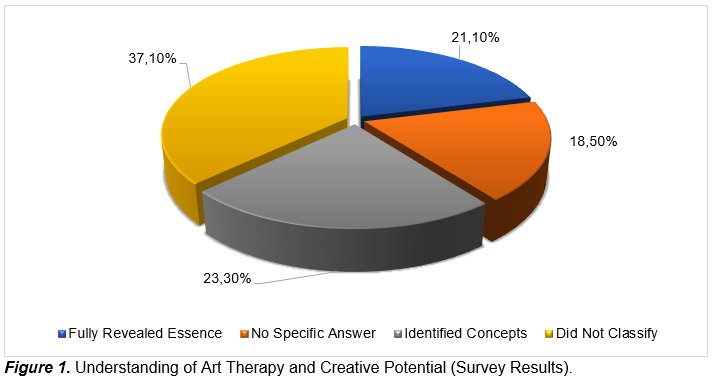
To clarify the state of preparation of future educators for the development of the creative potential of education seekers by means of art therapy in the educational process, their understanding of the significance of this problem for the teaching profession, and students (150 respondents) were asked to answer the questions of the questionnaire.
Analysis of the survey results showed an extremely low level of ways of forming the relevant skills for the implementation of art therapy, and the respondents' understanding of the essence of creative potential (Figure 1):
The following answers were received to the question about the significance of special training for future professional activity to develop the creative potential of the individual by means of art therapy (Figure 2):
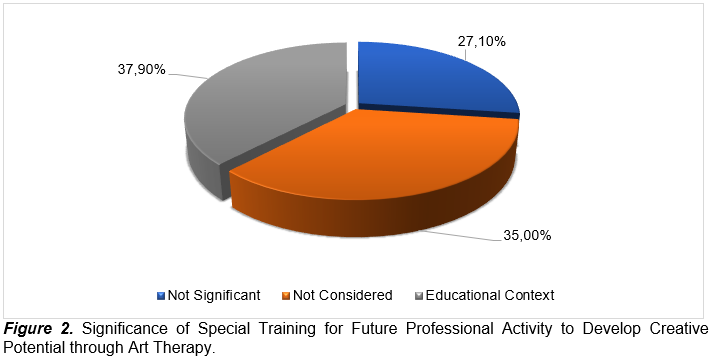
Analysis of students' responses to the questionnaire questions regarding the students' implementation of the task of planning and goal-setting, since the effectiveness of this professional pedagogical activity depends on this, shows that none of the students' responses contained a clear definition of the goal and tasks that they will solve in professional activities to solve the problem: 7.1% of respondents answered that since the effectiveness of educators' activities for future professional activities to develop the creative potential of the individual through art therapy depends on planning and goal-setting, they begin to implement professional tasks on goal-setting and planning.
It should be noted that the results of the observations allowed us to conclude that not all students consider special training for the development of the creative potential of the individual through art therapy to be significant for their future professional activities, but the identified problem of training future educators to develop the creative potential of students through art therapy in the educational process worries students: they easily make suggestions for deepening their knowledge, join discussions about its discussion, and are interested in acquiring relevant skills in special elective courses and group work.
During the pilot study at the ascertaining stage of the experiment, through conversations and observations, we revealed the attitude of educators to the problem of training future educators to develop the creative potential of students through art therapy in the educational process.
The results obtained provide grounds to say that almost all educators – 57 people participated in the survey – are aware of the importance of the problem under study, while 97.9% of them do not have sufficient qualifications to provide appropriate training for future educators to develop the creative potential of students using art therapy in the educational process.
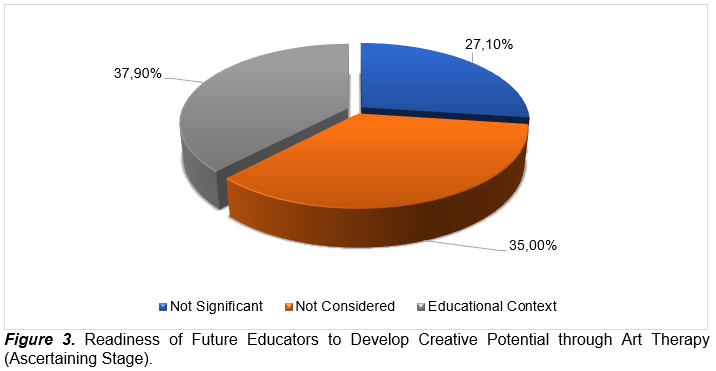
So, at the ascertaining stage of the experiment, a diagnosis was made of the initial level of readiness of future educators to develop the creative potential of students using art therapy in the experimental and control groups according to certain criteria (motivational, cognitive, activity-creative, reflective-resultative) and their indicators.
During the ascertaining stage of the pedagogical experiment, the analysis, interpretation, and generalization of the results obtained allowed us to say that the general state of readiness of future educators to develop the creative potential of education seekers through art therapy is as follows (Figure 3):
At the formative stage of the pedagogical experiment, the developed technology for training future educators to develop the creative potential of students through art therapy and the proposed pedagogical conditions for such training were implemented.
The implementation of the developed technology for training future educators to develop the creative potential of students through art therapy involved the use of art therapy functions in training future educators to develop the child's creative potential:
The implementation of this stage of the development and implementation of the technology for training future educators to develop the creative potential of education seekers by means of art therapy provided for:
In the process of research, we have developed and proposed pedagogical conditions that ensure the effective functioning of the developed technology for training future educators to develop the creative potential of education seekers by means of art therapy.
The pedagogical conditions for training future educators to develop the creative potential of education seekers by means of art therapy are:
Therefore, the pedagogical conditions for preparing future educators for the outlined activity ensure the creation of a high-quality purposeful educational process, give us a set of educational environment opportunities that contribute to the preparation of future future educators for the development of the creative potential of education seekers by means of art therapy, the readiness of future educators to use art therapy technologies that will contribute to the development of the child's creative potential.
Control stage of the pedagogical experiment. After the stage of development and implementation of the technology of training future educators to develop the creative potential of education seekers by means of art therapy in the educational process of higher education, the main tasks of the control stage of the pedagogical experiment were determined:
We present the dynamics of changes in the levels of readiness of future educators of the experimental group and the control group to develop the creative potential of students through art therapy.
The experimental data obtained indicate the positive implementation and positive impact of the developed technology for training future educators to develop the creative potential of students through art therapy.
It should be noted that the number of future educators with a low level of readiness to develop the creative potential of students through art therapy decreased in the experimental group by 54.0%, and in the control group, this indicator was ‒ 25.4%.
Dynamics of the levels of readiness of students to develop the creative potential of younger schoolchildren through art therapy (Figure 4).
Experimental group
High level: 5.7% – ascertaining stage, 57.9% – control stage.
Average level: 39.0% – ascertaining stage, 40.7% – control stage.
Low level: 55.3% – ascertaining stage, 1.4% – control stage.
Control group
High level: 9.6% – ascertaining stage, 23.4% – control stage.
Average level: 43.3% – ascertaining stage, 54.9% – control stage.
Low level: 47.1% – ascertaining stage, 21.7% – control stage.
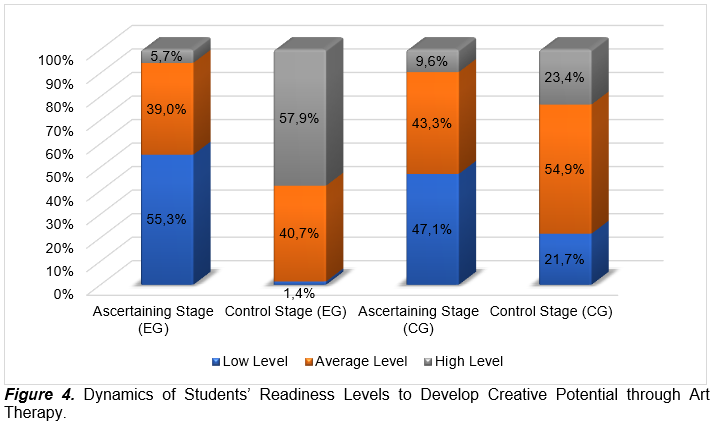
Thus, the control stage of the pedagogical experiment made it possible to state that as a result of the development and implementation of the technology of training future educators to develop the creative potential of students using art therapy in the educational process of higher education (in the EG), the number of future educators in the EG with a high level of certain readiness as a result of the experimental work carried out significantly increased at the formative stage of the experiment. A small increase at the formative stage of the experiment was observed in the CG.
To compare the distribution of educators by the levels of readiness of students to develop the creative potential of education seekers by means of art therapy in the EG and CG samples, non-parametric methods of mathematical statistics were used. A quantitative analysis of the experimental data was performed using the Pearson χ² criterion.
As a result of the experiment, we proposed a null hypothesis (H0) to clarify the reliability of the results of the experiment that the difference in data in the control and experimental samples regarding the levels of readiness of future educators to develop the creative potential of education seekers by means of art therapy is caused by representativeness errors, as well as an alternative hypothesis (H1) that the difference in data in the control and experimental samples is caused by the introduction of the developed experimental factor.
Hypotheses were formulated – null and alternative in order to verify the identified differences in the levels of readiness of future educators to develop the creative potential of education seekers by means of art therapy in the control group and the experimental group.
H0 – the levels of formation of skills and knowledge on the issues of forming the readiness of future educators to develop the creative potential of education seekers by means of art therapy in the experimental and control groups do not have significant differences.
H1 – the levels of formation of skills and knowledge on the issues of forming the readiness of future educators to develop the creative potential of education seekers by means of art therapy in the experimental and control groups, in which the developed technology was implemented, differ significantly.
It turned out to be appropriate to use the Pearson χ² criterion to verify these hypotheses, since the samples of the groups – CG and EG of future educators are independent and random, the members of each sample are also independent of each other; on the scale of order, the properties were measured, which has three categories: productive, creative, reproductive (c = 3).
So, the obtained value of the statistic Texp. > Tcr.
We, therefore, accept the alternative hypothesis: the differences in the distributions of future educators of the control group and the experimental group by the levels of readiness of future educators to develop the creative potential of education seekers by means of art therapy are statistically significant with a probability of 95%.
Based on the analysis of the obtained results of the experimental work, we say that the effectiveness of the developed training technology is proven by a significant increase in the indicators of the formation of all components of the readiness of future educators to develop the creative potential of education seekers by means of art therapy.
The reliability of the obtained results of the pedagogical experiment, the conclusions, was confirmed by the methods of mathematical statistics. And the processing of experimental data using the Pearson χ² criterion showed the presence of statistically significant changes in the experimental group. This confirmed the correctness of the hypothesis put forward (Tn > Tk, 24.22 > 5.991). Therefore, we can say that the developed technology for training future educators to develop the creative potential of education seekers using art therapy can be proposed for implementation in the process of professional training of specialists, because it is effective.
Conclusions
The content of the studied concept is considered, and the purpose and approaches to art therapy in the preparation of future educators for the development of the creative potential of education seekers are clarified. The significance of art therapy technologies in the preparation of future educators is proven. The functions of art therapy in the context of the practical activity of future specialists are highlighted. The possibilities of simultaneously combining several positions of a student and an educator in the process of professional training of specialists are clarified; the use of media art therapy in connection with the development of the information type of culture; the role of media competence in the process of media creativity.
Three categories (types) of higher education seekers that prevail in each student group, regardless of the year and age of study, are analyzed. The priority positions in the art therapy interaction of the educator are characterized.
When conducting the study, the factors that determined the reliability of the results obtained in the process of experimental work were identified.
We have included components, criteria, and indicators as basic, generally accepted components of the readiness of future educators to develop the creative potential of students through art therapy.
The levels of formation of the components of the readiness of future educators to develop the creative potential of students through art therapy in the educational process are identified: low, medium, and high.
A characteristic of the levels of readiness of future educators to develop the creative potential of students through art therapy is proposed.
When introducing art therapy technology into the work of future educators to develop the creative potential of students, we will highlight three stages that correlate with the sequence of studying professional disciplines, with the structure of training future educators and passing pedagogical practice, and their capabilities in forming readiness in the educational process for the use of art therapy technologies.
A pilot study preceded the experimental work. At the ascertaining stage of the experiment, a diagnosis of the formation of the initial level of readiness of future educators to develop the creative potential of education seekers by means of art therapy of the experimental and control groups was carried out according to the specified criteria (motivational, cognitive, activity-creative, reflective-resultative) and their indicators. The formation of the initial level of readiness is observed at a low level.
At the formative stage of the pedagogical experiment, the developed technology for training future educators to develop the creative potential of education seekers by means of art therapy, the proposed pedagogical conditions for such training were implemented.
The control stage of the pedagogical experiment made it possible to state that as a result of the development and implementation of the technology for training future educators to develop the creative potential of education seekers by means of art therapy in the educational process of higher school (in EG), the number of future educators in EG with a high level of determined readiness as a result of the experimental work carried out significantly increased at the formative stage of the experiment. A small increase in the formative stage of the experiment is observed in the CG.
To compare the distribution of educators by the levels of readiness of students to develop the creative potential of education seekers by means of art therapy in the EG and CG samples, non-parametric methods of mathematical statistics were used. A quantitative analysis of the experimental data was performed using the Pearson χ² criterion.
As a result of the experiment, we proposed a null hypothesis (H0) to clarify the reliability of the results of the experiment that the difference in data in the control and experimental samples regarding the levels of readiness of future educators to develop the creative potential of education seekers by means of art therapy is caused by representativeness errors, as well as an alternative hypothesis (H1) that the difference in data in the control and experimental samples is caused by the introduction of the developed experimental factor.
Hypotheses were formulated – null and alternative in order to verify the identified differences in the levels of readiness of future educators to develop the creative potential of education seekers by means of art therapy in the control group and the experimental group.
H0 – the levels of formation of skills and knowledge on the issues of forming the readiness of future educators to develop the creative potential of education seekers by means of art therapy in the experimental and control groups do not have significant differences.
H1 – the levels of formation of skills and knowledge on the issues of forming the readiness of future educators to develop the creative potential of education seekers by means of art therapy in the experimental and control groups, in which the developed technology was implemented, differ significantly.
It turned out to be appropriate to use the Pearson χ² criterion to test these hypotheses, since the samples of groups – CG and EG of future educators are independent and random, the members of each sample are also independent among themselves; on the order scale, the properties were measured, which has three categories: productive, creative, reproductive (c = 3).
Therefore, the obtained value of the statistic Texp. > Tcr.
We, therefore, accept the alternative hypothesis: the differences in the distributions of future educators of the control group and the experimental group by the levels of readiness of future educators to develop the creative potential of education seekers by means of art therapy are statistically significant with a probability of 95%.
Based on the analysis of the obtained results of the experimental work, we say that the effectiveness of the developed training technology is proven by a significant increase in the indicators of the formation of all components of the readiness of future educators to develop the creative potential of education seekers by means of art therapy.
The reliability of the obtained results of the pedagogical experiment, the conclusions, was confirmed by the methods of mathematical statistics. And the processing of experimental data using the Pearson χ² criterion showed the presence of statistically significant changes in the experimental group. This confirmed the correctness of the hypothesis put forward (Tn > Tk, 24.22 > 5.991). Therefore, we can say that the developed technology for training future educators to develop the creative potential of education seekers through art therapy can be proposed for implementation in the professional training process of specialists, as it is effective.
Further research requires clarification of the ways of applying the elements of art therapy, the use of art therapy technologies, and substantiation of the content of art therapy using artistic and creative activity in the reconstruction of a psychotraumatic situation, the corrective and therapeutic effects of art on the subject, the birth of creative needs, and the creation of new positive experiences.
Bibliographic references
Cáceres-Gutiérrez, J. M., & Santamaría-Osorio, L. P. (2018). La arteterapia como camino de transformación espiritual. Trabajo Social, 20(1), 133–161. https://doi.org/10.15446/ts.v20n1.71568
Ciornai, S., & Ruiz, M. C. (2016). Latin American art therapy: Collective dreams and horizons of hope. In D. E. Gussak & M. L. Rosal (Eds.), The Wiley handbook of art therapy (pp. 753–764). Wiley-Blackwell. https://doi.org/10.1002/9781118306543.ch74
Delgado-Fernandez-Baca, A. T., Chávez-Chuquimango, M., & Gallardo-Echenique, E. (2023). Photography as a therapeutic art medium according to the perspective of Peruvian art-therapy specialists. In Proceedings of the International Conference on Communication and Applied Technologies 2023 (ICOMTA 2023) (pp. 122–131). Atlantis Press. https://doi.org/10.2991/978-94-6463-254-5_13
Denning, H. J., Schwartz, J. B., Rastogi, M., Hartman, A., & Goucher, C. (2024). A descriptive summary of field placements in undergraduate art therapy education. Art Therapy, 42(3), 147–156. https://doi.org/10.1080/07421656.2024.2384143
Formaiano L. (2016). Abordaje arteterapéutico con niños institucionalizados. Arteterapia. Papeles de arteterapia y educación artística para la inclusión social, 11, 223-240. https://doi.org/10.5209/ARTE.54128
Formaiano, L. (2024). La Imaginación Activa y las imágenes emergentes en Arteterapia Junguiana. Arteterapia. Papeles de arteterapia y educación artística para la inclusión social, 19, e93594. https://doi.org/10.5209/arte.93594
Gallardo Saavedra, M. A. G., Padrón García, A. L., & Martínez-Wbaldo, M. del C. (2018). Diferencias conductuales y cognitivas en dos grupos de escolares con TDAH intervenidos con arteterapia vs metilfenidato y un grupo control. Artseduca, (19), 202–223. http://dx.doi.org/10.6035/Artseduca.2018.19.9
González, Á., Fernández, M. B., Pino-Yancovic, M., & Madrid, R. (2020). Teaching in the pandemic: Reconceptualizing Chilean educators' professionalism now and for the future. Journal of Professional Capital and Community, 5(3–4), 265–272. https://doi.org/10.1108/JPCC-06-2020-0043
Green, J. Y., Metzl, E. S., & Treviño, A. L. (2023). International online art therapy education program: evaluating cultural and global perspectives. Art Therapy, 40(2), 84–93. https://doi.org/10.1080/07421656.2023.2169564
Itczak, M., & Smolinske, A. (2023). Work of HeArt: addressing educator compassion fatigue with art therapy. Journal of Creativity in Mental Health, 19(3), 456–473. https://doi.org/10.1080/15401383.2023.2252323
Jorquera Cox, M., & Gómez Uriarte, A. (2024). Imagen emergente, un recorrido desde la teoría al hacer en arteterapia. Arteterapia. Papeles de arteterapia y educación artística para la inclusión social, 19, e97069. https://doi.org/10.5209/arte.97069
Kourilová, J., Mazehóová, Y., & Krninsky, L. (2022). The art-therapy collage technique as a tool for teachers' professional reflection. In M. Talvio & K. Lonka (Eds.), International approaches to promoting social and emotional learning in schools (pp. 131–146). Routledge. https://doi.org/10.4324/9781003093053-10
Leigh, H. (2021). Signature pedagogies for art therapy education: A Delphi study. Art Therapy, 38(1), 5–12. https://doi.org/10.1080/07421656.2020.1826932
Linesch, D., Metzl, E., & Treviño, A. L. (2016). Various aspects of art therapy in Mexico. In D. E. Gussak & M. L. Rosal (Eds.). The Wiley handbook of art therapy (pp. 745–752). Wiley-Blackwell. https://doi.org/10.1002/9781118306543.ch73
Marins, M. D., Daher, D. V., Pinto, A. A., Cardoso, R. D. S., & Sá, S. P. C. (2020). Art therapy and education between peers connecting the group: An experience report. Revista Brasileira de Enfermagem, 73(5), e20180958. https://doi.org/10.1590/0034-7167-2018-0958
Rubio Machuca, B., & Delgado García, M. (2024). Posibilidades de la arteterapia en educación como técnica de gestión de duelo: estrategias para potenciar la resiliencia en la formación docente. Arteterapia. Papeles de arteterapia y educación artística para la inclusión social, 19, e91706. https://doi.org/10.5209/arte.91706
Shefi, N., Orkibi, H., & Huss, E. (2025). Integrating social arts into creative arts therapies training: Teachers' and students' perspectives. The Arts in Psychotherapy, 95, 102332. https://doi.org/10.1016/j.aip.2025.102332
Stiegele, D., & Paipare, M. (2020). Arts therapies in lifelong learning – Opportunities and solutions. Society. Integration. Education. Proceedings of the International Scientific Conference, 5, 274–284. https://doi.org/10.17770/sie2020vol5.5092
Wong, T. Y. W., Goerdt, M. N., George, J., & Green, J. Y. (2025). Identity and belongingness of Asian art therapy educators: critical art-based collaborative autoethnography. International Journal of Art Therapy, 1–14. https://doi.org/10.1080/17454832.2025.2520821
Zhang, X. (2025). The impact of art therapy on the mental health of teacher education students. Schizophrenia Bulletin, 51(Supplement_1), S19–S20. https://doi.org/10.1093/schbul/sbaf007.036

Este artículo no presenta ningún conflicto de intereses. Este artículo está bajo la licencia Creative Commons Atribución 4.0 Internacional (CC BY 4.0). Se permite la reproducción, distribución y comunicación pública de la obra, así como la creación de obras derivadas, siempre que se cite la fuente original.