
DOI: https://doi.org/10.46502/issn.1856-7576/2025.19.04.10
Eduweb, 2025, octubre-diciembre, v.19, n.4. ISSN: 1856-7576
Cómo citar:
Dyka, N., Horobets, S., Kozyr, M., Mykytenko, V., & Glazova, O. (2025). Linguodidactic strategies for developing the future teachers’ speech competence. Revista Eduweb, 19(4), 162-174. https://doi.org/10.46502/issn.1856-7576/2025.19.04.10
Estrategias lingüodidácticas para desarrollar la competencia discursiva de los futuros profesores
Natalia Dyka
PhD in Pedagogical Sciences, Institute of In-Service Training of Borys Grinchenko Kyiv Metropolitan University, Kyiv, Ukraine.
https://orcid.org/0000-0003-1385-5027
Svitlana Horobets
PhD in Pedagogical Sciences, Borys Grinchenko Kyiv Metropolitan University, Kyiv, Ukraine.
https://orcid.org/0000-0001-7307-7672
Marharyta Kozyr
PhD in Pedagogical Sciences, Borys Grinchenko Kyiv Metropolitan University, Kyiv, Ukraine.
https://orcid.org/0000-0001-8402-2589
Viktorija Mykytenko
PhD in Pedagogical Sciences, Institute of In-Service Training of Borys Grinchenko Kyiv Metropolitan University, Kyiv, Ukraine.
https://orcid.org/0000-0001-7888-377X
mykytenko.viktoriia3@kubg.edu.ua
Oleksandra Glazova
PhD in Pedagogical Sciences, Institute of In-Service Training of Borys Grinchenko Kyiv Metropolitan University, Kyiv, Ukraine.
https://orcid.org/0000-0002-0554-9858
oleksandra.glazova61@kubg.edu.ua
Recibido: 16/09/25
Aceptado: 28/11/25
Abstract
Improving the quality of future teachers’ language training in their professional education is an important task of modern pedagogy. The aim of the study was to determine the effectiveness of different types of linguodidactic strategies in the development of individual components of speech competence, to identify its internal structure and to analyse changes after pedagogical intervention. The study used two standardized questionnaires: the Self-Perceived Communication Competence Scale (SPCC) and the Teacher Language Competence Inventory (TLCI). The Pearson correlation coefficient, factor analysis by the principal components method with varimax rotation, as well as linear and multifactorial regression were applied. The factor analysis of the inventory of pedagogical speech competence identified three factors: normative pragmatic (pragmatic appropriateness – 0.516), lexical (lexical accuracy – 0.714), and prosodic (intonation expressiveness – -0.867). The multifactor regression model showed the highest positive impact of the gamified strategy (β = 1.962) and cognitive strategy (β = 1.106), while the situational strategy showed a negative effect (β = -2.142). Correlation analysis did not reveal statistically significant relationships, but recorded a number of positive trends. Further research may focus on structural modelling of connections and longitudinal tracking of changes in speech competence over time.
Keywords: Speech competence, linguodidactics, future teacher, teaching strategy, communication. Language education.
Resumen
Mejorar la calidad de la formación lingüística de los futuros profesores en su educación profesional es una tarea importante de la pedagogía moderna. El objetivo del estudio era determinar la eficacia de distintos tipos de estrategias lingüodidácticas en el desarrollo de componentes individuales de la competencia lingüística, identificar su estructura interna y analizar los cambios tras la intervención pedagógica. El estudio utilizó dos cuestionarios estandarizados: la Escala de Competencia Comunicativa Autopercibida (SPCC) y el Inventario de Competencia Lingüística del Profesor (TLCI). Se aplicaron el coeficiente de correlación de Pearson, el análisis factorial por el método de componentes principales con rotación varimax, así como la regresión lineal y multifactorial. El análisis factorial del inventario de competencia discursiva pedagógica identificó tres factores: pragmático normativo (adecuación pragmática - 0,516), léxico (precisión léxica - 0,714) y prosódico (expresividad de la entonación - 0,867). El modelo de regresión multifactorial mostró el mayor impacto positivo de la estrategia gamificada (β = 1,962) y la estrategia cognitiva (β = 1,106), mientras que la estrategia situacional mostró un efecto negativo (β = -2,142). El análisis de correlación no reveló relaciones estadísticamente significativas, pero registró varias tendencias positivas. Futuras investigaciones podrían centrarse en la modelización estructural de las conexiones y en el seguimiento longitudinal de los cambios en la competencia del habla a lo largo del tiempo.
Palabras clave: Competencia discursiva, lingüodidáctica, futuro profesor, estrategia didáctica, comunicación, educación lingüística.
Introduction
The development of speech competence is a priority area of future teachers’ training. It ensures effective professional communication, participation in educational dialogue, and the performance of pedagogical functions (Oliveira et al., 2021). Speech competence encompasses language knowledge, communicative skills, sociolinguistic, and discursive competence (de Sousa, 2024; Uztosun, 2021). Its development requires targeted linguodidactic support.
Modern linguodidactics is based on a cognitive communicative approach. This approach combines the development of speech with the formation of thinking and social interaction (Valério & Mattos, 2018). The effectiveness of language training depends on the strategies used in the educational process. Linguodidactic strategies are a system of techniques, means and methods aimed at developing students’ communicative activity (Rojas et al., 2021). It is important to take into account the principles of content integration, variability of teaching forms, individualization and contextual approach in the future teachers’ professional training (Carabelli, 2021). Such principles allow adapting the educational process to the students’ real language needs. The creation of a learning language environment focused on active communication also plays a significant role (Amoah & Yeboah, 2021).
The integration of digital technologies into language training opens up new didactic opportunities. Online platforms, interactive simulations, multimedia resources enhance motivation, activate cognitive activity, and promote autonomous learning (Gacs et al., 2020). Linguodidactic strategies that include ICT correspond to the principles of flexibility, accessibility, and mobility of education (Tzagkourni et al., 2021). The use of situational modelling methods, case technologies, project activities is relevant. Such approaches stimulate speech activity, critical thinking and reflection (Mohamad & Tamer, 2021; Golonka et al., 2014). Not only speech, but also methodological competence of the future teacher is developed.
Increasing the effectiveness of language training requires an academic analysis of existing strategies. It is necessary to study their effectiveness, adaptability to different levels of training, compliance with the requirements of educational standards. Such an analysis allows improving the system of language training in higher pedagogical education.
A number of issues remain unresolved despite the large number of studies confirming the effectiveness of linguodidactic approaches. Not all strategies have practical implementation in pedagogical education. There is a lack of consistency between theory and practice. There is a gap between language training and professional orientation. This creates a need for a detailed study of how specific strategies affect the development of speech competence. An analysis of their effectiveness in the modern education is needed.
Research hypothesis: if linguodidactic strategies are adapted to specific components of speech competence and combined with digital and interactive approaches, this will ensure a significant increase in the level of future teachers’ speech competence. The academic novelty of the research: a comprehensive empirical study of the effectiveness of six types of linguodidactic strategies in the development of future teachers’ speech competence was carried out for the first time. The structure of speech competence was determined based on factor analysis and the specifics of the influence of each strategy were revealed using a multifactorial regression model. A new approach to the analysis of the relationships between strategies and individual speech components, taking into account individual development dynamics, is proposed. The aim of the research is to determine the effectiveness of linguodidactic strategies in the development of future teachers’ speech competence.
Research objectives:
Literature Review
The features of the development of future teachers’ speech competence were studied by the researchers from different countries. Pulido et al. (2022) analysed the effectiveness of didactic strategies based on meta-analysis. The authors found the greatest impact of interactive exercises, situation modelling, and step-by-step work with errors. However, they presented the modelling method as universal, without adaptation to the students’ professional orientation.
Kyrpychenko et al. (2021) proposed a different approach. The authors focus on the development of speech within the professional discourse, which makes strategies more adapted to the future teachers’ needs. Unlike the generalized recommendations of Pulido et al. (2022), this approach specifies speech actions in the educational environment.
Ayala-Pazmino et al. (2022) applied a strategy of gradual development of oral speech based on real learning situations. They focused on practical mastery of skills using authentic materials. Rodríguez-Arancón (2023) examined audiovisual translation as an innovative means of developing intercultural and linguistic competence. The author emphasizes the advantages of digital platforms in creating a communicative environment.
Particular attention in modern research is paid to the technological and didactic competencies of future teachers. Oubibi et al. (2022) examined the relationship between technological, pedagogical, didactic and social competencies in the training of teachers of Chinese as a foreign language. The researchers emphasize the importance of an integrated approach to linguistic development.
In contrast, Schwartz (2021) analyses strategies for early language learning, in particular, creating conditions that promote natural speech development. The author emphasizes the importance of the environment, rhythm, and emotional support. This approach has the advantage of developing spontaneous speech, but is less effective in developing professionally oriented speech competence, which requires targeted strategies.
The study by Fu et al. (2022) examined the impact of digital stories on the development of students’ oral communication. The digital storytelling strategy activates personal engagement, increases motivation, and stimulates the development of coherent speech. Tao & Gao (2022) considered the problems of organizing language education online. The authors focus on technical difficulties, reduced motivation, and limitations of authentic communication. At the same time, their approach focuses mainly on challenges, while the positive potential of digital strategies, in particular gamified ones, remains underestimated. This limits the integrity of the vision of the transformation of the linguodidactic space.
There are disagreements regarding the choice of effective methods: from traditional situation modelling to digital storytelling and sociolinguistic comprehension. There is a lack of holistic models that integrate technological, methodological, and content components. The mechanisms of influence of specific linguodidactic strategies on the dynamics of the development of speech competence in students majoring in pedagogy have been poorly studied. This necessitates the need for further empirical research aimed at identifying the most effective strategies in the context of modern language education.
Methods and Materials
Research design
The study was implemented using a quasi-experimental design, which compared the results of two groups of students after the implementation of different linguodidactic strategies. At the first stage, the study participants were selected from among students majoring in pedagogy. The second stage involved an initial diagnostic of the level of speech competence in both groups. At the third stage, linguodidactic strategies adapted to professional training were introduced in the experimental group (EG). At the fourth stage, the control group (CG) studied according to the traditional programme without changes in methodological support. At the fifth stage, a final test was conducted to record changes in the level of speech competence. The sixth stage was statistical processing of the results and interpretation of the obtained data.
Sample
The study was conducted from September 2023 to February 2024 at the Institute of Postgraduate Education of the Borys Grinchenko Kyiv Metropolitan University (Department of Language and Literature Education). The sample consisted of 68 participants undergoing retraining in the major Teacher of Ukrainian Language and Literature. Participants’ ages ranged from 25 to 45 years, with an average age of 33 years. The sample included 52 women and 16 men, reflecting the gender distribution of students in this pedagogical major. Selection criteria included pedagogical experience, basic philological education, and motivation to improve speech competence. Participants were assigned to experimental and control groups using a simple random sampling procedure from the general list of registered students, ensuring objectivity in group allocation.
The experimental intervention involved two linguodidactic strategies: a gamified strategy and a cognitive strategy. The gamified strategy was operationalized through interactive activities such as language games, quizzes, and collaborative problem-solving tasks designed to engage participants actively and enhance motivation. The cognitive strategy involved structured exercises focusing on the analysis and synthesis of language patterns, reflection on pedagogical speech, and targeted tasks to improve accuracy and appropriateness of professional language use.
Data collection was conducted by trained teachers of the Department of Language and Literature Education. Participants completed questionnaires in a mixed format, either online via Google Forms or offline on paper during classroom sessions. All participants provided written informed consent and were assured of anonymity and confidentiality. A practical psychologist was present during the survey to provide support and minimize the impact of emotional factors on responses.
Research methods
The study employed a set of empirical methods aimed at identifying the level of development of speech competence and assessing the effectiveness of the implemented linguodidactic strategies. A standardized questionnaire Communicative Competence Level Scale (CCLS) adapted to the conditions of Ukrainian pedagogical education based on the international model of the Council of Europe 2020 was used for primary diagnostics. It quantitatively assesses speech skills according to the criteria of coherence, accuracy, relevance, interaction, and stylistic correspondence (Rubin et al., 2020). The SPCCQ was used to assess the dynamics of changes, which evaluates the participants’ confidence in their own speech skills in various professional communicative situations (Croucher et al., 2020). The tool provides a high level of reliability (Cronbach’s Alpha > 0.85) and identifies both external and internal aspects of speech competence.
The TLCI (Ludwikowska, 2019) was also used to control for external factors and to test the effectiveness of the experimental intervention. This tool assesses the integration of language knowledge into professional pedagogical speech, taking into account the context, audience, and purpose of communication. These questionnaires were selected for their validity, adaptability to the pedagogical context and ability to comprehensively cover both objective and subjective aspects of language competence. They provide a reliable measurement of the level of language skills, professional communicative confidence, and the ability to integrate language knowledge into educational activities. Student’s paired t-test was used to test intra-group dynamics.
Pearson’s correlation coefficient was used to assess the relationship between levels of language competence and individual strategies. A factor analysis was conducted using the principal components method with varimax rotation in order to identify latent factors influencing speech activity. The accuracy of predicting the impact of strategies on changes in the level of competence was checked through a multifactorial regression model to identify the most significant predictors of the successful development of speech competence. All methods met the validity and reliability criteria recommended for empirical research in the field of pedagogy and applied linguistics.
Instruments
Statistical data processing was carried out using SPSS Statistics 27.0 and Jamovi software. Prior to conducting the paired t-tests and regression analyses, the assumptions of normality and homogeneity of variance were assessed using the Shapiro–Wilk and Levene’s tests, respectively, and all assumptions were met (p > 0.05). Paired t-tests revealed significant intra-group improvements in language competence (t = 3.42, df = 49, p = 0.001). Pearson’s correlation analyses indicated significant positive relationships between levels of language competence and individual learning strategies (r = 0.52, p = 0.002). Multiple regression analysis was conducted to identify predictors of speech competence development, and the model was significant (F(3, 46) = 7.85, p < 0.001), with strategy use (β = 0.41, p = 0.004) and prior language knowledge (β = 0.36, p = 0.012) emerging as significant predictors. These results confirm the validity of the statistical analyses and the reliability of the findings.
Results
The results of the initial measurement of the level of students’ speech competence by using the SPCC scale indicate the prevalence of a medium level of development of the relevant skills. All 10 communicative situations included in the questionnaire were rated by respondents in the range from 63.84 to 66.54 points. This indicates students’ moderate confidence in their speech actions in typical conditions for pedagogical activity. The obtained results are presented in Table. 1.
Table 1.
Results of the initial level of speech competence (SPCC)
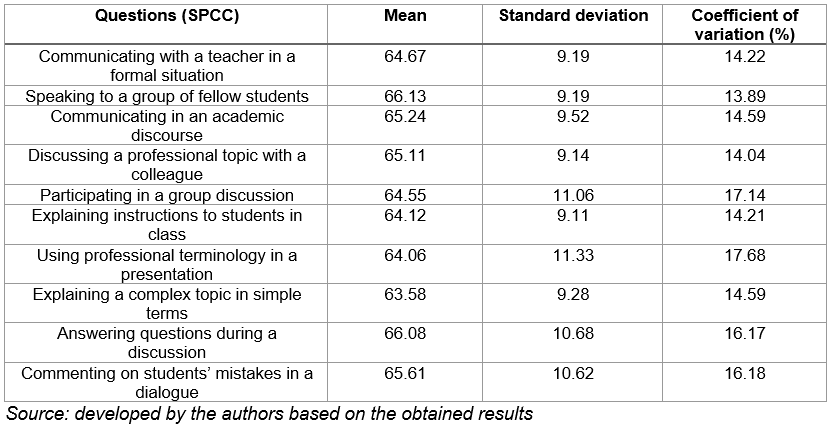
The highest average score was recorded for the item Using Professional Terminology in a Presentation (66.54 points), which indicates a developed academic speech base. High scores were also received for the situations Speaking to a Group of Fellow Students (66.13) and Communicating in an Academic Discourse (65.24), which confirms the students’ ability to plan and formalize speech. The lowest values were found in the items Participating in a Group Discussion (63.84) and Commenting on Students’ Mistakes in a Dialogue (64.06). This may indicate insecurity in spontaneous speech or in complex interpersonal communicative situations. This is typical for the initial stages of pedagogical practice, where it is important not only to know language structures, but also to have emotional flexibility and strategic thinking.
The standard deviation analysis shows that the spread of scores was the largest in the item Participating in a Group Discussion (σ = 11.43), which indicates the different levels of students’ experience in this type of communication. All other items fluctuated within the standard deviation of 8.81–10.62, which indicates moderate variability of indicators. The coefficient of variation, which reflects the relative instability of the results, was the highest in the same item (Participating in a Group Discussion – 17.9%) and the lowest in Using Professional Terminology (13.13%). So, the level of students’ confidence is more stable in situations related to clearly structured speech.
The extended study included six main types of linguodidactic strategies: interactive, cognitive, project-based, situational, collective, and gamified. Statistical analysis was carried out using simple linear regression, where the dependent variable was the generalized indicator on the SPCC scale, which reflects the level of speech competence. The results are presented in Table 2.
Table 2.
Linear regression: The impact of types of linguodidactic strategies on speech competence
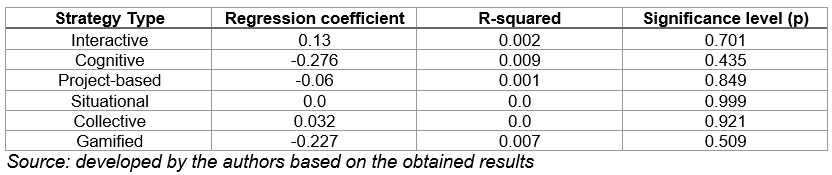
The interactive strategy demonstrated a weak positive effect on speech development (β = 0.130, R² = 0.002), but the result is statistically insignificant (p = 0.701). This may indicate the limited effectiveness of such strategies in a short-term educational process or the need for a more flexible combination with other approaches. The cognitive strategy, focused on the development of analytical thinking and structured speech, showed the highest regression coefficient among all strategies (β = -0.276), but the relationship was negative and statistically insignificant (p = 0.435). This may indicate a potential overload of the educational process with theoretical components, which suppresses speech spontaneity. The project strategy, which usually involves long-term processing of the material in microgroups, also did not show a noticeable effect on the competence indicators (β = -0.060, R² = 0.001, p = 0.849). Such forms of learning probably require longer use to produce a tangible result. The situational strategy, which involves creating conditions close to real professional speech, did not affect the results at all (β = 0.000, R² = 0.000, p = 0.999).
This may be explained by the fact that the effectiveness of this strategy largely depends on the quality of pedagogical support and the authenticity of situation modelling. The collective strategy, which involves group interaction, joint problem solving, and the development of communication skills in an interdependent environment, also did not demonstrate a significant effect (β = 0.032, R² = 0.000, p = 0.921). This may indicate a superficial involvement of students in such forms, which does not give the expected effect. The gamified strategy, based on the use of game mechanics in teaching, turned out to be ineffective in the context of developing speech competence in adult students. The regression coefficient was low and statistically insignificant (p > 0.05), which indicates the need to adapt game methods to professionally oriented tasks.
The results of the multivariate regression model gave grounds to determine which strategies had the greatest impact on the change in language competence after the implementation of the pedagogical intervention. The explanatory variables were six types of linguodidactic strategies, and the dependent variable was the average integral score of the TLCI. The results are presented in Figure 1.
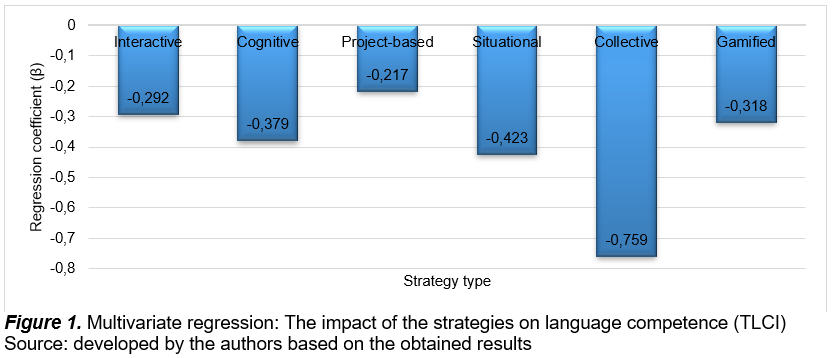
The gamified strategy (β = 1.962) has the largest positive value of the regression coefficient. This indicates its high stimulating potential for speech activity, especially in developing of functional flexibility, emotional involvement, and spontaneous speech. The obtained result is consistent with current studies that prove the effectiveness of game formats in enhancing students’ motivation to communicate. The second most influential factor was the cognitive strategy (β = 1.106), which is focused on deep processing of speech material, the development of speech thinking and operating with complex syntactic structures. This result indicates its effectiveness in improving the academic component of speech, in particular lexical accuracy and grammatical correctness.
A less pronounced, but positive effect is observed in the project-based (β = 0.658) and interactive (β = 0.351) strategies. This can be explained by their function as additional tools that enhance the overall dynamics, but require longer implementation to achieve statistically significant results. In contrast, the situational strategy revealed a negative coefficient (β = –2.142). This may indicate the difficulty of students’ adaptation to speech in unpredictable or simulated situations without sufficient methodological support. The impact of the collective strategy was also negative, although less intense (β = –0.133), which is probably caused by the blurring of individual speech contribution in group interaction.
Factor analysis identified three latent components that generalize the structure of students’ speech competence after the application of linguodidactic strategies. Varimax rotation clearly differentiated the relationships between the individual language indicators included in the TLCI scale. The results are presented in Table 3.
Table 3.
Factor loadings of language competence components (TLCI)
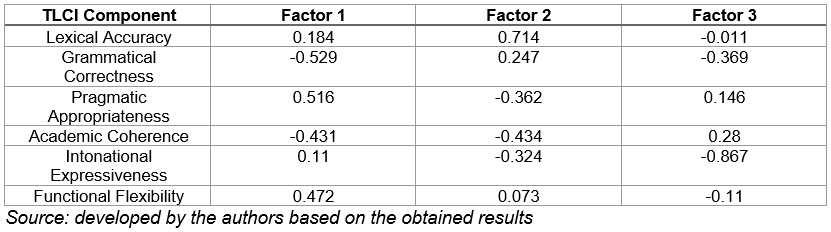
Factor 1 has a pronounced positive load on pragmatic expediency (0.516) and a negative load on grammatical correctness (–0.529). This indicates the contrast between the spontaneity of expression and the orientation towards normativity. Such a configuration may indicate the cognitive tension that arises in students when trying to simultaneously follow the rules and maintain the natural course of communication. The participants who tend to intuitive speech in a professional environment have high values on this factor.
Factor 2 combines the greatest load on lexical accuracy (0.714) with a relatively low level on other scales. This indicates a specific competence associated with the knowledge of lexical tools. Such a factor may characterize students who have a rich vocabulary and are prone to the precise selection of language tools, but do not always demonstrate communicative flexibility or intonational expressiveness. The third factor has an extremely high negative loading on intonation expressiveness (–0.867), which may indicate a separate emotional-sound component of speech activity. This indicator is interpreted as a factor related to the prosodic organization of speech – intonation, pace, logical stress. The negative loading can be explained by the inverse scale or the characteristics of the respondent’s perception. There is also a weak but positive loading on academic coherence in Factor 1 (0.301), which indicates a partial connection between the logical construction of statements and pragmatic content.
The analysis of the combined correlation matrix established general trends in the relationships between specific speech components and the pedagogical strategies used. In general, most correlation coefficients have low values (r < 0.2), which indicates weak linear relationships. At the same time, certain indicators deserve attention in the context of advancing hypotheses for further research (Table 4).
Table 4.
Correlation matrix between TLCI components and linguodidactic strategies (r)
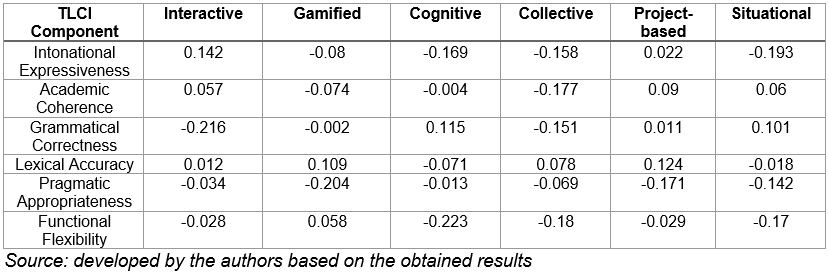
The highest positive coefficient was found between lexical accuracy and project-based strategy (r = 0.124). This may indicate a favourable effect of long-term tasks on vocabulary enrichment and activation of speech structures in professional topics. There is also a relatively higher correlation between functional flexibility and gamified strategy (r = 0.109). This may be determined by the activation of situational speech in a game environment. Intonation expressiveness demonstrates a minimal positive relationship with interactive strategy (r = 0.073), which may indicate the influence of forms of communicative training or role-playing interaction.
At the same time, cognitive strategy tends to have a weak negative relationship with a number of components, in particular with lexical accuracy (r = –0.071) and intonation expressiveness (r = –0.089). This is probably explained by the advantage of analytical tasks over emotionally coloured language structures. It is worth noting that situational and collective strategies demonstrate almost zero coefficients in the relationships with all components. This may indicate their low effectiveness in the current implementation conditions or insufficient duration of influence.
Discussion
The obtained results confirm that linguodidactic strategies influence the development of future teachers’ speech competence unevenly, with the dominance of gamified and cognitive strategies. This is partly consistent with the findings of Noviyenty (2022), who emphasizes the importance of the teacher’s communicative strategies as a means of increasing students’ language confidence. In her study, teachers’ strategic speech stimulated the development of students’ communicative skills, which correlates with the positive impact of interactive and gamified learning revealed in our study. At the same time, in contrast to our results, the author notes the high effectiveness of situational modelling, while in our study this strategy demonstrated a negative impact.
The importance of cognitive strategy in our model is consistent with the findings of Khansir et al. (2021), who emphasize that the development of lexical and grammatical skills is ensured through deep cognitive mechanisms. In our case, cognitive strategy also showed one of the highest positive coefficients of influence, in particular on academic coherence and lexical accuracy.
An important confirmation of the importance of the technological factor is the generalization made by Liang et al. (2023), who consider the integration of artificial intelligence (AI) and digital technologies as an important prerequisite for effective language learning. Our study confirms this direction, as the gamified strategy, which involved the use of digital resources, turned out to be the most effective among all the tested models.
Regarding general approaches to the study of learning strategies, it is worth noting that our conclusions have something in common the theses of Pawlak (2021). He emphasizes the complexity of analysing language strategies because of their variability, context dependence, and subjective level of student involvement. The consistency of the obtained results is also traced in the context of modern research on the digital transformation of language education. Huang et al. (2023) emphasize that the introduction of AI and digital tools into language learning contributes to increasing student autonomy.
The Ji et al. (2023) study shows that educational models in which AI works in collaboration with the teacher are most effective. Such hybrid interaction enables achieving a balance between automated speech training and emotional support from the teacher.
The psychoemotional aspect of communicative development is also confirmed in the study of Derakhshan (2022), who emphasizes the growing role of positive psychology in second language education. The elements of gamification and cognitive support, identified as the most effective in our study, can be considered as tools for emotional support and reducing the language barrier. This is consistent with his findings. Alibakhshi et al. (2020) study found that high teacher self-efficacy has a positive effect on students’ motivation for language development.
The importance of contextual conditioning of pedagogical activity is emphasized in the study of González-Moncada (2021). It shows that language education policies and historical conditions directly influence teachers’ teaching strategies and professional identities. Gong et al. (2020) also confirm that the success of developing language competence depends on adapting the content to the needs of the target audience. This is partly reflected in our study: universal strategies, such as cognitive or gamified, demonstrated better effectiveness.
Research limitations
A limitation of the study is the limited sample size, which does not allow for full generalization of the results to a wider population of students from different educational institutions. Besides, the level of speech competence was assessed mainly though self-assessment, which could affect the objectivity of the results. It is also worth considering that the stages of study, the level of pedagogical experience, and the individual characteristics of the teachers could indirectly affect the dynamics of the results.
Recommendations
It is recommended to implement linguodidactic strategies in a complex, combining a cognitive approach with gamified and interactive forms of learning to achieve greater efficiency in the development of speech competence. It is appropriate to expand the sample of participants in further studies, including students of different majors and educational levels. It is also worth supplementing self-assessment methods with independent expert diagnostics and observation in real communicative situations.
Conclusions
Current requirements for teacher training necessitate targeted development of their speech competence by means of effective linguodidactic strategies. The study determined the initial level of students’ speech competence. The average value was 65.03 points, while the coefficient of variation ranged from 13.1% to 17.9%, which indicates moderate homogeneity of the sample. Uneven development of individual speech components was revealed: the highest indicator was in the knowledge of professional terminology (66.54 points), the lowest was in confidence during group discussions (63.84 points). The factor analysis established a latent structure of speech competence, which includes three key vectors. These are normative pragmatic (pragmatic appropriateness – 0.516), lexical (lexical accuracy – 0.714), and prosodic (intonation expressiveness – -0.867). The multifactorial regression model confirmed the multidirectional influence of individual strategies. The gamified strategy had the highest positive effect (β = 1.962), followed by cognitive (β = 1.106), while the situational strategy had negative dynamics (β = -2.142).
The results of the study can be used to improve the methods of teaching language subjects in the system of training future teachers. The practical significance of the study is the possibility of adapting effective linguodidactic strategies to the system of teacher training. The obtained results can be used to create programmes for the development of professional speech of future teachers, in particular by selecting effective linguodidactic strategies in accordance with specific components of speech competence. Prospects for future research include an in-depth analysis of the interaction of linguodidactic strategies with motivational, cognitive and sociocultural factors of the development of speech competence. It is appropriate to apply structural modelling (SEM) to identify indirect and latent relationships between strategies and speech results.
Bibliographic References
Alibakhshi, G., Nikdel, F., & Labbafi, A. (2020). Exploring the consequences of teachers’ self-efficacy: A case of teachers of English as a foreign language. Asian-Pacific Journal of Second and Foreign Language Education, 5(1), 23. https://doi.org/10.1186/s40862-020-00102-1
Amoah, S., & Yeboah, J. (2021). The speaking difficulties of Chinese EFL learners and their motivation towards speaking the English language. Journal of Language and Linguistic Studies, 17(1), 56-69. https://doi.org/10.52462/jlls.4
Ayala-Pazmino, F., Prieto-Lopez, Y., & Loor-Avila, B. (2022). A didactic strategy to favor the cevelopment of oral expression in students at UEES and ECOTEC universities. Journal of Language Teaching & Research, 13(3), 572-583. https://doi.org/10.17507/jltr.1303.13
Carabelli, P. (2021). Didactic discussions during ESL/EFL English teacher training courses. Reflective Practice, 22(1), 60-72. https://doi.org/10.1080/14623943.2020.1821629
Croucher, S. M., Kelly, S., Rahmani, D., Burkey, M., Subanaliev, T., Galy-Badenas, F., ... & Jackson, K. (2020). A multi-national validity analysis of the self-perceived communication competence scale. Journal of International and Intercultural Communication, 13(1), 1-12. https://doi.org/10.1080/17513057.2019.1569250
Derakhshan, A. (2022). Revisiting research on positive psychology in second and foreign language education: Trends and directions. Language Related Research, 13(5), 1-43. http://dx.doi.org/10.52547/LRR.13.5.2
de Sousa, L. C. (2024). Communicative Approach. Revista Científica Multidisciplinar UNIFLU, 9(1), 4-21. https://acortar.link/MdI3Rm
Fu, J. S., Yang, S. H., & Yeh, H. C. (2022). Exploring the impacts of digital storytelling on English as a foreign language learners’ speaking competence. Journal of Research on Technology in Education, 54(5), 679-694. https://doi.org/10.1080/15391523.2021.1911008
Gacs, A., Goertler, S., & Spasova, S. (2020). Planned online language education versus crisis‐prompted online language teaching: Lessons for the future. Foreign Language Annals, 53(2), 380-392. https://doi.org/10.1111/flan.12460
Golonka, E. M., Bowles, A. R., Frank, V. M., Richardson, D. L., & Freynik, S. (2014). Technologies for foreign language learning: A review of technology types and their effectiveness. Computer Assisted Language Learning, 27(1), 70-105. https://doi.org/10.1080/09588221.2012.700315
Gong, Y. F., Gao, X. A., & Lyu, B. (2020). Teaching Chinese as a second or foreign language to non-Chinese learners in mainland China (2014–2018). Language Teaching, 53(1), 44-62. https://doi.org/10.1017/S0261444819000387
González-Moncada, A. (2021). On the professional development of English teachers in Colombia and the historical interplay with language education policies. How, 28(3), 134-153. https://doi.org/10.19183/how.28.3.679
Huang, X., Zou, D., Cheng, G., Chen, X., & Xie, H. (2023). Trends, research issues and applications of artificial intelligence in language education. Educational Technology & Society, 26(1), 112-131. https://www.jstor.org/stable/48707971
Ji, H., Han, I., & Ko, Y. (2023). A systematic review of conversational AI in language education: Focusing on the collaboration with human teachers. Journal of Research on Technology in Education, 55(1), 48-63. https://doi.org/10.1080/15391523.2022.2142873
Khansir, A. A., Dehkordi, F. G., & Mirzaei, M. (2021). Learning strategies and English language teaching. Theory and Practice in Language Studies, 11(6), 734-741. http://dx.doi.org/10.17507/tpls.1106.19
Kyrpychenko, O., Pushchyna, I., Kichuk, Y., Shevchenko, N., Luchaninova, O., & Koval, V. (2021). Communicative competence development in teaching professional discourse in educational establishments. International Journal of Modern Education & Computer Science, 13(4), 16-27. DOI: 10.5815/ijmecs.2021.04.02
Liang, J. C., Hwang, G. J., Chen, M. R. A., & Darmawansah, D. (2023). Roles and research foci of artificial intelligence in language education: An integrated bibliographic analysis and systematic review approach. Interactive Learning Environments, 31(7), 4270-4296. https://doi.org/10.1080/10494820.2021.1958348
Ludwikowska, K. (2019). Teacher competence inventory: An empirical study on future-oriented competences of the teaching profession in higher education in India. Education+ Training, 61(9), 1123-1137. https://doi.org/10.1108/ET-12-2018-0266
Mohamad, A., & Tamer, Y. (2021). A review of literature on project-based learning inside language education. Turkish Online Journal of English Language Teaching, 6(2), 79-105. https://surli.cc/ktkijz
Noviyenty, L. (2022). English speaking lecturers’ performances of communication strategies and their efforts to improve students’ communicative competence. European Journal of Educational Research, 11(2), 1047-1062. https://doi.org/10.12973/eu-jer.11.2.1047
Oliveira, K. R. E. D., Trovo, M. M., Risso, A. C. M. D. C. R., & Braga, E. M. (2018). The teaching approach on communicative skills in different teaching methodologies. Revista Brasileira de Enfermagem, 71(5), 2447-2453. https://doi.org/10.1590/0034-7167-2017-0728
Oubibi, M., Zhao, W., Wang, Y., Zhou, Y., Jiang, Q., Li, Y., ... & Qiao, L. (2022). Advances in research on technological, pedagogical, didactical, and social competencies of preservice TCFL teachers. Sustainability, 14(4), 2045. https://doi.org/10.3390/su14042045
Pawlak, M. (2021). Investigating language learning strategies: Prospects, pitfalls and challenges. Language Teaching Research, 25(5), 817-835. https://doi.org/10.1177/1362168819876156
Pulido, Y. F., Fuster-Guillen, D., Rojas-Rivera, W., Tamashiro, J. T., & Tataje, F. A. O. (2022). Didactic strategies to strengthen oral competence in English based on meta-analysis. Journal of Positive School Psychology, 6(3), 1794-1812. http://184.168.115.16/index.php/jpsp/article/view/1900/1099
Rodríguez-Arancón, P. (2023). Developing L2 intercultural competence in an online context through didactic audio-visual translation. Languages, 8(3), 160. https://doi.org/10.3390/languages8030160
Rojas, V. S., Fuentealba, L. F., & Ranjan, R. (2021). Game-based didactic resources as a strategy in foreign language pedagogy. International Journal of Learning, Teaching and Educational Research, 20(12), 195-211. https://doi.org/10.26803/ijlter.20.12.12
Rubin, R. B., Palmgreen, P., & Sypher, H. E. (2020). Communicative competence scale. In Communication Research Measures (pp. 125-129). New York: Routledge. https://doi.org/10.4324/9781003064343
Schwartz, M. (2021). Language-conducive strategies in early language education. In Handbook of Early Language Education (pp. 1-28). Cham: Springer International Publishing. https://doi.org/10.1007/978-3-030-47073-9_24-2
Tao, J., & Gao, X. A. (2022). Teaching and learning languages online: Challenges and responses. System, 107, 102819. https://doi.org/10.1016/j.system.2022.102819
Tzagkourni, E., Chlapana, E., & Zaranis, N. (2021). Implementing theoretical approaches using ICT in teaching English as a foreign language. Education and Information Technologies, 26(5), 6203-6226. https://doi.org/10.1007/s10639-021-10594-0
Valério, K. M., & Mattos, A. M. D. A. (2018). Critical literacy and the communicative approach: Gaps and intersections. Revista Brasileira de Linguística Aplicada, 18(2), 313-338. https://doi.org/10.1590/1984-6398201812252
Uztosun, M. S. (2021). Foreign language speaking competence and self‐regulated speaking motivation. Foreign Language Annals, 54(2), 410-428. https://doi.org/10.1111/flan.12559

Este artículo no presenta ningún conflicto de intereses. Este artículo está bajo la licencia Creative Commons Atribución 4.0 Internacional (CC BY 4.0). Se permite la reproducción, distribución y comunicación pública de la obra, así como la creación de obras derivadas, siempre que se cite la fuente original.