
DOI: https://doi.org/10.46502/issn.1856-7576/2025.19.04.11
Eduweb, 2025, octubre-diciembre, v.19, n.4. ISSN: 1856-7576
Cómo citar:
Shmyndruk, O., Ustrytska, N., Serkevych, I., Baltadzhy, P., & Yasin, I. (2025). ICT and modern technologies for training professional mediators in restorative justice and related processes. Revista Eduweb, 19(4), 175-187. https://doi.org/10.46502/issn.1856-7576/2025.19.04.11
TIC y tecnologías modernas para la formación de mediadores profesionales en justicia restaurativa y procesos afines
Оlha Shmyndruk
PhD., Associate Professor of the Department of Civil and Legal Disciplines ofThe National University of Ostroh Academy, Ostroh, Ukraine.
https://orcid.org/0000-0002-7135-2594
Nataliia Ustrytska
PhD., Associate Professor of the Department of Criminal Law Disciplines of the Educational and Scientific Institute of Law and Law Enforcement Activities of the Lviv State University of Internal Affairs, Lviv, Ukraine.
https://orcid.org/0000-0003-0075-9458
Iryna Serkevych
PhD in Law, Associate Professor of the Department of Criminal Law Disciplines of the Educational and Scientific Institute of Law and Law Enforcement Activities of the Lviv State University of Internal Affairs, Lviv, Ukraine.
https://orcid.org/0000-0001-7678-0291
Polina Baltadzhy
PhD in Law, Professor of the Department of State and Legal Disciplines, Institute of Law and Security, Odesa State University of Internal Affairs, Odesa, Ukraine.
https://orcid.org/0000-0003-2346-4230
Ilona Yasin
PhD in Law, Associate Professor of the Department of Criminal Law Disciplines of the Educational and Scientific Institute of Law and Law Enforcement Activities of the Lviv State University of Internal Affairs, Lviv, Ukraine.
https://orcid.org/0000-0002-8074-8953
Recibido: 15/07/25
Aceptado: 01/12/25
Abstract
The purpose of the study is to determine the role and potential of information and communication technologies and modern digital tools in the system of training professional mediators in the field of restorative justice and related processes, as well as in developing approaches to integrating these technologies into educational programs. The research methodology consists of the following methods: comparative analysis method, policy analysis method, empirical method and system method. The study found that the integration of modern information and communication technologies into the system of training mediators in the field of restorative justice contributes to increasing the efficiency of the educational process and professional activities of specialists. The use of digital platforms and online environments provides the opportunity to conduct trainings, simulations and role-playing games in a remote format, which significantly expands access to training and increases its flexibility. The models of application of videoconferencing technologies, interactive software solutions and artificial intelligence tools and their role in forming in future mediators the digital competencies necessary for effective work with participants in restorative processes in various social and legal contexts were analyzed. A number of challenges associated with the use of ICT were identified, including issues of ethics, protection of personal data, adaptation of training methods to online environments and preservation of the authenticity of restorative dialogue. The results obtained confirm the need to develop comprehensive training programs for mediators that combine traditional training methods with innovative technological approaches, contributing to the formation of a new generation of specialists capable of operating in a digital society.
Keywords: ICT, professional training, digital technologies, restorative justice, mediation, online environment, artificial intelligence.
Resumen
El objetivo del estudio es determinar el papel y el potencial de las tecnologías de la información y la comunicación (TIC) y las herramientas digitales modernas en la formación de mediadores profesionales en el ámbito de la justicia restaurativa y procesos afines, así como en el desarrollo de enfoques para integrar estas tecnologías en los programas educativos. La metodología de investigación consta de los siguientes métodos: análisis comparativo, análisis de políticas, empírico y sistémico. El estudio concluyó que la integración de las TIC modernas en la formación de mediadores en el ámbito de la justicia restaurativa contribuye a aumentar la eficiencia del proceso educativo y la actividad profesional de los especialistas. El uso de plataformas digitales y entornos en línea permite realizar capacitaciones, simulaciones y juegos de rol a distancia, lo que amplía significativamente el acceso a la formación y aumenta su flexibilidad. Se analizaron los modelos de aplicación de las tecnologías de videoconferencia, las soluciones de software interactivo y las herramientas de inteligencia artificial, y su papel en la formación de las competencias digitales necesarias para el trabajo eficaz con los participantes en procesos restaurativos en diversos contextos sociales y legales. Se identificaron diversos desafíos asociados al uso de las TIC, incluyendo cuestiones éticas, protección de datos personales, adaptación de los métodos de formación a entornos en línea y preservación de la autenticidad del diálogo restaurativo. Los resultados obtenidos confirman la necesidad de desarrollar programas integrales de formación para mediadores que combinen métodos de formación tradicionales con enfoques tecnológicos innovadores, contribuyendo así a la formación de una nueva generación de especialistas capaces de operar en una sociedad digital.
Palabras clave: TIC, formación profesional, tecnologías digitales, justicia restaurativa, mediación, entorno online, inteligencia artificial.
Introduction
In the current context of the development of legal systems, restorative justice is gaining increasing importance, being seen as a humanistically oriented alternative to traditional punitive models of criminal justice, the central task of which is not so much the punishment of the offender as the restoration of social justice, ensuring the rights and interests of victims and creating conditions for the resocialization of the guilty person. This approach forms a new paradigm of justice, in which priority is given to dialogue, responsibility and reconciliation of the parties (Park University, 2024).
At the same time, restorative justice is being influenced by global processes of digitalization, which are opening up new perspectives for the development of mediation and other restorative practices. A growing body of research demonstrates the potential of digital tools and online platforms to become an important complement to restorative justice, facilitating access to procedures, expanding the range of participants and increasing the effectiveness of communication between them (Universitat Oberta de Catalunya, 2024). Such an approach is particularly relevant in situations where the physical presence of the parties is difficult, as well as in cases that require the creation of a safe environment for victims.
In Europe it is common the use of mediation in probation practice contributes not only to reducing conflict, but also to reintegrate the offenders back into society (Innovative Prison Systems, 2023), which indicates the potential of mediation as a tool for reducing recidivism and ensuring a balance of interests of all participants in legal relations. Restorative programs have a positive impact on both victims and offenders. In particular, a decrease in the level of recidivism, an increase in victims' satisfaction with participation in programs, and the formation of a safer social environment are noted (Government of Canada, 2022), which makes restorative justice an important component of modern reforms in the field of criminal justice, as it combines the interests of the individual and society, increasing the effectiveness of law enforcement.
In view of the above, the relevance of research into the role of information and communication technologies (hereinafter referred to as ICT) and modern digital tools in the training of professional mediators in the field of restorative justice is determined by the need to combine humanistic principles of justice with innovative technological solutions, which opens up prospects for the formation of a new professional culture of mediation that meets the challenges of the digital age and contributes to building a more just, inclusive and effective society.
The object of the study is the relationships that arise in the process of professional training of mediators in the field of restorative justice in the context of digitalization of the legal and educational systems.
The subject of the research is information and communication technologies and modern digital tools as a means of improving the training of professional mediators and increasing the effectiveness of restorative practices.
The research objectives are as follows:
The following key concepts and terms are used within the study:
Restorative justice is a set of approaches and practices in criminal law and related areas aimed at restoring justice, compensating victims, and resocializing the offender through dialogue, mediation, and reconciliation of the parties.
Mediator training is a systematic process of professional training and competence development, which includes both legal and psychological knowledge, as well as digital skills for effective work in the modern information society.
Related processes are practices that support and develop restorative justice, including probation, educational programs in educational institutions, conflict management, digital mediation, and online mediation.
Theoretical Framework and Literature Review
Modern research demonstrates that the development of information and communication technologies is gradually changing approaches to organizing and teaching mediation in the field of restorative justice.
We agree that the online environment significantly expands access to restorative justice procedures. Romero-Seseña (2025) rightly notes that digital platforms allow the involvement of parties who, for various reasons, cannot be physically present, thereby ensuring the inclusiveness of the processes. In this context, we can talk about the formation of elements of “digital restorative justice”, which is especially relevant in the context of globalization and social mobility.
The question of integrating artificial intelligence into education was examined in the article by Davydova et al. (2023), which focuses on the competencies students need to successfully enter professions that rely on AI technologies. Their work emphasizes the growing importance of preparing future specialists who can operate effectively in environments shaped by artificial intelligence and digital innovations.
Also important is the approach of Carneiro et al. (2012), who propose the creation of context-aware online dispute resolution systems. Taking into account cultural, social and emotional context using analytical tools and artificial intelligence can improve the quality of mediator support. This allows for a better understanding of the participants and creates conditions for more flexible and effective interaction.
Another aspect that deserves support concerns the training of professional mediators. Barjau & Biffi (2021) emphasize the need to develop digital competence of trainers and mediators. A modern mediator should have the ability to work with different online platforms, ensure the ethics and confidentiality of remote procedures, and critically evaluate the use of digital tools in practice.
At the same time, there are some concerns. Hollósvölgyi (2025) emphasizes the promise of restorative justice, but it is important to remember that empathy and “live” contact are central to such processes. Transferring them to a digital format can reduce the level of trust between participants and reduce the sense of personal involvement. Similar risks exist in the approach of Carneiro et al. (2012), which places great emphasis on algorithms and automation. Complete or excessive reliance on artificial intelligence can negate the unique role of the mediator as a carrier of empathy, moral sensitivity and human understanding, which no algorithm can replace.
The ethical risks of digital platforms, as raised by Romero-Seseña (2025), also remain an open question. Modern technologies should guarantee confidentiality and data security, but practical standards and legal mechanisms in this area are not yet sufficiently developed. Furthermore, while Barjau & Biffi (2021) propose various mediator training programs through digital tools, the absence of recent research on the effectiveness of such online or hybrid courses compared to classic training formats.
Marder (2022) shows, using the example of Ireland, that the implementation of restorative practices depends on cultural and legal frameworks, and therefore the effectiveness of ICT in mediation is not universal and requires contextual analysis. This again proves the need for additional comparative research to assess the impact of digital technologies on trust in procedures and on perceptions of justice in different societies.
The classical vision of restorative justice (Marshall, 1999) emphasizes the role of personal interaction and empathy. The use of ICT in this context raises some doubts, since videoconferencing or algorithmic systems are not always able to recreate live contact and emotional connection between the parties. Therefore, the integration of technologies should be moderate: digital tools should be considered as a complement to traditional practice, and not as its complete replacement.
At the same time, recent studies, such as Kumar & Singh (2024) and Musgrave et al. (2025), show that artificial intelligence and videoconferencing platforms are transforming alternative dispute resolution practices. Kumar & Singh (2024) considers the concept of a “robo-mediator” that can automate some of the analytical work, including assessing the parties’ positions and making recommendations for conflict resolution. At the same time, there is a risk of devaluing the human factor and empathy. Musgrave et al. (2025) demonstrate how restorative justice practitioners are using video platforms. These findings support the idea that digital technologies can be a powerful tool if properly integrated, but require careful design and ethical standards. Modern technologies increase the accessibility of procedures, allow modeling of various conflict situations and provide analytical support during mediation sessions. At the same time, there is a need for a balance between digital tools and live contact of participants in order to preserve the key principles of empathy, trust and fairness. Issues of confidentiality, ethics of using AI and the effectiveness of online training of mediators remain relevant for further research and development of practice. Scheuerman & Keith (2023) emphasize that the type of crime and the characteristics of the victim significantly affect the results of restorative mediation. This indicates the need to create digital tools and training platforms that help mediators adapt approaches to different conflict scenarios and individual needs of participants. In this context, technologies can act as an additional means of analyzing data on crimes and their impact on participants, increasing the accuracy of mediator training.
Wijaya & Sari (2024) demonstrate an example of the application of a restorative approach in a digital environment in the resolution of health disputes in Indonesia. The authors emphasize the importance of online platforms to ensure the accessibility of mediation procedures. ICT is a major tool to have different stakeholders and increase the inclusiveness of the process, especially in the context of digitalization of society.
Wählisch (2024) examines the role of artificial intelligence in mediation, noting that AI can automate some of the analytical work, including scenario generation, assessment of participants’ positions, and decision-making support. This approach contributes to the training of mediators, as they can focus on facilitation and empathy, receiving assistance from AI in the preparatory work. At the same time, the author warns that automation should not replace the human factor, which is critically important in restorative processes. Mayer (2018) emphasizes in the context of supporting professions that mediators should have skills not only in classical facilitation, but also digital competencies. The ability to communicate effectively through online platforms, manage digital resources, and interactive simulators is becoming an integral part of professional training.
Freitas & Palermo (2016) demonstrate the practical aspects of using technology in restorative justice. They note that digital tools can provide access to resources, standardized methodologies, and interactive training, which helps to improve the quality of mediator training and reduce the risk of errors in the mediation process.
Restorative practices are becoming an integral part of the system for ensuring effective protection of the rights and interests of conflict participants. One of the key tasks is to train highly qualified mediators who are able to apply both traditional methods of facilitation, negotiations and conflict management, and modern information and communication technologies in their practical activities. The integration of digital tools into training programs allows for the simulation of conflict situations, increases the accessibility of procedures for participants who cannot be physically present, and ensures the standardization of knowledge and skills of mediators in different contexts.
Previous studies highlight the relevance of this approach. For example, Pereira et al. (2023) examine training programmes for judges and prosecutors in the EU, noting the existence of a “digital divide”. Bonensteffen et al. (2022) demonstrate that computerised communication platforms can be a valuable addition to mediation between victims and offenders, especially when face-to-face contact is limited.
Menkel-Meadow (2016) made a research on new technologies, which allows for increased training effectiveness and the development of critical thinking. Varfi, Parmentier & Aertsen (2014) note that training programs for judges should include interactive and technological elements, such as online courses, video training and simulation modules, which promotes standardization of knowledge and improves understanding of restorative practices. In addition, research by Gazi & Altınay-Aksal (2017) demonstrates the effectiveness of digital platforms, online testing and conflict simulation in training, which can be adapted for mediator training, providing a safe environment for practicing practical skills.
Thus, modern scientific literature confirms the need for comprehensive integration of ICT into curricula for the training of mediators and other restorative justice professionals, which allows to improve the quality of education, the effectiveness of practical training and the accessibility of procedures for all participants.
Therefore, we can conclude: the integration of ICT and modern technologies into the training of mediators and restorative justice practices is a promising direction that ensures accessibility, scalability and innovation. Issues of ethics, confidentiality, as well as the effectiveness of online training formats require further research.
Overall, the analysis of these sources confirms key trends in the field of restorative justice and mediator training:
First, ICT and digital tools significantly increase the accessibility of procedures, allow modeling of complex conflict situations, and support the analytical work of mediators.
Second, effective use of technology requires a balance between digital resources and the live human factor, as the emotional component and empathy remain critically important.
Third, training programs for mediators, judges, and other professionals should include interactive and technological components to ensure modern and effective training.
Methodology
The comparative analysis method was applied by comparing national and international practices of mediator training and the integration of digital technologies, in particular online platforms, video conferencing, VR/AR simulations and learning management systems. The application of the method allowed us to identify key differences in approaches to digital mediator training in different countries and to identify common effective practices and to draw conclusions that international programs demonstrate high efficiency of blended learning integration, active use of video platforms for recovery sessions, as well as simulation VR/AR simulators for practicing negotiation and communication skills, which indicates the need to adapt such technologies to Ukrainian educational and legal realities.
The policy analysis method was used to systematically study regulatory documents, methodological recommendations and training programs that regulate the training of mediators and the implementation of restorative justice. The application of this method allowed to identify gaps in the implementation of digital technologies, as well as to analyze existing standards for the professional training of mediators. With the help of this method, conclusions were drawn about the lack of unified methodological approaches to the integration of digital tools into training programs, insufficient attention to the development of digital competencies, and the need to standardize approaches to online mediation and VR/AR training at the national and international levels.
The empirical method was implemented through a systematic analysis of factual data on the use of digital technologies in the field of restorative justice, including online platforms, video conferencing, VR/AR simulations and other technological tools. The application of this method allowed us to conclude that digital technologies contribute to increasing the accessibility and efficiency of restorative processes, optimize the organizational and communication aspects of the work of mediators, but their effectiveness is limited by technological barriers, uneven digital competence of the participants in the process and the need to develop regulatory and methodological regulations for the safe and ethical use of innovative tools.
A systems approach was used to integrate the results of comparative analysis, policy analysis, and empirical data into a holistic conceptual model of mediator training in a digital environment, which allowed us to establish structural relationships between educational programs, technological support, and the effectiveness of restorative practices.
Thus, the combination of these methods provides a multi-level analysis of the problem, allows for the formation of scientifically based conclusions on the integration of ICT and modern technologies in the training of mediators, and the development of practical recommendations for increasing the effectiveness of restorative justice.
Results and Discussion
Restorative justice, also known as reparative or humanistic justice, emerged in the 1970s as an alternative philosophy of conflict resolution. In contrast to traditional models that view disputes as a confrontation between the individual and the state, this approach focuses on the direct interaction of the parties. It is used both in small domestic conflicts and in complex cases, such as meetings between victims and perpetrators of serious crimes or even terrorist acts (Universitat Oberta de Catalunya, 2024). The effectiveness of restorative justice depends largely on the professionalism of mediators who facilitate constructive dialogue, and therefore, modern training of such professionals requires innovative methods and technologies that meet the challenges of the digital age.
Higher education institutions play a key role in shaping future mediators by integrating restorative justice principles into curricula. Universities are constantly improving educational practices to remain competitive and meet societal needs. In this process, it is important to implement a culture of performance that determines the institution’s development strategy and focuses on the needs and satisfaction of students. Teaching and learning are the main indicators of educational quality, and the “student voice” is becoming a key element in evaluating and improving the educational process (Gazi & Altınay-Aksal, 2017).
Information and communication technologies open up new opportunities for the training of mediators in the field of restorative justice. Digitalization contributes to the creation of authentic learning environments that form universal skills necessary for mediation practice: empathy, communication, problem solving. The use of video simulations, role-playing games and online platforms allows you to recreate complex scenarios of real conflicts and practice professional skills in a safe, but as close to reality as possible format. The growth of mobile technologies and access to the Internet ensure flexibility and inclusiveness of the educational process, opening up opportunities for students with special educational needs (Gazi & Altınay-Aksal, 2017).
Teachers act as mediators who help students constantly go beyond their own capabilities and acquire new knowledge through experience and collective interaction, with technology also acting as a mediator. Contextualized and activity-oriented tasks using technology provide an opportunity to learn through practice (Gazi & Altınay-Aksal, 2017). At the same time, teaching using videos and role-playing games contributes to the development of skills in students within the framework of group and partner learning. This approach creates an active educational environment where success is achieved through positive interdependence, direct interaction, group work and technologically supported tasks. Research confirms that the level of knowledge acquisition increases in group forms of work (Gazi & Altınay-Aksal, 2017). The use of technology in the training of future teachers to overcome educational inequality, in particular with regard to students with disabilities, is especially relevant. There is a growing need in teacher education programs to focus on how technology integration contributes to the development of students’ professional skills and how such educational environments can be expanded to accommodate the needs of people with special educational needs.
Effective training of judges, prosecutors and other professionals in this field requires innovative teaching methods that combine theoretical knowledge and practical skills. Modern technologies, such as video tutorials and role-playing games, create an interactive learning environment, promote the development of communication, collaboration, critical thinking and reflection skills. Spain, the Netherlands and Northern Ireland demonstrates the effectiveness of online methods for training mediators and integrating restorative justice into judicial practice, as well as for raising awareness (Table 1).
Table 1.
ICT and modern technologies in the training of professional mediators in restorative justice: experience of European countries.
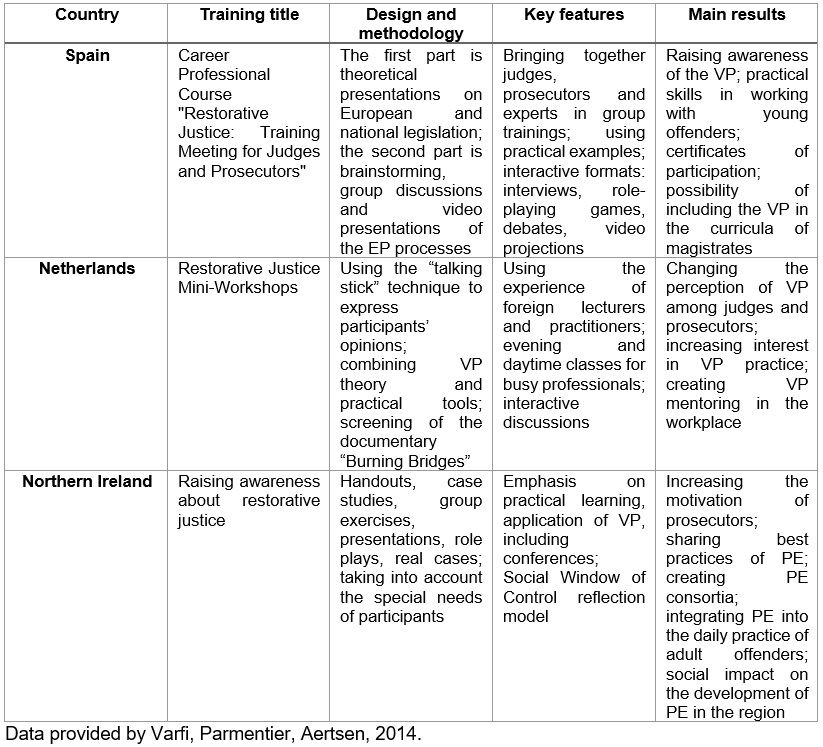
The experience of European trainings shows that the integration of modern technologies into restorative justice curricula significantly increases the effectiveness of training judges, prosecutors and mediators. The use of role-playing games, video instructions and active learning contributes to the development of professional competence, communication skills and critical thinking of participants. In addition, technologies provide the possibility of a more inclusive learning environment and expand access to knowledge for different groups of participants, including people with special needs. The development of integrated training models taking into account modern technologies is a promising direction for the further development of professional training of mediators in the restorative justice system.
Modern technologies are playing an increasingly important role in the development of alternative dispute resolution, in particular in restorative justice. As Kumar & Singh (2024) notes, artificial intelligence and automated mediators – the so-called “robo-mediators” – can transform conflict resolution processes, ensuring speed, objectivity and personalization of recommendations. The use of such tools is especially relevant for judges, prosecutors and restorative justice practitioners, as it allows overcoming geographical, time and organizational constraints, increasing the accessibility of services for all parties to the conflict.
Specialized mediator training programs aimed at minors include interactive methods, case studies, role-playing games and video analysis of practice (Council of Europe, 2024). This allows mediators to take into account the psychological and emotional needs of children.
Musgrave, Bell & Schoenebeck (2025) highlight the role of technology, such as videoconferencing platforms. This allow to control access to information, maintain confidentiality and create a more interactive environment that supports active participation. In addition, the use of such technologies contributes to the development of empathy, communication skills and self-expression in children, and provides the opportunity for continuous feedback between the conflict participants and the mediator.
It is important that digital tools and video technologies allow for an individual approach to each participant, in particular to children with special educational needs or from vulnerable groups. This not only ensures equal rights and opportunities for participation, but also helps reduce the risk of traumatization during the process. Thus, the integration of technology with the principles of restorative justice creates conditions for the protection of children and increasing the effectiveness of mediation practices. The combination of artificial intelligence, digital platforms and the principles of restorative justice forms a new paradigm of alternative dispute resolution, in which special attention is paid to the rights and safety of minors. The use of technology allows not only to increase the efficiency of the process, but also to ensure respect for the individual needs of each participant, develop the professional competencies of mediators and ensure a fair and humane approach to conflict resolution.
At the same time, digital platforms provide fewer resources for managing complex situations. For example, if one of the participants says something inappropriate during a face-to-face meeting, the mediator can stop it with a look, while doing so via a mobile phone or computer is much more difficult (Universitat Oberta de Catalunya, 2024). The circumstances in which online dispute resolution takes place in a virtual environment, devoid of the richness of face-to-face interaction, are seen as a serious disadvantage. This applies not only to the field of conflict resolution, but also to any other field where virtual environments are used. Such environments are often perceived as “cold” because emotions and other aspects of complex human interaction play almost no role. One of the key aspects in this context is body language. In everyday contacts, we (often unconsciously) rely on non-verbal signals to more fully express our thoughts and emotions. In particular, in face-to-face communication, the main elements are words, tone of voice and non-verbal behavior, with non-verbal signals being particularly important for conveying emotions and attitudes, as they account for the majority of the information conveyed. In other words, the way in which words are said is more important than the words themselves. In a virtual environment, this information is lost, making it difficult for participants (mediators, parties to the conflict) to understand each other’s emotional state. In addition, when communicating online, people often forget that there is another person behind the screen. This creates a relaxing effect, as a result of which participants pay less attention to the emotions of the other and think less about the consequences of their words and actions. As a result, it is easier to offend the interlocutor, which can become a serious obstacle to successful conflict resolution, because trust is an extremely important element of the process.
Therefore, in the context of the development of ICT technologies, the traditional model of negotiations and mediation is proposed to be expanded by an intelligent environment that uses sensors and devices to discreetly collect information about the state and behavior of participants, as well as adaptation phases, allowing the mediator to change strategies in the event of important changes in the dynamics of interaction. This creates a flexible model of dispute resolution that takes into account the real-time context - from the behavioral styles of the parties (competition, cooperation, compromise, etc.) to their stress level, which is determined by non-invasive data (for example, the accuracy, strength and nature of touches on sensory devices). Thanks to this, the process becomes closer to live communication and increases the chances of achieving a successful agreement (Carneiro et al., 2012).
Therefore, the use of information and communication technologies in restorative justice practice has numerous advantages that increase the effectiveness of mediators’ training and work. The online platforms, video conferencing and simulation programs allow for the accessibility and inclusiveness of the mediation process for participants from remote regions or people with special needs. In addition, video games help to improve communication skills, critical thinking, the ability to reflect and evaluate their own practice. Recording and viewing sessions allow for the analysis of mediators’ actions.
Along with the benefits, the use of ICTs comes with certain challenges. Limited access to the necessary equipment and software remains a problem for individual participants and institutions. Low awareness and motivation of judges, prosecutors and other professionals complicate the development of restorative justice programs and their integration into training courses. In addition, the use of online platforms and videos requires increased attention to confidentiality and protection of personal data, especially of children. Methodological and technical limitations require mediators to develop additional skills and adapt traditional techniques to the digital environment.
To overcome these challenges, it is important to integrate ICT into the training of mediators. This can be done through specialized training programs using videos and role-playing games that form professional skills, communication and reflective abilities. The use of AI and interactive platforms allows you to simulate conflict situations and analyze decisions made, which contributes to the standardization of training and assessment of mediators' competencies.
At the same time, the integration of AI requires careful consideration of ethical, legal and organizational aspects, in particular the transparency of decisions, the protection of personal data and the prevention of algorithmic bias. To prepare mediators to work in a modern technological environment, it is important to include training modules on the use of digital tools, video conferencing, online platforms and algorithmic systems for simulations and modeling of restorative justice processes. The development of a clear regulatory framework and standards for the use of technology in mediation will ensure fairness, reliability and improve the quality of training for future professionals.
Conclusions
As a result of the research conducted on the role of ICT and modern technologies for the training of professional mediators in the field of restorative justice and related processes, the following conclusions were made:
The analysis of scientific sources shows that restorative justice in modern legal systems is considered as an important alternative or addition to traditional criminal and civil justice, the main role of which is to restore broken relationships between the victim, the offender and society, which involves the active participation of the parties in the mediation process and a focus on fair compensation for damage. The importance of empathetic interaction and adaptation of procedures to the type of crime, the specifics of the victims and the cultural context is emphasized and it is concluded that the effective integration of restorative justice into legal systems requires proper training of mediators, judges and prosecutors, including the development of knowledge about legal norms, ethical standards and socio-cultural features. At the same time, scientific sources point to problems in the implementation of restorative justice: the lack of unified standards and methodologies, insufficiently developed training programs for judges, prosecutors and mediators, as well as differences in the perception of restorative justice in different legal systems. To overcome these problems, it is recommended to develop standardized training programs and methodological recommendations, disseminate best practices through interstate exchange programs, and conduct comparative studies of the effectiveness of restorative justice in different countries to determine optimal implementation models.
The use of information and communication technologies in mediation and restorative processes opens up new opportunities for increasing the accessibility of procedures and developing the professional competencies of mediators. Online platforms, video conferencing, simulation trainers and artificial intelligence allow modeling various conflict situations, practicing skills without risk for participants, increasing critical thinking and analytical abilities, and standardizing training programs for judges, prosecutors and mediators. The problems in this area are related to the insufficient integration of digital competencies into training programs, the risk of reducing empathy and trust during online sessions, the issue of confidentiality and data security, as well as the limited number of studies on the effectiveness of online training in training mediators. The recommendations are to include ICT in curricula as a mandatory component, create hybrid learning formats combining online and offline practice, develop ethical and legal standards for the use of digital platforms, and conduct empirical research on the effectiveness of various forms of digital learning.
The use of ICT in restorative justice practice has a number of advantages, including increasing the accessibility of procedures for different categories of participants, standardizing training, modeling complex conflict scenarios, and developing analytical and organizational competencies of mediators. Digital tools, in particular AI, can provide analytical support and assist in the preparation of scenarios, which increases the effectiveness of training specialists. At the same time, there are challenges: reduced live contact and empathy between participants in online sessions, issues of data protection and confidentiality, as well as the gap between traditional mediator training and digital competencies. To overcome these problems, it is recommended to integrate digital platforms and simulation trainers into the training programs of mediators and judges, combine online and offline practice, use AI as an auxiliary tool rather than a replacement for a live mediator, develop ethical and legal standards for online mediation, and conduct further research on the impact of digital technologies on the quality of the restorative process.
Thus, restorative justice in modern legal systems is effectively developing through the integration of ICT, which ensure accessibility, standardization and development of professional competencies of mediators. At the same time, the successful integration of digital technologies requires preserving the human factor, empathy and trust, developing ethical standards, data protection and conducting additional research to increase the efficiency and safety of restorative processes.
Regarding further research, it is important to focus on comparative studies of EE models in different legal and cultural contexts to identify best practices for ICT integration.
Bibliographic references
Barjau, J., & Biffi, E. (2021). Training trainers in mediation and restorative justice. European Forum for Restorative Justice. Retrieved from https://www.euforumrj.org/sites/default/files/2022-04/AFMediarejHandbook_01.22.pdf
Bonensteffen, F., Zebel, S., & Giebels, E. (2022). Is computer-based communication a valuable addition to victim-offender mediation? A qualitative exploration among victims, offenders and mediators. Victims & Offenders, 17(8), 1173–1195. Retrieved from https://doi.org/10.1080/15564886.2021.2020946
Carneiro, D., Novais, P., Andrade, F., Zeleznikow, J., & Neves, J. (2012). Context-aware environments for online dispute resolution. In Proceedings of GDN 2012 – The 12th International Conference of the Group Decision and Negotiation (pp. 1–12). Brazil: Recife. Retrieved from https://core.ac.uk/download/pdf/55624137.pdf
Council of Europe Office in Ukraine. (2024). Council of Europe presents the launch of the specialized training program of mediators: Mediation in restorative justice involving minors. Council of Europe. Retrieved from https://acortar.link/1y1MsH
Davydova, I., Andronov, I., Zhurylo, S., Zubar, V., & Iliopol, I. (2023). Perspectivas del uso de la inteligencia artificial en la jurisprudencia: del proceso educativo a la práctica jurídica. La experiencia de China. Revista Eduweb, 17(4), 87–95. https://doi.org/10.46502/issn.1856-7576/2023.17.04.9
Dontsov, D., NeugоdnikovA., Bignyak, O., Kharytonova, O., & Panova, L. (2021). Mediación online en la cuarentena provocada por la pandemia COVID-19. Cuestiones Políticas, 39(68), 914-926. Retrieved from https://produccioncientificaluz.org/index.php/cuestiones/article/view/35459
Freitas, P. M., & Palermo, P. G. (2016). Restorative justice and technology. In Interdisciplinary perspectives on contemporary conflict resolution (pp. 15–35). IGI Global. Retrieved from https://www.igi-global.com/chapter/restorative-justice-and-technology/150039
Gazi, Z., & Altınay-Aksal, F. (2017). Technology as a mediation tool for improving teaching profession in higher education practices. Eurasia Journal of Mathematics, Science and Technology Education, 13(3), 803–813. Retrieved from https://acortar.link/9W7pX3
Government of Canada. (2022). The effects of restorative justice programming: A review of the empirical. Department of Justice Canada. Retrieved from https://www.justice.gc.ca/eng/rp-pr/csj-sjc/jsp-sjp/rr00_16/p2.htm
Hollósvölgyi, M. (2025). What does restorative justice promise? European Journal of Probation, 17(1), 21-34. Retrieved from https://doi.org/10.1177/20662203251319907
Innovative Prison Systems. (2023). Mediation and restorative justice practices in Europe: Improving the probation process. Retrieved from https://acortar.link/KGVqab
Kumar, R., & Singh, B. D. (2024). The rise of the robo-mediator: AI’s transformative role in alternative dispute resolution. White Black Legal, 3(1), 1–11. Retrieved from https://papers.ssrn.com/sol3/papers.cfm?abstract_id=5222318
Marder, I. D. (2022). Mapping restorative justice and restorative practices in criminal justice in the Republic of Ireland. International Journal of Law, Crime and Justice, 70, 100544. Retrieved from https://doi.org/10.1016/j.ijlcj.2022.100544
Marshall, F. T. (1999). Restorative justice: An overview. Home Office, Research Development and Statistics Directorate. Retrieved from http://www.antoniocasella.eu/restorative/Marshall_1999-b.pdf
Mayer, B. (2018). Conflict resolution for the helping professions: Negotiation, mediation, advocacy, facilitation, and restorative justice [Book review]. Journal of Teaching in Social Work, 38(4), 446–450. Retrieved from https://doi.org/10.1080/08841233.2018.1489656
Menkel-Meadow, C. (2016). The case for mediation: The things that mediators should be learning and doing. Arbitration. The International Journal of Arbitration, Mediation and Dispute Management, 82(1), 22–33. Retrieved from https://acortar.link/WnvK89
Musgrave, T., Bell, A., & Schoenebeck, S. (2025). Techno-mediated justice: How restorative justice practitioners use videoconferencing platforms and what HCI can learn from them. ACM Transactions on Computer-Human Interaction, 9(2). Retrieved from https://dl.acm.org/doi/abs/10.1145/3711081
Park University. (2024). The role of restorative justice in modern criminal justice administration. Retrieved from https://www.park.edu/blog/the-role-of-restorative-justice-in-modern-criminal-justice-administration/
Pereira, A. C., Craen, B. D., & Aertsen, I. (2023). Restorative justice training for judges and public prosecutors in the European Union: What is on offer and where are the gaps? The International Journal of Restorative Justice, 6(1), 45–68. Retrieved from https://brill.com/view/journals/tij/6/1/article-p45_4.xml
Scheuerman, H. L., & Keith, S. (2023). Importance of victims: How does offense type affect restoration and reparation in restorative justice conferencing? TEMIDA, 26(3), 325–343. Retrieved from https://doi.org/10.2298/TEM2303325S
Romero-Seseña, P. (2025). Applicability and uses of the online environment in restorative mediation: Towards a digital restorative justice? Current Issues in Criminal Justice, 37(1), 75–93. Retrieved from https://doi.org/10.1080/10345329.2024.2319919
Universitat Oberta de Catalunya. (2024). Digital tools in restorative justice: A useful complement. Retrieved from https://www.uoc.edu/en/news/2024/digital-tools-in-restorative-justice
Varfi, T., Parmentier, S., & Aertsen, I. (2014). Developing judicial training for restorative justice: Towards a European approach. European Forum for Restorative Justice. Retrieved from https://acortar.link/bzQIrf
Wählisch, M. (2024). AI and the future of mediation. In T. Whitfield (Ed.), Still time to talk: Adaptation and innovation in peace mediation (pp. 112–114). Accord, vol. 30. Conciliation Resources. Retrieved from https://www.c-r.org/accord/still-time-to-talk
Wijaya, F., & Sari, D. (2024). A restorative approach in the solution of difficulties in digital health services in Indonesia. Indonesian Health Law Journal, 10(1), 77–92.

Este artículo no presenta ningún conflicto de intereses. Este artículo está bajo la licencia Creative Commons Atribución 4.0 Internacional (CC BY 4.0). Se permite la reproducción, distribución y comunicación pública de la obra, así como la creación de obras derivadas, siempre que se cite la fuente original.