
DOI: https://doi.org/10.46502/issn.1856-7576/2025.19.04.13
Eduweb, 2025, octubre-diciembre, v.19, n.4. ISSN: 1856-7576
Cómo citar:
Shevchenko, O., Bahinska, O., Vasyliev, H., Protsiuk, O., & Izbash, L. (2025). Rehabilitation readiness as an outcome of professional education in physical culture and sports. Revista Eduweb, 19(4), 217-243. https://doi.org/10.46502/issn.1856-7576/2025.19.04.13
La preparación para la rehabilitación como resultado de la formación profesional en cultura física y deportes
Olha Shevchenko
Candidate of Pedagogical Sciences, Associate Professor, Associate Professor of the Physical Education and Medical and Biological Disciplines, Volodymyr Vynnychenko Central Ukrainian State University, Ukraine.
https://orcid.org/0000-0002-9493-348X
Olha Bahinska
Doctor of Pedagogical Sciences, Head of the Department of Theory and Methods of Physical Culture and Sports, T. Н. Shevchenko National University «Cernihiv Colehium», Ukraine.
https://orcid.org/0000-0002-2856-8701
Hennadii Vasyliev
Doctor of Philosophy, Senior Lecturer, Institute of Medical Engineering, Department of Physical Education and Sports, Odesа Polytechnic National University, Ukraine.
https://orcid.org/0000-0003-3172-3271
Oleksandr Protsiuk
PhD in Psychology, Associate Professor of the Department of Social Sciences, National University of Water and Environmental Engineering, Ukraine.
https://orcid.org/0009-0003-0936-357X
Leonid Izbash
Candidate of Pedagogical Sciences, Professor of the Department of Physical Culture and Sports, Admiral Makarov National University of Shipbuilding, Ukraine.
https://orcid.org/0009-0006-2866-9525
Recibido: 11/10/25
Aceptado: 02/12/25
Abstract
The article presents the results of an empirical study aimed at determining the effectiveness of pedagogical conditions for the formation of readiness of future physical education and sports specialists for rehabilitation activities. The study was implemented in the format of a quasi-experimental mixed design with parallel groups of education seekers. The empirical procedure included three stages: preparatory (conceptual analysis, development of a model and tools), ascertaining (measurement of baseline levels, assessment of sample homogeneity) and formative (implementation of pedagogical conditions and final diagnostics). A validated diagnostic toolkit was used for the assessment, which measured the motivational-value, informational-cognitive, self-educational-professional and operational-activity components of readiness. The results show that the modernization of the content of academic disciplines, a special course on innovative rehabilitation technologies, and interactive practice-oriented methods significantly increase the level of readiness of students for rehabilitation activities. The proposed model has significant potential for improving professional training in the field of physical rehabilitation in higher education institutions.
Keywords: readiness, future specialists in physical culture and sports, rehabilitation work, the process of professional training, health-saving technologies.
Resumen
El artículo presenta los resultados de un estudio empírico cuyo objetivo fue determinar la efectividad de las condiciones pedagógicas para la formación de la preparación de futuros especialistas en educación física y deporte para las actividades de rehabilitación. El estudio se implementó mediante un diseño mixto cuasiexperimental con grupos paralelos de estudiantes. El procedimiento empírico incluyó tres etapas: preparatoria (análisis conceptual, desarrollo de un modelo e instrumentos), constatánea (medición de los niveles basales, evaluación de la homogeneidad de la muestra) y formativa (implementación de las condiciones pedagógicas y diagnóstico final). Para la evaluación se utilizó un conjunto de herramientas de diagnóstico validadas, que midieron los componentes motivacional-valorativo, informativo-cognitivo, autoeducativo-profesional y operacional-activo de la preparación. Los resultados muestran que la modernización del contenido de las disciplinas académicas, un curso específico sobre tecnologías innovadoras de rehabilitación y métodos interactivos orientados a la práctica incrementan significativamente el nivel de preparación de los estudiantes para las actividades de rehabilitación. El modelo propuesto tiene un gran potencial para mejorar la formación profesional en el campo de la rehabilitación física en instituciones de educación superior.
Palabras clave: preparación, futuros especialistas en cultura física y deportes, trabajo de rehabilitación, el proceso de formación profesional, tecnologías para la preservación de la salud.
Introduction
The need to update educational content and to use innovative teaching methods, forms, and technologies in educational activities in modern conditions is determined by the problems of professional training for future specialists in physical culture and sports. The requirements for the quality of students' knowledge are increasing, requiring them to develop readiness to perform professional activities and to improve their professional competence (Neira-Tovar & Castilla Rodriguez, 2018).
Physical culture, as a type of culture, is a means of physical improvement for a person, a specific process and result of human activity, serving social functions. A future specialist must master the psychological, pedagogical, socio-cultural, medical and biological foundations in the field of physical culture and sports; methods, principles, technologies, forms of organization of the educational process; master the features and content of the application and implementation of various innovative pedagogical technologies in the field of physical culture and sports (Abreus Mora et al., 2022).
This issue is relevant in connection with the steady trend towards increasing disability and morbidity among the population, therefore, issues related to the provision of comprehensive rehabilitation services to various categories of the population, with a wide range of modern innovative methods, rehabilitation technologies and means, a variety of rehabilitation equipment, which requires professionally oriented, thorough skills, abilities, and knowledge of future specialists in physical education and sports regarding the implementation of rehabilitation activities, are acutely emerging in the modern world. Therefore, the problem of preparing future specialists in physical education and sports for rehabilitation work is socially significant (Ceravolo et al., 2023).
The research is based on a logically consistent system of interconnected components that form a conceptual structure for the formation of the readiness of future physical education and sports specialists for rehabilitation activities. At the heart of the structure is a structural-functional model that combines methodological approaches (competence-based, activity-based, systemic, axiological, student-centered) with key content blocks of professional training. This model provides for the harmonious development of four components of readiness - motivational-value, information-cognitive, self-educational-professional and operational-activity - through the targeted implementation of pedagogical conditions, innovative technologies, modernization of professionally oriented disciplines and organization of a special course on innovations in rehabilitation activities.
The content of the structure is also based on the integration of modern approaches: rehabilitation, which sets the professional vector of activity; humanistic, which determines the value nature of interaction; physical education and health education, which forms medical-biological and valeological competence; as well as competence-based education, which ensures practical effectiveness of training.
Analysis of empirical data and the content of professional training allows us to identify a number of factual gaps that complicate the formation of students' readiness for rehabilitation activities:
Empirical results confirm the effectiveness of the proposed conceptual structure: it is precisely the elements identified as problematic that form the basis for the pedagogical conditions implemented during the formative stage. Thus, updating discipline content, introducing a special course, and stimulating the motivational sphere led to a significant increase in the experimental group's readiness level. Statistically significant changes (χ²emp = 14.53 > χ²crit = 7.81) demonstrate that it was the systemic implementation of the conceptual design that provided positive dynamics.
At the same time, the absence of noticeable dynamics in the control group confirms the assumption that the traditional training model is unable to compensate for the existing gaps. Thus, the practical results of the experiment directly verify the theoretical provisions of the model:
Literature Review
The scholarly discourse on preparing future specialists in physical culture and sports for rehabilitation work demonstrates the absence of a unified theoretical framework capable of integrating the multidimensional nature of rehabilitation-oriented professional readiness. Existing studies analyse fragmented aspects of readiness—such as cognitive preparedness, motor competencies, motivational factors, or clinical decision-making—but rarely conceptualise readiness as a holistic, multi-component construct. Therefore, to structure current knowledge and identify gaps, this review is organised along three analytical axes that define the theoretical basis of the research: (1) conceptual foundations of rehabilitation readiness, (2) pedagogical and methodological determinants of competency formation, and (3) systemic and contextual factors shaping rehabilitation-oriented professional identity.
Analytical Axis 1: Conceptual Foundations of Rehabilitation Readiness
This axis synthesises theoretical perspectives underpinning rehabilitation readiness as a professional construct. Researchers describe readiness either as a personal-state category (motivation, values, psychological openness to working with vulnerable populations) or as a functional-operational category (knowledge, skills, clinical judgement). Pereira et al. (2021) emphasise the gradual formation of readiness through experiential learning and professional socialisation, while Reyes-Díaz et al. (2023) highlight the centrality of functional recovery knowledge and therapeutic exercise methodology. From a theoretical standpoint, readiness emerges as a hybrid construct, combining:
This conceptualisation aligns with multidimensional competence models in rehabilitation sciences (León Reyes et al., 2025; Janssen et al., 2022), confirming that readiness is not a static condition but a dynamic and developmental construct, shaped through pedagogical interventions and clinical exposure.
Analytical Axis 2: Pedagogical and Methodological Determinants of Competency Formation
This axis explores how pedagogical conditions and training models influence the development of rehabilitation readiness.
Competency-Based and Activity-Oriented Approaches
A recurring theme in the literature is the shift from content-centred to competency-based curricula. Scholars (Steinmetz et al., 2024; Ceravolo et al., 2023) emphasise the integration of: practice-oriented learning, simulation environments, case-based and problem-based learning, interdisciplinary contexts (physiotherapy, occupational therapy, sports medicine).
These instructional designs deepen cognitive understanding and enhance clinical-action competence. They support the theoretical assumption that professional activity cannot be mastered without authentic, contextualised tasks, which is also confirmed by González Rosabal & Castillo Limonta (2016), who found that teachers lack methodological resources for providing rehabilitation training without specialised preparation.
Humanistic and Student-Centred Approaches
Humanistic-oriented research (Joseph, 2015; Morcillo-Valencia et al., 2025) stresses the need to cultivate empathy, inclusivity, and social responsibility. These studies argue that rehabilitation contexts require emotional intelligence and interpersonal sensitivity; thus pedagogical strategies must incorporate: reflective practice, volunteer engagement, supervised work with vulnerable populations, inclusive educational designs.
Integrative Models Combining Theory and Practice
Several authors advocate for integrated models that combine rehabilitation theory, physical culture concepts, and medical-biological knowledge (Cordovi Naranjo et al., 2025; Martínez et al., 2022). These models align with the structural-functional design adopted in the present study and substantiate the theoretical claim that competence formation is most effective when instructional content is aligned with real professional settings.
Analytical Axis 3: Systemic and Contextual Factors Shaping Professional Identity
A third line of research identifies broader systemic factors determining rehabilitation readiness:
Institutional Support and Educational Infrastructure
Studies emphasise that readiness is shaped by access to:
The absence of such resources in many institutions leads to inconsistent levels of preparedness and reproduces structural inequalities in professional training.
Standards, Regulations, and International Requirements
European rehabilitation standards (Barotsis et al., 2024; Selb et al., 2024) demonstrate that readiness must meet clearly defined professional benchmarks, including competencies in clinical reasoning, assessment, intervention planning, and interprofessional collaboration. These standards confirm that the development of readiness cannot rely solely on traditional physical culture training but requires alignment with global rehabilitation frameworks (Zampolini et al., 2022).
Social and Demographic Contexts
Global increases in disability prevalence and chronic health conditions strengthen the societal demand for rehabilitation-oriented training. Studies (Abreus Mora et al., 2022) indicate that pandemic-related health deterioration has intensified the need for specialists capable of designing multidimensional rehabilitation programs. This reinforces the conceptual significance of readiness as a public-health–oriented competence.
Conceptual Categories Synthesising the Literature
Based on these analytical axes, the literature supports four core conceptual categories that structure the theoretical basis of the study:
These categories form the conceptual architecture of the current research and justify the structural-functional model used in the study.
Synthesis and Identified Gaps
Despite considerable progress, the literature reveals several persistent gaps:
The present study directly addresses these gaps by: developing a structural-functional model integrating all conceptual components of readiness; empirically testing pedagogical conditions through controlled experimental methods; aligning the training structure with multidimensional competence frameworks; and providing statistical evidence of effectiveness (χ² analysis, effect sizes).
Therefore, the scientific problem under study – the formation of the readiness of future specialists in physical culture and sports for rehabilitation work – is multifaceted. The scientists analyzed the literature on the problem of readiness in educational institutions for the professional activity of a future specialist in physical culture and sports; determined the dynamics of readiness for the professional activity of a future specialist in physical culture and sports in educational institutions, characterized the content of the concept of readiness for the professional activity of a future specialist in physical culture and sports in educational institutions.
Purpose of the article: formation of readiness of future physical education and sports specialists for rehabilitation work.
Methodology
To achieve the goal, a set of research methods was used: theoretical: analysis, comparison, synthesis, comparison in order to study in higher education the experience of forming the readiness of future specialists in physical culture and sports for rehabilitation work, scientific sources, determination of methodological approaches to solving the problem during professional training; generalization in order to clarify the key concepts of the study, formulation of conclusions; empirical – conversations, surveys, questionnaires, pedagogical observation of students to identify the levels of readiness of future specialists in physical culture and sports for rehabilitation work; pedagogical experiment in order to verify the effectiveness of the developed pedagogical conditions for forming the readiness of future specialists in physical culture and sports for rehabilitation work; statistical – in order to quantitatively and qualitatively analyze the results obtained, for mathematical processing of pedagogical experiment data, and to prove the statistical reliability of the results obtained.
The scientific and research toolkit of the set of approaches is the methodological basis of the study (student-centered, competency-based, systemic, professioniographic, informational, activity-based, axiological, integrative, personal-creative, differentiated). It is these approaches that made it possible to conduct a holistic and objective analysis of the process of developing the readiness of future physical culture and sports specialists for rehabilitation work, and to substantiate the ways of implementing the developed pedagogical conditions.
The purpose of the experimental work: experimental verification of the effectiveness of the pedagogical conditions for forming the readiness of future physical culture and sports specialists for rehabilitation work in the process of professional training.
The working hypothesis of the experimental work: provided that the developed pedagogical conditions for forming the readiness of future physical culture and sports specialists for rehabilitation work are implemented in professional training, positive dynamics in the levels of the studied readiness can be achieved.
A parallel-group quasi-experimental design was implemented over three academic years (2022–2024). Two comparable groups were formed: an experimental group (EG) exposed to the developed pedagogical conditions, and a control group (CG) that underwent traditional training without targeted interventions. This design enabled testing the causal influence of pedagogical conditions on changes in students’ readiness levels while preserving ecological validity within real higher-education settings.
The study involved 210 undergraduate students enrolled in physical culture and sports degree programs. The experimental group included 108 students, and the control group 102 students. Group equivalence at baseline was confirmed through Pearson’s chi-square test (χ² = 0.27, p = 0.874), ensuring the validity of subsequent cross-group comparisons. Participation was voluntary, and ethical principles of confidentiality and informed consent were observed.
The research comprised three sequential stages:
Implementation of the pedagogical conditions in EG, including:
A comprehensive diagnostic toolkit was developed and validated to measure the four components of rehabilitation readiness:
The instruments underwent content validation by expert panels in physical culture, physiotherapy, sports medicine, and pedagogy. Internal consistency was assessed using Cronbach’s alpha, yielding coefficients between 0.78 and 0.89, confirming good reliability.
Pedagogical Intervention
The experimental group received a targeted set of pedagogical conditions, including:
These conditions were implemented systematically, ensuring consistency with the structural–functional model.
Data were collected twice: initial measurement (ascertaining stage), final measurement (formative stage).
All procedures were conducted under identical conditions for EG and CG. The same diagnostic tools and criteria were used to ensure longitudinal comparability.
Quantitative data were processed using Microsoft Excel and SPSS. The following statistical procedures were applied:
At the formative stage, results indicated statistically significant differences between groups (χ² = 20.99, p < 0.001; Cramer’s V = 0.320), confirming the effectiveness of the pedagogical intervention.
Qualitative data (teacher interviews, observation notes) were analysed through thematic coding, enabling interpretation of contextual insights and triangulation of quantitative findings.
Ethical Considerations
The study adhered to international research ethics standards, including voluntary participation, anonymity, informed consent, and appropriate data handling. All participants were briefed on the goals and procedures of the research, and no personal identifying information was used in the analysis.
Results and Discussion
The relevance of the problem and the main approaches (rehabilitation, humanistic, physical culture and health, competence) to the professional training of future specialists in physical culture and sports for rehabilitation work.
The highest level of social activity is associated with student age and a high level of cognitive motivation, which provide favorable prerequisites for the formation of health itself and the need for a healthy lifestyle. Currently, the motivational priority area in the professional training of specialists is the development of a health culture in physical culture and sports, and the preparation of future specialists for the formation of readiness for rehabilitation work.
Teachers, during their studies at a higher educational institution, must not only equip the student with knowledge of physical rehabilitation, occupational therapy, and physical therapy, but also form in the student the need to improve their own health and the health of children, form motivational and value orientations, and promote a motivational direction in the constant improvement of professional skills and knowledge. The purpose of such a system of training future specialists in physical education and sports for rehabilitation work with children is to develop professional readiness for this role (Leochico et al., 2024).
In the system of training future specialists in physical education and sports for rehabilitation work, we base our approach on rehabilitation, humanistic, physical culture, and health competencies. During the training of future specialists in physical education and sports for rehabilitation work in higher educational institutions, special attention is paid to the humanistic approach.
The rehabilitation approach to training future specialists in physical education and sports for rehabilitation work is aimed at gaining knowledge about:
The main directions of the humanistic approach include volunteer activities of future specialists in physical education and sports, such as participation in rehabilitation programs for students, programs aimed at popularizing a healthy lifestyle, programs to restore lost physical functions of the human body, and programs to provide those in need with household and emotional assistance.
An essential component of training future specialists in physical education and sports for rehabilitation work is the physical culture and health-improving approach. It is professional physical culture and health-improving activities that, in the future, will form a specialist in physical education and sports, in harmony with physical development and social activity, based on recognizing the values of physical culture and the priority of health (Janssen et al., 2022).
The competency-based approach to training future physical education and sports specialists for rehabilitation work is grounded in the professional competence of these specialists. Modern training of future physical education and sports specialists for rehabilitation work requires knowledge of the clinical manifestations of various diseases, their pathogenesis and etiology, and the basics of the anatomy and physiology of the child. Mandatory mastery of physical technologies and methods of restoring people's health by future physical education and sports specialists involves a competency-based approach (Steinmetz et al., 2024).
Designing an educational and professional environment for training future physical culture and sports specialists for rehabilitation work.
The structure of training future physical culture and sports specialists for rehabilitation work depends on an organized, innovative educational and professional environment in higher education. Higher education teachers must have the opportunity to design an educational and professional environment purposefully, thanks to modern technology, rather than simply using various types of scientific work and organizational and educational activities to achieve individual didactic goals (Steinmetz et al., 2024).
Personally oriented training of future physical culture and sports specialists for rehabilitation work includes perceptual and empathetic skills, as well as the ability to engage in professional activity, that is, communicative competence.
The structure of training such specialists depends on the innovativeness of the higher education environment (scientific, organizational, and educational). Methodological approaches to the system of training future physical culture and sports specialists for rehabilitation work include competence-based, personally oriented, professionally-personal, functional, and activity-oriented.
The content and structural direction of training future specialists consists of personal-professional, professional, and general content, with a proportional ratio of valeological-rehabilitation, health-preserving, medical, physical culture, and health-improving knowledge.
The organization of physical culture and health-improving, game, recreational, entertainment, and rehabilitation activities includes rehabilitation technologies, which are oriented towards improving the culture of everyday life, a healthy lifestyle, and are based on the active use of the latest achievements of social, psychological, physical, and medical rehabilitation (Martínez et al., 2022).
Rehabilitation, physical culture, and health-improving technologies are part of general physical culture. Rehabilitation, physical culture, and health-improving technologies aim to restore impaired body functions, strengthen human health, and maintain the individual's high working capacity (partial treatment and recovery).
We note the great importance of health-improving physical culture and emphasize the work carried out in recent years by many state and public organizations to create conditions for the population, introduce regular physical culture classes for full-fledged leisure, and improve individual health (Zampolini et al., 2022).
All possible areas of activity of an educational institution for the formation, strengthening, and preservation of children's health during education involve the use of health-saving technologies. The process of forming a conscious attitude towards one's own health requires a mandatory combination of motivational and informational components from children's practical activities, which will contribute to the mastery of the necessary health-saving skills and abilities of children (Selb et al., 2024).
The orientation of future specialists in physical culture and sports toward rehabilitation work.
The readiness of future specialists in physical culture and sports for rehabilitation work is an integral formation of the personality, which consists in a selective orientation towards pedagogical activity with children and rehabilitation, is guided by the corresponding needs and motives of professional activity, and arises based on a positive attitude towards health (Barotsis et al., 2024).
The readiness of future specialists in physical culture and sports for rehabilitation work is aimed at the manifestation of professionalism, which enables them to realize themselves in a specific activity fully and contributes to their self-improvement and development.
A future specialist in physical education and sports for rehabilitation work must be ready for rehabilitation work and possess such professional skills and abilities as:
Organization and course of the experimental study.
The purpose of the experimental work: experimental verification of the effectiveness of pedagogical conditions for the formation of the readiness of future physical culture and sports specialists for rehabilitation work in the process of professional training.
Working hypothesis of the experimental work: subject to the implementation of elaborated pedagogical conditions for the formation of the readiness of future physical culture and sports specialists for rehabilitation work in the professions of professional training, positive dynamics in the levels of the studied readiness can be achieved.
According to the structure of proving the working hypothesis, a parallel experiment was chosen. An experimental group (EG) of students was created, which was influenced by the developed pedagogical conditions for the formation of the readiness of future physical culture and sports specialists for rehabilitation work in the process of professional training, and a control group (CG) of students, which was not subject to such a positive influence.
From 2022 to 2024, experimental work was carried out in three stages: preparatory, ascertaining, and formative.
To ensure methodological rigor and the psychometric soundness of the measurements used in the study, a multi-stage validation and reliability assessment was conducted. The diagnostic toolkit was designed to measure four structural components of students’ readiness for rehabilitation work: motivational–value, informational–cognitive, self-educational–professional, and operational–activity. The evaluation procedures included pilot testing, expert validation, factor analysis, correlation matrices, criterion-related validation, and internal consistency analysis.
Pilot Study
A pilot study was conducted with 42 students not included in the main sample to refine the diagnostic tools. The pilot phase aimed to:
Based on item–total correlations (< 0.25), four items from the cognitive scale and three items from the operational scale were removed to optimise construct clarity and improve scale reliability.
Content Validity
Content validity was established through an expert panel review involving 10 specialists in physical rehabilitation, sports medicine, pedagogy, and physical culture. Experts rated each item for relevance, representativeness, and linguistic clarity. The Content Validity Index (CVI) was calculated for each scale:
All CVI values exceeded the acceptable threshold of 0.80, confirming strong content validity.
Construct Validity
Exploratory Factor Analysis (EFA)
Exploratory Factor Analysis with Varimax rotation was used to confirm the underlying construct structure. Sampling adequacy was verified (KMO = 0.82; Bartlett’s test: χ² = 1243.6, p < 0.001). The analysis revealed four distinct factors, consistent with the theoretical model of readiness.
The four-factor solution accounted for 68.4% of the total variance, demonstrating an adequate level of structural representation for educational and social science research instruments.
Correlation Matrix
Inter-scale correlations ranged between r = 0.42–0.61, indicating moderate relationships without multicollinearity (r < 0.80). This pattern confirms that the scales measure related—but conceptually distinct—dimensions of readiness, supporting the construct validity of the instrument.
Criterion-Related Validity
Criterion validity was evaluated by correlating instrument scores with external indicators of student performance, including:
Significant correlations were found:
These results indicate that higher readiness scores are associated with stronger academic and practical performance, confirming adequate criterion-related validity.
Internal Consistency Reliability
Reliability analysis using Cronbach’s alpha demonstrated high internal consistency across all components:
Table 1.
Internal consistency between all components

All values exceed the accepted reliability threshold of 0.70, confirming that the instrument provides stable and consistent measurements.
Additional Procedures for Maintaining Validity During the Experiment
Several methodological safeguards were implemented to ensure data integrity:
These procedures ensured the stability of measurement conditions and the accuracy of longitudinal comparisons.
The validation procedures confirmed that the diagnostic instruments used in this study demonstrate: high content validity, robust construct validity supported by factor analysis, adequate criterion-related validity, strong internal consistency (α = 0.78–0.89), replicability in pre–post measurements, empirical confirmation through pilot testing. Thus, the instruments used to assess students’ readiness for rehabilitation work are psychometrically sound and suitable for rigorous empirical research.
To verify the initial equivalence of the experimental (EG) and control (CG) groups and to assess the effectiveness of the developed pedagogical conditions, the Pearson chi-square (χ²) test for independence was applied to 2×3 contingency tables. The statistical procedure included the construction of empirical tables, calculation of expected frequencies, determination of χ² values, degrees of freedom, p-values, and estimation of effect size using Cramer's V.
The initial distribution of students’ readiness levels for rehabilitation work demonstrated similar characteristics in both groups. Table 2 presents the contingency table based on the recorded frequencies.
Table 2.
Distribution of Readiness Levels in EG and CG at the Ascertaining Stage

The Pearson chi-square test demonstrated that the differences were statistically insignificant: χ² (empirical) = 0.27, df = 2, p = 0.874, Cramer's V = 0.036
Since p > 0.05 and Cramer's V < 0.10, the groups can be considered statistically homogeneous at the beginning of the experiment. The negligible effect size indicates that the observed differences were due to random variation and not to systematic differences between EG and CG. This confirms the correctness of the sampling procedure and the validity of subsequent comparisons.
Following the implementation of the structural–functional model and the pedagogical conditions designed to enhance students’ readiness for rehabilitation work, a second measurement was conducted.
Table 3.
Distribution of readiness levels in EG and CG at the formative stage

The chi-square test indicated statistically significant differences between groups: χ² (empirical) = 20.99, df = 2, p = 0.000028, Cramer's V = 0.320
The extremely low p-value (p < 0.001) confirms the presence of a highly significant relationship between group membership and readiness level at the end of the experiment. The effect size (V ≈ 0.32) corresponds to a medium practical effect, indicating a substantial influence of the pedagogical conditions on the development of students’ readiness for rehabilitation work.
Students in the experimental group demonstrated a marked shift towards medium and high readiness levels, while a considerable proportion of control group students remained at the low level.
The application of the Pearson χ² test across two stages of the experiment produced the following comparative outcomes in Table 4.
Table 4.
Results of the Pearson’s χ² Test at the Ascertaining and Formative Stages of the Experiment

The results demonstrate that:
Post-Test Statistical Results
Frequency Distribution (Observed Counts)
Table 5.
Observed frequencies of readiness levels after the intervention

Expected Frequencies
Table 6.
Expected frequencies for χ² calculation

All expected frequencies are > 5, so the χ² test is applied correctly.
Chi-Square Test Results
Test: Pearson’s Chi-Square (χ²)
Comparison: EG vs CG, post-test readiness distribution.
Table 7.
Chi-Square Test Results for Post-Test Readiness Levels (EG vs. CG)

The difference in readiness level distribution between EG and CG at the end of the experiment is statistically significant. The probability that such differences occurred by chance is < 0.1%.
Effect Size
Cramer’s V

where k — Number of categories (3 levels).

Interpretation of Effect Size
Table 8.
Interpretation of Cramer’s V Effect Size

V = 0.320 – medium practical effect.
This means that the influx of pedagogical minds is not only statistically significant but also practical.
Percentage Distribution Shift
Table 9.
Percentage comparison before vs after

Key Findings
This confirms that the dynamics of EG are related to the experimental influx itself.
The chi-square analysis demonstrated significant group differences in post-test readiness levels (χ²(2) = 20.99, p < 0.001). Students in the experimental group were considerably more likely to achieve higher readiness levels after the intervention, whereas the control group maintained the pre-test distribution pattern. Cramer’s V = 0.320 indicates a medium effect size, suggesting that the implemented pedagogical conditions had a meaningful practical impact on students' professional readiness for rehabilitation work.
The ascertaining stage of the study allowed for the inclusion in the system of professional training of EG specialists:
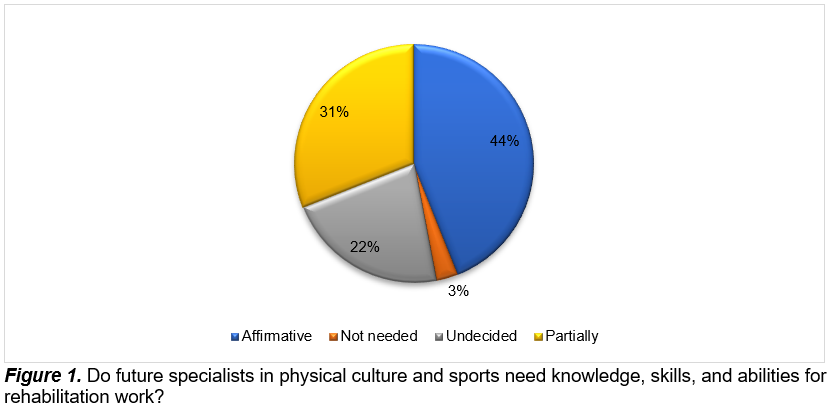
At the ascertaining stage, a questionnaire survey of higher education teachers was conducted. The responses of the surveyed teachers were analyzed to determine whether future specialists in physical culture and sports need knowledge, skills, and abilities for rehabilitation work during professional training in the field of developing and implementing physical rehabilitation programs for practical activities. Analysis of the teachers' responses showed that (Figure 1):
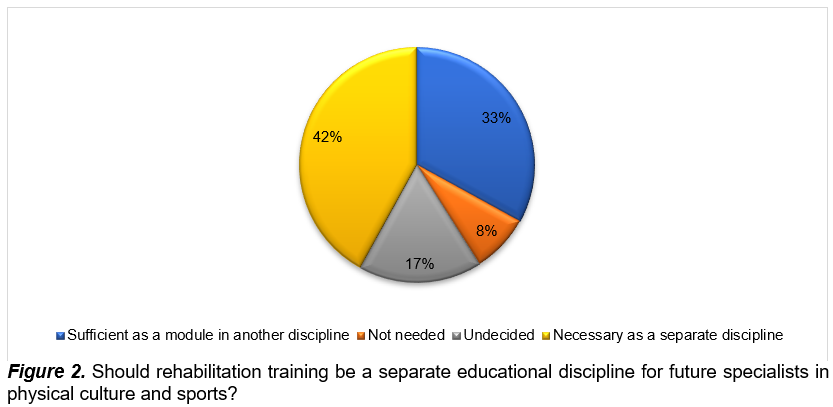
The next question in the questionnaire asks whether an educational professional program for training future specialists in physical culture and sports for rehabilitation work should be a special educational discipline that develops practical skills in students in rehabilitation work. The answers of the teachers showed (Figure 2):
The next question, “Would you undertake to teach such an educational discipline for the high-quality training of future specialists in physical culture and sports for rehabilitation work?” showed the results of the answers, which allowed us to understand to what extent the teachers have the necessary knowledge to teach such a discipline (Figure 3):
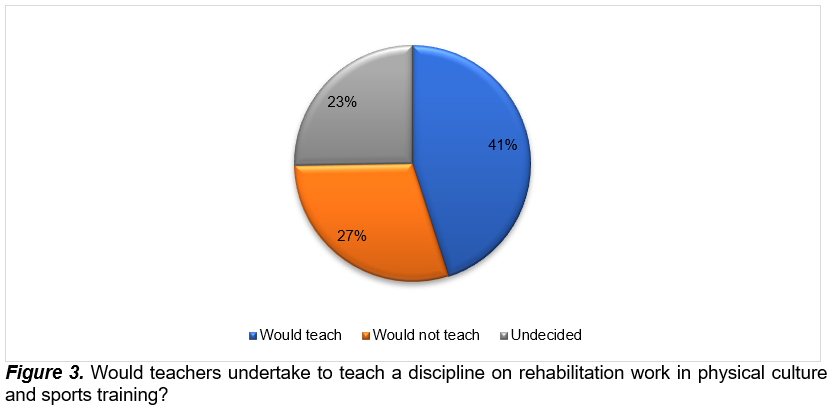
Thus, it was found that teachers disagree on how to organize a high-quality professional training process, and the process of developing the readiness of future physical education and sports specialists for rehabilitation work has not acquired a systematic, holistic character in modern professional training.
During the study, during the interviews, it was found out that the teachers of the higher school confirmed the necessity and expediency of increasing the efficiency of professional training of future specialists in physical culture and sports for rehabilitation work in the process of professional training by implementing certain pedagogical productive conditions based on modern methods and technologies and which will ensure the formation of the studied readiness of specialists.
Two hundred ten students of the higher school participated in the experimental work as part of their professional training. The EG consisted of 108 students, the CG – 102 students.
The results of the process of ascertaining the cross-section of the CG and EG students indicate that they were generally characterized by a lack of clear ideas about rehabilitation work, its forms and possibilities, and an unformed, positive attitude towards it. A low level of readiness was observed among the majority of students in this direction of work.
The results of the diagnostic ascertaining experiment proved that the initial level of preparation for physical rehabilitation of future specialists of the EG and CG is characterized by the same parameters and requires purposeful activity to improve rehabilitation work.
Thus, the students who participated in the ascertaining experiment demonstrated the following levels of readiness (Figure 4):
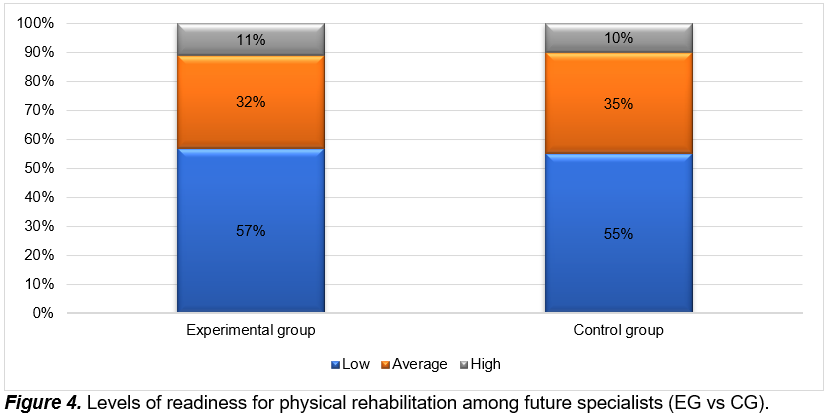
Thus, more than half of the EG and CG students demonstrated insufficient mastery of the system of knowledge on health preservation and the basics of physical rehabilitation; insufficient familiarity with methods, technologies, and methods of individual rehabilitation; and insufficient familiarity with methods of organizing motor health and recreational activity.
At a high level, we see very low indicators in the tested students.
Such results are expected, since the process of preparing future specialists in physical culture and sports for rehabilitation work during professional training is implemented through certain pedagogical productive conditions based on modern methods and technologies, which will ensure the formation of the studied readiness of specialists in the future.
It was important at the ascertaining stage of the experiment to demonstrate the homogeneity of the selected groups (EG and CG), to assess the reliability of the results, and to determine whether the EG and CG belong to the same general population. In this regard, the results obtained were subjected to statistical processing. Using the Pearson criterion, the feasibility of the sample and its correctness were determined (in accordance with the three levels of readiness, an ordinal scale with L=3 gradations was applied; the sample size was more than 50).
In the process of the study, two hypotheses were put forward: null (H0) – the difference between the readiness to work, according to the null hypothesis, in CG and EG students is insignificant, that is, the sampling was carried out correctly, and alternative hypothesis (H1) – the difference between the levels of readiness, according to the alternative hypothesis, in CG and EG is significant.
Calculations were made in Microsoft Excel. According to the results of calculating the values of the Pearson χ2 criterion (empirical – 0.16 and critical – 7.81), and comparing them (i.e. 0.16 < 7.81, χ2emp < χ2crit), we can say that when determining the levels of readiness, the indicators of the ascertaining experiment in EG and CG students do not differ significantly, that is, we carried out the sampling correctly.
Thus, the results of the initial cut enabled determining the state of formation of the studied phenomenon in student groups at the beginning of the experiment. The results of the ascertaining stage of the study helped to outline the tactics for conducting the formative experiment.
The formative stage of the experiment involved the direct introduction of pedagogical conditions into the professional training of students to develop the readiness of future specialists in physical culture and sports for rehabilitation work when applying the structural-functional model in higher education. At the same time, qualitative and quantitative analyses of the research results were conducted using statistical methods, and the results of implementing the author's developed pedagogical conditions were analyzed. Thus, the formative stage aimed to study the dynamics of the studied readiness during the professional training of future specialists (specially organized) and the active formation of the studied components of readiness (motivational-value, informational-cognitive, self-educational-professional, operational-activity).
A set of pedagogical conditions for the formation of the studied readiness has been determined:
During the scientific search in the EG to improve the professional training of future specialists in physical culture and sports for rehabilitation work, the system of professional training was improved, which is characterized by a high density of innovative processes: in particular, these are research programs, combined clinical programs, training internships, interdisciplinary master's programs, etc.
The developed model of forming the readiness of future specialists in physical culture and sports for rehabilitation work is adapted to the real practice of higher education, namely: the purpose of the study, the implementation mechanisms of the set of pedagogical conditions, the current state of forming the readiness of future specialists in physical culture and sports for rehabilitation work are taken into account, diagnostic and methodological tools are highlighted.
The target block of the model substantiates the goal of ensuring positive dynamics in the levels of readiness of future specialists by implementing pedagogical conditions for developing their readiness in physical culture and sports for rehabilitation work.
The methodological block is represented by:
The components of professional training for future specialists are represented by the content blocks (functional, cognitive, technological, and activity components) of the developed special course.
The implementation block shows possible training formats (traditional, mixed, distance) for future specialists under pedagogical conditions.
The components of the readiness of future specialists, the criterion indicators of their manifestation are represented by the diagnostic block (motivational-value, informational-cognitive, self-educational-professional, operational-activity), and the levels of this readiness are high, average, and low.
The experimental verification of the effectiveness of the author's pedagogical conditions for developing the readiness of future specialists in physical culture and sports for rehabilitation work was carried out in accordance with a program designed based on the author's model.
Let us emphasize that the diagnostic toolkit used to identify the levels of the studied readiness remained the same throughout the entire experimental work, as did the quantitative composition of the participants.
At the formative experiment stage, we will present the results of the general level of readiness of future specialists in physical culture and sports for rehabilitation work (a generalized indicator).
Experimental groups.
Control groups.
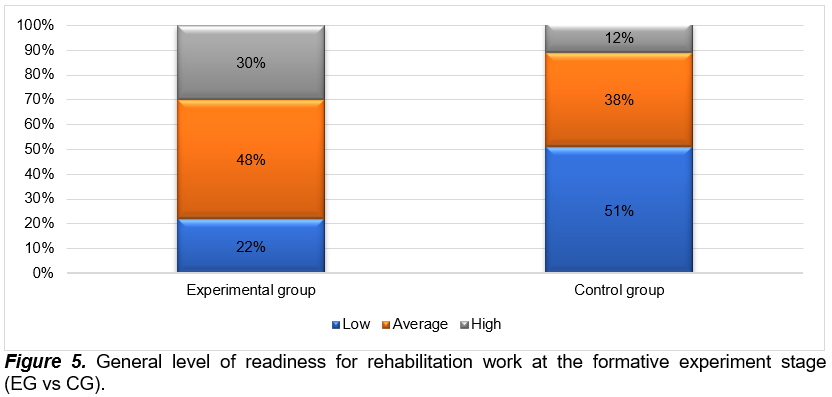
After conducting the formative experiment, a comparative analysis of the experimental data shows that positive dynamics were observed in the EG: we observe a significant increase in the number of respondents (by 16%) who are at a high level demonstrate depth, systematicity, completeness, flexibility, generalization, universality of knowledge on the basics of health preservation and physical rehabilitation, possess rehabilitation techniques and innovative technologies and methods; show efficiency in obtaining new knowledge; in the context of physical culture and sports rehabilitation demonstrate a wide range of ways to organize information activities, health and recreational activities, show interest in the problem of physical rehabilitation and show a positive attitude to work; creatively approach the implementation of the physical rehabilitation program, during health classes; possess methods of promoting a healthy lifestyle; show activity in acquiring knowledge.
The number of EG students who showed an average level of readiness for rehabilitation work increased by 16%.
We observe a 31% decrease in the number of EG students, many of whom have low readiness levels.
In the CG, we also note specific positive changes, but they are insignificant (an increase of 2% – high level; an increase of 3% – average level; low level – decreased by 5%) and did not affect the formation of the studied readiness, the general picture of the increase in the level.
The results obtained during the formative stage of the experiment were analyzed using the Pearson χ2 test. It was found that the representativeness of the student sample was ensured – the reliability of the experiment results (EG=103, CG=101), on which the reliability of the obtained experimental data and correctness depend.
Within the framework of statistical data processing, at the end of the formative stage of the study, two hypotheses were also formulated:
According to the results of calculations carried out in Microsoft Excel, the values of the Pearson criterion (empirical – 14.53 and critical – 7.81) are compared (14.53 > 7.81, i.e., χ2emp < χ2crit), and we conclude that the alternative hypothesis should be accepted and the null hypothesis rejected.
During the experiment, the dynamics of the indicators obtained for the general level of students' readiness for rehabilitation work in the EG indicate that the implemented model and the developed pedagogical conditions contribute to an increase in the level of readiness of future specialists in physical culture and sports for rehabilitation work.
Thus, the described quantitative and qualitative analysis of the results of the experiment showed positive dynamics in the levels of readiness of students in physical culture and sports for rehabilitation work after the implementation of pedagogical conditions and experimental training in the educational innovative environment of higher education in relation to the component specific structure of the studied readiness, their parameters of formation and criterion indicators, which occurred during the experimental testing of the developed model.
The analysis of the experiment's results confirmed the study's hypothesis: provided that a set of pedagogical conditions for the formation of the readiness of future specialists in physical culture and sports for rehabilitation work is implemented, positive dynamics can be achieved in the levels of the studied readiness.
The results of the chi-square analysis provide compelling evidence regarding the impact of the developed pedagogical conditions on the formation of readiness for rehabilitation work among future specialists in physical culture and sports. The interpretation of these findings gains deeper clarity when viewed through the lens of previous research and theoretical frameworks that have explored related constructs of professional readiness, competence development, and rehabilitation-oriented training.
The absence of statistically significant differences between the experimental (EG) and control (CG) groups at the ascertaining stage (χ² = 0.27, p = 0.874; Cramer's V = 0.036) confirms that both groups started from nearly identical initial conditions regarding their knowledge, motivation, and skills related to rehabilitation work. This equivalence is essential for validating the experiment’s internal reliability. It supports the idea expressed by Pereira et al. (2021) that students commonly begin rehabilitation-related coursework with fragmented or underdeveloped conceptions of therapeutic physical activity. Similar findings are reported by González Rosabal & Castillo Limonta (2016), who demonstrated that even practicing teachers often lack systematic understanding of rehabilitation methodologies, which leads to inconsistent professional practice.
This homogeneity at baseline highlights a broader systemic issue: higher education programs in physical culture and sports traditionally underemphasize rehabilitation competencies, resulting in insufficient readiness among students. The present study’s initial results confirm the patterns identified in the literature and emphasize the need for structural changes in curricula, which many scholars (e.g., Barotsis et al., 2024; Ceravolo et al., 2023) describe as urgent for aligning education with contemporary rehabilitation standards.
The statistically significant differences observed at the formative stage (χ² = 20.99, p < 0.001; Cramer's V = 0.320) reflect a substantive shift in readiness levels in the EG compared to the CG. The medium-sized effect suggests that the pedagogical conditions implemented—updates to curricular content, an innovation-oriented special course, increased practical engagement, and use of interactive technologies—had a meaningful influence on students’ readiness.
This aligns closely with the conclusions of Leochico et al. (2024), who argued that modern rehabilitation training must incorporate technology, multidimensional learning environments, and clinical simulations to produce measurable gains in competence. Similarly, Cordovi Naranjo et al. (2025) emphasize the efficacy of integrated physical culture and therapeutic approaches in strengthening students’ understanding of rehabilitation mechanisms. The increase in high readiness levels among EG students indicates that the intervention not only improved knowledge acquisition but also enhanced motivational and operational components, echoing the competency-based transformations described by Steinmetz et al. (2024).
However, despite the substantial improvement, it is important to recognize that the intervention did not eliminate all deficits. For instance, while high readiness increased significantly, a notable share of EG students remained at the medium level, suggesting that some components of readiness—such as independent decision-making in rehabilitation or advanced diagnostic judgment—may require longer-term or more intensive pedagogical strategies. This echoes Janssen et al. (2022), who argue that rehabilitation competence arises from complex interaction between theoretical knowledge and supervised clinical practice and cannot be achieved solely through short-term curricular modifications.
From a critical standpoint, the results highlight several important issues:
The limits of traditional training models
The control group’s lack of substantial improvement reinforces the critique of traditional physical education curricula as insufficiently responsive to the realities of modern rehabilitation contexts. This supports earlier findings by Morcillo-Valencia et al. (2025), who noted that educators often lack preparation for inclusive and rehabilitation-oriented environments, which limits students’ ability to transfer theoretical knowledge into practice.
The pedagogical conditions appear to address multidimensional readiness
The medium effect size illustrates that readiness is not a singular construct. Instead, it requires coordinated development across motivational, cognitive, self-educational, and operational domains. This multidimensionality reflects theories advanced by Martínez et al. (2022) and León Reyes et al. (2025), who argue that competence formation in rehabilitation requires both internal (motivation, self-awareness) and external (content, practice, environment) drivers.
Gaps remain in long-term sustainability of competence
While the study demonstrates short-term success, the literature warns that readiness tends to regress without continuous professional development (Bell Kindelán et al., 2025). Future research should therefore incorporate longitudinal tracking to assess the durability of the pedagogical effects.
Contextual factors must not be overlooked
Cultural, institutional, and infrastructural factors—such as access to rehabilitation facilities, equipment, and qualified instructors—may have amplified the intervention’s effect. As identified by Zampolini et al. (2022), systemic support structures are essential for the effective formation of rehabilitation professionals. The present results should therefore be interpreted within the specific educational context in which the model was implemented.
Conclusions
The problem's relevance is demonstrated, and the main approaches to the professional training of future specialists in physical culture and sports for rehabilitation work (rehabilitation, humanistic, physical culture and health, competency-based) are clarified. The design of the educational and professional environment for the training of future specialists in physical culture and sports for rehabilitation work is considered. The orientation of future specialists in physical culture and sports toward rehabilitation work is shown.
The purpose of the experimental work: experimental verification of the effectiveness of pedagogical conditions for the formation of the readiness of future specialists in physical culture and sports for rehabilitation work in the process of professional training.
Working hypothesis of the experimental work: subject to the implementation of elaborated pedagogical conditions for the formation of the readiness of future specialists in physical culture and sports for rehabilitation work in professional training, positive dynamics in the levels of the studied readiness can be achieved.
Experimental work was carried out in three stages: preparatory, ascertaining, and formative.
During the study, during the interviews, it was found out that the teachers of the higher school confirmed the necessity and expediency of increasing the efficiency of professional training of future specialists in physical culture and sports for rehabilitation work in the process of professional training by implementing certain pedagogical productive conditions based on modern methods and technologies and which will ensure the formation of the studied readiness of specialists.
The results of the process of ascertaining the cross-section of students of the CG and EG indicate that they were generally characterized by a lack of clear ideas about rehabilitation work, its forms and possibilities, and an unformed, positive attitude towards it. A low level of readiness was observed among most students in this area of work.
The results of the diagnostic experiment showed that the initial level of preparation for physical rehabilitation among future specialists of EG and CG is similar across these groups and requires targeted activities to improve rehabilitation work.
The formative stage of the experiment involved the direct introduction of pedagogical conditions into the professional training of students to develop the readiness of future specialists in physical culture and sports for rehabilitation work when applying the structural-functional model in higher education.
After conducting the formative experiment, a comparative analysis of the experimental data shows that positive dynamics were observed in EG: we observe a significant increase in the number of respondents (by 16%) who are at a high level. The number of EG students who showed an average level of readiness for rehabilitation work increased by 16%.
We observe a 31% decrease in the number of EG students with low readiness levels.
In the CG, we also note specific positive changes, but they are insignificant (an increase of 2% – high level; an increase of 3% – average level; low level – decreased by 5%) and did not affect the formation of the studied readiness, the general picture of the level increase.
During the experiment, the dynamics of the indicators obtained for the general level of students' readiness for rehabilitation work in the EG indicate that the implemented model and the developed pedagogical conditions contribute to an increase in the level of readiness of future specialists in physical culture and sports for rehabilitation work.
The analysis of the experiment's results confirmed the study's hypothesis. We see the prospect of further scientific research into advanced foreign experience in the professional training of future specialists in physical culture and sports for rehabilitation work, and its implementation in higher education practice.
Bibliographic references
Abreus Mora, J.L., González Curbelo, V.B., Mena Pérez, O., Abreus Vázquez, J.A., del Sol Santiago, F.J., & Bernal Valladares, E.J. (2022). Rehabilitación física y COVID-19. Universidad Y Sociedad, 14(S1), 172–183. https://rus.ucf.edu.cu/index.php/rus/article/view/2620
Barotsis, N., Oral, A., Zampolini, M., Janssen, W., Frischknecht, R., Tederko, P., & Ceravolo, M. G. (2024). Setting the European standards for training in physical and rehabilitation medicine. European Journal of Physical and Rehabilitation Medicine, 60(4), 552–555. https://doi.org/10.23736/S1973-9087.24.08577-0
Bell Kindelán, M., Robert Hechavarría, R. E., & Salfrán Vergara, C. M. (2025). Estrategia para formación continua a profesores de Escuela para Profesores de Educación Física (EPEF). Arrancada, 25(50), 26–36. https://revistarrancada.cujae.edu.cu/index.php/arrancada/article/view/721
Ceravolo, M. G., Gimigliano, F., & Lains, J. (2023). Editorial: Pursuing quality education in Physical and Rehabilitation Medicine. Frontiers in Rehabilitation Sciences, 4, 1242522. https://doi.org/10.3389/fresc.2023.1242522
Cordovi Naranjo, J. R., Castillo Limonta, S. M., & González Rosabal, J. L. (2025). La rehabilitación en el hogar desde la cultura física terapéutica en tiempos de pandemia COVID-19. Arrancada, 25(50), 191–197. https://revistarrancada.cujae.edu.cu/index.php/arrancada/article/view/740
Gao, S., Chen, J., Chen, X., Uchitel, J., Tang, C., Li, C., Pan, Y., & Zhao, H. (2024). Temporal dynamics and physical priori multimodal network for rehabilitation physical training evaluation. IEEE Journal of Biomedical and Health Informatics, 28(9), 5613–5623. https://doi.org/10.1109/JBHI.2024.3414291
González Rosabal, J. L., & Castillo Limonta, S. M. (2016). Diagnóstico de necesidades de superación de profesores para la rehabilitación física de las personas obesas. Arrancada, 15(28), 21–32. https://revistarrancada.cujae.edu.cu/index.php/arrancada/article/view/3-28
Janssen, H., Bird, M.-L., Luker, J., Sellar, B., Berndt, A., Ashby, S., McCluskey, A., Ada, L., Blennerhassett, J., & Bernhardt, J. (2022). Impairments, and physical design and culture of a rehabilitation unit influence stroke survivor activity: Qualitative analysis of rehabilitation staff perceptions. Disability and Rehabilitation, 44(26), 8436–8441. https://doi.org/10.1080/09638288.2021.2019840
Joseph, J. (2015). Physical Culture and Alternative Rehabilitation: Qualitative Insights from a Martial Arts Intervention Program. In J. Joseph & W. Crichlow (Eds.), Alternative Offender Rehabilitation and Social Justice: Arts and Physical Engagement in Criminal Justice and Community Settings (pp. 55–77). Palgrave Macmillan. https://doi.org/10.1057/9781137476821_4
Leochico, C. F. D., Carlos, F. A. B., Supnet, I. E., Tiangco, A. C. S. A., Rey-Matias, R. R., Ignacio, S. D., & Mojica, J. A. P. (2024). Telerehabilitation as a teaching-learning tool in physical medicine and rehabilitation residency training in the Philippines. Rehabilitation Research, Policy, and Education, 38(1), 18–30. https://doi.org/10.1891/RE-24-01
León Reyes, B. B., Tenorio Sánchez, R. A., Aguinda Cajape, V. A., Montes Reyna, W. E., & Olivo Solis, J. E. (2025). Comparación de la actividad y el autoconcepto físicos en estudiantes universitarios ecuatorianos. Arrancada, 25(50), 152–159. https://revistarrancada.cujae.edu.cu/index.php/arrancada/article/view/736
Martínez, C. I., Sanchez, A. N., Knecht, K., Frontera, J., Escalon, M. X., Verduzco-Gutierrez, M., & Lee, M. Y. (2022). Training characteristics, academic accomplishments, and motivation of current chairs in physical medicine and rehabilitation. American Journal of Physical Medicine & Rehabilitation, 101(7, Suppl. 1), S62–S70. https://doi.org/10.1097/PHM.0000000000001858
Morcillo-Valencia, R. J., García Caicedo, V. V., Falcones Barbosa, E. del R., & Medina Quiñonez, J. E. (2025). La inclusión educativa en la educación física. Arrancada, 25(50), 80–88. https://revistarrancada.cujae.edu.cu/index.php/arrancada/article/view/727
Neira-Tovar, L., & Castilla Rodriguez, I. (2018). The use of virtual and augmented reality to prevent the physical effects caused by diabetes mellitus type 2: An integrative review. In J. Chen & G. Fragomeni (Eds.), Virtual, augmented and mixed reality: Applications in health, cultural heritage, and industry (Lecture Notes in Computer Science, Vol. 10910). Springer. https://doi.org/10.1007/978-3-319-91584-5_11
Pereira, S. N., Alarcon, M. F. S., Selleti, J. D. D., & Marin, M. J. S. (2021). Experiencing the education process in physical rehabilitation. Revista da Escola de Enfermagem da USP, 55, e20210256. https://doi.org/10.1590/1980-220X-REEUSP-2021-0256
Reyes-Díaz, J. C., Ávila-Mojena, D., & Reyes-Guerra, R. (2023). Rehabilitación multidimensional para un caso con secuelas de ictus hemorrágico desde la Cultura Física terapéutica. Arrancada, 23(46), 84–109. https://dialnet.unirioja.es/servlet/articulo?codigo=9948254
Selb, M., Zampolini, M., Barotsis, N., Oral, A., & Stucki, G.; & UEMS-PRM Section and Board. (2024). The standards and tools of the European Union of Medical Specialists Physical and Rehabilitation Medicine Section and Board for rehabilitation management and care: An evidence brief for rehabilitation practitioners. European Journal of Physical and Rehabilitation Medicine, 60(5), 729–736. https://doi.org/10.23736/S1973-9087.24.08653-2
Steinmetz, A., Vinzelberg, S., & Emmerich, J. (2024). Manual medicine in the discipline of physical medicine and rehabilitation — medical degree and specialist training. Manuelle Medizin, 62(2, SI), 73–78. https://doi.org/10.1007/s00337-024-01050-4
Zampolini, M., Selb, M., Boldrini, P., Branco, C. A., Golyk, V., Hu, X., Kiekens, C., Negrini, S., Nulle, A., Oral, A., Sgantzos, M., Shmonin, A., Treger, I., Stucki, G., & UEMS-PRM Section and Board. (2022). The Individual Rehabilitation Project as the core of person-centred rehabilitation: the Physical and Rehabilitation Medicine Section and Board of the European Union of Medical Specialists Framework for Rehabilitation in Europe. European Journal of Physical and Rehabilitation Medicine, 58(4), 503–510. https://doi.org/10.23736/S1973-9087.22.07402-0

Este artículo no presenta ningún conflicto de intereses. Este artículo está bajo la licencia Creative Commons Atribución 4.0 Internacional (CC BY 4.0). Se permite la reproducción, distribución y comunicación pública de la obra, así como la creación de obras derivadas, siempre que se cite la fuente original.