
DOI: https://doi.org/10.46502/issn.1856-7576/2025.19.04.14
Eduweb, 2025, octubre-diciembre, v.19, n.4. ISSN: 1856-7576
Cómo citar:
Tian, L., Funtikova, O., Shumska, O., Horodyska, V., & Vdovych, S. (2025). Formation of aesthetic culture of future educators in preschool and primary educational institutions. Revista Eduweb, 19(4), 244-258. https://doi.org/10.46502/issn.1856-7576/2025.19.04.14
Formación de la cultura estética de los futuros educadores en instituciones de educación preescolar y primaria
Lin Tian
Doctor of Philosophy in Musical Art, Teacher at the Faculty of Early Education, Guangdong Baiyun University, Guangzhou, China.
https://orcid.org/0009-0009-3661-4569
Olga Funtikova
Doctor of Pedagogical Sciences, Professor, Department of Preschool Education, Faculty of Psychology and Pedagogy, Mariupol State University, Kyiv, Ukraine.
https://orcid.org/0000-0003-4183-3263
Olha Shumska
Candidate of Pedagogical Sciences, Associate Professor, Department of Piano, Faculty of Physical Education and Arts, Kharkiv Humanitarian-Pedagogical Academy, Kharkiv, Ukraine.
https://orcid.org/0000-0002-5422-8663
Violetta Horodyska
Candidate of Pedagogical Sciences, Associate Professor, Department of General Pedagogy and Preschool Education, Faculty of History, Pedagogy and Psychology, Ivan Franko Drohobych State Pedagogical University, Ukraine.
https://orcid.org/0000-0002-2415-4317
Svitlana Vdovych
PhD (Pedagogy), Associate Professor, Lviv State University of Life Safety, Senior Researcher, Private Scientific Institution «Ukrainian Research Institute of Educational Consulting», Lviv, Ukraine.
https://orcid.org/0000-0003-3582-4395
Recibido: 01/07/25
Aceptado: 27/08/25
Abstract
The purpose of the study is to analyze the characteristics that shape the aesthetic culture of future teachers in preschool and primary education institutions, and to examine the pedagogical conditions that will contribute to their effective development. The study was mixed in nature and consisted of three stages: ascertaining, formative, and concluding. The results show that Ukrainian students obtained better results in value orientation: attitude towards art, aesthetic interests, and attitudes (the role of art in students' lives and their participation in artistic events). Chinese students were better in knowledge and creative activity. The strongest predictors of the development of aesthetic culture were determined to be knowledge (β=0.38), creative activity (β=0.41). Self-esteem (β = 0.29) and participation in cultural events had a somewhat smaller impact. Comparison of the obtained results indicated a statistically significant increase in all components of aesthetic culture, particularly in the greatest achievements in individual knowledge and creative activity. The study confirmed the effectiveness of targeted pedagogical interventions, in particular the integration of art into the educational process, the implementation of projects, and the participation of students in cultural events. The conclusions indicate a need to improve educational programs for the training of teachers in preschool and primary schools.
Keywords: Aesthetic culture, creative activity, pedagogical conditions, preschool and primary education, teacher training.
Resumen
El objetivo del estudio es analizar las principales características de la formación de la cultura estética en futuros docentes de educación preescolar y primaria, y estudiar las condiciones pedagógicas que contribuirán a su desarrollo efectivo. Metodológicamente, el estudio tuvo una naturaleza mixta y constó de tres etapas: constatación, formación y conclusión. Los resultados muestran que los estudiantes ucranianos obtuvieron mejores resultados en la orientación de valores: actitud hacia el arte, intereses y actitudes estéticas (el papel del arte en la vida de los estudiantes y su participación en eventos artísticos). Los estudiantes chinos obtuvieron mejores resultados en conocimiento y actividad creativa. Los predictores más sólidos del desarrollo de la cultura estética fueron el conocimiento (β = 0,38) y la actividad creativa (β = 0,41). La autoestima (β = 0,29) y la participación en eventos culturales tuvieron un impacto ligeramente menor. La comparación de los resultados obtenidos indicó un aumento estadísticamente significativo en todos los componentes de la cultura estética, en particular, con los mayores logros en conocimiento individual y actividad creativa. Las conclusiones confirmaron la eficacia de las intervenciones pedagógicas específicas, en particular la integración del arte en el proceso educativo, la implementación de proyectos creativos y la participación del alumnado en eventos culturales.
Palabras clave: Cultura estética, actividad creativa, condiciones pedagógicas, educación infantil y primaria, formación del profesorado.
Introduction
The current education system in Ukraine is undergoing active transformations aimed at developing and forming harmonious, spiritually evolved, and creative personalities. Aesthetic culture plays a crucial role in this system, determining a person's ability to perceive and create beauty, shaping value orientations and contributing to the development of emotional and imaginative thinking. The problem of forming aesthetic culture is particularly relevant in the professional training of future teachers of preschool and primary educational institutions, since they lay the first foundations for children's aesthetic perception of the world.
However, despite the growing attention to issues in artistic and aesthetic education, there are several contradictions in the training of teaching staff. In particular, there is a dilemma between society's need for teachers who can organise a culturally rich and aesthetically enriched environment and the actual level of their aesthetic training. In addition, there are discrepancies between modern educational standards and the insufficient number of methodological developments aimed at fostering aesthetic culture. As a result, graduates of pedagogical universities are not always ready to effectively implement aesthetic education in the practice of preschool and primary education (Yang et al., 2025). There are not many special studies on the peculiarities of the development of aesthetic culture in future teachers (Gómez García, 2021). Previous scientific work has mostly focused on the aesthetic education of children and the role of art in personality formation, but there is a lack of systematic, practice-oriented studies specifically aimed at future educators (Concha-Díaz et al., 2024). The real level of aesthetic culture among students of pedagogical specialities and the role of methods for integrating artistic disciplines into professional training remain insufficiently studied (Escalona Vázquez et al., 2025). Hence, despite the existing theoretical results in the field of art and aesthetic education, a key scientific problem remains unresolved - the lack of a systematic and empirically confirmed understanding of the level of aesthetic culture of future teachers and the pedagogical conditions that influence its formation (Diachenko et al., 2022). In particular, it has been proven that today there are no agreed-upon approaches to assessing students' aesthetic culture, as well as no clearly defined criteria, methods, and educational practices that would effectively integrate artistic disciplines into the professional training of future educators and primary school teachers (Turabay et al., 2023).
Moreover, analysis of modern research has shown that scientific attention has been focused mainly on the aesthetic education of children and the influence of art on the development of personality, however, the issues of the formation of aesthetic culture of future teachers remain incompletely studied. Existing works have not proposed holistic models for assessing the aesthetic culture of students. There is also a lack of empirical data on its real level. Thus, the scientific gap lies in the lack of systematic, evidence-based and practice-oriented research on the formation of aesthetic culture of future educators and primary school teachers. Thus, the study will fill an important scientific and practical gap and offer new approaches to teacher training. The novelty of the study involves conducting an empirical analysis of the level of aesthetic culture among future educators and identifying the pedagogical conditions that contribute to its development.
Previous studies indicate significant attention to the artistic and aesthetic education of children, however, the level of formation of the aesthetic culture of future teachers, as well as the pedagogical conditions that determine its development, remain insufficiently studied. There are no agreed approaches to assessing the aesthetic culture of students, clear criteria and valid methods of its diagnosis, as well as practically oriented models of integrating artistic disciplines into the professional training of teachers. It is this uncertainty in the approaches and the lack of empirically substantiated data that form a key theoretical gap that requires systematic analysis.
The aim of this study is to identify the characteristics of aesthetic culture formation among future educators in preschool and primary educational institutions and to describe the main pedagogical conditions that contribute to its effective development.
Research objectives
In connection with the outlined contradictions, a key research question arises:
which components of the aesthetic culture of future teachers are the most important for its development and what pedagogical conditions ensure their effective formation?
An additional question is to identify differences in the formation of the aesthetic culture of students from different educational contexts (Ukraine - China) and the influence of pedagogical interventions on its dynamics.
This study focuses only on future teachers of preschool and primary education, however, the training of secondary and art school teachers is not considered. At the same time, the analysis covered aesthetic culture as an integral personal and professional component, which does not include detailed art historical characteristics of individual artistic disciplines. Therefore, the results obtained will be important for improving educational programmes for training future educators and primary school teachers.
Literature Review
Modern approaches to teacher training have identified aesthetic culture as an integral personal and professional component, which consists of a cognitive understanding of artistic phenomena, emotional and value sensitivity to beauty and the ability to apply aesthetic principles in pedagogical activity. Modern scientific works by Latin American authors also indicate that the aesthetic culture of a future teacher is an artistic competence and plays the role of an important core of pedagogical professionalism (Egana-delSol et al., 2019; Gonçalves, 2024). Other authors also indicate that it determines the ability to form a culturally enriched educational environment (Oliver-Barcelo et al., 2024).
Accordingly, according to other works, the features of the formation of aesthetic culture require a systematic combination of art history knowledge, personal artistic experience, and reflective practices (Egana-delSol, 2023). Others indicated that in teacher training, art-based methods that foster creativity, empathy, visual thinking, and the interpretation of cultural symbols are of great importance. A standard position unites all these theoretical approaches. In particular, the development of the aesthetic culture of future teachers is possible only under the conditions of a holistic educational model, which consists of the integration of artistic disciplines, the practice of immersion in the artistic environment, and pedagogical conditions that contribute to the formation of emotional and value sensitivity, creativity, and cultural competence. These provisions provided an essential theoretical basis for an empirical analysis aimed at determining students' level of aesthetic culture.
In recent years (2020–2025), there has been a noticeable increase in interest in the problems of aesthetic culture formation among future educators in scientific articles and monographs, especially when considering the contexts of preschool and primary education. Numerous publications by researchers from Latin America, Spain, and other countries highlight that aesthetic culture is not an auxiliary or optional element (Samaniego et al., 2024). It is clearly a key component of teachers' professional development. Aesthetic culture combines the development of artistic and creative abilities, sensitivity to the transformation of cultural codes, the ability to think critically, the ability to reflect on the artistic experiences of others, and the skillful integration of art into the educational process in educational institutions.
Contemporary publications have also demonstrated a range of distinct productive practices: the gradual integration of art and science, reflected in curricula (Hamilton et al., 2019; Berdichevsky et al., 2024). Researchers also highlight the importance of using workshops and art projects to prepare future teachers, emphasizing interdisciplinary approaches that combine artistic methods with aspects such as language learning, social sciences, or natural sciences (Barahona-Salgado & Torres, 2024). Positive results in research environments are associated with experiments with digital art and other multimedia tools, which became particularly relevant during the COVID-19 pandemic.
It is also important to highlight certain debatable aspects that can be traced in modern scientific publications. For example, there is no unity in terminology or specific conceptual approaches today: researchers use terms such as "aesthetic culture," "aesthetic competence," "art education," and "creative development" (Vera Noriega et al., 2024). These terms are considered interchangeable, which makes it difficult to compare results and develop unified standards.
Secondly, there is a noticeable gap between theory and practice. While students are usually introduced to the theoretical foundations of aesthetic education, the actual opportunities to use specific artistic methods in practice within the school environment are minimal. Researchers noted that mentors in schools and kindergartens often lack sufficient competence in this area themselves, which generally does not contribute to the effective acquisition of the necessary skills (Acosta Marroquín, 2020). There is certainly a problem of inequality in resource provision. The real financial limitations in many educational institutions in the Global South (Latin America, Ukraine, Asian countries) have led to a lack of material resources (workshops, tools, art supplies). Furthermore, artistic subjects are significantly inferior to disciplines that are focused on standard measurement of results.
Existing scientific research is largely based on primarily qualitative methods (interviews, observations, surveys) (García-Gómez, 2023). At the same time, some tools for measuring the level of aesthetic culture formation remain methodologically underdeveloped. Modern scientific research sometimes lacks large-scale and long-term studies that would allow us to determine how training will impact graduates' future professional work and individual child development outcomes (Muzyka et al., 2021). Individual political or administrative factors can primarily hinder the systemic implementation of aesthetic education. In many countries, state standards, the accreditation system, and external control prioritize academic results in mathematics and languages (the humanities component), while art and aesthetic practices are on the periphery of the learning process (Silva et al., 2018). Modern scholars also emphasized the importance of considering changes in cultural relevance. In a number of countries, models borrowed primarily from Europe or North America are prevalent, which do not always take into account certain local cultural traditions and artistic practices. This allows for a discussion about the decolonial approach and the importance of integrating local art forms and cultural practices into future teacher training (Escala et al., 2024).
Finally, the digitalization of education has opened up new possibilities for further combining multimedia and digital art practices (Anzules-Falcones et al., 2025; Godinez-Flores et al., 2025). However, the question remains open as to how capable they are of shaping the aesthetic sensitivity of future educators and how these results can be adequately assessed.
Therefore, an analysis of current research has allowed us to conclude that the challenge of shaping the aesthetic culture of future educators has reached a high level of scientific relevance, but will require the development of a systematic terminology, the formation of comprehensive training programs, and the creation of validated tools for assessment and consideration of local cultural characteristics. Future research should also focus on the problem of finding effective models for integrating art into the professional training of educators, which would combine global trends with the cultural uniqueness of the region.
Methodology
Researh design
The article uses a mixed methodological approach. The design of the study was quasi-experimental and was based on the pretest–posttest model without a control group. At the first stage, an input measurement (pretest) was carried out, after which an eight-week formative program was implemented, and at the final stage, an output measurement (posttest). Randomization of participants was not carried out, and therefore the design belongs to quasi-experimental according to the Campbell & Stanley classification.
The comparison of the results of the Ukrainian and Chinese samples did not serve as a control group, but had an analytical, cross-cultural nature, aimed at identifying differences in educational contexts. Both groups underwent the same measurement procedure but were not considered experimental and control in the strict sense. For this purpose, a sequential explanatory design was chosen, in which quantitative data were obtained at the first stage, and qualitative data were used to interpret and deepen the quantitative results. Integration was carried out based on 2 components:
Thus, the study had a mixed nature and consisted of ascertaining, formative, and concluding stages.
The ascertaining stage consisted of diagnosing the initial level of formation of the aesthetic culture of future educators.
The forming stage involved testing pedagogical conditions and methodological techniques aimed at developing the aesthetic culture of students.
The concluding stage consisted of a comparative analysis of the results and determining the effectiveness of the applied approaches.
An important point was that the study had a cross-cultural design. Thus, it was proposed to compare the levels and features of the formation of aesthetic culture in two different cultural and educational contexts - Ukrainian and Chinese.
Participations
The study involved 166 students of pedagogical specialties studying in higher education institutions in Ukraine and China. The sample was formed purposefully and taking into account the future professional activities of the participants in the field of preschool and primary education.
Thus, 135 students from Ukraine were selected, representing the specialties "Preschool Education" and "Primary Education". The sample included students of 2nd–4th years of pedagogical universities. The participants' age range was 18 to 22 years. At the time of the study, the students had theoretical training and initial experience of pedagogical practice in educational institutions.
31 students from China are future educators of preschool educational institutions. The participants' ages ranged from 18 to 23 years. The sample included students receiving professional training at a pedagogical university who are at the stage of developing basic pedagogical, cultural, and aesthetic competencies.
Despite the limited number of participants from China (N = 31), their inclusion in the study was methodologically justified and scientifically significant. It was the cross-cultural comparison that enabled identification of differences between educational systems. This made it possible not only to outline different emphases of aesthetic training and ensured the analyticality of the results. Thus, even a small Chinese sample enriched the study and confirmed its cross-cultural purpose. Hence, the total number of participants was 166 people.
The international composition of the sample made it possible to carry out analysis at such levels as: intra-national (analysis of the level of formation of aesthetic culture of students of pedagogical specialties in Ukraine) and intercultural (comparison with the experience of training).
The formative program lasted 8 weeks and included 16 training sessions. It consisted of the following modules: cognitive (short lecture blocks on aesthetics and art history), value (discussions, reflections, viewing works of art, analysis of emotions, values), activity (performing artistic and creative tasks, participating in cultural events, creating mini-projects). The implementation of the intervention was carried out by teachers and methodologists who were instructed in a single assessment algorithm.
Data collection process and instruments
Data collection was carried out in stages and in accordance with the characteristics of the sample and research objectives.
At the preparatory stage, research tools (questionnaires, questionnaires, test tasks, rating scales) were developed and adapted. Then, the questionnaires were translated and partially adapted into Ukrainian and English for participants from China, with subsequent verification of content compliance (translation and back-translation procedure). Then, the time, place and conditions of the study were agreed.
At the ascertaining stage, a questionnaire was administered to students to identify the level of aesthetic interests, attitudes towards art and cultural practices. Knowledge of art, aesthetic categories and cultural phenomena was also tested. In some cases, students' activities were observed during classes and creative tasks (participation in theatrical, musical or artistic events). At the same stage, self-assessment was carried out using a special scale (students determined their own level of aesthetic culture).
To ensure data quality, data were checked for omissions, anomalies, and logical consistency. Incomplete questionnaires (less than 70% of responses) were excluded from the final sample. Before combining the Ukrainian and Chinese samples, a translation equivalence test was performed using the back-translation procedure.
At the formative stage, pedagogical conditions aimed at the development of aesthetic culture were introduced (integration of artistic elements into educational activities, creative tasks, participation in cultural events). A series of seminars and practical classes were also held, aimed at activating students' emotional and value-based attitude towards art.
At the final stage, repeated questionnaires and testing of students from both samples were carried out. Teachers and methodologists evaluated the results of pedagogical tasks.
Instruments
The questionnaire "Aesthetic Interests and Cultural Practices" was used to identify involvement in artistic activities and attitude to art as a value.
Test on aesthetics and art (max. = 20 points). It consists of 20 tasks of different types (multiple choice, matching, definition of concepts, examples from art).
The assessment was as follows:
0–6 points - low level (fragmentary ideas),
7–13 points - medium level (basic, but without depth),
14–17 points - sufficient level (formation of concepts),
18–20 points - high level (ability to apply knowledge).
The self-assessment scale of aesthetic culture (1–5 points) was also used. Students assessed their own attitude to art, the level of aesthetic skills and the ability to creative self-expression.
The pedagogical observation map provided for the involvement of expert assessment (from 0–5 points).
Experts (teachers of artistic and pedagogical disciplines) recorded the following criteria:
cognitive activity (interest in art),
value-based attitude,
participation in creative tasks,
independent artistic initiative.
To compare the general level of aesthetic culture, an integral indicator was calculated (maximum = 20 points), which included weighted results:
Integral score was also expressed according to the scheme: Tknowledge+Sself-assessment+Pculture+Ccreativity
T–test scores (0–10, recalculated from 20),
S–self-assessment (0–5),
P–participation in cultural practices (0–3),
C–creative activity according to experts (0–5).
The validity and reliability of the instruments were verified. The validation of the instruments was implemented on the basis of the psychometric standards of AERA/APA. In particular, various types of validity were ensured. The substantive validity was ensured on the basis of expert assessment of the correspondence of the tasks to the research objectives. Thus, an expert group (5 teachers of pedagogical and artistic disciplines) checked the compliance of the content of the tasks with the objectives of the study, after which the instruments were adjusted. In addition, a preliminary factor analysis was conducted, which indicated the presence of three main components of aesthetic culture: cognitive, value and activity-creative. The linguistic validity was ensured using the translation-back translation procedure.
Construct validity involved a preliminary factor analysis. The reliability of the instruments was confirmed by the following indicators: test: KR–20 = 0.79; self-assessment scale: Cronbach’s α = 0.84; cultural practices questionnaire: α = 0.82; observation card: α = 0.86. All values exceed the recommended threshold of 0.70
This indicated consistency and validity.
Data Analysis
Descriptive statistics were used to analyze the data. In particular, at the initial stage, data processing was carried out using descriptive statistics methods: calculating the mean, median, standard deviation for the results of questionnaires, tests, observations and expert assessments. Participants were also classified according to the levels of aesthetic culture:
low - 0–6 points (according to the test),
average - 7–13 points,
sufficient - 14–17 points,
high - 18–20 points.
The average results of tests, self-assessment scales, questionnaires and expert assessments were compared.
The choice of statistical procedures was justified by the type of data and the research questions. The t-test for independent samples was used to compare the means in the two groups (Ukraine–China). This was chosen because the dependent variables are interval variables and the groups are independent.
Before applying the t-test, the assumptions of normality (Shapiro–Wilk, p > .05) and homogeneity of variances (Levene, p > .05) were tested.
Correlation analysis (Pearson r) was used for interval data; in the case of categorical or rank variables, Spearman ρ was used. For example, to identify relationships between different indicators of the level of aesthetic culture, the Pearson coefficient (r) was used for parametric data and the Spearman (ρ) for non-parametric data. The analysis was conducted using the following variables:
test results (knowledge of aesthetics and art);
self-assessment scale scores;
frequency of participation in cultural practices (according to questionnaires);
indicators of creative activity (according to observations);
expert assessments of teachers.
To determine the factors that most influence the level of aesthetic culture, multiple regression analysis was used.
Dependent variable: integral indicator of aesthetic culture (total result of the test, self-assessment, observations and expert assessments).
Independent variables (predictors):
level of knowledge (scores according to the test);
self-assessment of aesthetic culture (scale 1–5);
participation in cultural events (frequency, from 0 to 5 points);
creative activity (expert assessment 1–5 points).
Results and Discussion
The level of formation of aesthetic culture was assessed by 3 main components: cognitive (knowledge), value (attitudes, interests) and activity-creative (activity, skills). The results of the knowledge test, in which the maximum score is 20, showed that most students are at an average level of knowledge, however, in some cases Chinese students demonstrated a slightly higher average score and a larger proportion of participants with a high level (See Figure 1).
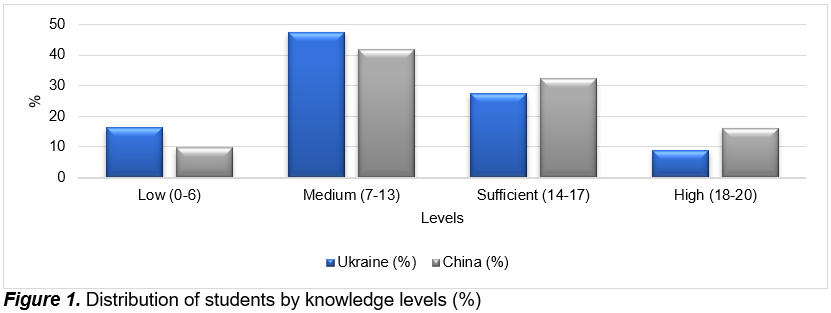
At the same time, most students defined their level as average or sufficient. On average, the grades ranged from 3.2 to 3.5 points. Table 1 presents the results of students' self-assessment.
Table 1.
Distribution of students by self-assessment of the level of aesthetic culture

The results of expert assessment (0–5 points for each criterion) showed that the highest indicators in both samples were demonstrated by students in the field of value attitude towards art (2.6 points in Ukraine and 2.8 points in China).
The lowest results were recorded in the category of creative activity (2.0 points in Ukraine and 2.4 points in China). This indicated insufficient implementation of the practical component of aesthetic culture.
According to the general integrated indicator, the groups scored from 9.1 to 10.2 points out of 20 possible. This is the average level.
The results of descriptive statistics indicated that Chinese students have higher results in knowledge of aesthetics and art (13.6 vs. 12.3), self-assessment of the level of aesthetic culture (3.5 vs. 3.2) and creative activity (2.4 vs. 2.0). This indicator was assessed by participation in creative tasks (0–5). At the same time, differences in the frequency of participation in cultural events are statistically insignificant (p=0.385). Thus, in the conditions of Chinese pedagogical education, more attention is paid to knowledge and practical activity, while in Ukraine, a value-based attitude dominates. (See Table 2).
Table 2.
Descriptive statistics of main variables

Correlations between indicators in a sample of students from Ukraine were established. The strongest relationship is observed between self-esteem and creative activity (r=0.62, p<0.01). Thus, the higher the level of awareness of one’s own aesthetic culture is associated with more active inclusion in creative activity. In addition, significant relationships were found between participation in cultural events and expert assessments (r=0.39, p<0.05). Thus, for Ukrainian students, the leading factor is the value-motivational sphere, and not just knowledge (see Table 3).
Table 3.
Correlation matrix (Ukraine)

In the Chinese sample, a different situation is noticeable. In particular, the main connection is formed between knowledge and self-assessment of aesthetic culture (r=0.58, p<0.01). In addition, knowledge is strongly correlated with expert assessments of teachers (r=0.55). Thus, according to these regressions, knowledge and creativity are the leading predictors. For these students, it is the cognitive component that is key in the formation of aesthetic culture, while creative activity (r=0.61 with expert assessments) plays a supporting, but also significant role (See Table 4).
Table 4.
Correlation matrix (China)

Data from multiple regression indicated that the greatest influence on the integral level of aesthetic culture is exerted by knowledge (β=0.38, p<0.01) and creative activity (β=0.41, p<0.01). Thus, according to these regressions, knowledge and creativity are the leading predictors. Self-esteem is also a significant factor (β=0.29, p<0.05), while participation in cultural events shows only a tendency to influence (p=0.060). Thus, cognitive and creative-activity factors are leading in the formation of students' aesthetic culture.
After using and implementing a pedagogical program aimed at developing students' aesthetic culture (integration of art elements into the curriculum, creative master classes, cultural events, reflective practices), significant positive changes were observed in the experimental groups compared to the control groups. Improvements were especially noticeable in the cognitive (knowledge) and activity-creative (creative activity) components, while the value component (attitude) also demonstrated stable positive dynamics (see Table 5). In particular, in Ukraine, the average score on the knowledge test increased from 12.3 to 14.0 (t=3.21; p<0.01), and on self-assessment – from 3.2 to 3.6 (t=2.89; p<0.01). An increase in the level of creative activity was also recorded from 2.0 to 2.5 points (t=3.11; p<0.01). The integral indicator increased from 9.1 to 11.2 (t=3.42; p<0.01). In the Chinese sample, the dynamics were similar: knowledge increased from 13.6 to 15.1 (t=2.68; p<0.05), self-esteem – from 3.5 to 3.9 (t=2.73; p<0.05), creative activity – from 2.4 to 2.9 (t=2.94; p<0.01), and the integral indicator – from 10.2 to 12.0 (t=3.02; p<0.01) (See Table 5).
Table 5.
Dynamics of students’ aesthetic culture (N=166)

The generalized results for the entire sample (N=166) indicated that after the implementation of the program, the average integral indicator of aesthetic culture increased from 9.3 to 11.4 points (p<0.01). Thus, this indicated the effectiveness of the development of special aesthetic-formative conditions regardless of the national sample. The greatest increase was recorded in the cognitive component (knowledge) and creative activity (See Figure 2).
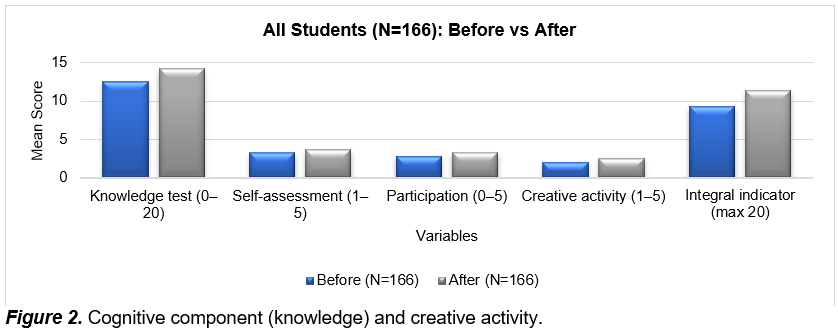
Thus, after the implementation of the aesthetic culture development program, positive dynamics were recorded for all key indicators. The largest increases were in the cognitive component (knowledge) and the activity-creative component (creative activity); value attitudes also increased, but more moderately. Comparatively, the average values of knowledge, self-esteem, and creative activity were somewhat higher in students from China than in the Ukrainian subsample, and the overall integral indicator also increased in both groups.
The fact of higher knowledge and the associated effects in the Chinese group resonates well with works on the role of aesthetic experience and aesthetic education in the professional development of Chinese teachers. Other authors have indicated that aesthetic experiences and experiences were correlated with professional growth and are supported by current state policies in the field of education in China (Sámuel et al., 2021; Casham et al., 2024).
The study proved the effectiveness of a structured framework for aesthetic education. The obtained before-and-after indicators of growth in knowledge, creativity, and communication skills are determined by recent empirical studies, which indicate an improvement in artistic perception, critical thinking, creativity, and educational communication of students (Heller, 2021; Aquino et al., 2021). This indirectly confirms that targeted curriculum interventions are effective.
In the Ukrainian education system, value-motivational spheres and innovations play an important role. This is also indicated in other works by European authors about the strong role of technology involvement (Aguirre-Canales et al., 2021). This study indicated a strong connection between self-esteem and creative activity in students from Ukraine. Such data are compared with the results of other authors who indicated the importance of creativity, aesthetic attitudes, and the introduction of innovative technologies in art education (Garcia‐Lazo et al., 2024; González-Zamar & Abad-Segura, 2021). This is noticeable in the indicators of increased involvement, motivation for learning, development of skills, and artistic self-expression) (Rios-Atehortua et al., 2024). Value orientation and innovative methods are critical conditions for the development of aesthetic culture (Hollingsworth et al., 2025).
In the scientific literature, which highlights the pedagogical conditions for the development of aesthetic/artistic experience in future teachers, the value of purposeful organization of artistic activity (vocal/performative practices), integration of disciplines, and reflective forms of assessment is also indicated (Oliver-Barcelo et al., 2024; Penteado et al., 2025; Kurebay et al., 2023). All these factors were used in this research program. Thus, the results obtained are in good agreement with international works. In particular, it has been proven that structured, interdisciplinary, intercultural and reflective interventions consistently increase the indicators of aesthetic culture of future teachers (Medeiros & Ferreira, 2024; Seitenova et al., 2023). In a theoretical sense, the obtained results supported the model of aesthetic culture as an integral quality with three interconnected components (cognitive, value, activity-creative) and showed that strengthening one (knowledge) works best in conjunction with another (creative practice) (Muñoz-Salinas et al., 2025; Bacca Pachón et al., 2021).
However, the study has certain limitations. First, the sample was uneven and non-random: the Ukrainian group (N = 135) significantly outnumbered the Chinese group (N = 31). Such an imbalance could affect the generalized statistical indicators and the strength of intergroup comparisons.
Second, some of the indicators were based on self-assessment. This, in turn, may contain the effects of socially desirable responses. In addition, the recruitment took place on a target sample of future teachers, and not on a representative sample of general student youth. Therefore, the results cannot be fully extrapolated to the entire population of students in Ukraine and China.
At the same time, these limitations open up prospects for further scientific exploration. In particular, it is advisable to: apply experimental or quasi-experimental designs with control groups. In the future, it is proposed to expand the range of variables and include digital and multimedia aesthetic practices that are relevant in the context of digitalization of education. It is also worth conducting long-term studies to identify the sustainability of the effects obtained after pedagogical interventions.However, despite the results obtained, the study has certain limitations. First, these are unequal and non-random subsamples. The ratio of 135 (Ukraine) to 31 (China) may affect the overall estimates and the power of statistical tests between countries. It is also worth considering that some of the variables (self-esteem, participation in activities) are self-reported, so the answers may be overestimated or underestimated.
This opens up new avenues for further research. In particular, it is worth conducting an experimental or quasi-experimental design with control groups (or rotational implementation). It is also important to expand the variables, in particular to include digital/multimedia practices and their relationship to aesthetic culture.
Conclusions
Thus, most students were at an average or sufficient level of aesthetic culture formation. Ukrainian students showed higher results in value attitudes, while Chinese students showed higher results in knowledge and creative activity. This indicated the existence of different accents in educational systems: in Ukraine - humanistic and value orientation, in China - cognitive and activity.
The most significant predictors of the development of aesthetic culture were knowledge (β=0.38) and creative activity (β=0.41). Self-esteem (β=0.29) and participation in cultural events had a significant, but somewhat weaker influence (p≈0.06). Comparison of results before and after the program showed a statistically significant increase in all components of aesthetic culture. The greatest gains were recorded in knowledge and creative activity; value orientations also improved. This confirms that targeted pedagogical interventions (integration of art into the educational process, creative projects, cultural events) are effective for training future teachers. Ukrainian students demonstrated an advantage in their value attitude towards art, while Chinese students had higher indicators of knowledge and creative activity.
Future research directions include expanding the sample and involving more students from different universities and countries to increase the external validity of the results. It is also worth conducting long-term studies and: tracking changes in the dynamics of aesthetic culture after several months/years to determine the stability of the effects.
Bibliographic references
Acosta Marroquín, N. P. (2020). Formación de maestros en educación infantil: revisión de tendencias investigativas. Pedagogía y Saberes, (53). https://doi.org/10.17227/pys.num53-10402
Aguirre-Canales, V. I., Gamarra-Vásquez, J. A., Lira-Seguín, N. A., & Carcausto, W. (2021). La formación continua de los docentes de educación básica infantil en américa latina: una revisión sistemática. Investigación Valdizana, 15(2), 101–111. https://doi.org/10.33554/riv.15.2.890
Anzules-Falcones, W., Martin-Castilla, J. I., & Tulcanaza-Prieto, A. B. (2025). Holistic Approach in Higher Education in Latin America to Adapt to New Social and Labor Needs: Challenges for Quality Assurance. Education Sciences, 15(8), 1035. https://doi.org/10.3390/educsci15081035
Aquino, O. F., Zuta, P. M., & Cao, E. R. (2021). Remote Teaching in Professor Training: Three Latin American Experiences in Times of COVID-19 Pandemic. Education Sciences, 11(12), 818. https://doi.org/10.3390/educsci11120818
Bacca Pachón, P. A., Rueda Rueda, E. V., Bacca Pachón, J. M., & Briceño, O. L. (2021). Formación docente: una mirada entre el arte y la tecnología. Praxis Educación y Pedagogía, (6). https://doi.org/10.25100/praxis_educacion.v0i6.10351
Barahona-Salgado, A., & Torres, L. P. (2024). La educación artística en programas de formación docente en Honduras. Revista Varela, 24(67), 33–40. https://doi.org/10.5281/zenodo.10429155
Berdichevsky, P., Mejía, S., & Welti, E. (2024). Art Education, Visual Culture, and Curriculum in South America and Argentina. In Curriculum, Culture, and Art Education, Second Edition (pp. 277–290). State University of New York Press. https://doi.org/10.2307/jj.18530819.21
Concha-Díaz, V., Bakieva Karimova, M., & Jornet Meliá, J. M. (2024). La formación inicial del profesorado de Educación y Atención de la Primera Infancia en América Latina y el Caribe. Revista Colombiana de Educación, (91), 239–265. https://doi.org/10.17227/rce.num91-16274
Diachenko, I., Kalishchuk, S., Zhylin, M., Kyyko, A., & Volkova, Y. (2022). Color education: A study on methods of influence on memory. Heliyon, 8(11), e11607. https://doi.org/10.1016/j.heliyon.2022.e11607
Egana-delSol, P., Contreras, D., & Valenzuela, J. P. (2019). The impact of art-education on human Capital: An empirical assessment of a youth orchestra. International Journal of Educational Development, 71, 102105. https://doi.org/10.1016/j.ijedudev.2019.102105
Egana-delSol, P. (2023). The impacts of a middle-school art-based program on academic achievements, creativity, and creative behaviors. npj Science of Learning, 8(1). https://doi.org/10.1038/s41539-023-00187-6
Escala, N., Ángel Herrera-Pavo, M., Guitert, M., & Romeu, T. (2024). Educational experiences integrating the arts into teaching practice in primary education in Ecuador. Thinking Skills and Creativity, 54, 101671. https://doi.org/10.1016/j.tsc.2024.101671
Escalona Vázquez, I. d. l. C., Sagarra Téllez, M., & Céspedes Quiala, A. (2025). El educador de la primera infancia en la formación lúdico-profesional. Prohominum, 7(2), 170–194. https://doi.org/10.47606/acven/ph0341
García-Gómez, S. (2023). Vivencias profesionales de docentes varones de educación inicial en América Latina. Estudios pedagógicos (Valdivia), 49(3), 207–222. https://doi.org/10.4067/s0718-07052023000400207
Garcia‐Lazo, V., Donoso, V., Springinzeisz, K., & Jeldres, R. (2024). The Potential of Visual Arts Education: Strengthening Pre‐Service Primary Teachers’ Cultural Identity. International Journal of Art & Design Education, 43(2), 221-240. https://doi.org/10.1111/jade.12499
Casham, S., Sheridan, L., & Agostinho, S. (2024). Artistry in teaching: A systematic literature review of the research spanning 50 years (1972–2022). Teaching and Teacher Education, 152, 104804. https://doi.org/10.1016/j.tate.2024.104804
Godinez-Flores, G. C., González-Peralta, M. F., & Olivares-Escorza, M. (2025). Towards an Educational Transformation Based on Digital Humanities. In Latin American Perspectives on Innovation in Higher Education (pp. 173–184). Switzerland: Springer Nature. https://doi.org/10.1007/978-3-031-96751-1_14
Gómez García, D. P. (2021). Sustainable Latin American Aesthetics. In Textile Science and Clothing Technology (pp. 131–159). Singapore: Springer. https://doi.org/10.1007/978-981-16-1850-5_7
Gonçalves, J. C. (2024). What Is (Not) Aesthetic Education? Bakhtiniana: Revista de Estudos do Discurso, 19(2). https://doi.org/10.1590/2176-4573e63561
González-Zamar, M.-D., & Abad-Segura, E. (2021). Emotional Creativity in Art Education: An Exploratory Analysis and Research Trends. International Journal of Environmental Research and Public Health, 18(12), 6209. https://doi.org/10.3390/ijerph18126209
Hamilton, A., Jin, Y., & Krieg, S. (2019). Early childhood arts curriculum: a cross-cultural study. Journal of Curriculum Studies, 51(5), 698–714. https://doi.org/10.1080/00220272.2019.1575984
Heller, A. (2021). The “Open Studio” Model in Educational Frameworks. In Integrating Arts Therapies into Education (pp. 111–127). Routledge. https://doi.org/10.4324/9781003008323-9
Hollingsworth, H. L., Burress, B., Carpenter, J. P., & Enfield, M. (2025). Preservice teachers and field experiences in education settings abroad: A scoping review of research 2014–2024. Teaching and Teacher Education, 165, 105119. https://doi.org/10.1016/j.tate.2025.105119
Kurebay, B., Saginovna, S. S., Khassanova, I., Kazetova, A., Bayukanskaya, S., & Mailybaeva, G. (2023). Competence of Primary School Teachers in the Use of Internet Resources. International Journal of Education in Mathematics, Science and Technology, 11(4), 964–980. https://doi.org/10.46328/ijemst.3466
Medeiros, J. d. L., & Ferreira, J. C. d. M. (2024). Early childhood education teacher training: Intercultural practices. In E-book without borders international research (pp. 56–58). Amplamente cursos e formação continuada. https://doi.org/10.47538/ac-2024.18-r14
Muñoz-Salinas, Y., Caro-Zúñiga, D., & Jeria, I. (2025). Creativity and Preservice Teachers: A Literature Review of an Underexplored Field (2014–2024). Education Sciences, 15(3), 395. https://doi.org/10.3390/educsci15030395
Muzyka, O., Lopatiuk, Y., Belinska, T., Belozerskaya, A., & Shvets, I. (2021). Modern aesthetic education and its further directions. Linguistics and Culture Review, 5(S4), 12–21. https://doi.org/10.37028/lingcure.v5nS4.1537
Penteado, A., Mello, G. F. d., & Coutinho, I. R. (2025). Ateliê pedagógico: Formação artística e sensível de futuros professores. Revista Apotheke, 11(1),m209–226. https://doi.org/10.5965/244712671112025209
Oliver-Barcelo, M., Ferrer-Ribot, M., & Jové, G. (2024). Arts education in early childhood teacher training: An international analysis. Teaching and Teacher Education, 148, 104703. https://doi.org/10.1016/j.tate.2024.104703
Rios-Atehortua, L. D., Torres-Valois, T., Solaz-Portolés, J. J., & Sanjosé, V. (2024). Pre-Service Science Teachers’ Beliefs About Creativity at School: A Study in the Hispanic Context. Education Sciences, 14(11), 1194. https://doi.org/10.3390/educsci14111194
Samaniego, M., Usca, N., Salguero, J., & Quevedo, W. (2024). Creative Thinking in Art and Design Education: A Systematic Review. Education Sciences, 14(2), 192. https://doi.org/10.3390/educsci14020192
Sámuel, M., Vanegas Muñoz, Y. M., & Giménez Rodríguez, J. (2021). Visualización y simetría en la formación de maestros de Educación Infantil. Edma 0-6: Educación Matemática en la Infancia, 5(1), 21–32. https://doi.org/10.24197/edmain.1.2016.21-32
Seitenova, S., Khassanova, I., Khabiyeva, D., Kazetova, A., Madenova, L., & Yerbolat, B. (2023). The Effect of STEM Practices on Teaching Speaking Skills in Language Lessons. International Journal of Education in Mathematics, Science and Technology, 11(2), 388–406. https://doi.org/10.46328/ijemst.3060
Silva, M. C. D. R. F. d., Alvarenga, V. M. d., & Bellan, C. C. (2018). Observatório da formação de professores de Artes Visuais: uma análise à luz das políticas vigentes. Revista GEARTE, 5(2). https://doi.org/10.22456/2357-9854.84680
Turabay, G., Mailybaeva, G., Seitenova, S., Meterbayeva, K., Duisenbayev, A., & Ismailova, G. (2023). Analysis of Intercultural Communication Competencies in Prospective Primary School Teachers' Use of Internet Technologies. International Journal of Education in Mathematics, Science and Technology, 11(6), 1537–1554. https://doi.org/10.46328/ijemst.3795
Vera Noriega, J. A., Rodríguez Carvajal, C. K., & Siles López, A. (2024). Formación docente en la educación artística: Un análisis de las prácticas docentes en la educación básica primaria en México. In Educación intercultural: visiones multidisciplinarias de investigaciones sociales en la UAIM (pp. 105–122). Astra Editorial. https://doi.org/10.61728/ae24002684
Yang, M., Zhang, J., Yahaya, W. A. J. W., & Yang, Y. (2025). Developing and implementing the four-dimensional aesthetic education framework in elementary education. Frontiers in Education, 10. https://www.frontiersin.org/journals/education/articles/10.3389/feduc.2025.1601869/full

Este artículo no presenta ningún conflicto de intereses. Este artículo está bajo la licencia Creative Commons Atribución 4.0 Internacional (CC BY 4.0). Se permite la reproducción, distribución y comunicación pública de la obra, así como la creación de obras derivadas, siempre que se cite la fuente original.