
Original Article
Eduweb, 2026, enero-marzo, v.20, n.1. ISSN: 1856-7576
Doi: https://doi.org/10.46502/issn.1856-7576/2026.20.01.7
El entorno educativo digital como predictor de la competencia inclusiva del futuro docente: un análisis de mediación
Olga Funtikova
Doctor of Pedagogical Sciences, Professor, Department of Preschool Education, Faculty of Psychology and Pedagogy, Mariupol State University, Kyiv, Ukraine.
https://orcid.org/0000-0003-4183-3263
Kateryna Kuznietsova
Candidate of Pedagogical Sciences, Associate Professor, Department of Pedagogy and Psychology of Preschool and Special Education, Faculty of Pedagogy, Psychology and Social Work, Yuriy Fedkovych Chernivtsi National University, Chernivtsi, Ukraine.
https://orcid.org/0000-0002-9744-0840
Yaryna Taniavska
Candidate of Pedagogical Sciences, Associate Professor, Department of Pedagogy and Psychology of Preschool and Special Education, Faculty of Pedagogy, Psychology and Social Work, Yuriy Fedkovych Chernivtsi National University, Chernivtsi, Ukraine.
https://orcid.org/0000-0003-4270-878X
Olha Hubar
Candidate of Pedagogical Sciences, Associate Professor, Head of the Department of Technologies of Correctional and Inclusive Education, Speech Therapy and Rehabilitation of the Educational and Scientific Institute of Special and Inclusive Education of the V.G. Korolenko Poltava National Pedagogical University, Poltava, Ukraine.
https://orcid.org/0000-0003-3640-1490
Anastasiia Poliakova
PhD in Botany, Senior Lecturer, Department of Theory and Methods of Teaching Natural Sciences, Faculty of Natural and Physical and Mathematical Education, Oleksandr Dovzhenko Hlukhiv National Pedagogical University, Hlukhiv, Ukraine.
https://orcid.org/0000-0003-0098-4313
Cómo citar:
Funtikova, O., Kuznietsova, K., Taniavska, Y., Hubar, O., & Poliakova, A. (2026). The digital educational environment as a predictor of future teachers' inclusive competence: A mediation analysis. Revista Eduweb, 20(1), 107-121. https://doi.org/10.46502/issn.1856-7576/2026.20.01.7
Recibido: 05/01/26 Aceptado: 25/02/26
Abstract
This study investigates the characteristics of the digital educational environment that influence the development of teachers' inclusive competence. Utilizing a quantitative, correlational-regression design with mediation analysis, the research involved 214 undergraduate students from pedagogical specialties in Ukraine. Standardized instruments based on DigCompEdu and UNESCO frameworks were employed to assess the digital environment's supportive potential and students' inclusive competence. Results indicate that participants possess an above-average level of inclusive competence, particularly in value-motivational aspects. Statistical analysis reveals that a supportive digital context (β = 0.36) and the accessibility of digital services (β = 0.24) are significant predictors of inclusive competence. Furthermore, mediation analysis confirms that the accessibility of digital services partially mediates the relationship between a supportive environment and inclusive competence (indirect effect = 0.16). The findings suggest that higher education institutions should prioritize creating supportive, accessible digital ecosystems to foster future teachers' readiness for inclusive education effectively.
Keywords: accessibility of digital services, digital educational environment, inclusive competence, professional competence of teachers, support.
Resumen
Este estudio investiga las características del entorno educativo digital que influyen en el desarrollo de la competencia inclusiva del profesorado. Utilizando un diseño cuantitativo de regresión correlacional con análisis de mediación, la investigación involucró a 214 estudiantes universitarios de especialidades pedagógicas en Ucrania. Se emplearon instrumentos estandarizados basados en los marcos DigCompEdu y UNESCO para evaluar el potencial de apoyo del entorno digital y la competencia inclusiva del alumnado. Los resultados indican que los participantes poseen un nivel de competencia inclusiva superior a la media, especialmente en aspectos de motivación de valores. El análisis estadístico revela que un contexto digital de apoyo (β = 0,36) y la accesibilidad a los servicios digitales (β = 0,24) son predictores significativos de la competencia inclusiva. Además, el análisis de mediación confirma que la accesibilidad a los servicios digitales media parcialmente la relación entre un entorno de apoyo y la competencia inclusiva (efecto indirecto = 0,16). Los hallazgos sugieren que las instituciones de educación superior deberían priorizar la creación de ecosistemas digitales de apoyo y accesibles para fomentar eficazmente la preparación del futuro profesorado para la educación inclusiva.
Palabras clave: accesibilidad de los servicios digitales, entorno educativo digital, competencia inclusiva, competencia profesional del profesorado, apoyo.
Introduction
In the current conditions of transformation in the field of education, digitalization has become an important factor. In fact, it has determined the possibilities of accessibility, equality and inclusion in the educational process. The digital educational environment was understood as a set of technological tools, which today has turned into a specific “ecosystem” that combines individualization of learning, adaptation of educational materials to the needs of different categories of education seekers, overcoming barriers that traditionally made access to quality education for education seekers with special needs more difficult. Despite significant progress in the development of inclusive education, modern scientific discussions emphasize that technological innovations are not fully integrated into the educational process. Under such circumstances, their impact on the real level of inclusion remains poorly studied.
The scientific problem underlying the proposed study is the insufficient theoretical and empirical substantiation of the role of the digital educational environment, which was a systemic factor in the development of inclusive education. In particular, some studies noted that digital tools were capable of ensuring the accessibility of educational content, supporting differentiation and adaptability of the educational process (Jones & Lomas, 2025; Rodríguez Zidán et al., 2025). However, the instruments of their influence on the structure and effectiveness of inclusive practices have been studied only fragmentarily (Zicari, 2022; Sharma & Sengupta, 2023). Under such circumstances, additional attention would be required to the issue of the readiness of all participants in the educational process (teachers, administrators, students and their parents) to use digital solutions in the context of deepening inclusive learning (Tomczyk et al., 2021). An analysis of the available scientific literature demonstrated the contradictions of conclusions regarding the extent to which digital environments actually expand the possibilities of inclusive interaction (Masoumi & Noroozi, 2023). There were also opposing assessments indicating the possibility of a negative impact of digitalization.
The study was aimed at determining the main characteristics of the digital educational environment that affect the development of inclusive competence of teachers.
RQ1. What is the level of inclusive competence of future teachers, and how much does it vary in its cognitive, value-motivational, and activity aspects?
RQ2. What characteristics of the digital educational environment are associated with the formation of students' inclusive competence?
RQ3. What elements of the digital educational environment are statistically significant predictors of inclusive competence of future teachers?
RQ4. Does the availability of digital services mediate the effect of a supportive environment on inclusive competence?
Literature Review
In modern studies, the digital educational environment is considered as an important factor in the development of teachers' professional competencies. Scientists have especially paid attention to the acquisition of inclusive competence (Göltl et al., 2024; Hurtado-Mazeyra et al., 2022). In particular, the analysis of reports by international organizations (UNESCO, ECLAC) emphasized that the digitalization of education has significantly expanded access to education for students with different needs (Wyss et al., 2022). However, this is only possible if teachers are sufficiently trained and there is a high-quality digital environment in educational institutions.
Studies that have been devoted to the characteristics of digital educational environments (for example, Moodle or other VLE) have shown that the accessibility of the platform, the structure of the materials provided, the use of multimedia and adaptive tools have influenced the engagement and success of students (Karakasidi et al., 2024). Accordingly, this is also relevant for students with special educational needs (Chiner et al., 2024). However, some researchers have emphasized that technology alone does not guarantee inclusion (Ghoneim et al., 2024). Teachers who are able to adapt digital content to modern pedagogy and choose appropriate support methods for students with disabilities will continue to play a crucial role. At the same time, it is worth noting that interest has grown in the concept of digital competence of teachers as a set of skills for working with digital resources, communication, content creation and organization of online learning. Such studies have shown the emergence of strong links between the level of digital competence and the readiness of teachers to work in an inclusive environment (Isoda et al., 2021). In particular, some studies have shown that teachers with higher digital literacy are more likely to use inclusive practices and have a more positive attitude towards working with different groups of students. This thesis has also been repeatedly confirmed in other scientific publications, which is an important component of the proposed study.
In Latin American countries, where digital inequality is more pronounced, studies have confirmed that the digital environment is adapted to support inclusion, creating solutions to overcome additional barriers (Navas-Bonilla et al., 2025; Reyes & Gurubel-Tec, 2024). Reports from international organizations have shown that the level of digital competence of teachers in different regions varies significantly (Vásquez et al., 2021; Sarubbi-Baltazar et al., 2025). For the South American region, this has affected the quality of work in virtual platforms and the ability to adapt learning to the needs of different learners. In particular, several empirical studies have found that participation in learning in a digital environment significantly contributed to the development of important skills in future teachers - interaction, reflection, emotional responsiveness - which were a key part of inclusive pedagogical practice (Salas-Pilco et al., 2022).
In conclusion, the analysis of the scientific literature showed that the digital educational environment contributed to the development of inclusive approaches, the role of the teacher was key, since it was she who determined whether the digital environment became accessible and flexible, the development of teachers' digital competence was directly related to their ability to implement inclusive practices (Valero-Tapia et al., 2024; Velandia Rodriguez et al., 2022). Therefore, these areas substantiated the relevance of studying the connection between the digital educational environment and the development of inclusive competence of teachers. At the same time, despite the proposed analysis of the digitalization of education and inclusive pedagogy, scientific research demonstrated the presence of several important research gaps. First of all, it is worth pointing out that the analysis of teachers' digital competence and inclusive practices separately, while the direct relationship between these two components has not been sufficiently studied. There is little research that addresses the digital educational environment as a factor in changing teachers’ inclusive competence. Another notable gap is the small number of proposed tools and methodologies that can be used to measure teachers’ inclusive competence when working in digital or blended learning formats.
Methodology
Research design
The study is based on a quantitative paradigm using correlational regression design and mediation analysis. The choice of this methodology is due to the aim of the work - to identify digital characteristics as predictors (prognostic factors) of inclusive competence. Theoretically, the work fits into the concept of a digital ecosystem of education, where technological tools are considered as a means of ensuring accessibility and individualization of learning. The study fills a scientific gap by connecting two previously separate areas: digital competence within the DigCompEdu framework and inclusive competence according to UNESCO standards.
The adapted instruments are structured according to international domains: environmental parameters (support, intensity, accessibility) and competence components (cognitive, value, activity).
The adapted instruments are structured according to international domains: environmental parameters (support, intensity, accessibility) and competence components (cognitive, value, activity).
Within the design, the features of the digital educational environment were assessed (independent variable): 1. availability of digital resources and services; 2. frequency and intensity of use of digital technologies in the educational process; 3. students' subjective perception of the supportive/inclusive nature of the digital environment.
The inclusive competence of future teachers was also assessed (dependent variable):
Participants
The participants were selected from higher pedagogical education institutions in Ukraine, which at the time of data collection were experiencing active digitalization and widespread implementation of inclusive education. All participants studied at higher pedagogical education institutions that used LMS platforms, distance and blended learning tools, and implemented educational components related to inclusive teacher training. This institutional context should be taken into account when interpreting and generalizing the results.
The study involved 214 students of pedagogical specialties who study educational programs of preschool and primary education, as well as special/inclusive education in higher education institutions of Ukraine.
Educational level of participants: 2–4 years of bachelor's degree (future educators of preschool education institutions, primary school teachers, teacher assistants / special educators).
Age was correlated in the range of mainly 18–23 years (average age about 20 years).
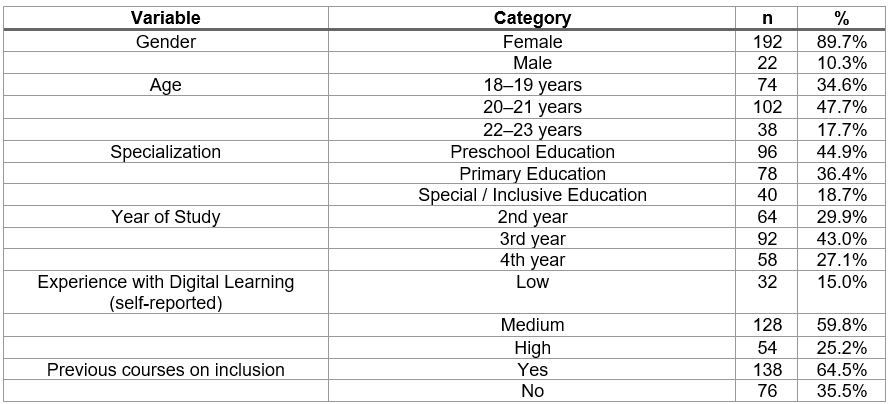
The study was dominated by women, which is typical for pedagogical institutions (See Table 1).
Table 1.
Characteristics of Study Participants (N = 214)
Inclusion criteria for the sample:
Participants were recruited based on the use of convenience sampling. The main link to the questionnaire was distributed through academic groups on social networks and e-mail of curators/teachers. Participants were informed about the objectives of the study, voluntary participation, anonymity and confidentiality of the data obtained.
Instruments
To determine the impact of the digital educational environment on the development of inclusive competence of future teachers, a set of standardized and adapted questionnaires was used. The instrument included two blocks: (1) scales measuring the parameters of the digital environment, and (2) scales of inclusive competence.
To assess the digital educational environment, an author-adapted instrument was used. This instrument was formed based on DigCompEdu components and modern models of the digital ecosystem in education. The scale consisted of three subscales:
Accessibility and functionality of digital services (Scale: 1–5; α = 0.79). The main examples of statements related to the following areas:
“The university LMS is convenient and easy to use.”
“Interactive tools (forum, chats, video conferences) work stably.”
The total scores made it possible to describe the level of development of the digital educational environment and its potential for the formation of students’ professional competencies.
The assessment of inclusive competence of future teachers was based on the use of a special questionnaire on inclusive competence, which was compiled on the basis of the UNESCO international framework and modern Ukrainian standards for professional training of teachers.
It included three interrelated subscales.
The main examples of statements related to the following areas:
The overall indicator of inclusive competence was calculated as the integral sum of the three subscales.
Data collection procedure
The instruments underwent a preliminary content validation procedure. In particular, the expert assessment was conducted by six specialists (with 8–20 years of experience) in the fields of pedagogy, inclusive education, and digital educational technologies. The experts assessed the relevance, clarity and compliance of the items with the research objectives on a 4-point scale.
Items with a compliance coefficient below 0.78 were revised or removed. Based on the results of the assessment, the wording of 7 items was clarified, and the final version of the instrument demonstrated an appropriate level of internal consistency (α = 0.79–0.88).
The data collection procedure was staged. At the first stage, students were provided with information about the purpose, methods and voluntariness of participation. At the same time, all participants confirmed their informed consent. At the next stage, an online survey was conducted. The questionnaire was created in Google Forms. The questionnaire included all the questionnaires mentioned above. The questionnaire took approximately 20–25 minutes to complete. Recruitment was carried out through academic groups, corporate email, and university learning platforms. All data were collected over 3 weeks until the required sample size (n = 214) was reached.
Data analysis
Data processing and analysis were carried out using SPSS 28 software. The analysis was carried out in several stages. In particular, the initial data processing was carried out first.
Before conducting statistical procedures, the following was performed:
checking for the presence of missing values and their correction (less than 2% of cases, filling in according to the average value of the corresponding scale). The homogeneity of variances was also checked using the Levene method. The next stage involved the use of descriptive statistics. In particular, for all main variables, the following were calculated:
mean value (M), standard deviation (SD), minimum and maximum, 95% confidence intervals. Pearson's coefficient (r) was used to establish relationships between the characteristics of the digital educational environment and the level of inclusive competence. The statistical significance level was set at p <0 .05. Regression analysis was also used.
The multiple linear regression model consisted of:
Dependent variable: 1. general indicator of inclusive competence (or separately - cognitive, motivational, activity components).
Independent variables: 1. supporting potential of the digital environment, 2. intensity of use of digital technologies, accessibility, 3. functionality of digital services.
Regression made it possible to indicate which aspects of the digital educational environment have the greatest influence on the formation of inclusive competence of students. The method of comparative analysis was also used. These methods made it possible to establish the level of inclusive competence in students with different experience of using digital technologies.
Results and Discussion
Results
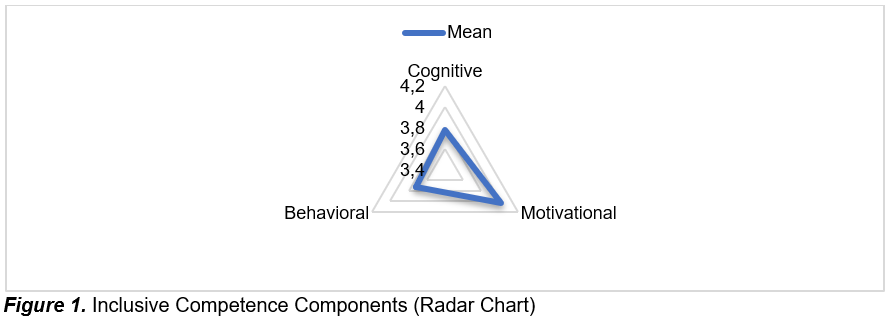
The analysis of descriptive statistics indicated the general level of inclusive competence of future teachers. The general integral indicator of inclusive competence demonstrated an above-average level of formation (M = 3.84; SD = 0.52). Therefore, there are sufficiently positive attitudes to promote inclusive competence.
The cognitive component, which indicated students' knowledge of the principles of inclusion, legislative norms and features of supporting children with special needs, had a moderately high level (M = 3.78; SD = 0.58). Therefore, students are generally well-versed in the theoretical aspects of inclusive education. The value-motivational block had the highest indicators among all subscales (M = 4.02; SD = 0.63). Students expressed a positive attitude towards inclusive education and recognized its necessity. The increased role of this aspect indicated a humanistic position and high internal motivation to support inclusive practices.
The activity aspect was the lowest among the three components (M = 3.72; SD = 0.54). Despite the positive results, it is the practical skills of students that need further development (See Figure 1).
An important direction of this research was to determine the characteristics of the digital educational environment that are associated with inclusive skills. For this purpose, a correlation analysis was carried out between the 3 components of the digital educational environment (supportive potential, intensity of use of digital technologies, availability of digital services) and the general level of inclusive competence of students. Accordingly, moderate and strong relationships were obtained between all characteristics of the digital educational environment and the level of inclusive competence of students. In particular, the strongest relationship was established between the support of the digital environment and general inclusive competence (r = 0.46, p < 0.001). Thus, students who studied in a more friendly and adaptive digital environment had a higher level of readiness for inclusive pedagogical activity (Kulichenko et al., 2018).
The second strongest relationship was between the availability of digital services or technologies and inclusive competence (r = 0.39, p < 0.001). Thus, the quality of the LMS, interactive platforms, and the ability to access materials for students with different needs improved the level of students’ professional skills.
The smallest, but still significant, relationship was between the intensity of use of digital technologies and inclusive competence (r = 0.28, p < 0.01). Thus, the frequency of use of digital tools is less important than their supportive and adaptive potential (See Table 2).
Table 2.
Correlation Matrix Between Digital Environment Characteristics and Inclusive Competence (N = 214)

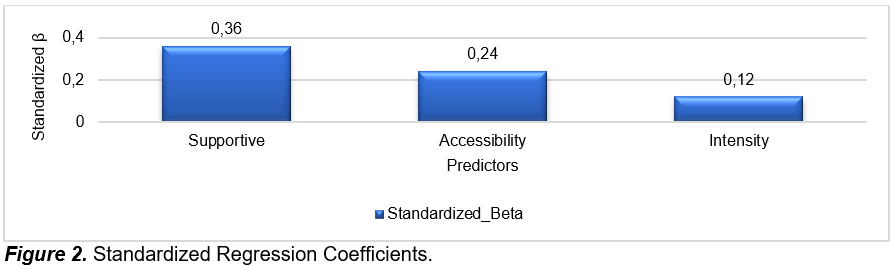
Multiple linear regression allowed us to identify the main characteristics of the digital educational environment that are predictors of inclusive competence. The model was statistically significant (F(3, 210) = 44.78, p < 0.001) and explained 39% of the variation in students’ inclusive competence (R² = 0.39). The strongest predictor was a supportive digital context (β = 0.36, p < 0.001). This therefore indicated the importance of a friendly, adaptive and pedagogically structured digital environment. The availability of digital services was also an important predictor (β = 0.24, p = 0.002). The intensity of digital technology use had the lowest effect. However, this effect was significant (β = 0.12, p = 0.037). Thus, the quality of the digital educational environment plays a significant role in shaping the inclusive competence of future teachers (See Table 3 and Figure 2).
Table 3.
Multiple Regression (N = 214)

Figure 2 shows the contribution of three characteristics of the digital learning environment—supportive context, availability of digital services, and intensity of digital use—to predicting students’ level of inclusive competence. The calculated β-coefficients indicated that the supportive digital environment was the strongest predictor, followed by the availability of digital services.
To establish the impact of a supportive digital environment on students’ inclusive competence, a mediation analysis was also conducted using the “Supportive → Accessibility → Competence” model. Thus, a supportive digital environment significantly predicted the accessibility of digital services (β = 0.48, p < 0.001). At the same time, the accessibility of digital services became a significant predictor of inclusive competence (β = 0.28, p = 0.001).
The indirect effect was statistically significant (a × b = 0.16, 95% CI [0.07, 0.27]). This indicated partial mediation. In addition, after taking into account the mediator, the direct effect of Supportive → Competence decreased. However, it remained significant (β = 0.30, p < 0.001). This indicated a mixed, i.e. direct and mediated nature of the effect (See Table 4).
Table 4.
Mediation Analysis: Accessibility is a Mediator between Digital Enabling Environment and Inclusive

Therefore, data from correlation, regression, and mediation analyses consistently indicated that the quality of the digital educational environment, in particular, its supportive nature and the accessibility of digital services, play an important role in developing the inclusive competence of future teachers.
Discussion
This study was aimed at determining the impact of the characteristics of the digital educational environment on the development of inclusive competence of future teachers. The results obtained made it possible to identify the main mechanisms for the formation of inclusive skills within the framework of the digitalization of education.
The first research question concerned the determination of the general level of inclusive competence of future teachers and its components. The results indicated that in general, the level of inclusive competence of students was at the average and above average level. This situation corresponds to the general current trends in the training of teachers focused on inclusive values (Utami et al., 2025; Skantz-Åberg et al., 2022). At the same time, it was indicated that the highest level was achieved by the value-motivational and cognitive components. However, the activity component was weaker in this system.
This is consistent with previous works, which indicated that students of pedagogical specialties had positive attitudes towards the development of inclusion (Rodrigues de Souza Fausto et al., 2021; Okoye et al., 2022). However, the authors also indicated that they needed more opportunities for the practical application of inclusive strategies (Palacios-Rodríguez, 2024; Martín Párraga et al., 2022). Thus, the results of our sample confirmed the existing trend. It is proven that values and knowledge are formed faster than practical skills.
The next task was aimed at identifying the main characteristics of the digital educational environment, which are associated with the inclusive competence of students. In particular, the conducted correlation analysis indicated that all three characteristics of the digital environment had statistically significant relationships with inclusive competence. However, the strongest relationship was recorded between the supportive digital environment and inclusive competence (r = 0.46). Thus, such phenomena as friendliness, pedagogical support, intuitiveness of interfaces and interaction of the teacher with students affected the level of readiness for inclusive practice.
Similar results are also presented in other works. In particular, the authors proved that a digital environment with a high level of support allows for the development of cooperation, self-regulation and a positive learning experience (Samaniego López et al., 2025; Dolezal et al., 2025; Bobro, 2024). Such data also correlate with the development of inclusive values (Marcus-Quinn, 2025; Nogueira et al., 2022).
The accessibility of digital services was also a significant factor (r = 0.39). The idea that technical accessibility and universal design contribute to equal access to education has also been supported in other works. The lowest association was between the intensity of digital technology use and inclusive competence (r = 0.28). However, it was statistically significant. This important observation was consistent with other scholars who indicated that the frequency of technology use did not guarantee the quality of inclusive training. The third question was aimed at identifying the characteristics of the digital educational environment that influenced the formation of inclusive competence. The results of multiple regression showed that a significant predictor of inclusive competence was a supportive digital context (β = 0.36). The second strongest was the accessibility of digital services (β = 0.24). The results also indicated that inclusion is developed through a well-formed educational digital environment. In general, the results are consistent with the works of other scholars who emphasized that inclusion and digitalization interacted based on an accessible and supportive digital space (Kasperė & Liubinienė, 2022; Jogezai et al., 2023). The conducted mediation analysis indicated a partial but statistically significant mediation. Thus, a supportive digital environment influenced inclusive competence through increasing the accessibility of digital services. The indirect effect was 0.16 (95% CI [0.07, 0.27]). This confirmed the model according to which it is necessary to first form a supportive, structured digital environment. This in turn will lead to increasing the accessibility of materials, which will ultimately enhance the development of inclusive skills. Therefore, the category of accessibility acted as a significant mechanism for transmitting the influence of Supportive – Competence (Basantes-Andrade et al., 2022). Similar data have been presented in other works, which indicated that the availability of digital resources is a significant factor in the development of pedagogical skills (Montenegro-Rueda & Fernández-Batanero, 2022; Pimentel & Miranda, 2025; Byrko et al., 2022). Therefore, the digital educational environment has become an important factor in the development of inclusive competence, as the support and availability of digital resources played a key role.
Therefore, the study showed that digital practice was often reduced to the reproductive use of technology, and little time was devoted to modeling real inclusive pedagogical situations. In the absence of practice-oriented modules, simulations or mentoring support from teachers, digital inclusive activities remain abstract for students.
The results of the mediation analysis had important implications for management decisions in higher education institutions. In particular, it was indicated that a supportive digital environment influenced the development of inclusive competence not only directly, but also indirectly. This means that administrative decisions should be aimed at creating a holistic, friendly and inclusively oriented digital ecosystem.
From a practical point of view, it is advisable for university administrations to integrate practice-oriented inclusive tasks into digital courses. It is also worth ensuring the accessibility of LMS and digital services in accordance with the principles of universal learning design so that students can practically work with accessible interfaces.
In addition, it is worth training teachers as digital mentors who can demonstrate examples of inclusive digital practices and accompany students in the process of their application. In the future, it is also worth shifting the emphasis from the frequency of technology use to the quality of pedagogical support, as the intensity of digital activity itself does not guarantee the development of inclusive competence.
Despite the results obtained, the study also had some limitations. In particular, the study was of a correlation-regression nature. This did not allow us to form causal relationships with absolute certainty. Although the mediation model was statistically confirmed, it is still based on cross-sectional data. It is also worth recognizing that the assessment of variables was based on self-assessment, which may affect subjective statements. In the future, it is planned to conduct long-term studies that will allow us to track the dynamics of the development of inclusive competence in students during the long-term use of digital technologies. This will allow us to establish the stability of the effects and the reliability of causal relationships.
Conclusions
Thus, the overall level of inclusive competence of students was quite high, especially in the value-motivational and cognitive aspects. However, the activity component remains to be formed. This indicated the need to expand practice-oriented forms of learning in the digital environment.
It was determined that the main characteristics of the digital educational environment are related to the development of inclusive skills. A supportive digital environment plays an important role for high-quality pedagogical interaction. The availability of resources and a positive learning experience were important factors in the development of inclusion.
The results of multiple regression indicated the predictive potential of digital characteristics. In particular, the supportability and accessibility of digital services are statistically significant predictors of inclusive competence.
Finally, the mediation analysis indicated that the availability of digital services partially mediates the effect of a supportive digital environment on students' inclusive competence. Thus, a well-organized, structured, and friendly digital environment contributed to the formation of inclusive skills based on ensuring equal access to resources and adaptive opportunities.
Therefore, the results obtained have important implications for educational policy and curriculum design, as they indicate the need to strengthen practice-oriented components of digital inclusion in the training of future teachers.
Bibliographic references
Basantes-Andrade, A., Casillas-Martín, S., Cabezas-González, M., Naranjo-Toro, M., & Guerra-Reyes, F. (2022). Standards of teacher digital competence in higher education: A systematic literature review. Sustainability, 14(21), 13983. https://doi.org/10.3390/su142113983
Bobro, N. (2024). Application of artificial intelligence in higher education institutions: Foreign experience. Three Seas Economic Journal, 5(1), 19–23. https://doi.org/10.30525/2661-5150/2024-5-3
Byrko, N., Tolchieva, H., Babiak, O., Zamsha, A., Fedorenko, O., & Adamiuk, N. (2022). Training of teachers for the implementation of universal design in educational activities. AD ALTA: Journal of Interdisciplinary Research, 12/02–XXVIII, 117–125. https://acortar.link/tAiSZO
Chiner, E., Gómez-Puerta, M., Manosalba, C., & Friz-Carrillo, M. (2024). Teachers’ Perspectives on Internet Use: Towards the Digital Inclusion of Students with Intellectual Disability or autism spectrum disorder. Disabilities, 4(4), 1156–1169. https://doi.org/10.3390/disabilities4040072
Dolezal, D., Motschnig, R., & Ambros, R. (2025). Pre-Service Teachers’ Digital Competence: A Call for Action. Education Sciences, 15(2), 160. https://doi.org/10.3390/educsci15020160
Ghoneim, R., Aljedaani, W., Bryce, R., Javed, Y., & Khan, Z. I. (2024). Why Are Other Teachers More Inclusive in Online Learning Than Us? Exploring Challenges Faced by Teachers of Blind and Visually Impaired Students: A Literature Review. Computers, 13(10), 247. https://doi.org/10.3390/computers13100247
Göltl, K., Ambros, R., Dolezal, D., & Motschnig, R. (2024). Pre-Service Teachers’ Perceptions of Their Digital Competencies and Ways to Acquire Those through Their Studies and Self-Organized Learning. Education Sciences, 14(9), 951. https://doi.org/10.3390/educsci14090951
Hurtado-Mazeyra, A., Núñez-Pacheco, R., Barreda-Parra, A., Guillén-Chávez, E.-P., & Turpo-Gebera, O. (2022). Digital competencies of Peruvian teachers in basic education. Frontiers in Education, 7, 1058653. https://doi.org/10.3389/feduc.2022.1058653
Isoda, M., Estrella, S., Zakaryan, D., Baldin, Y., Olfos, R., & Araya, R. (2021). Digital competence of a teacher involved in the implementation of a cross-border lesson for classrooms in Brazil and Chile. International Journal for Lesson & Learning Studies, 10(4), 362–377. https://doi.org/10.1108/ijlls-05-2021-0045
Jogezai, N. A., Koroleva, D., & Baloch, F. A. (2023). Teachers’ digital competence in the post COVID-19 era: The effects of digital nativeness, and digital leadership capital. Contemporary Educational Technology, 15(4), ep466. https://doi.org/10.30935/cedtech/13620
Jones, E., & Lomas, C. (2025). Teachers’ professional digital competence: the case for psychological digital competence. In Reimagining Teacher Digital Competence (pp. 107–126). Edward Elgar Publishing. https://doi.org/10.4337/9781035337514.00014
Karakasidi, O., Balashov, A., Perehuda, Y., Kryvoberets, M., Semenets-Orlova, I., & Klochko, A. (2024). Readiness of Educational Managers and Teachers to Enhance Distance Education and Knowledge Management. In R. Shchokin, A. Iatsyshyn, V. Kovach, & A. Zaporozhets (Eds.)Digital Technologies in Education (pp. 27–41). Cham, Switzerland: Springer. https://doi.org/10.1007/978-3-031-57422-1_3
Kasperė, R., & Liubinienė, V. (2022). Digital Competence and Teacher Training Overview: Is Lithuania Ready for Digitalism in Education? In Digital Literacy for Teachers (pp. 291–311). Singapore: Springer. https://doi.org/10.1007/978-981-19-1738-7_16
Kulichenko, A. K., Sotnik, T. V., & Stadnychenko, K. V. (2018). Electronic portfolio as a technique of developing creativity of a foreign language teacher. Information Technologies and Learning Tools, 66(4), 286–304. https://doi.org/10.33407/itlt.v66i4.2178
Marcus-Quinn, A. (2025). Teachers’ professional digital competence: exploring issues of social justice and fairness. In Reimagining Teacher Digital Competence (pp. 60–76). Edward Elgar Publishing. https://doi.org/10.4337/9781035337514.00011
Martín Párraga, L., Llorente Cejudo, C., & Barroso Osuna, J. (2022). Validation of the DigCompEdu Check-in questionnaire through structural equations: A study at a university in Peru. Education Sciences, 12(8), 574. https://doi.org/10.3390/educsci12080574
Masoumi, D., & Noroozi, O. (2023). Developing early career teachers’ professional digital competence: a systematic literature review. European Journal of Teacher Education, 48(3), 644–666. https://doi.org/10.1080/02619768.2023.2229006
Montenegro-Rueda, M., & Fernández-Batanero, J. M. (2022). Digital Competence of Special Education Teachers: Impact, Challenges and Opportunities. Australasian Journal of Special and Inclusive Education, 1–15. https://doi.org/10.1017/jsi.2022.8
Navas-Bonilla, C. d. R., Guerra-Arango, J. A., Oviedo-Guado, D. A., & Murillo-Noriega, D. E. (2025). Inclusive education through technology: a systematic review of types, tools and characteristics. Frontiers in Education, 10. https://doi.org/10.3389/feduc.2025.1527851
Nogueira, V. B., Teixeira, D. G., de Lima, I. A. C. N., Moreira, M. V. C., de Oliveira, B. S. C., Pedrosa, I. M. B., ... & Jeronimo, S. M. B. (2022). Towards an inclusive digital literacy: An experimental intervention study in a rural area of Brazil. Education and Information Technologies, 27, 2807–2834. https://doi.org/10.1007/s10639-021-10711-z
Okoye, K., Hussein, H., Arrona-Palacios, A., Quintero, H. N., Ortega, L. O. P., Sanchez, A. L., Ortiz, E. A., Escamilla, J., & Hosseini, S. (2022). Impact of digital technologies upon teaching and learning in higher education in Latin America: an outlook on the reach, barriers, and bottlenecks. Education and Information Technologies, 28, 2291–2360. https://doi.org/10.1007/s10639-022-11214-1
Palacios-Rodríguez, A. (2024). Competencia digital docente. In Domene-Martos, S., & Díaz-Noguera Mª D. (Eds.). In Formación y empleabilidad en organizaciones inclusivas y sostenibles (pp. 95–106). Dykinson. https://doi.org/10.2307/jj.17381589.11
Pimentel, S. C., & Miranda, T. G. (2025). Accessibility of Students with disabilities to remote teaching in State Universities of Bahia. Educação e Pesquisa, 51. https://doi.org/10.1590/s1678-4634202551275076en
Reyes, W., & Gurubel-Tec, N. E. (2024). Digital Competence of Teachers in the Mayan Region of Mexico: Results of a Preliminary Research in Secondary Education. International Journal of Instruction, 17(2), 617–634. https://doi.org/10.29333/iji.2024.17234a
Rodrigues de Souza Fausto, I., Fonseca de Souza, E., Rodrigues, M., & Mariani Braz, R. M. (2021). The inclusive virtual learning environment in the federal institute of education, science and technology of rondônia. In 14th annual international conference of education, research and innovation. IATED. https://doi.org/10.21125/iceri.2021.1902
Rodríguez Zidán, E., Bentancor Biagas, G., & Solari, M. (2025). Analytics and gaps in the use of digital platforms for mathematics education in Uruguay. Revista Electrónica de Investigación Educativa, 27, e05. https://doi.org/10.24320/redie.2025.27.e05.6438
Salas-Pilco, S. Z., Xiao, K., & Oshima, J. (2022). Artificial Intelligence and New Technologies in Inclusive Education for Minority Students: A Systematic Review. Sustainability, 14(20), 13572. https://doi.org/10.3390/su142013572
Samaniego López, M. V., Orrego Riofrío, M. C., Barriga-Fray, S. F., & Paz Viteri, B. S. (2025). Technologies in Inclusive Education: Solution or Challenge? A Systematic Review. Education Sciences, 15(6), 715. https://doi.org/10.3390/educsci15060715
Sarubbi-Baltazar, F. A., Arango-Ramírez, P. M., Martínez-Vargas, A., Maldonado-Cruz, G., Cruz-Cruz, E., & Sánchez-Soriano, M. (2025). Student Profiles and Technological Challenges in Virtual Learning Environments: Evidence from a Technological Institute in Southern Mexico. Education Sciences, 15(9), 1106. https://doi.org/10.3390/educsci15091106
Sharma, S., & Sengupta, S. (2023). What Engages Teachers of Higher Education Institutes of India? An Empirical Study Using Job Demands and Resources Theory. In P. Mishra, A. Sharma, S. Khanra, S. K. Kundu, & S. K. Mishra (Eds.)Digital Economy Post COVID-19 Era (pp. 669–681). Singapore: Springer. https://link.springer.com/chapter/10.1007/978-981-99-0197-5_42
Skantz-Åberg, E., Lantz-Andersson, A., Lundin, M., & Williams, P. (2022). Teachers’ professional digital competence: an overview of conceptualisations in the literature. Cogent Education, 9(1). https://doi.org/10.1080/2331186x.2022.2063224
Tomczyk, Ł., Martins, V. F., de la Higuera Amato, C. A., Eliseo, M. A., & Silveira, I. F. (2021). The Use of Technology on Inclusive Education in Brazil - A Discussion on the Teacher and Student Views. In Advances in Digital Science (pp. 105–115). Springer International Publishing. https://doi.org/10.1007/978-3-030-71782-7_10
Utami, I. S., Ghufron, A., & Ishartiwi. (2025). Professional Development in Digital Competence for Special Education Teachers: A Systematic Review. Electronic Journal of e-Learning, 23(4), 53–68. https://doi.org/10.34190/ejel.23.4.4273
Valero-Tapia, S., Torné, F. S., & Orejudo, S. (2024). Innovando para las competencias docentes: perspectivas desde la investigación (1st ed.). Madrid, España: Dykinson, S.L. https://doi.org/10.2307/jj.22246927.21
Vásquez, M.-S., Roig-Vila, R., & Peñafiel, M. (2021). Teacher's Digital Competencies. A Systematic Review in the Latin-American Context. International Journal on Advanced Science, Engineering and InformationTechnology, 11(6), 2495. https://ijaseit.insightsociety.org/index.php/ijaseit/article/view/12542
Velandia Rodriguez, C. A., Mena-Guacas, A. F., Tobón, S., & López-Meneses, E. (2022). Digital Teacher Competence Frameworks Evolution and Their Use in Ibero-America up to the Year the COVID-19 Pandemic Began: A Systematic Review. International Journal of Environmental Research and Public Health, 19(24), 16828. https://doi.org/10.3390/ijerph192416828
Wyss, N., Myers, C., Villavicencio Peralta, X., & Coflan, C. (2022). Mapping and Analysing EdTech initiatives in Latin America and the Caribbean. EdTech Hub. https://doi.org/10.53832/edtechhub.0111
Zicari, M. (2022). Digital Contention in Latin America. Performance Research, 27(3-4), 71–80. https://www.tandfonline.com/doi/full/10.1080/13528165.2022.2155400

Este artículo no presenta ningún conflicto de intereses. Este artículo está bajo la licencia Creative Commons Atribución 4.0 Internacional (CC BY 4.0). Se permite la reproducción, distribución y comunicación pública de la obra, así como la creación de obras derivadas, siempre que se cite la fuente original.