
Original Article
Eduweb, 2026, enero-marzo, v.20, n.1. ISSN: 1856-7576
Doi: https://doi.org/10.46502/issn.1856-7576/2026.20.01.9
Designing digital higher education environments for information and digital competence development
Diseño de entornos digitales de educación superior para el desarrollo de la información y la competencia digital
Kostiantyn Chub
Candidate of Physical and Mathematical Sciences, Associate Professor of the Department of Primary Education, Poltava V. G. Korolenkо National Pedagogical University, Ukraine.
https://orcid.org/0000-0001-6325-6466
Igor Verbovskyi
Candidate of Pedagogic Sciences, Associate Professor of the Department of Professional and Pedagogical, Special Education, Andragogy and Management, Head of Education Division, Zhytomyr Ivan Franko State University, Ukraine.
https://orcid.org/0000-0001-7202-3429
Mariia Holieva
PhD., Assistant of the Department of Production and Investment Management, National University of Life and Environmental Sciences of Ukraine, Ukraine.
https://orcid.org/0000-0001-7394-9098
Tetiana Korobchuk
PhD in Economics, Associate Professor, Associate Professor of the Department of Finance, Banking and Insurance, Lutsk National Technical University, Ukraine.
https://orcid.org/0000-0002-0356-4157
Tetiana Stoliarova
Candidate of Pedagogic Sciences, Associate Professor, Associate Professor of the Department of Computer Science and Information Systems, State University of Trade and Economics, Ukraine.
https://orcid.org/0009-0006-8463-495X
Cómo citar:
Chub, K., Verbovskyi, I., Holieva, M., Korobchuk, T., & Stoliarova, T. (2026). Designing digital higher education environments for information and digital competence development. Revista Eduweb, 20(1), 144-158. https://doi.org/10.46502/issn.1856-7576/2026.20.01.9
Recibido: 08/12/25 Aceptado: 12/02/26
Abstract
The article develops the content and justifies the features of professional training for specialists by creating a digital higher-education environment to develop their information and digital competence. The factors most influencing a student's level of information and digital competence are identified. The content of the digital environment of higher education is substantiated. The core idea of the experimental study is that our system for training future specialists in higher education, by creating a digital environment to develop students' information and digital competence, is an effective means of preparing competitive specialists. We, based on statistical analysis, have proven that the developed system of training future specialists of higher education by creating a digital environment for the formation of information and digital competence of students makes it possible to form a value component, a technological component, an activity component, and a reflexive component of the specified competence of future specialists. Thus, our experiment confirmed the study's hypothesis and demonstrated the effectiveness of the proposed system in developing the information and digital competence of future specialists.
Keywords: competence, digital environment, higher education institutions, digital technologies, virtual reality.
Resumen
El artículo desarrolla el contenido y justifica las características de la formación profesional de especialistas mediante la creación de un entorno digital de educación superior para el desarrollo de su competencia informativa y digital. Se identifican los factores que más influyen en el nivel de competencia informativa y digital de un estudiante. Se fundamenta el contenido del entorno digital de la educación superior. La idea central del estudio experimental es que nuestro sistema de formación de futuros especialistas en educación superior, mediante la creación de un entorno digital para el desarrollo de la competencia informativa y digital de los estudiantes, constituye un medio eficaz para preparar especialistas competitivos. Mediante análisis estadísticos, hemos demostrado que el sistema desarrollado para la formación de futuros especialistas en educación superior mediante la creación de un entorno digital para la formación de la competencia informativa y digital de los estudiantes permite formar un componente de valor, un componente tecnológico, un componente de actividad y un componente reflexivo de la competencia específica de los futuros especialistas. Por lo tanto, nuestro experimento confirmó la hipótesis del estudio y demostró la eficacia del sistema propuesto para el desarrollo de la competencia informativa y digital de los futuros especialistas.
Palabras clave: competencia, entorno digital, instituciones de educación superior, tecnologías digitales, realidad virtual.
Introduction
The rapid digitalization of society and the expansion of information technologies have significantly transformed higher education systems worldwide. Modern labor markets increasingly require specialists who possess not only professional knowledge but also a high level of information and digital competence. In this context, higher education institutions face the strategic task of creating effective digital educational environments that support the development of these competencies and ensure the competitiveness of graduates (Sarango-Lapo et al., 2021).
The integration of digital technologies into higher education has expanded opportunities for innovative teaching and learning methods, including virtual learning environments, cloud services, and interactive digital tools. At the same time, the transition toward digitally mediated education requires reconsideration of traditional approaches to professional training and competence formation. Students must be able to effectively search, analyze, process, and apply information using digital technologies, as well as adapt to rapidly changing technological conditions.
Previous research has emphasized the importance of digital literacy and digital competence for successful professional activity and lifelong learning. However, despite the significant number of studies devoted to digital competence development, there remains insufficient systematization of approaches to creating integrated digital environments in higher education aimed at the comprehensive formation of information and digital competence among future specialists. In particular, there is a need for empirical verification of the effectiveness of structured digital educational systems that combine technological, pedagogical, and value-based components (Huamán-Romaní et al., 2022).
In modern educational conditions, the digital environment of higher education becomes not only a technological platform but also a pedagogical system that influences the development of students’ professional, cognitive, and reflective abilities. Therefore, the formation of information and digital competence should be considered as a multidimensional process that includes value, technological, activity-based, and reflective components.
Literature Review
The rapid digital transformation of higher education has significantly intensified scholarly attention toward the development of information and digital competence among future specialists. Researchers worldwide increasingly emphasize that digital competence has become a core prerequisite for professional competitiveness, lifelong learning, and effective participation in the knowledge society.
A number of studies have examined the impact of digitalization on competence formation in higher education. Nieto-Rivas et al. (2025) revealed substantial gaps in students’ digital competence during the COVID-19 pandemic, highlighting deficiencies in digital communication, information management, and collaborative skills. Their findings indicate that most students demonstrate only a moderate level of digital competence, which negatively affects professional training quality.
Similarly, González Calleros et al. (2022), through a systematic literature review, concluded that university teachers’ digital competence often remains at an average or low level, emphasizing the need for institutional programs to strengthen digital skills and understanding of virtual learning environments.
The relationship between digital competence and teaching effectiveness has also been widely explored. Churampi-Cangalaya et al. (2024) demonstrated a strong positive correlation between digital competence and teaching effectiveness in higher education, confirming that the integration of digital technologies enhances learning outcomes. Mondragon-Estrada et al. (2023) further highlighted that teachers’ digital transformation strategies and technological readiness significantly influence the success of hybrid and online learning environments. Their results suggest that basic digital competencies are essential for maintaining student engagement and ensuring effective instruction.
Another important line of research focuses on virtual learning environments and digital platforms. Lobo & Alvarez (2023) analyzed students’ digital skills within Moodle and Google Classroom environments and found that active use of digital platforms significantly improves students’ digital literacy and technological proficiency. The expansion of virtual environments during the pandemic accelerated students’ adaptation to digital tools and contributed to the development of autonomous learning skills. Similarly, Estrada-Molina et al. (2022) demonstrated that integrating formal online learning with informal digital networks (e.g., LinkedIn, ResearchGate) significantly enhances students’ digital competence, emphasizing the importance of combining structured and open learning environments.
Several scholars have also examined digital competence from a systemic and socio-educational perspective. Antón-Sancho et al. (2023) analyzed digital competence among university teachers in Pacific Alliance countries and reported a substantial increase in ICT use after the pandemic, although uneven across regions. Their study confirms that digital competence development depends not only on technological infrastructure but also on pedagogical integration and institutional support. In a broader context, Del Prete & Cabero Almenara (2020) conceptualized digital competence as a multidimensional construct that includes critical thinking, responsible use of digital technologies, communication, and continuous professional self-development.
Despite the growing body of research, several unresolved issues remain. First, most studies focus on individual aspects of digital competence rather than its holistic formation within an integrated digital educational environment. Second, empirical evidence regarding the effectiveness of comprehensive digital learning systems remains limited. Third, insufficient attention has been paid to the interaction between value-based, technological, activity-oriented, and reflective components of digital competence development.
Therefore, the present study aims to address these gaps by substantiating and experimentally verifying a structured digital higher-education environment designed to support the comprehensive formation of information and digital competence among future specialists. The study contributes to the existing literature by providing an integrated pedagogical model and empirical evidence of its effectiveness.
Research purpose. To substantiate and empirically verify the effectiveness of designing a digital environment for higher education in developing information and digital competence of future specialists.
Methodology
The study employed a quasi-experimental research design with experimental (EG) and control (CG) groups in order to examine the effectiveness of a specially designed digital educational system for the formation of information and digital competence of future specialists. The research design combined quantitative and qualitative approaches and included ascertaining, formative, and control stages.
The participants of the study were undergraduate students from higher education institutions in Ukraine. The total sample of students was divided into an experimental group (EG) and a control group (CG). The groups were formed according to the principle of equivalence with respect to academic performance, field of study, and initial levels of information and digital competence.
Homogeneity of the groups was verified statistically prior to the formative stage to ensure the comparability of the samples.
The assessment scale was based on a 100-point system, which allowed the classification of students’ competence levels into three categories:
The structure of information and digital competence included four components: value, technological, activity, and reflective.
The study was conducted over three academic years and included the following stages:
Quantitative data were processed using statistical methods, including:
The null hypothesis (H0) stated that the implementation of the developed digital environment does not significantly affect the level of students’ information and digital competence. The alternative hypothesis (H1) assumed a statistically significant effect of the developed system on competence formation.
All statistical analyses were conducted using SPSS software. The level of statistical significance was set at α = 0.05.
Participation in the study was voluntary. Students were informed about the purpose of the research, and anonymity and confidentiality of the collected data were ensured. The study was conducted in accordance with ethical standards for educational research.
Results and Discussion
The content and features of professional training for specialists are developed in the digital higher-education environment to develop their information and digital competence.
Digital technologies are essential tools in modern professional activity, making digital literacy a key condition for specialist success. Training future professionals therefore requires developing a new model of the individual equipped with strong digital skills.
Modern specialists must be able to search, analyze, manage, and securely store information; communicate and collaborate in digital environments; use cloud systems and digital services; ensure cybersecurity; and apply digital tools effectively in education and professional work.
A core component of professional development is information and digital competence. It includes the ability to use digital technologies consciously and responsibly, organize communication and collaboration, reflect on experience, and continuously improve skills. This competence shapes career growth and encompasses all aspects of professional activity (Villarreal-Villa et al., 2019).
Virtual reality and other advanced technologies further enhance digital competence by engaging creativity, imagination, and practical skills. The level of a student’s digital competence depends on the quality of professional training and their experience with digital technologies in higher education. Updating IT-related curricula is therefore essential, and recent graduates are expected to demonstrate higher levels of digital competence (Mytnyk et al., 2024).
Information and digital competence can be defined as a student’s readiness and ability to solve professional tasks using modern digital tools. It involves searching, analyzing, systematizing, presenting, and creating information; using digital resources critically and confidently; and maintaining a continuous need for learning and self-improvement (Del Prete & Cabero Almenara, 2020).
Thus, students in higher education must be able to access and use information sources, process and present data in various formats, apply analytical techniques, navigate digital environments, and use technologies effectively in both professional and everyday contexts (Farias-Gaytan et al., 2023).
The content of the digital environment of higher education. The main functions of each student in the digital learning environment. The main aspects of information security are the psychological component of national security.
Equivalent components of the formation of information and digital competence of future specialists and their importance in the digital environment of higher education.
The formation of information and digital competence requires creating a comprehensive digital environment in higher education that supports students’ professional, personal, and cultural development. This environment should promote self-organization and prepare future specialists for professional activity through the integration of professional growth, personal development, and professional culture (Laurente-Cárdenas et al., 2020).
The conceptual model of such an environment is based on a triadic principle. First, digitalization should ensure synergistic interaction between three core components: professional development, personal development, and professional-cultural growth. These elements are interconnected and oriented toward achieving professionalism, value-based maturity, and career self-improvement.
Second, student development in the digital environment should focus on three key outcomes: digital professionalism, professional digital culture, and a system of professional digital competencies. This process is continuous and supports lifelong professional growth through creativity, self-education, and self-development.
Third, career advancement in the digital environment unfolds through phases: mastering digital tools, developing professional-digital competencies, and achieving professional digital culture. The main regulatory mechanism of this process is self-creation, which includes self-knowledge, self-regulation, and value-based self-awareness. (Ocaña-Fernández et al., 2020).
In the context of societal digitalization, future specialists must also perform key functions: heuristic (innovative thinking), digital (technical and managerial use of technologies), self-developmental, security-related, and value-oriented functions. Information security, particularly its psychological and axiological aspects, becomes especially important, as students must develop resilience to information threats and maintain value-based stability (Peres et al., 2016).
Information and digital competence develops through interconnected components: knowledge, skills, responsibility, communication, and autonomy. To remain competitive, future specialists must master digital tools and online services, critically evaluate information, follow legal and ethical standards (including copyright and academic integrity), ensure cybersecurity, and engage in lifelong learning (Terreni et al., 2019).
They should also be able to select, evaluate, create, modify, and share digital educational resources; use open resources and e-portfolios; analyze educational data; organize safe digital interaction; and apply digital communication tools for collaboration and professional growth (Mejías-Acosta et al., 2024).
Overall, the digital environment of higher education must systematically support the development of competent, responsible, and culturally aware professionals capable of effective work in a digital society (Julio Juvenal et al., 2025).
Experimental research
The main idea of the experimental study is that our system for training future specialists in higher education, developed by creating a digital environment to build students' information and digital competence, is an effective means of training competitive specialists.
The hypothesis of the study is based on the following assumption: if the process of training future specialists is carried out according to a specially developed system, which includes a methodology based on the creation of a digital environment, then this will contribute to the formation of information and digital competence of students.
The study was conducted over three years and covered the following stages: preparatory, ascertaining, formative, and control.
At the preparatory stage of the scientific and pedagogical search, the experience was analyzed; a theoretical analysis of the state of the outlined research problem was conducted; the content and structure of the information and digital competence of future specialists were determined; and the goal and leading idea of the study were established.
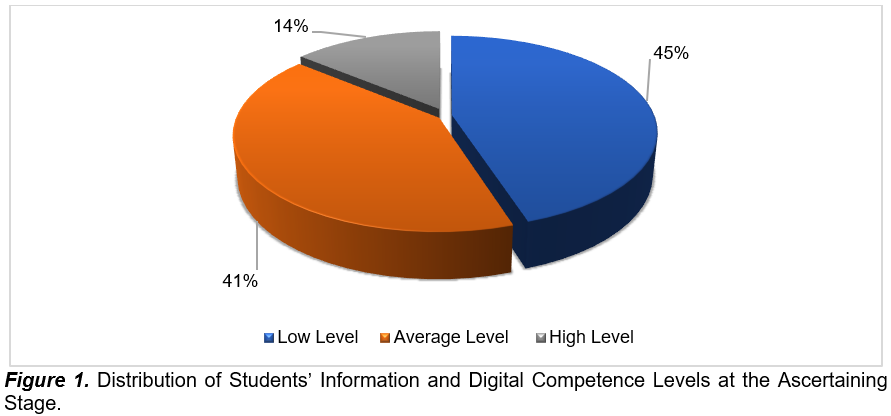
At the ascertaining stage of the study, a hypothesis for the experimental study was formulated; a system for training future specialists in higher education was developed; a research program was outlined; levels were defined; experimental methods were determined for the participants; and the experimental studies were conducted. At the ascertaining stage, a survey was conducted to assess the level of students' information and digital competence when using only internal academic cloud resources in higher education, namely educational electronic courses from each discipline. The following results of the ascertaining section were obtained (Fig. 1):
The structure of information and digital competence of students, which is the student's ability to carry out innovative activities in order to improve practical skills and deepen theoretical knowledge for a flexible response of each person to constant changes in the digital modern society, and is the ability to skillfully and coherently solve professional tasks to increase the competitiveness of the individual in the labor market. Therefore, we have identified the following components: value component, technological component, activity component, reflective component:
At the ascertaining stage, EG and CG were distinguished. For EG, we substantiated the principles and approaches to organizing a digital environment that will contribute to the formation of information and digital competence of students, based on the outlined principles and approaches by which information and digital competence are formed.
A special course was developed, and its content was designed to provide professional guidance on developing EG students' information and digital competence. The system of training students has been improved using innovative methods, forms of organizing the educational process of higher education have been determined, which will contribute to the formation of information and digital competence of EG students (independent work, training sessions), methods (project activities, coaching, interactive, problem-based, blended, flipped learning), the use of which will contribute to the formation of information and digital competence in higher education applicants.
Substantiated levels (low, average, high) for formation based on the criteria of information and digital competence (cognitive, personal, pragmatic, reflective). Indicators have been developed to assess them.
At the formative stage of the experiment, we carried out an experimental test of the hypothesis, implemented the developed system and a special course in the EG to form the information and digital competence of specialists, investigated the main components in the process of professional training of future specialists, experimentally verified the effectiveness of the proposed system, which includes innovative methods and a special course. To deepen and acquire practical digital skills, EG students were recommended digital platforms from professional disciplines for performing practical tasks, and virtual desktops with the necessary software were provided for individual and laboratory work. The use of digital platforms in the study of the educational components of the professional direction encouraged EG students to adopt these services and platforms in their professional activities, enhancing their competitiveness. In EG, students had the opportunity to select services and e-resources that would support their professional growth. Thus, the value and activity components of students' information and digital competence were formed among EG students.
The primary methods of teaching students in the EG are blended and flipped learning, coaching, interactive activities, problem-solving, and project-based activities.
The developed system, which was implemented in the EG, included innovative methods, a special course for the formation of the student's information and digital competence, as well as the constant use of the Moodle platform, which was focused on interaction in the educational process of higher education between EG students and the teacher using an electronic special course; online academies (Cisco, Microsoft, etc.); professional blogs, forums, sites, communities; services for communication and cooperation; automated task verification systems. Thus, the reflective and technological components of students' information and digital competence were developed among EG students.
In the EG, attention was paid to ensuring the organization of group project work using digital technologies. The use of group project work in training future specialists strengthened their ability to select, search for, and analyze the necessary information. Using informal education resources, communication and cooperation services, and tools for reflection and assessment, students developed the ability to plan and allocate their time effectively, collaborate in teams, and communicate. Implementing the proposed professional projects strengthened EG students' professional skills and increased their motivation for self-education.
In the formative experiment, we investigated the impact of using systems, platforms, and external academic cloud resources on EG students' training. At the same time, each subsequent component of the environment was added to the set of previous components. As a result, we observe the dynamics of the growth in students' information and digital competence. The following research results were obtained in EG (Fig. 2):

Thus, the study indicates an increase in students' information and digital competence who studied using the developed system.
The spectrum of innovative methods used in a special course to develop students' information and digital competence during the learning process, and the experimental testing of their knowledge and skills, provides grounds to assert the feasibility of applying the developed system of training future specialists in higher education by creating a digital environment.
At the control stage of the study, we carried out a generalization, systematization of the final measurement of the levels of formation of information and digital competence of future specialists, processing the results obtained, comparing them with the predicted results, obtained experimental results, formulating general conclusions of the study, and identifying prospects for further research on the specified problem.
During the control experiment, the success levels and indicators for students enrolled in the experimental program were determined. It was shown that all respondents who participated in the experimental study across the different stages were homogeneous. We proposed ANOVA methods and used SPSS tools to test the hypothesis that students' success depends on the level of information and digital competence and on the system used. The following results were obtained (Fig. 3):
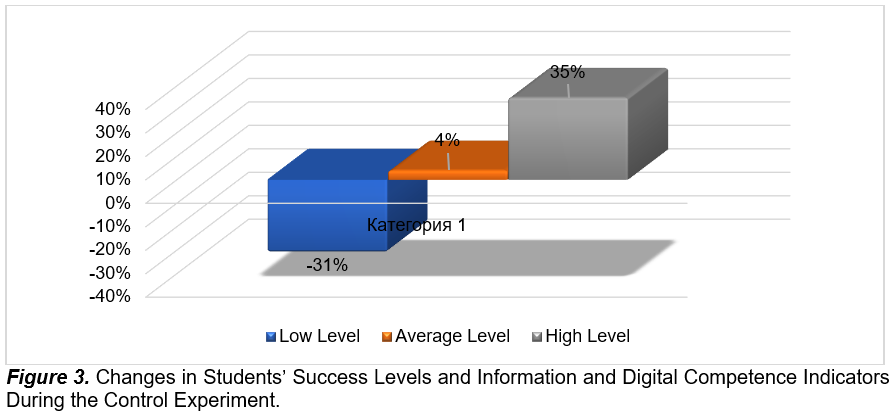
During the experiment, the system was tested. It demonstrated a positive impact on students' professional training, effectively contributing to the development of information and digital competence among future specialists and increasing their success.
Interpretation of results and statistical analysis
Samples for homogeneity, i.e., equality/similarity, allow us to evaluate the analysis of variance. The average values of each sample are compared with each other. In a one-factor analysis of variance, the overall significance of differences is calculated.
For respondents, questionnaires were developed based on previously defined indicators of information and digital competence. A 100-point scale was used to assess each indicator's achievement.
All students who participated in the experiment were evaluated. The average value of all indicators was used to create a conjugation table.
According to this principle, the values were clustered:
Thus, to assess information and digital competence, we grouped the results into three levels based on the quality of learning during the educational activity. Also, assuming there are no differences between the experimental groups, the expected frequencies for the levels of information and digital competence are:
Let us formulate the null hypothesis H0 in order to test the first assumption: the use of the developed system does not affect the level of information and digital competence, that is, the changes in the variable SK are random.
Let us formulate an alternative hypothesis, H1, in order to test the assumption: the use of the developed system significantly affects the level of information and digital competence, that is, the changes in the variable SK are not random.
We use the Pearson χ² consistency criterion for quantitative confirmation. If the obtained statistics exceed the quantile of the χ² distribution, then the null hypothesis H0 is rejected. If not, the hypothesis is accepted at the 0.05 significance level.
The calculated value of the Pearson criterion is greater than the critical one for 6 degrees of freedom: 40.021>12.592. The value of asymptotic significance also indicates this and determines the probability of error when rejecting the null hypothesis. As a result, we accept the alternative hypothesis that the system we developed affects the assessment of information and digital competence levels.
The existing data from the one-way analysis of variance for the experiments yield a value of 22.015, which is Fisher's exact test (F-test). The corresponding critical value of the F-test at degrees of freedom (4-1) = 3 for the between-group (variance) and at degrees of freedom (388-4) = 384 − within-group and at a significance level of α = 0.05 is 2.628. Therefore, the calculated Fisher's exact test statistic for the experimental data exceeds the critical value: 22.015 > 2.628. Therefore, the proposed null hypothesis regarding the differences that are random in the group means was rejected, and the alternative hypothesis was accepted: the values of the general means differ significantly. That is, the actual data do not agree with the null hypothesis; therefore, the null hypothesis of the analysis of variance is rejected as a result – that is, a factor acted over the years, which determined the difference in success, the absence of the effect of the factor under consideration. Based on the positive results of the analysis of variance, we can conclude that the level of training in the developed system affects students' educational outcomes.
We were interested in the influence of individual levels of the factor. For this, we used a posteriori tests – the results of comparisons of pairwise levels of the independent variable. We used the Tukey criterion – a criterion of true significance, which, to determine differences between groups, uses the Student's t-statistic and controls the frequency of results that are false positives with correction for the effect of multiple comparisons.
The table of one-way analysis of variance for experiments gives us a value equal to 11.5 F-criterion (Fisher's criterion). The corresponding value of the F-criterion, which is critical at α=0.05, is 3.043.
Therefore, the value of the Fisher criterion calculated from the experimental data exceeds the critical value – 882.997 > 3.043. As a result, the null hypothesis of the analysis of variance is rejected – the absence of the considered factor effect. We can state that the level of the specified competence affects learning outcomes, as shown by the results of the analysis of variance.
We, based on statistical analysis, have proven that the developed system of training future specialists of higher education by creating a digital environment for the formation of students' information and digital competence makes it possible to form a value component, a technological component, an activity component, and a reflexive component of the specified competence of future specialists. Therefore, the experiment we conducted confirmed the research hypothesis and demonstrated the effectiveness of the proposed system in developing the information and digital competence of future specialists.
Comparing These Results with Previous Studies
The findings are consistent with previous research emphasizing the importance of digital competence in higher education. Similar to Churampi-Cangalaya et al. (2024), our results confirm a positive relationship between digital competence and academic performance. The significant increase in students with a high competence level (from 14% to 48%) supports this conclusion.
The multidimensional structure of competence identified in our study (value, technological, activity, reflective components) aligns with the framework proposed by Del Prete & Cabero Almenara (2020).
Consistent with Laurente-Cárdenas et al. (2020) and Terreni et al. (2019), the results highlight the importance of structured digital learning environments. However, unlike many studies focusing on individual tools, this research provides empirical evidence of the effectiveness of a holistic, system-based digital model.
Baseline results confirming low initial competence levels correspond with Nieto-Rivas et al. (2025), while the significant improvements observed demonstrate the effectiveness of a long-term, integrated intervention.
Overall, the findings support existing literature and contribute new empirical evidence on the effectiveness of comprehensive digital environment design in higher education.
Conclusions
This study substantiated and empirically verified the effectiveness of a structured digital higher education environment designed to develop information and digital competence among future specialists. The research addressed the identified gap in the literature concerning the lack of integrated and experimentally validated models for competence formation within holistic digital ecosystems.
The findings demonstrate that the implementation of a system-based digital educational model significantly improves students’ information and digital competence across four interrelated components: value, technological, activity, and reflective. Statistical analysis (χ² and ANOVA at α = 0.05) confirmed that the observed changes were not random and that the developed digital environment had a statistically significant impact on competence levels.
The results indicate a substantial decrease in the proportion of students with a low level of competence and a corresponding increase in the proportion of students with a high level. This confirms that a comprehensive approach—combining digital infrastructure, innovative pedagogical methods (blended learning, flipped learning, project-based learning), structured LMS integration, and professional digital platforms—produces sustainable educational effects.
The study contributes to the existing body of research by providing empirical evidence of the effectiveness of a longitudinal, multidimensional, and pedagogically grounded digital transformation model in higher education. Unlike approaches focused solely on technological tools, the proposed system integrates technological, value-oriented, and reflective dimensions of competence formation.
From a practical perspective, the findings suggest that higher education institutions should adopt systemic digital environment strategies rather than isolated digital interventions. Structured digital ecosystems can serve as a foundation for preparing competitive specialists capable of functioning effectively in a rapidly digitalizing labor market.
Limitations
The study was conducted within Ukrainian higher education institutions, which may limit the generalizability of the findings to other educational contexts. Additionally, although statistical significance was established, further research could include broader international samples and additional effect size analysis.
Implications for Future Research
Future studies may focus on cross-cultural validation of the proposed model, long-term tracking of graduates’ professional success, and the integration of emerging technologies (e.g., artificial intelligence and immersive environments) into digital competence development frameworks.
Overall, the results confirm the research hypothesis and demonstrate that designing and implementing a structured digital higher education environment is an effective strategy for fostering the information and digital competence of future specialists.
Bibliographic references
Antón-Sancho, Á., Melgarejo-Solis, R., Vergara-Rodríguez, D., Navarro Depaz, C. E., Nieto-Sobrino, M., & Montilla Contreras, M. A. (2023). Higher education in the Pacific Alliance: Use of ICT tools among university professors. In 2023 XIII International Conference on Virtual Campus (JICV) (pp. 1–4). doi: 10.1109/JICV59748.2023.10565667
Churampi-Cangalaya, R. L., Inga-Ávila, M. F., Lopez Coz, K. R., Churampi-Cangalaya, J. J., Huamán-Pérez, F., Mendoza Caballero, E., & Apardo Quispe, M. (2024). The impact of digital skills on teaching performance in higher education: A meta-analysis. International Journal of Data and Network Science, 8(4), 2185–2192. https://doi.org/10.5267/j.ijdns.2024.6.01
Del Prete, A., & Cabero Almenara, J. (2020). El uso del ambiente virtual de aprendizaje entre el profesorado de educación superior: Un análisis de género. Revista de Educación a Distancia (RED), 20(62). https://doi.org/10.6018/red.400061
Estrada-Molina, O., Guerrero-Proenza, R. S., & Fuentes-Cancell, D. R. (2022). Las competencias digitales en el desarrollo profesional: un estudio desde las redes sociales. Education in the Knowledge Society (EKS), 23. https://doi.org/10.14201/eks.26763
Farias-Gaytan, S., Aguaded, I., & Ramirez-Montoya, M. S. (2023). Digital transformation and digital literacy in the context of complexity within higher education institutions: A systematic literature review. Humanities and Social Sciences Communications, 10, 386. https://doi.org/10.1057/s41599-023-01875-9
González Calleros, C. B., Guerrero García, J., Navarro Rangel, Y., González Calleros, J. M., & Collazos Ordoñez, C. A. (2022). Digital competencies of higher education institutions in Mexico: A systematic literature review. In Ł. Tomczyk & L. Fedeli (Eds.), Digital literacy for teachers. Lecture Notes in Educational Technology. Singapore: Springer. https://doi.org/10.1007/978-981-19-1738-7_17
Huamán-Romaní, Y.-L., Roque-Tito, E., Kurokawa-Guerreros, M., Luque-Brazan, E.-P., & Apaza-Apaza, O. (2022). Perspectives of the challenges of information and communication technology in higher education: Teachers' case. International Journal of Emerging Technology and Advanced Engineering, 12(6). https://doi.org/10.46338/ijetae0622_16
Julio Juvenal, A. Z., Viviana del Rocío, M. M., Janneth Ximena, I. Q., & Óscar Gonzalo, J. M. (2025). Transformación digital y desarrollo de habilidades investigativas en la formación jurídica universitaria en Ecuador. Revista Conrado, 21(107), e4962. https://conrado.ucf.edu.cu/index.php/conrado/article/view/4962
Laurente-Cárdenas, C. M., Rengifo-Lozano, R. A., Asmat-Vega, N. S., & Neyra-Huamani, L. (2020). Desarrollo de competencias digitales en docentes universitarios a través de entornos virtuales: experiencias de docentes universitarios en Lima. Eleuthera, 22(2), 71–87. https://doi.org/10.17151/eleu.2020.22.2.5
Lobo, W. L. S., & Alvarez, G. R. (2023). Competências digitais no uso dos ambientes virtuais de aprendizagem: um estudo de caso a partir da opinião dos alunos do curso de graduação em Biblioteconomia e Documentação da Universidade Federal Fluminense. AtoZ: Novas práticas Em informação E Conhecimento, 12, 1–14. https://doi.org/10.5380/atoz.v12i0.90794
Mejías-Acosta, A., D'Armas Regnault, M., Vargas-Cano, E., Cárdenas-Cobo, J., & Vidal-Silva, C. (2024). Assessment of digital competencies in higher education students: Development and validation of a measurement scale. Frontiers in Education, 9, 1497376. https://doi.org/10.3389/feduc.2024.1497376
Mondragon-Estrada, E., Kirschning, I., Nolazco-Flores, J. A., & Camacho-Zuñiga, C. (2023). Fostering digital transformation in education: Technology enhanced learning from professors’ experiences in emergency remote teaching. Frontiers in Education, 8, 1250461. https://doi.org/10.3389/feduc.2023.1250461
Mytnyk, A., Uninets, I., Ivashkevych, E., Rashkovska, I., Ivashkevych, E., & Kuchai, O. (2024). Formation of professional competence in future psychologists using innovative technologies. Revista Conrado, 20(100), 293–304. https://conrado.ucf.edu.cu/index.php/conrado/article/view/3963
Nieto-Rivas, E. A., Barboza Arenas, L. A., Colina Sabariego, I. S., Blanco Blanco, M. A., & Calvanapon-Alva, F. A. (2025). Analysis of digital competencies from the perspective of higher education students in Peru. Proceedings of the LACCEI International Multi-Conference for Engineering, Education and Technology. https://doi.org/10.18687/LACCEI2025.1.1.933
Ocaña-Fernández, Y., Valenzuela-Fernández, L., & Morillo-Flores, J. (2020). La competencia digital en el docente universitario. Propósitos y Representaciones, 8(1), e455. https://doi.org/10.20511/pyr2020.v8n1.455
Peres, M. R., Miranda, A. L. C. de, & Simeão, E. L. M. S. (2016). Promoção de competências em informação: formação para iniciação científica no ensino superior e comunidades. Revista Ibero-Americana De Ciência Da Informação, 9(1), 213–220. https://doi.org/10.26512/rici.v9.n1.2016.2231
Sarango-Lapo, C. P., Mena, J., & Ramírez-Montoya, M. S. (2021). Evidence-based educational innovation model linked to digital information competence in the framework of Education 4.0. Sustainability, 13(18), 10034. https://doi.org/10.3390/su131810034
Terreni, L., Vilanova, G., & Varas, J. (2019). Desarrollo de competencias digitales en propuestas pedagógicas en ambientes mediados: Un caso en educación superior bajo modelo de aula extendida. Informes Científicos Técnicos – UNPA, 11(3), 61–87. https://doi.org/10.22305/ict-unpa.v11.n3.797
Villarreal-Villa, S., García-Guliany, J., Hernández-Palma, H., & Steffens-Sanabria, E. (2019). Competencias docentes y transformaciones en la educación en la era digital. Formación universitaria, 12(6), 3–14. http://dx.doi.org/10.4067/S0718-50062019000600003

Este artículo no presenta ningún conflicto de intereses. Este artículo está bajo la licencia Creative Commons Atribución 4.0 Internacional (CC BY 4.0). Se permite la reproducción, distribución y comunicación pública de la obra, así como la creación de obras derivadas, siempre que se cite la fuente original.