
Original Article
Eduweb, 2026, enero-marzo, v.20, n.1. ISSN: 1856-7576
Doi: https://doi.org/10.46502/issn.1856-7576/2026.20.01.18
Tecnologías digitales e inteligencia artificial para la competencia multicultural en literatura de secundaria
Oleksandr Ostrovski
PhD, Associate Professor, Ferenc Rakoczi II Transcarpathian Hungarian University, Berehove, Ukraine.
https://orcid.org/0000-0003-0441-6866
Kateryna Margitych
PhD in Pedagogy, Associate Professor, Ferenc Rakoczi II Transcarpathian Hungarian University, Berehove, Ukraine.
https://orcid.org/0000-0003-4300-5939
Vasyl Siladi
PhD, Associate Professor, Ferenc Rakoczi II Transcarpathian Hungarian University, Berehove, Ukraine.
https://orcid.org/0000-0002-9710-2286
Eva Molnar
Assistant of Philology Department, Ferenc Rakoczi II Transcarpathian Hungarian University, Berehove, Ukraine.
https://orcid.org/0009-0009-5785-5214
Larysa Udovychenko
Doctor of Pedagogical Sciences, Professor, Borys Grinchenko Kyiv Metropolitan University, Kyiv, Ukraine.
https://orcid.org/0000-0002-5698-557X
Cómo citar:
Ostrovski, O., Margitych, K., Siladi, V., Molnar, E., & Udovychenko, L. (2026). Digital technologies and artificial intelligence for multicultural competence in high school literature. Revista Eduweb, 20(1), 303-316. https://doi.org/10.46502/issn.1856-7576/2026.20.01.18
Recibido: 29/11/25 Aceptado: 06/03/26
Abstract
The development of skills to effectively interact, adapt, and maintain relationships in a diverse socio-cultural environment is becoming particularly relevant in the education system. The aim of the research was to study the possibilities of building students’ multicultural competence in literature lessons using digital technologies. The study used empirical methods such as experiment, observation, evaluation and questionnaire. During the experiment, services for creating text, visual and video content based on artificial intelligence were used, in particular: OpenAI, MidJourney, Synthesia, DeepAI, Runway ML. Student collaboration, discussions and debates were implemented using Google Teams, Telegram and Zoom services. Assessment was carried out using a mobile application developed on the SkillzRun platform. The concept of the online Foreign Literature course was elaborated to develop multicultural competence in secondary school students in a digital environment. An educational experiment was conducted with the participation of 130 students of 10 grades aged 15-16 years of secondary schools of Ukraine. The level of development of multicultural competence in students of the control group (CG) and experimental group (EG) was assessed after the educational experiment. The testing results showed that digital technologies enable students to expand their perception of literary works and motivate them to carry out more detailed analysis. This, in turn, contributes to active interaction with texts, the development of cultural intelligence, and the intercultural communication skills. The level of knowledge in the subject showed that students who participated in the educational experiment had higher scores. They scored 9.1 points on average, while the CG students scored 7.8 points only. The study confirmed that studying foreign literature through IT technologies enhances students’ interest in the cultural diversity of the peoples of the world, develops cultural sensitivity, and stimulates the practice of key multicultural skills. Prospects for further research will be creating a universal pedagogical model for the development of multicultural competencies for secondary school students with an orientation to the cognitive, value-motivational, emotional and behavioral components. Special attention will be paid to the development of effective pedagogical approaches to the integration of cultural diversity into the educational space.
Keywords: artificial intelligence, digital environment, interactive learning, intercultural interaction, multicultural education.
Resumen
El desarrollo de competencias para interactuar, adaptarse y mantener relaciones eficaces en un entorno sociocultural diverso está adquiriendo una importancia particular en el sistema educativo. El objetivo de la investigación era estudiar las posibilidades de construir la competencia multicultural de los estudiantes en las clases de literatura utilizando tecnologías digitales. El estudio empírico empírico utilizó métodos como la experimentación, la observación, la evaluación y el cuestionario. Durante el experimento, se emplearon servicios de creación de contenido textual, visual y de vídeo basados en inteligencia artificial, en particular: OpenAI, MidJourney, Synthesia, DeepAI y Runway ML. La colaboración, las discusiones y los debates estudiantiles se implementaron mediante Google Teams, Telegram y Zoom. La evaluación se realizó mediante una aplicación móvil desarrollada en la plataforma SkillzRun. El concepto del curso en línea de literatura extranjera se elaboró para desarrollar la competencia multicultural en los estudiantes de secundaria en un entorno digital. Se llevó a cabo un experimento educativo con la participación de 130 estudiantes de 10 grados de 15-16 años de las escuelas secundarias de Ucrania. Se evaluó el nivel de desarrollo de la competencia multicultural en los alumnos del grupo control (GC) y del grupo experimental (GE) después del experimento educativo. Los resultados de las pruebas mostraron que las tecnologías digitales permiten a los estudiantes ampliar su percepción de las obras literarias y motivarlos para llevar a cabo un análisis más detallado. Esto, a su vez, contribuye a la interacción activa con los textos, el desarrollo de la inteligencia cultural y las habilidades de comunicación intercultural. El nivel de conocimiento en la asignatura mostró que los estudiantes que participaron en el experimento educativo tenían puntajes más altos. En promedio, obtuvieron 9,1 puntos, mientras que los estudiantes de GC obtuvieron solo 7,8 puntos. El estudio confirmó que el estudio de la literatura extranjera a través de las tecnologías de la información aumenta el interés de los estudiantes por la diversidad cultural de los pueblos del mundo, desarrolla la sensibilidad cultural y estimula la práctica de competencias multiculturales clave. Las perspectivas de investigación futuras serán la creación de un modelo pedagógico universal para el desarrollo de competencias multiculturales en estudiantes de secundaria, con énfasis en los componentes cognitivos, motivacionales, emocionales y conductuales. Se prestará especial atención al desarrollo de enfoques pedagógicos eficaces para la integración de la diversidad cultural en el ámbito educativo.
Palabras clave: aprendizaje interactivo, educación multicultural, entorno digital, inteligencia artificial, interacción intercultural.
Introduction
In an era of increasing cultural interconnectedness, multicultural competence is a valuable resource for shaping intercultural interaction, professional and personal self-realization. The challenges and prospects of global multiculturalism increase the need to integrate targeted socio-cultural educational practices into the school learning environment. The integration of literary learning and intercultural education opens the way to the formation of socio-cultural awareness of students, promoting adaptability in international contexts and competence in intercultural communications.
The development of students' integrated sociocultural awareness is based on two key competencies: cultural empathy and cognitive awareness of cultural diversity. In the study of Roza & Guimarães (2022), a clear relationship between literary reading and the development of empathy in children and adolescents is outlined. The authors argue that literary interventions can qualitatively influence the development of empathic competencies, cognitive functions and emotional intelligence. According to Qi & You (2025), the emotional integration of foreign narratives in the process of reading foreign literature promotes a personal connection with the multicultural context and strengthens cultural empathy. The authors emphasize that foreign literature is an influential tool for the development of intercultural empathy, opening up the experience of diverse cultural perspectives. Davis (2020) notes that the cultural component plays an important role in the formation of intercultural competence. Milovanović (2025) argues that cultural empathy should be considered as a culturally mediated phenomenon, formed through symbolic interaction, integration into social communicative practices. In his opinion, empathy forms the basis of emotional literacy, social responsibility and intercultural understanding. This statement is supported by Finkelstein & Soffer-Vital (2025) noting that cultural empathy, which involves a tolerant attitude, understanding and respect for diverse points of view, is critically important for cooperation and effective communication in a multicultural environment.
Cultural empathy and cognitive awareness of cultural diversity are manifestations of intercultural competence. Bakum et al. (2022), considers multicultural competence through the prism of four interconnected and interdependent components: linguistic, sociocultural, functional and emotional-axiological. According to Urgun, et al. (2025) intercultural competence should be considered as a set of personal characteristics - intercultural traits, intercultural abilities and intercultural attitudes and worldviews. According to Kremer & Pinto (2025), along with the main components of intercultural competence, such as cultural sensitivity, empathy, awareness and adaptability, social integration and communication skills play an important role. According to the authors, the ability to participate in sociocultural interaction, critically evaluate cultural contexts and adapt to sociocultural realities form the functional basis of multicultural competence. According to Pintor & Premazzi (2024), Sarwari et al. (2024) adaptability in communication and tolerant attitude towards different cultures are manifestations of the formation of intercultural competence. According to Hamaniuk et al. (2024), intercultural competence involves the ability to adapt, form mutual understanding and effective interaction with representatives of other cultures in a diverse socio-cultural environment. Chyzhykova et al. (2022) identifies the professional context of intercultural competence, which reflects the ability of an individual to form effective business relationships in a multinational environment. According to the authors of the study, multicultural competence includes knowledge and understanding of different cultural characteristics, the ability to interact with representatives of different cultures. The ability to be sensitive, tolerant and flexible in interaction with different cultural contexts, as well as to adapt one’s personal perception to the national values of other cultures is extremely important. The development of multicultural competencies of students in high school, stimulating the development of cultural empathy, intercultural tolerance and respect in the process of literary learning achieves progress provided that it is structured and modern teaching methods are implemented. Our statement is supported by to Qi & You (2025), who believe that the use of blended learning methods in literature lessons with the use of modern digital technologies improves empathic understanding and critical thinking in students.
In the context of globalization and digital transformation, intercultural interaction urges the issues of developing multicultural competence in educational contexts. The issues of creating conditions favourable for the development of multicultural competence in the educational environment are being studied by educators and researchers. Academic research mainly focuses on the instrumental, methodological and technological characteristics of digital pedagogical solutions, ignoring their impact on the development of multicultural competence in the process of educational activity. The hypothesis of this study is that the use of digital technologies in foreign literature lessons has a positive effect on the development of key elements of multicultural competence. In particular, this applies to the textual, interpretative, communicative, aesthetic, value and content, cultural, creative, and adaptive components. The academic novelty of the study is the identified and substantiated pedagogical ways of developing multicultural competence in secondary school students studying literary subjects. A pedagogical strategy for the development of multicultural competence using digital technologies is proposed, taking into account the synergy of individual and collective teaching methods.
The aim of this research was to study the possibilities of building students’ multicultural competence in literature lessons using digital technologies. The aim was achieved through the fulfilment of the following research objectives:
Literature Review
Modern school education is experiencing a dynamic era of transformations caused by the convergence of advanced technologies and innovative teaching methods. Modern digital technologies open up opportunities for improving educational scenarios through management, analytics and personalization functions (Ellikkal & Rajamohan, 2024), gamification and simulation (Gautam & Dua, 2021). According to Schön et al. (2023), the introduction of modern digital services based on artificial intelligence (AI) into educational interactions allows to improve the quality and efficiency of learning. Nguyen, et al., (2022) note the impact of AI on changing approaches to learning towards personalization and adaptability. And Archibald et al. (2023) note the prospects of AI in improving the assessment and moderation of the educational process. Dynamic planning of personalized learning paths using adaptive AI-based systems (Li, et al., 2024) transforms approaches to learning and the educational environment, making it adapted to the needs of students. According to Chovriy et al. (2024), the generative functions of modern digital technologies can increase student engagement by modeling an interactive learning environment with gamification elements. Möller et al. (2024) emphasize that the integration of digital technologies into educational contexts can significantly increase student success. Kocot et al. (2024) note that the potential of digital integration can be revealed under the condition of technological support, the quality of educational content, and the ability of students to learn independently. According to the authors of this study, the integration of modern digital tools into students' educational scenarios allows diversifying and improving the learning experience, creating an environment of high-quality interaction, and realizing the potential of innovative teaching methods. The integration of AI into educational practices allows for increased motivation and increased knowledge acquisition by diversifying the learning load, diversifying it, and modernizing educational content.
Digital technologies expand the possibilities of studying literature by allowing students to delve deeper into the cultural component of the world's literary heritage. Interaction with literary cultural content in a digital environment reveals the research potential of students, which includes the ability to analyze, evaluate, argue and identify key features inherent in a particular culture. According to Alfaruque, et al. (2023), digital technologies have transformed traditional approaches to studying literature. Multimedia visualizations, electronic editions of classic works, video storytelling, graphic adaptations, interactive hypertexts and remote reading platforms expand interpretive possibilities. Modern digital tools allow you to model the structure of the text, create digital artifacts and maps of artistic space, visualize thematic lines and deepen the analytical perception of a literary work. According to Guo (2025), digital tools will enrich students' learning experience, positively affect students' motivation and understanding of complex literary concepts. Daghamin & Daghamin (2025) argue that the integration of digital technologies based on artificial intelligence into literary teaching allows students to personalize their approach to systematic work with literary topics, create their own unique methods of reading and analyzing literature, and improve the comparative analysis of different literary works. According to the authors of this study, the study of literature in a digital educational environment contributes to the development of cultural empathy, integrating the student's attention into cultural literary content and stimulating cognitive research interest. The generative functions of digital technologies have powerful potential for modelling an engaging learning environment with elements of gamification and interactivity.
Given the trends of digital transformation in education, strategies for implementing digital tools in educational interactions require in-depth research. Despite the significant contribution of researchers to the study of the possibilities of digital technologies in educational contexts, some aspects remain poorly covered. In particular, we are talking about the possibilities, advantages and disadvantages of using digital tools in the study of the humanities. Furthermore, the issue of developing global multicultural competencies in a digital environment within the framework of secondary education curricula requires additional research.
Methodology
Research stages
The research was conducted from January to May 2025. The stages of the research are presented in Figure 1.
Sampling
The educational experiment involved 130 10th grade students aged 15-16 from secondary schools in Ukraine. An official invitation was sent to the directorates of 27 schools with a proposal to participate in the study. The aim of the appeal was to involve 10th grade students in an educational experiment, survey and exchange of experience on the appropriateness of using digital technologies in literature lessons. It was also intended to study the impact of these technologies on the development of key elements of multicultural competence. Involvement in the experiment was voluntary. An online registration form was developed for students to participate in the study, which was a tool for collecting basic data about the participants. The form provided for information about the educational institution, grade, age, as well as consent to participate in the study. As of the beginning of January 2025, 167 applications from students to participate in the study were received. The initial analysis of the questionnaire data and the participants’ compliance with the research criteria was followed by a screening, during which some of the applications were rejected. The main sample included 130 participants who met the established requirements and expressed their willingness to actively participate in all stages of the experiment. The main inclusion criteria were age 15-16 years and studying in the 10th grade of secondary schools in Ukraine.
Two groups of participants were randomly formed to ensure the objectivity of the research results: the EG and the CG. For 4 months, the EG students (65 students) participated in the educational experiment. The experiment was based on the author’s model of developing multicultural competence in secondary school students using modern digital tools in the Foreign Literature. The CG participants studied using the traditional method according to the curriculum. The educational online Foreign Literature course was deveoped and the educational experiment was conducted by 6 teachers of the Ferenc Rakoczi II Transcarpathian Hungarian College of Higher Education and Borys Grinchenko Kyiv Metropolitan University.
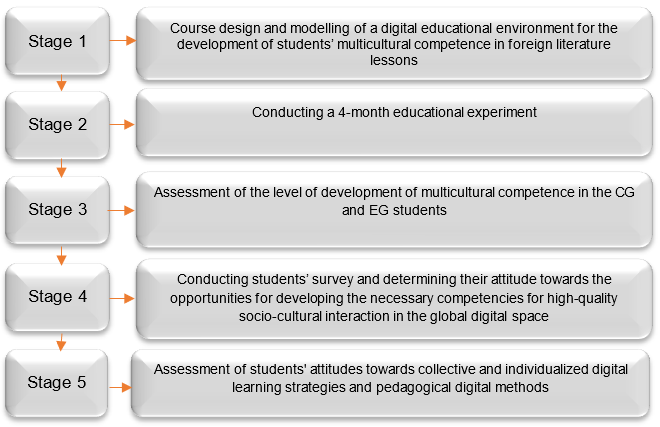
Figure 1. Research stages
Source: developed by the authors
Methods
Instruments
Results and Discussion
The educational experiment proved that studying literature in the modern digital space enables students to acquire the knowledge, skills and practical qualities necessary for high-quality interaction with the international environment. Communication games, seminars, virtual reviews and excursions, as well as visual generation of literary images had a positive impact on the level of students’ multicultural competence. Interaction with educational video content created using AI contributed to the development of analytical and creative skills. In addition, joint work on projects and conducting group research also made a significant contribution to improving intercultural interaction among students. The assessment results showed that the EG students demonstrated a higher level of development of elements of multicultural competence than the CG students (Figure 2).
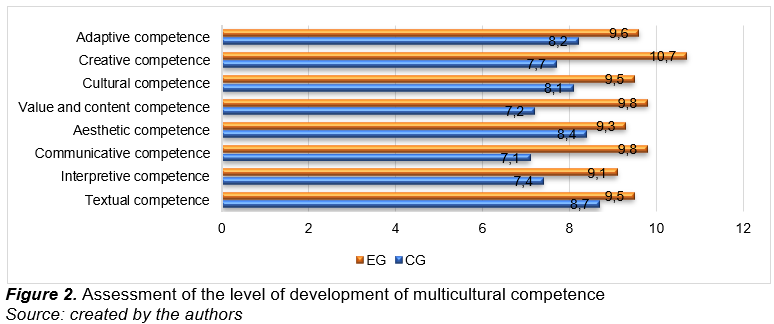
The analysis of the test results proved that digital technologies enable students to expand their perception of literary works. They motivate students to more detailed analysis and active interaction with texts, which contributes to the development of their cultural intelligence and intercultural communication skills. In addition, the results of testing the level of knowledge in the Foreign Literature showed that students who participated in the educational experiment had higher scores. Their scores were 9.1 on average, while this indicator was 7.8 for the CG students. The implemented pedagogical methods, which involved group learning in a simulated digital environment, have proven their effectiveness in the context of developing multicultural competence. The results of the student survey showed that digital technologies are able to improve the quality and efficiency of the educational process. They contribute to the development not only of key elements of multicultural competence, but also of skills for high-quality socio-cultural interaction in the global digital space. The results of the student survey are presented in Table 1.
Table 1.
Students’ attitudes towards opportunities to develop the necessary competencies for high-quality socio-cultural interaction in the global digital space