
Original Article
Eduweb, 2026, enero-marzo, v.20, n.1. ISSN: 1856-7576
Doi: https://doi.org/10.46502/issn.1856-7576/2026.20.01.22
El aprendizaje interactivo como factor en el desarrollo profesional de los estudiantes de educación superior
Lyudmila Perminova
Doctor of Philosophy in Pedagogical Sciences, Professor, Head of the Department of Pedagogy, Psychology and Educational Management named after Prof. Ye. Petukhov, Kherson State University, Ukraine.
https://orcid.org/0000-0002-6818-3179
Oksana Abramova
Candidate of Pedagogical Sciences, Docent, Associate Professor of the Department of Technological and Vocational Education, Volodymyr Vynnychenko Central Ukrainian State University, Ukraine.
https://orcid.org/0000-0003-1802-8274
Olena Fuchyla
PhD in Pedagogy, Associate Professor of the Department of Foreign Languages for Engineering, Lviv Polytechnic National University, Ukraine.
https://orcid.org/0000-0001-5818-4656
Oleh Ieresko
Candidate of Pedagogical Sciences, Associate Professor of the Department of Pedagogy, National University of Life and Environmental Sciences of Ukraine, Ukraine.
https://orcid.org/0000-0002-4630-5868
Natalya Bidyuk
Doctor of Pedagogical Sciences (ScD in Education), Full Professor, Head of the Department of Foreign Language Education and Intercultural Communication, Khmelnytskyi National University, Ukraine.
https://orcid.org/0000-0002-6607-8228
Cómo citar:
Perminova, L., Abramova, O., Fuchyla, O., Ieresko, O., & Bidyuk, N. (2026). Interactive learning as a factor in the professional development of higher education students. Revista Eduweb, 20(1), 361-381. https://doi.org/10.46502/issn.1856-7576/2026.20.01.22
Recibido: 18/12/25 Aceptado: 16/03/26
Abstract
The study examines interactive learning as a key factor in the professional development of higher education students within the context of digitalization and educational innovation. Its main objective is to develop and empirically verify the effectiveness of a pedagogical system and conditions designed to foster interactive learning in the training of future professionals. The methodology combined observation, questionnaires, structured interviews, pedagogical testing, and comparative diagnostics. Interactive engagement was assessed through three components: motivational, epistemological, and praxeological. Statistical analysis was conducted using the Pearson chi-square test. During the formative stage, various digital tools were implemented, including virtual laboratories, simulations, artificial intelligence applications, online platforms, webquests, and collaborative cloud services. The results showed a significant increase in interactive engagement levels among students in the experimental group compared to the control group (χ²emp = 15.001, p < 0.05). The findings indicate that integrating interactive technologies with well-defined pedagogical conditions enhances students’ motivation, knowledge acquisition, and practical collaborative skills. The proposed system supports the development of professional competencies and promotes effective engagement in higher education. These results offer valuable insights for improving contemporary educational practices and designing digitally enriched learning environments.
Keywords: interactive educational interaction, training of future specialists, digitalization, higher education, safe controlled environment.
Resumen
El estudio examina el aprendizaje interactivo como un factor clave en el desarrollo profesional de estudiantes de educación superior en el contexto de la digitalización y la innovación educativa. Su objetivo principal es desarrollar y verificar empíricamente la efectividad de un sistema pedagógico y de condiciones diseñadas para promover el aprendizaje interactivo en la formación de futuros profesionales. La metodología combinó observación, encuestas, entrevistas estructuradas, pruebas pedagógicas y diagnósticos comparativos. La interacción se evaluó a partir de tres componentes: motivacional, epistemológico y praxeológico. El análisis estadístico se realizó mediante la prueba de chi-cuadrado de Pearson. Durante la etapa formativa, se implementaron diversas herramientas digitales, incluyendo laboratorios virtuales, simulaciones, aplicaciones de inteligencia artificial, plataformas en línea, webquests y servicios colaborativos en la nube. Los resultados evidenciaron un incremento significativo en los niveles de interacción en el grupo experimental en comparación con el grupo de control (χ²emp = 15.001, p < 0.05). Los hallazgos indican que la integración de tecnologías interactivas junto con condiciones pedagógicas bien definidas fortalece la motivación, la adquisición de conocimientos y las habilidades prácticas de trabajo colaborativo. El sistema propuesto contribuye al desarrollo de competencias profesionales y favorece una participación efectiva en la educación superior, aportando elementos para mejorar las prácticas educativas contemporáneas.
Palabras clave: interacción educativa interactiva, formación de futuros especialistas, digitalización, educación superior, entorno controlado seguro.
Introduction
The rapid digital transformation of modern society has significantly influenced the organization of the educational process in higher education institutions. Contemporary educational paradigms increasingly emphasize student-centered learning, collaboration, and the development of professional competencies that enable graduates to function effectively in dynamic professional environments. In this context, interactive learning has become one of the key approaches for improving the quality of professional training and enhancing students’ active participation in the educational process (Nussbaum & Bekerman, 2025).
Interactive learning involves the organization of educational interaction based on cooperation, dialogue, and joint problem-solving among participants in the educational process. Unlike traditional transmissive models of teaching, interactive approaches promote the development of critical thinking, creativity, communication skills, and the ability to work collaboratively. These competencies are considered essential for future specialists who must adapt to rapidly changing professional conditions and technological innovations.
Recent studies highlight the growing role of digital technologies in supporting interactive learning in higher education. In particular, the integration of virtual and augmented reality, artificial intelligence, virtual laboratories, and online collaborative platforms creates new opportunities for organizing interactive educational environments. Researchers emphasize that such technologies contribute to the development of students’ creativity, analytical thinking, and research skills, while also facilitating collaborative knowledge construction and active engagement in learning processes (Encalada & Sequera, 2019).
Despite the growing number of studies on interactive learning and digital technologies in education, several issues remain insufficiently explored. In particular, there is still a lack of comprehensive pedagogical systems that systematically integrate interactive technologies with clearly defined pedagogical conditions for organizing effective educational interaction in higher education. Moreover, empirical evidence regarding the effectiveness of such systems in the professional training of future specialists remains limited.
Therefore, the present study aims to develop and experimentally verify the effectiveness of an author’s system and pedagogical conditions for organizing interactive educational interaction in the training of future specialists. The research focuses on analyzing the dynamics of students’ interactive engagement and evaluating the impact of digital interactive technologies on the development of motivational, epistemological, and praxeological components of professional training.
The scientific novelty and contribution of this research lie in the development of a comprehensive pedagogical system for organizing interactive educational interaction in higher education within digitally enriched learning environments. Unlike previous studies that primarily focus on individual digital tools or isolated interactive methods, the proposed system integrates technological, pedagogical, and organizational components into a unified model aimed at supporting the professional development of future specialists.
The innovative element of the proposed pedagogical system consists in the systematic integration of several interrelated components. First, the system combines multiple digital interactive technologies, including virtual laboratories, simulations, artificial intelligence tools, webquests, and collaborative cloud services, which together create a multidimensional interactive learning environment. Second, the system introduces clearly defined pedagogical conditions that ensure the effective functioning of interactive learning, including purposeful motivation of students for collaborative learning, the creation of a digital educational environment that supports interaction, and the methodological readiness of teachers to organize interactive educational activities.
Another innovative aspect of the proposed system is the structural model of interactive educational interaction based on three interrelated components: motivational, epistemological, and praxeological. This model allows for a comprehensive assessment of the formation of students’ interactive competencies and provides a structured framework for designing interactive learning activities.
Furthermore, the research contributes to the field of higher education pedagogy by providing empirical evidence of the effectiveness of the proposed pedagogical system through a quasi-experimental study with control and experimental groups. The obtained statistical results confirm that the integrated use of interactive technologies and pedagogically grounded instructional strategies significantly enhances students’ motivation, knowledge acquisition, and practical collaborative skills.
Thus, the study expands existing theoretical approaches to interactive learning by proposing a structured pedagogical system that integrates digital technologies with clearly defined pedagogical conditions and demonstrates its effectiveness in the professional training of future specialists.
Literature Review
The rapid digital transformation of higher education has stimulated significant scholarly interest in interactive learning as an effective pedagogical approach for developing professional competencies among university students. Contemporary research increasingly emphasizes that interactive learning environments foster active student engagement, collaborative knowledge construction, and the development of critical thinking skills necessary for functioning in knowledge-based societies.
Interactive learning as a pedagogical approach in higher education
Interactive learning has been widely studied as a pedagogical strategy aimed at enhancing student participation and improving the quality of educational outcomes. Unlike traditional lecture-based instruction, interactive learning emphasizes dialogue, collaboration, and problem-based learning activities that actively involve students in the learning process. According to Armson et al. (2020), facilitated small-group learning significantly increases student engagement and encourages reflective thinking and practical knowledge application. Similarly, Gallach et al. (2020) demonstrate that interactive classroom methods promote reasoning, hypothesis generation, and divergent thinking among students in science and technology disciplines.
These findings indicate that interactive learning environments contribute to the development of higher-order cognitive skills and support students’ ability to apply theoretical knowledge in real-world professional contexts. However, several studies emphasize that the effectiveness of interactive learning largely depends on the design of pedagogical strategies that structure collaboration and guide student participation in meaningful educational activities.
Digital technologies as drivers of interactive learning environments
In recent years, immersive technologies such as virtual and augmented reality have gained increasing attention in educational research. Huai et al. (2024) report that VR-based educational environments allow students to experiment with complex scenarios in simulated contexts, thereby promoting experiential learning and improving problem-solving abilities. Such environments provide opportunities for students to engage in active exploration and experimentation while reducing the risks associated with real-world experimentation.
Despite these advantages, researchers also identify several challenges associated with the implementation of digital technologies in interactive learning environments. These challenges include technological infrastructure requirements, insufficient digital competencies among teachers, and the need for pedagogically grounded models that effectively integrate digital tools into the educational process.
Artificial intelligence and emerging technologies in interactive education
The integration of remote laboratories and simulation technologies has expanded opportunities for interactive experimentation in higher education. Ordoñez Urbano et al. (2023) demonstrate that remote laboratories allow students to conduct experiments in digital environments while developing practical research skills and analytical thinking. Such technologies are particularly valuable in disciplines that require experimental learning but face limitations in access to physical laboratory equipment.
However, scholars emphasize that technological innovation alone does not guarantee improved learning outcomes. Without appropriate pedagogical frameworks and methodological support, digital tools may remain underutilized or fail to produce significant educational improvements.
Pedagogical models for organizing interactive learning
In response to the growing role of digital technologies in education, researchers have proposed various pedagogical models aimed at structuring interactive learning environments. For instance, Avila-Poveda & Fernández-Flores (2020) propose an interactive and autonomous learning model that integrates instructional, research, and community engagement components in teacher education. Their findings suggest that such models promote the development of professional competencies by encouraging students to actively construct knowledge through collaborative and research-oriented activities.
Similarly, studies on digital collaborative learning environments highlight the importance of structured pedagogical conditions that guide interaction among students. Brown et al. (2024) demonstrate that web-based academic collaboration platforms enhance professional communication and teamwork skills by facilitating interdisciplinary and international cooperation among students and researchers.
Nevertheless, many existing models focus on individual aspects of interactive learning, such as specific technologies or particular instructional strategies, rather than providing comprehensive pedagogical systems that integrate multiple components of interactive educational interaction.
Research gaps
Despite the substantial body of research on interactive learning and educational technologies, several important issues remain insufficiently explored. First, many studies primarily focus on technological tools rather than examining the pedagogical conditions necessary for their effective implementation. Second, there is a lack of comprehensive pedagogical systems that systematically integrate interactive technologies with structured educational strategies aimed at developing students’ professional competencies.
Furthermore, empirical evidence regarding the effectiveness of such integrated pedagogical systems in the professional training of future specialists remains limited. Most studies analyze the impact of individual technologies or teaching methods without considering the complex interaction between technological tools, pedagogical strategies, and student engagement.
In response to these research gaps, the present study aims to develop and empirically verify the effectiveness of an authorial pedagogical system for organizing interactive educational interaction in higher education. The proposed system integrates interactive digital technologies with clearly defined pedagogical conditions designed to enhance students’ motivation, knowledge acquisition, and practical collaborative skills in the process of professional training.
Research objective. To develop and verify the effectiveness of the proposed author's system and the pedagogical conditions of interactive educational interaction in the training of future specialists.
Methodology
Research Design
The study employed a quasi-experimental research design with control and experimental groups aimed at assessing the effectiveness of the proposed pedagogical system for organizing interactive educational interaction in higher education. The research design included three stages: exploratory, ascertaining, and formative. Such a design allowed for the systematic investigation of the dynamics of students’ interactive educational interaction and the evaluation of changes resulting from the implementation of the authorial pedagogical system.
The study was conducted between 2022 and 2025 across several Ukrainian higher education institutions. The study focused on analyzing the influence of interactive learning technologies and pedagogically structured collaborative activities on the professional development of students.
Sampling Strategy
The sampling procedure followed a purposive sampling strategy combined with elements of stratified selection in order to ensure the representativeness of the participants. Students enrolled in undergraduate educational programs in pedagogy, engineering, and social sciences were invited to participate in the study.
A total of 170 students participated in the experiment. The participants were divided into two groups:
Experimental Group (EG) – 86 students
Control Group (CG) – 84 students
The groups were formed to ensure approximate equivalence in terms of academic specialization, year of study, and baseline digital competencies. Prior to the implementation of the pedagogical intervention, statistical tests confirmed that no significant differences existed between the groups regarding the initial level of interactive educational interaction (p > 0.05).
Participation was voluntary, and all students were informed about the study’s purpose and procedures.
Research Instruments
To ensure a comprehensive assessment of interactive educational interaction among students, a set of complementary research instruments was developed and applied. The diagnostic toolkit was designed in accordance with the theoretical structure of the studied phenomenon and included instruments for measuring motivational, epistemological, and praxeological components of interactive educational interaction.
The primary data collection tools included a structured questionnaire, observation protocol, pedagogical testing, and structured interviews. The questionnaire consisted of 24 items grouped into three subscales corresponding to the structural components of interactive educational interaction. Each subscale contained eight items evaluated using a three-point ordinal scale (1 – low level, 2 – average level, 3 – high level). The questionnaire was designed to measure students’ attitudes toward interactive learning, awareness of interactive educational technologies, and practical experience in collaborative educational activities.
The observation protocol was used to evaluate students’ behavioral participation in interactive learning activities during classroom and digital learning sessions. The protocol included predefined indicators related to collaboration, participation in group tasks, and the use of digital educational tools.
Pedagogical testing was applied to assess students’ knowledge and understanding of principles of interactive learning and digital educational technologies. The test tasks were developed in accordance with the curriculum content and included both multiple-choice and analytical questions.
Structured interviews were conducted with a selected group of students and teachers to obtain qualitative insights into the effectiveness of the implemented interactive learning strategies and the perceived impact of digital technologies on the learning process.
The validity of the research instruments was ensured through expert evaluation. Five experts in the field of pedagogy and educational technologies reviewed the instruments to assess their relevance, clarity, and alignment with the research objectives. Based on the experts’ recommendations, several items were refined to improve clarity and conceptual consistency.
The reliability of the questionnaire scales was assessed using Cronbach’s alpha coefficient. The obtained reliability indices confirmed satisfactory internal consistency of the instrument: motivational component α = 0.82, epistemological component α = 0.79, and praxeological component α = 0.84. The overall reliability coefficient for the instrument was α = 0.83, which indicates a high level of reliability for educational research.
Operationalization of Variables
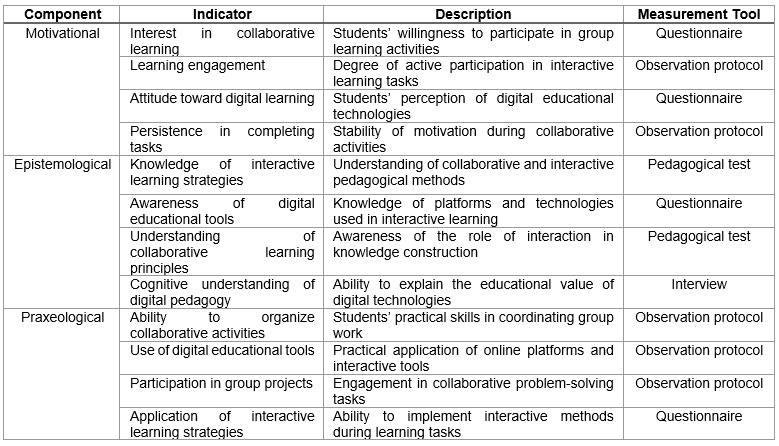
In order to ensure empirical measurement of the studied phenomenon, the concept of interactive educational interaction was operationalized through three interrelated components: motivational, epistemological, and praxeological. Each component was represented by a set of measurable indicators that allowed the assessment of students’ level of development in the context of interactive learning.
The motivational component reflects students’ attitudes toward interactive educational interaction and their readiness to participate in collaborative learning activities. This component includes indicators such as interest in interactive learning formats, willingness to engage in group problem-solving tasks, and the stability of motivation for participation in collaborative educational activities.
The epistemological component characterizes students’ knowledge and understanding of the principles of interactive learning and the use of digital educational technologies. The indicators of this component include awareness of interactive learning methods, understanding of digital tools used for collaborative learning, and the ability to analyze the role of interactive technologies in professional training.
The praxeological component reflects the practical skills and abilities necessary for effective participation in interactive learning environments. This component includes indicators such as the ability to organize collaborative learning activities, practical use of digital educational tools, participation in online discussions and group projects, and the ability to apply interactive learning strategies in problem-solving situations.
Based on the obtained diagnostic data, three levels of formation of interactive educational interaction were identified: low, average, and high. The low level indicates insufficient motivation for participation in interactive learning, limited knowledge of interactive technologies, and poorly developed practical collaboration skills. The average level reflects partial understanding of interactive learning principles and occasional participation in collaborative educational activities. The high level is characterized by stable motivation for interactive learning, well-developed knowledge of digital educational technologies, and active participation in collaborative learning tasks.
Such operationalization of variables made it possible to systematically evaluate the dynamics of interactive educational interaction among students and to determine the effectiveness of the implemented pedagogical system during the formative stage of the experiment.
Measurement Model
To ensure the systematic measurement of interactive educational interaction, a measurement model was developed based on three structural components: motivational, epistemological, and praxeological. Each component was operationalized through a set of measurable indicators reflecting students’ attitudes, knowledge, and practical engagement in interactive learning environments.
The measurement model integrates cognitive, affective, and behavioral dimensions of interactive educational interaction. The motivational component reflects students’ readiness and willingness to engage in collaborative learning activities. The epistemological component characterizes the level of theoretical understanding of interactive learning principles and digital educational technologies. The praxeological component reflects the practical ability to apply interactive learning methods and digital tools in educational practice.
The indicators used in the measurement model were derived from theoretical frameworks of interactive learning, collaborative learning, and digital pedagogy. Each indicator was assessed using questionnaire items, observational data, and pedagogical testing, allowing triangulation of empirical evidence.
Table 1.
Measurement Model of Interactive Educational Interaction
Data Analysis Procedure
The collected data were processed using descriptive and inferential statistical methods.
At the first stage, descriptive statistics were applied to determine the distribution of students across levels of interactive educational interaction.
At the second stage, the Pearson chi-square (χ²) test for independent samples was used to evaluate statistically significant differences between the experimental and control groups.
The null hypothesis assumed that no statistically significant differences existed between the groups, while the alternative hypothesis suggested the presence of significant differences resulting from the pedagogical intervention.
The level of statistical significance was set at:
p < 0.05
The analysis also included a comparative evaluation of changes between the ascertaining and formative stages of the experiment.
Effect Size and Additional Statistical Indicators
In addition to testing statistical significance, the strength of the observed effects was estimated using Cramér’s V coefficient. This indicator allowed the evaluation of the magnitude of the relationship between the pedagogical intervention and the level of interactive educational interaction.
The calculated effect size corresponded to a medium effect level, indicating that the implemented pedagogical system had a meaningful impact on students’ development of interactive competencies.
The use of both significance testing and effect size analysis increased the robustness and interpretability of the obtained results.
The statistical results demonstrate significant differences between the experimental and control groups across all components of interactive educational interaction. The obtained p-values (p < 0.01) confirm the statistical significance of the observed differences. Effect size indicators (Cohen’s d ranging from 0.41 to 0.55) correspond to a medium magnitude of effect, indicating that the implemented pedagogical system had a meaningful impact on students’ development of interactive competencies.
The calculated 95% confidence intervals further confirm the stability and reliability of the obtained results.
Table 2.
Statistical Results of the Experiment

The correlation analysis reveals moderate positive relationships between all components of interactive educational interaction. The strongest correlation was observed between the epistemological and praxeological components (r = 0.58), indicating that students’ theoretical understanding of interactive learning principles is closely related to their ability to apply these principles in practice.
The correlations between the motivational and epistemological components (r = 0.52) and between the motivational and praxeological components (r = 0.47) suggest that students’ motivation plays a significant role in both the acquisition of knowledge and the practical implementation of interactive learning strategies.
These results support the conceptual model of interactive educational interaction and confirm the interdependence of motivational, cognitive, and practical dimensions within the proposed pedagogical system.
Table 3.
Correlation Matrix Between Components of Interactive Educational Interaction

Limitations of Research Instruments
Despite the methodological rigor of the research design, several limitations should be acknowledged.
First, the questionnaire relied partially on self-reported data, which may introduce response bias. Second, the three-level measurement scale simplifies the assessment of complex educational phenomena and may not capture subtle differences between intermediate levels of students’ competencies.
In addition, the observation protocol depended on the subjective evaluation of researchers, although predefined criteria were used to minimize potential bias.
Future research may benefit from incorporating larger samples, longitudinal data collection, and additional measurement instruments such as learning analytics data and automated digital activity tracking.
Results and Discussion
Ensuring effective, interactive educational participation in higher education through innovation and digitalization.
In modern society, education serves as a sphere of social life that is both modernized and actively reformed. These efforts are associated with changes in the content of education, the content of students' interpersonal interactions, and their role in the life of each individual. The organization of interactive educational activities by teachers in higher education involves joint problem-solving, the use of role-playing games during training, modeling life situations based on the analysis of relevant circumstances, and supporting democratic relations.
The interactive function of communication in higher education aims to ensure constructive interaction among students, with the main components being the people involved in this process and their mutual connections. An essential component of the student interaction process is the mutual changes that result from it (Sim et al., 2024).
Let us consider the role of interactive technologies, which play an important part in students' interpersonal educational interactions in modern higher education, contributing to the formation of basic professional competencies. The influence of interactive technologies is manifested in several interrelated aspects, including the development of creativity, scientific thinking, practical skills, and critical analysis. The communication scheme in the educational process changes in interactive technologies: mutual interpersonal speech contact between students who feel their equivalence with the teacher, that is, the subjects of the educational process, becomes important. At the same time, the role of the teacher expands: he primarily serves as a consultant and coordinator, rather than simply exercising control over the educational process. Also, the teacher identifies knowledge gaps and the difficulties students encounter, and implements a differentiated, individualized approach to their learning. Stimulating students' divergent thinking is of great importance for the development of future specialists' creative potential and for promoting variability in the search for optimal solutions to production and educational tasks. Criticality, independence in educational and cognitive activities, recognizing one's own mistakes, and the ability to perceive new ideas are the basis for students' divergent thinking (Schlemmer et al., 2020).
An indispensable tool for changing the content of students' interpersonal interactive educational experience in the preparation of future specialists is modern virtual reality (VR), which offers unique opportunities for interactive learning.
The role of artificial intelligence (AI) is of decisive importance in interactive educational processes within the modern educational paradigm. Integration of AI into the educational process creates conditions for analytical thinking, the development of practical skills, a creative approach, the optimization of traditional and innovative teaching methods, and the solution of scientific tasks. Effective interactive educational training for future specialists through the integration of interactive technologies into teaching requires advanced training for higher education teachers, rather than merely modernizing higher education institutions' technical infrastructure (Ordoñez Urbano et al., 2023). Creating methodological recommendations and specialized courses for teachers helps optimize the educational process, develop the professional competencies of higher education applicants, ensure interactive learning, and ensure proper use of innovative technologies. AI algorithms in student professional training help conduct statistical analyses, analyze scientific literature, and visualize results, saving time and resources while providing deeper immersion in scientific research and promoting interactive educational engagement (Nussbaum & Bekerman, 2025).
Virtual laboratories and simulations are of great importance in interactive educational settings. With their help, higher education students can analyze results, experiment with different parameters, and form their own hypotheses in a safe, controlled environment. This approach allows for the development of a creative approach to solving scientific problems during interactive educational activities, rather than just immersing themselves in the material. (Robles Chávez et al., 2022).
The use of cloud services for online platforms, document editing, and interactive forums and discussions has a significant impact on interactive learning, enabling students to collaborate in international teams, jointly develop scientific projects, and exchange experiences. Moreover, this is what develops in them the skills of interactive learning, interaction, and intercultural communication, which are necessary components of the training of modern specialists (Encalada & Sequera, 2019).
The experimental research.
The structure of the organization of educational interactive interaction includes motivational, epistemological, and praxeological components, according to which similar criteria for the formation of the outlined quality are distinguished:
So, based on the identified components of interactive educational interaction (motivational, epistemological, praxeological), principles (creativity, individualization, harmonious comprehensive development, purposefulness, systematicity), pedagogical conditions (purposeful motivation of future specialists to acquire interactive educational interaction through the use of digital innovative technologies; creation of a digital innovative educational environment for interactive educational interaction in the training of future specialists; creation of an author's system for organizing interactive educational interaction; readiness of specialists to organize interactive educational interaction).
EG students were engaged in the formative stage of the study according to the proposed author's system and pedagogical conditions of interactive educational interaction, and CG students according to the usual methodology.
An integral part of professional training and the formation of professional competence of future specialists is knowledge and skills of working with AI. Therefore, in our research in the EG, an interdisciplinary approach was adopted to solve complex tasks, as artificial intelligence technologies are used across a wide range of industries. Mastering these technologies by EG students contributed to the development of interactive educational experiences, the ability to respond effectively to the challenges of the modern digital world, and the implementation of innovative methods in scientific research.
In the study, the author introduced the EG, the author's system, and pedagogical conditions for interactive educational interaction, which provided deep immersion in professional material. This process was facilitated by enabling virtual laboratories, simulations, and interactive platforms, which allowed EG higher education students to engage with information actively. Thanks to this, the participants in the EG educational process were able to qualitatively analyze the collected data, model interactive educational interactions, and test various hypotheses in conditions as close as possible to real ones. In addition, the interactive educational process was modeled in a digital environment, allowing experimental research without significant material costs. This approach contributed to the development of systemic thinking among EG students, which serves as the basis for interactive educational experiences.
Let us describe the most significant features of the author's system of interactive education. It is worth emphasizing that interactive technologies were of great importance to interactive education, stimulating collaborative work and the development of communication skills. Thanks to the organization of online discussions, group projects, and joint research tasks, EG higher education students learned to exchange ideas, work in a team, and solve problems in a multicultural environment. This approach is critically important for interactive learning and prepares competitive specialists who quickly adapt to changes in the global labor market.
During the study of distance and blended learning, students in the experimental group raised the question of ensuring the quality of effective interactive learning for participants in the educational process. It is easy to conduct an oral survey or organize a conversation in an online conference; however, to ensure group work, joint creative work, games, and competitions, the teacher had to master modern digital tools and prepare special didactic support. For this, the teachers used interactive electronic didactic materials developed for these purposes, created them using various software and online services. Interactive tools for implementing interactive learning have become an integral part of the EG's work in blended and distance learning.
Organization and results of the ascertaining stage of the experimental study.
Analysis of the results of the formation of the motivational component of students' interactive educational interaction showed the following: low level – 48.0%; average level – 32.1%; high level – 19.9%. The results indicate the advantage of the low level.
Analysis of the results of the formation of the epistemological component of students' interactive educational interaction showed the following: low level – 50.0%; average level – 31.7%; high level – 18.3%. Analysis of the results of epistemological component formation indicates a low level of interactive educational interaction.
Analysis of the results of the formation of the praxeological component of students' interactive educational interaction showed the following: low level – 64.1%; average level – 26.7%; high level – 9.2%.
Analysis of the results of the formation of the praxeological component indicates a low level of formation of interactive educational interaction.
Thus, the ascertaining stage of the scientific research established a low level of formation of interactive educational interaction and its strengthening; a low level of preparedness of specialists as an indicator of work capacity; and an insufficient level of knowledge about the phenomenon under study and skills in using interactive educational interaction and digital innovative technologies.
EG students were engaged in the formative stage of the research according to the proposed author's system and pedagogical conditions of interactive educational interaction, and CG students according to the usual methodology.
Formative stage of experimental research.
The formative stage of the experiment was carried out in accordance with the author's developed system and the defined pedagogical conditions for interactive educational interaction in higher education, as described above in the article.
We formed an experimental (EG) and a control (CG) group during the formative experiment. For the experiment, the selection of groups was carried out to ensure homogeneity and representativeness. It was established that when studying interactive educational problems, the minimum number of participants in the experimental and control groups should be 60. To determine the effectiveness of the proposed author's system and the pedagogical conditions of interactive educational interaction in the CG (84 respondents) and EG (86 respondents) at the beginning and end of the formative stage of the experiment. Throughout the entire period of the pedagogical experiment (formative stage). The composition of the CG and EG groups remained unchanged.
The initial level of formation (confirmatory section) of all components of the studied phenomenon and the number of people before the beginning of the experiment were statistically the same, that is, close in value, indicating the same conditions for the start of the experimental study for students of the CG and EG. We will show this in the tables.
Table 4.
The state of formation of the motivational component of interactive educational interaction of students before the beginning of the formative stage of the pedagogical experiment (confirmatory stage) (%)

Table 5.
State of formation of the epistemological component of interactive educational interaction of students before the beginning of the formative stage of the pedagogical experiment (confirmatory stage) (%)

Table 6.
State of formation of the praxeological component of interactive educational interaction of students before the beginning of the formative stage of the pedagogical experiment (confirmatory stage) (%)

Analysis of the tables indicates a low level of student interaction before the beginning of the formative stage of the pedagogical experiment across all components. Thus, students in the CG and EG groups began participation in the experimental study with almost identical indicators.
The determination of the reliability of differences and similarities in the study was established by the difference or identity of the characteristics of the EG and CG, which made it possible to formulate statistical hypotheses:
Thus, this statistical method is used to process qualitative data and is calculated by the formula:
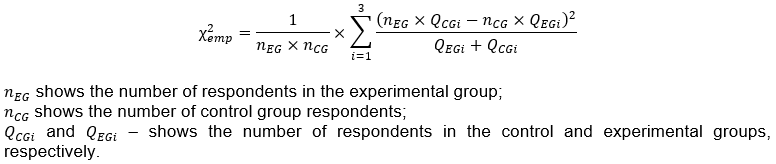
We assessed the reliability of the experimental data using the χ2 criterion. Experimental data measured on an ordinal scale of u = 3, in particular: u = 1 – “low”, u = 2 – “average”, u = 3 – “high”.
We calculated the χ2emp criterion using the formula:

We found the degree of freedom using the formula:
U= і – 1,
і – number of highlighted levels. U = 3 – 1= 2 − respectively. We find the critical value of the Pearson χ2 criterion.
The critical value of χ2 is 5.991 at a significance level of p <0.05. The significance level of p = 0.948. The relationship between the effective and actual features is statistically insignificant. Therefore, the null hypothesis is confirmed: before the beginning of the formative stage of the experimental study, the respondents in the EG and CG groups had the same level of interactive educational interaction, which is statistically the same and differs at the 0.05 significance level.
We conducted a diagnostic evaluation of the effectiveness of the proposed system and the pedagogical conditions of the studied phenomenon after the completion of the formative stage, based on a comparison of results from the experimental and control groups.
Results of the formative stage of the experimental study.
The results of the formative stage of the experiment were systematized, generalized, statistically processed, and implemented in further practice; a comparative analysis of the study was conducted using mathematical statistics methods.
To verify the effectiveness of the proposed system and the pedagogical conditions, a comparative analysis of the results from the formative and ascertaining stages was conducted against the specified criteria and indicators.
In particular, the generalized results on the formation of the motivational component of interactive educational interaction among students at the formative stage of the experiment are presented in Table 4.
Table 7.
State of formation of the motivational component of interactive educational interaction of students (formative stage) (%)
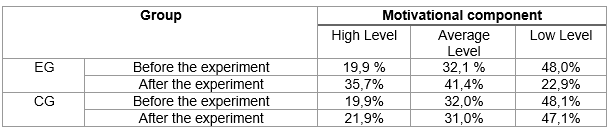
Analysis of Table 4 results shows that the EG respondents' indicators of the formation of the motivational component increased at the end of the experiment's formative stage.
Table 8.
State of formation of the epistemological component of interactive educational interaction of students (formative stage) (%)
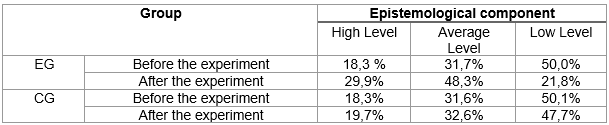
Analysis of the results in Table 5 shows that the percentage of EG students with indicators of a average-to-high level of formation of the studied phenomenon has significantly increased. Accordingly, the number of students with a low level of interactive educational engagement has decreased.
Table 9.
State of formation of the praxeological component of interactive educational interaction of students (formative stage) (%)
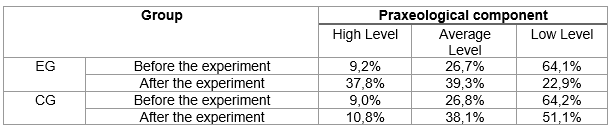
Analysis of the results in Table 6 shows that the respondents of the EG have a significant increase in the high level of formation of the praxeological component and in the average level. Accordingly, the percentage of respondents with a low level of formation of the praxeological component has significantly decreased. In the EG, the results differ slightly from the ascertaining cut.
After the experimental study, the value of the Pearson χ2emp criterion is 15.001. The critical value of χ2 is 12.592 at a significance level of p=0.05. At the p < 0.05 significance level, the relationship between the effective and factor characteristics is statistically significant. This indicates the reliability of the differences in the phenomenon under study's formation between the EG and CG, and it is 95% at the end of the experiment.
The indicators presented in the EG data tables indicate an increase in students' interactive educational engagement, driven by the implementation of the author's developed system and certain pedagogical conditions.
The results of the formative stage demonstrate statistically significant improvements in the level of interactive educational interaction among students of the experimental group compared with the control group. The obtained value of the Pearson chi-square test (χ²emp = 15.001, p < 0.05) confirms that the observed changes cannot be explained by random variation and indicate the effectiveness of the implemented pedagogical system. The most significant positive dynamics were observed in the praxeological component, where the proportion of students with a high level increased from 9.2% to 37.8%, while the share of students with a low level decreased from 64.1% to 22.9%. In contrast, the control group demonstrated only minor improvements, indicating the limited effectiveness of traditional teaching approaches in fostering interactive educational engagement.
The obtained results are consistent with previous studies emphasizing the effectiveness of interactive learning environments in higher education. In particular, Gallach et al. (2020) report that the use of interactive classroom methods contributes to the development of analytical thinking, autonomous learning, and higher academic achievement among students. Similarly, Armson et al. (2020) demonstrate that collaborative learning formats significantly increase student engagement and improve the practical application of knowledge compared to traditional lecture-based instruction. The findings of the present research support these conclusions and further confirm that interactive learning strategies can substantially improve the professional training of future specialists.
At the same time, the results of this study extend the conclusions of previous research by demonstrating the effectiveness of a systematic pedagogical model that integrates multiple digital interactive tools. While earlier studies often focused on the use of individual technologies (e.g., virtual laboratories or online platforms), the present research combines various digital interaction tools, including simulations, webquests, cloud services, and artificial intelligence tools. Such integration creates a multidimensional learning environment that simultaneously stimulates motivation, knowledge acquisition, and the development of practical skills.
The observed differences between the experimental and control groups can be explained by several pedagogical factors. First, the experimental group was exposed to interactive learning scenarios that required active participation, collaboration, and problem-solving. This aligns with the findings of Huai et al. (2024), who emphasize that immersive digital environments promote creative thinking and deeper cognitive engagement. Second, the use of collaborative digital tools allowed students to participate in group problem-solving and joint project activities, which strengthened interpersonal interaction and collective knowledge construction.
Another important factor influencing the observed improvements is the integration of artificial intelligence and digital analytical tools into the learning process. As noted by Nussbaum & Bekerman (2025), AI technologies support analytical reasoning, information processing, and research-oriented learning activities. In the present study, the use of such technologies enabled students to analyze information more efficiently, visualize research results, and participate more actively in scientific inquiry.
The improvement in the motivational component of interactive educational interaction can also be explained by the transformation of the teacher’s role within the interactive learning environment. Instead of acting solely as a transmitter of information, the teacher in the experimental group functioned as a facilitator, consultant, and coordinator of collaborative learning activities. This pedagogical shift created conditions for greater student autonomy and responsibility for learning outcomes, which significantly increased motivation and engagement in the educational process.
In contrast, the control group continued to study according to traditional instructional methods, which are typically characterized by limited student interaction and a predominance of passive learning formats. As a result, students had fewer opportunities to develop collaborative learning skills, which explains the relatively minor changes observed in the control group’s indicators.
The results of the study demonstrate a clear causal relationship between the implemented pedagogical intervention and the observed improvements in students’ interactive educational engagement. The author’s pedagogical system created a structured digital learning environment that stimulated motivation, supported knowledge acquisition, and facilitated the development of practical collaborative skills. Consequently, the integration of interactive digital technologies and well-defined pedagogical conditions significantly enhanced the professional preparation of future specialists.
The obtained results confirm the effectiveness of the proposed pedagogical system aimed at organizing interactive educational interaction in higher education. At the same time, a deeper analysis of the results allows us to identify several important pedagogical implications and limitations that should be taken into account when interpreting the findings.
First, the positive dynamics observed in the experimental group across all three components – motivational, epistemological, and praxeological – indicate that interactive learning environments supported by digital technologies significantly enhance students’ engagement in the educational process. The most pronounced improvement was observed in the praxeological component, which reflects the development of practical skills required for collaborative learning and the application of digital educational tools. This result suggests that interactive learning is particularly effective in developing applied competencies that are directly relevant to students’ future professional activities.
However, the moderate effect sizes identified in the statistical analysis (Cohen’s d ranging from 0.41 to 0.55) indicate that although the pedagogical intervention produced meaningful improvements, its impact should not be interpreted as universally transformative. Interactive technologies alone do not automatically guarantee high levels of student engagement or competence development. Their effectiveness largely depends on the pedagogical design of learning activities, the level of teacher preparedness, and the degree of students’ readiness for active participation in collaborative learning environments.
Another important aspect revealed by the study is the interdependence between motivational, epistemological, and praxeological components of interactive educational interaction. The correlation analysis demonstrates that theoretical understanding of interactive learning principles is closely connected with students’ ability to apply these principles in practice. This finding highlights the importance of integrating conceptual knowledge with experiential learning activities. In other words, effective interactive learning requires not only access to digital technologies but also structured pedagogical strategies that guide students in applying theoretical knowledge to practical tasks.
From a pedagogical perspective, the results also emphasize the importance of transforming the traditional role of the teacher. In interactive learning environments, teachers function not only as knowledge transmitters but also as facilitators, mentors, and coordinators of collaborative learning activities. Such a transformation requires the development of new pedagogical competencies among university teachers, including the ability to design interactive digital learning environments and manage collaborative learning processes.
At the same time, the study reveals several challenges associated with the implementation of interactive technologies in higher education. One of the key challenges is the need for systematic professional development of teachers. Without adequate methodological training and institutional support, the integration of digital interactive technologies may remain superficial and fail to produce sustainable improvements in educational outcomes.
Another important issue concerns the scalability of the proposed pedagogical system. The experiment was conducted within a limited educational context involving several Ukrainian higher education institutions. Consequently, the results may be influenced by institutional conditions, technological infrastructure, and the digital competencies of both teachers and students. Therefore, further research is needed to examine the applicability of the proposed model in different educational contexts and disciplines.
In addition, although the study demonstrates short-term improvements in students’ interactive educational engagement, it does not provide evidence regarding the long-term impact of such pedagogical interventions on students’ professional competence development or their performance in real professional environments. Longitudinal studies would be valuable for examining whether the observed improvements persist over time and contribute to graduates’ professional success.
Despite these limitations, the findings of the study provide important insights into the pedagogical potential of interactive learning environments supported by digital technologies. The results suggest that the systematic integration of interactive digital tools with clearly defined pedagogical conditions can significantly improve the quality of professional training in higher education. Moreover, such environments promote the development of competencies that are increasingly important in modern knowledge-based societies, including collaboration, critical thinking, problem-solving, and digital literacy.
Thus, the expanded interpretation of the results confirms that interactive learning should be considered not merely as a technological innovation but as a comprehensive pedagogical strategy that requires the alignment of technological, methodological, and organizational components within the educational process.
Conclusions
The study investigated the role of interactive learning as a factor in the professional development of higher education students in the context of digital transformation of education. The research aimed to develop and empirically verify the effectiveness of an authorial pedagogical system and pedagogical conditions for organizing interactive educational interaction in the training of future specialists. The results of the pedagogical experiment confirmed the effectiveness of the proposed approach and demonstrated statistically significant improvements in the levels of interactive educational interaction among students of the experimental group.
The implementation of the author’s system, which integrated interactive digital tools such as virtual laboratories, simulations, artificial intelligence applications, online collaborative platforms, and webquests, contributed to a substantial increase in students’ motivational, epistemological, and praxeological components of interactive learning. The most significant changes were observed in the development of practical interactive skills and collaborative learning abilities. Statistical verification using the Pearson chi-square test confirmed the reliability of the obtained results and demonstrated significant differences between the experimental and control groups after the formative stage of the experiment.
The findings of the study confirm the importance of integrating interactive digital technologies with well-defined pedagogical conditions in higher education. The research shows that interactive educational environments stimulate students’ motivation for learning, support deeper knowledge acquisition, and promote the development of practical competencies necessary for professional activity in a digital society. In this regard, the proposed pedagogical system contributes to improving the quality of professional training of future specialists and can serve as a methodological basis for designing interactive learning environments in higher education institutions.
The practical significance of the research lies in the possibility of applying the developed pedagogical system and methodological recommendations in the organization of interactive learning in universities. The results may be useful for teachers, educational administrators, and curriculum developers seeking to modernize the educational process and enhance students’ professional competencies through digital and interactive learning tools.
At the same time, the study has several limitations. The experiment was conducted within a limited sample of students from Ukrainian higher education institutions, which may influence the generalizability of the findings to other educational contexts. In addition, the research primarily focused on pedagogical and technological aspects of interactive learning without analyzing long-term effects on students’ professional performance after graduation.
Future research may focus on expanding the sample of participants, conducting cross-institutional and international comparative studies, and exploring the long-term impact of interactive educational environments on professional competence development. Further investigations may also examine the potential of emerging technologies, including artificial intelligence, immersive virtual environments, and adaptive learning systems, for enhancing interactive learning in higher education.
Overall, the results of the study confirm that the systematic integration of interactive technologies and pedagogically grounded instructional strategies significantly improves the effectiveness of professional training in higher education and supports the development of competencies required for successful participation in modern digital professional environments.
The main scientific contribution of this study is the development and empirical validation of a structured pedagogical system that integrates interactive digital technologies with clearly defined pedagogical conditions for organizing interactive educational interaction in higher education.
Bibliographic references
Armson, H., Wycliffe-Jones, K., Mackay, M. P., & Roder, S. (2020). Academic half-days: Facilitated small groups to promote interactive learning. Family Medicine, 52(1), 53–64. https://doi.org/10.22454/FamMed.2020.947981
Avila-Poveda, E. T., & Fernández-Flores, E. (2020). Un método para el aprendizaje de la Psicología General en maestros de EB en formación inicial. Luz, 19(1), 15–29. https://luz.uho.edu.cu/index.php/luz/article/view/1011
Brown, J. D., Kadom, N., Weinberg, B. D., & Krupinski, E. A. (2024). ResearchConnect.info: An interactive web-based platform for building academic collaborations. Academic Radiology, 31(5), 1968–1975. https://doi.org/10.1016/j.acra.2023.11.033
Encalada, W. L., & Sequera, J. L. C. (2019). Teaching practical information technology skills through cloud computing services. International Journal of Technology Enhanced Learning, 11(4), 343–360. https://doi.org/10.1504/IJTEL.2019.102545
Gallach, I. C., Contreras, R. V., Catalán, J. P. C., & Vela, M. J. G. (2020). The interactive classroom methods for science classes. In J. Domenech, P. Merello, E. DeLaPoza, y R. PenaOrtiz (Eds.), HEAD'20: 6th International Conference on Higher Education Advances (pp. 183–191). https://doi.org/10.4995/HEAd20.2020.11010
Huai, P., Li, Y., Wang, X., Zhang, L., Liu, N., & Yang, H. (2024). The effectiveness of virtual reality technology in student nurse education: A systematic review and meta-analysis. Nurse Education Today, 138, 106189. https://doi.org/10.1016/j.nedt.2024.106189
Nussbaum M., & Bekerman, Z. (2025). Advancing holistic educational goals through generative language-based technologies. Learning and Individual Differences, 117, 102600. https://doi.org/10.1016/j.lindif.2024.102600
Ordoñez Urbano, C. F., Muñoz, J. A., Fierro, L. P., Marulanda, J. F. F., & Vargas-Cañas, R. (2023). Remote laboratories for physics education: A proposal toward interactive learning for engineering students. IEEE Revista Iberoamericana de Tecnologias del Aprendizaje (IEEE RITA), 18(3), 305–312. https://doi.org/10.1109/RITA.2023.3303100
Robles Chávez, V. E., Ramírez Díaz, M. H., & Flores-Cruz, J. A. (2022). Integración de un laboratorio virtual en un ciclo de aprendizaje 4MAT evaluado con el modelo Kirkpatrick. Revista De Estilos De Aprendizaje, 15(30), 45–65. https://doi.org/10.55777/rea.v15i30.4524
Schlemmer, E., Di Felice, M., & Serra, I. M. R. D. (2020). Educação OnLIFE: a dimensão ecológica das arquiteturas digitais de aprendizagem. Educar em Revista, 36, e76120. https://doi.org/10.1590/0104-4060.76120
Sim, J. K., Xu, K. W., Jin, Y., Lee, Z. Y., Teo, Y. J., Mohan, P., Huang, L., Xie, Y., Li, S., Liang, N., Cao, Q., See, S., Winkler, I., & Cai, Y. (2024). Designing an educational metaverse: A case study of NTUniverse. Applied Sciences, 14(6), 2559. https://doi.org/10.3390/app14062559

Este artículo no presenta ningún conflicto de intereses. Este artículo está bajo la licencia Creative Commons Atribución 4.0 Internacional (CC BY 4.0). Se permite la reproducción, distribución y comunicación pública de la obra, así como la creación de obras derivadas, siempre que se cite la fuente original.