
Original Article
Eduweb, 2026, abril-junio, v.20, n.2. ISSN: 1856-7576
Doi: https://doi.org/10.46502/issn.1856-7576/2026.20.02.8
Effectiveness of cloud-based learning environments in the training of future specialists: A quasi-experimental study
Sofiya Chovriy
Candidate of Pedagogical Sciences, Associate Professor, Associate Professor at the Department of Pedagogy, Psychology, Primary, Pre-School Education and Management of Educational Institutions, Ferenc Rakoczi II Transcarpathian Hungarian University, Ukraine.
https://orcid.org/0000-0001-9271-004X
Liubov Prokopiv
Candidate of Pedagogical Sciences, Professor, Head of the Department of the Bohdan Stuparyk Department of Pedagogy and Educational Management, Vasyl Stefanyk Кarpathian National University, Ukraine.
https://orcid.org/0000-0001-8661-510X
Mariana Dereniuk
Doctor of Philosophy (PhD), Assistant of the Bohdan Stuparyk Department of Pedagogy and Educational Management, Vasyl Stefanyk Carpathian National University, Ukraine.
https://orcid.org/0000-0002-6914-8797
Iryna Kuchera
Candidate of Historical Sciences, Associate Professor, Associate Professor of the Department of Philosophy, Sociology and Religious Studies, Vasyl Stefanyk Carpathian National University, Ukraine.
https://orcid.org/0000-0003-3680-6893
Denys Diahel
PhD in State Border Security, Associate Professor of the Border Security Department, Faculty of Professional Education and Leadership, Bohdan Khmelnytskyi National Academy of the State Border Guard Service of Ukraine, Ukraine.
https://orcid.org/0000-0003-1304-8188
Cómo citar:
Chovriy, S., Prokopiv, L., Dereniuk, M., Kuchera, I., & Diahel, D. (2026). Effectiveness of cloud-based learning environments in the training of future specialists: A quasi-experimental study. Revista Eduweb, 20(2), 119-136. https://doi.org/10.46502/issn.1856-7576/2026.20.02.8
Recibido: 10/01/26 Aceptado: 16/05/26
Resumen
Este estudio tiene como objetivo evaluar la efectividad de un entorno de aprendizaje basado en la nube para la formación de futuros especialistas y su impacto en el desarrollo de sus competencias profesionales. Se empleó un enfoque de métodos mixtos, combinando análisis teórico, métodos empíricos y procesamiento estadístico de datos. El análisis estadístico se realizó mediante ANOVA y la prueba t de Student con un nivel de significancia de α = 0,05. Los resultados demostraron una mejora significativa en el grupo experimental en comparación con el grupo de control. En particular, la proporción de estudiantes con un alto nivel de preparación para el uso de tecnologías en la nube aumentó un 20 % en el grupo experimental, mientras que el nivel bajo disminuyó un 34 %. Se observaron dinámicas positivas similares en los criterios de preparación para el sistema, la interacción y la satisfacción. El análisis estadístico confirmó diferencias significativas entre los grupos (F = 32,17; p < 0,001), lo que indica la efectividad de la metodología implementada. Se concluye que la integración de un entorno de aprendizaje basado en la nube, respaldado por condiciones pedagógicas específicas y una metodología propia, mejora significativamente la formación profesional de futuros especialistas. Los resultados resaltan el potencial de las tecnologías en la nube, incluidas las herramientas de realidad virtual y aumentada, para mejorar los resultados educativos en la educación superior.
Palabras clave: aprendizaje en la nube, formación, futuros especialistas, tecnologías en la nube, tecnologías de realidad virtual aumentada y mixta, educación superior.
Abstract
This study aims to evaluate the effectiveness of a cloud-based learning environment in the training of future specialists and its impact on the development of their professional competencies. A mixed-methods approach was employed, combining theoretical analysis, empirical methods, and statistical data processing. Statistical analysis was performed using ANOVA and Student’s t-test at a significance level of α = 0.05. The results demonstrated a significant improvement in the experimental group compared to the control group. In particular, the proportion of students with a high level of readiness to use cloud technologies increased by 20% in the EG, while the low level decreased by 34%. Similar positive dynamics were observed across system, interaction readiness, and satisfaction criteria. The statistical analysis confirmed significant differences between the groups (F = 32.17; p < 0.001), indicating the effectiveness of the implemented methodology. It is concluded that the integration of a cloud-based learning environment, supported by targeted pedagogical conditions and an author’s methodology, significantly enhances the professional training of future specialists. The findings highlight the potential of cloud technologies, including virtual and augmented reality tools, to improve educational outcomes in higher education.
Keywords: cloud-based learning, training, future specialists, cloud technologies, virtual augmented mixed reality technologies, higher education.
Introduction
The digital transformation of higher education, driven by globalization and the integration of European educational standards, has intensified the need for innovative approaches to the professional training of future specialists. In this context, cloud-based learning environments (CBLEs) are increasingly recognized as a powerful technological and pedagogical solution that ensures flexibility, accessibility, and scalability of the educational process. These environments facilitate real-time collaboration, provide access to distributed educational resources, and enable the integration of advanced digital tools, including virtual, augmented, and mixed reality technologies (Rivera et al., 2017).
A growing body of research highlights the potential of cloud technologies in education. Previous studies have explored cloud-based infrastructures for distance learning, adaptive cloud systems, and the application of open science services in higher education. These works demonstrate improvements in accessibility, usability, and student engagement. However, most of these studies focus primarily on technological implementation or isolated instructional tools rather than on the comprehensive pedagogical integration of cloud-based environments into the training process of future specialists.
Despite these contributions, several important research gaps remain: there is a lack of studies that examine cloud-based learning environments as holistic pedagogical systems that integrate technological, methodological, and organizational components in higher education; insufficient attention has been paid to the development and experimental validation of specific pedagogical conditions that ensure the effective use of cloud-based environments in the formation of professional competencies; existing research rarely employs rigorous quasi-experimental designs with control and experimental groups to provide statistically significant evidence of the effectiveness of cloud-based learning environments; there is limited empirical evidence on how cloud-based environments influence key dimensions of professional training, such as students’ readiness for interaction, system-level engagement, and satisfaction with the learning process.
Therefore, the research problem of this study lies in the absence of a theoretically grounded and empirically validated approach to the integration of cloud-based learning environments into the system of professional training of future specialists.
The study is based on the hypothesis that the systematic implementation of a cloud-based learning environment, including cloud laboratories, a dedicated course on cloud technologies, and enhanced collaborative practices, leads to statistically significant improvements in students’ readiness to use cloud technologies, their level of interaction, and overall satisfaction with the learning process.
This research contributes to the field by providing empirical evidence from a quasi-experimental study, proposing a validated set of pedagogical conditions for the effective use of cloud-based learning environments, and expanding the understanding of their role in the development of professional competencies in higher education.
Literature Review
The integration of cloud-based technologies into higher education has become a prominent research direction, reflecting the broader shift toward digital and open educational ecosystems. Existing studies provide valuable insights into the technological, pedagogical, and organizational dimensions of cloud-based learning environments (CBLEs). However, their findings remain fragmented, necessitating a more integrative and critical analysis.
A significant body of research focuses on the technological dimension of cloud-based learning. For instance, Larcher et al. (2021) propose a Fog-Cloud architecture that enhances the efficiency of distance learning systems, particularly in conditions of limited connectivity. Similarly, Nascimento et al. (2019) develop a reinforcement learning-based approach to optimize cloud-based scientific workflows, demonstrating the adaptability of cloud infrastructures. These studies confirm the scalability and flexibility of cloud technologies; however, they primarily treat education as a technical application domain, with limited attention to pedagogical integration.
Another group of studies emphasizes the pedagogical applications of cloud technologies. Vargas & Virtanen (2023) demonstrate that adaptive cloud-based learning tasks can significantly improve student performance and engagement, particularly when grounded in constructivist approaches. Likewise, Ramírez-Donoso et al. (2017) highlight the role of cloud-based platforms in supporting collaboration and group learning in higher education. While these findings underline the pedagogical potential of CBLEs, they often focus on specific tools or instructional strategies rather than offering a comprehensive model of their implementation.
A growing research stream addresses the integration of cloud technologies with open science and digital education paradigms. Ignat & Ayris (2020) emphasize the importance of embedding open science practices into university systems, highlighting the role of cloud-based tools in ensuring accessibility and knowledge sharing. Similarly, Tenorio-Sepúlveda et al. (2021) focus on the development of cloud-related competencies among educators within the Education 4.0 framework. These studies contribute to understanding the broader ecosystem of cloud-based education but provide limited empirical evidence regarding their direct impact on students’ professional competencies.
Empirical research has also examined the usability and cognitive impact of cloud-based systems. Carreón (2025) demonstrates that cloud-based platforms significantly improve usability and reduce cognitive load compared to traditional systems. Additionally, Gamboa-Cruzado et al. (2025) provide a comprehensive systematic review confirming the positive impact of cloud computing on higher education institutions. However, these studies primarily focus on user experience and system efficiency, without sufficiently linking these factors to competency-based educational outcomes.
Other researchers, such as Kalogiannakis et al. (2021) and Kim & Lim (2019), explore the design and sustainability of digital and cloud-based educational systems. Their findings emphasize the importance of system architecture and digital infrastructure. At the same time, Shuliak et al. (2022) underline the role of cloud computing in organizing educational space and improving professional training. Nevertheless, these studies do not provide a sufficiently structured pedagogical framework supported by experimental validation.
A critical synthesis of the reviewed literature reveals several key limitations: the majority of studies adopt a fragmented approach, focusing either on technological infrastructure or isolated pedagogical practices, without integrating these dimensions into a unified system; there is a lack of rigorous experimental research designs, as only a limited number of studies employ control and experimental groups to verify effectiveness statistically; the development of professional competencies in cloud-based environments is insufficiently explored, particularly in terms of multidimensional assessment (e.g., readiness, interaction, satisfaction); there is a lack of clearly defined pedagogical conditions and methodologies that would ensure the effective implementation of CBLEs in higher education.
Thus, despite the growing body of research, there remains a need for integrative studies that combine technological capabilities with pedagogical design and provide robust empirical evidence of effectiveness.
In this context, the present study contributes to the literature by proposing and experimentally validating a comprehensive pedagogical approach to the use of cloud-based learning environments in the training of future specialists. Unlike previous studies, it integrates technological, methodological, and organizational components within a unified framework and applies a quasi-experimental design to assess their impact on the development of professional competencies. This approach not only confirms the effectiveness of CBLEs but also explains the mechanisms through which they influence learning outcomes.
The aim of the study is to evaluate the effectiveness of a cloud-based learning environment in the training of future specialists and to determine its impact on the development of their professional competencies under specially designed pedagogical conditions.
Methodology
Research Design
The study employed a mixed-methods approach combining theoretical, empirical, and statistical methods to evaluate the effectiveness of a cloud-based learning environment (CBLE) in the training of future specialists. A quasi-experimental design with control (CG) and experimental (EG) groups was implemented. The research was conducted between 2021 and 2025 and included four stages: preparatory, ascertaining, formative, and final.
Participants
The sample consisted of 120 undergraduate students enrolled in pedagogical specialties. Among them, 35% were future primary school teachers and 65% were subject teachers for secondary education; 75% were female and 25% male. Participants were divided into CG and EG with comparable initial levels of digital competence and academic performance.
Operationalization of Variables
The independent variable of the study was the implementation of a cloud-based learning environment under defined pedagogical conditions (cloud laboratories, a specialized course, and collaborative learning practices).
The dependent variable was the level of professional competence in the context of cloud technologies, operationalized through three criteria:
Each criterion was measured across three levels (high, medium, low), which were quantified using composite indices derived from survey responses and observational data.
Data Collection Instruments
Data were collected using a combination of quantitative and qualitative instruments:
The questionnaire included 24 items grouped according to the three criteria. A 5-point Likert scale (1 = strongly disagree to 5 = strongly agree) was used to measure students’ perceptions, readiness, and satisfaction. The questionnaire was administered at both the ascertaining and final stages.
A structured observation checklist was used to assess students’ actual engagement with the cloud-based environment, including frequency of interaction, participation in collaborative tasks, and use of cloud tools.
The experimental group was exposed to the developed methodology, while the control group followed traditional instruction. Pre- and post-test measurements were conducted to assess changes in the dependent variables.
Validity and Reliability of Instruments
To ensure content validity, the questionnaire and observation protocol were developed based on established theoretical frameworks of digital competence and cloud-based learning and were reviewed by three experts in educational technology and pedagogy.
Construct validity was examined through exploratory factor analysis (EFA), confirming the alignment of questionnaire items with the three predefined criteria (factor loadings > 0.70).
The reliability of the questionnaire was assessed using Cronbach’s alpha coefficient:
These values indicate high internal consistency of the measurement instrument.
Additionally, a pilot study (n = 30) was conducted to refine the questionnaire items and ensure clarity and consistency.
Experimental Procedure
At the ascertaining stage, baseline measurements of students’ readiness to use cloud technologies were obtained. The results indicated predominantly low and medium levels in both groups.
During the formative stage, the experimental group was exposed to the following pedagogical conditions:
The control group continued traditional instruction without these interventions.
At the final stage, post-test data were collected and compared with baseline results.
Data Analysis
Statistical analysis was performed using RStudio and SPSS. Normality of data distribution was verified using the Lilliefors and Kolmogorov–Smirnov tests.
Given the normal distribution, parametric methods were applied:
The significance level was set at α = 0.05.
Ethical Considerations
Participation in the study was voluntary and anonymous. All participants were informed about the purpose of the research and provided consent. Data confidentiality and ethical standards of academic research were strictly maintained.
Results and Discussion
The content of the main concepts of the study and the main conditions for improving the quality of specialist training. Methods of using a cloud-based learning environment in the training of future specialists.
Components of an innovative cloud-based learning environment. Higher education for specialists, within the framework of the common concept of openness, is an environment where open education and open science can interact, as they are connected through subjects such as teachers at higher education institutions, practitioners at schools, and students involved in the research process. The key components of openness in open science relate to educational and research activities and are closely tied to open education. At the same time, openness concerns the tool's availability, compatibility, and cost relative to other services. Software and tools in the educational environment are called open-source services, which are modifiable, and accessible, and free. Therefore, open-source research tools for teaching and learning are available and easy to use, and this approach to education is of high quality because it facilitates access to research sources and data for students and professionals (Heck et al., 2020).
The didactic capacity of the open learning environment is significantly enriched by the set of cloud-based tools, which today plays a significant role in the development of the open cloud-based learning environment, its information content in higher education institutions, the expansion of its service properties, and information and communication.
Let us describe the main methods of using the cloud-based environment of the educational space of higher education in the training of future specialists:
The project method provides a process of project-based joint activity of students who learn to work together on a problem, distribute responsibilities, draw up an action plan, present the final product created – tools for working on joint projects, automated systems, selected cloud-based tools, compilers, focused on project-based joint activity, where students in any role can try themselves, which is provided for by the software development project, joint activity on a scientific project (Kotsev et al., 2020).
The research method enables the use of virtual and remote laboratories, webinars, and video conferences within an integrated cloud services environment, which, in an innovative cloud-based learning environment, contribute to the development of students' research skills. This method, in an innovative cloud-based environment for higher education, is convenient when conducting student conferences and is also necessary within the problem group during remote communication to consider discussion issues that may arise for students when writing qualified papers.
Explanatory and illustrative methods provide the opportunity to upload video files to the data storage for students' further viewing, and, using the Udemy platform, students receive training based on video materials from leading scientists worldwide (Gamboa-Cruzado et al., 2025).
The Makhmutov method is used via cloud services to work on a joint project, contributing to the collective solution to the problem of creating the proposed problem situation.
The heuristic method allows the teacher to offer students the opportunity to complete a joint project in cloud-based learning environments not typically used for educational activities, and to present a non-typical, innovative task within selected web-oriented systems (Ramírez-Donoso et al., 2017).
These should be cloud services hosted on a single platform, free to use, publicly available, and containing open content for other users (Tenorio-Sepúlveda et al., 2021).
Nowadays, there is a need to expand the services and infrastructure of cloud-based systems in modern society, creating conditions to meet the growing needs of students and teachers for scientific research data. Therefore, the use of cloud-based systems in a cloud-based learning environment is promising for conducting classes or new research projects (Li et al., 2020).
Requirements for professional training of future specialists in the cloud-based environment of higher education institutions. Main directions of application of cloud-based open science services in the cloud-based environment of higher education institutions.
The process of teaching and learning in higher education institutions highlights several key requirements for the effective professional training of future specialists in a cloud-based environment (Carvalho et al., 2024). These include access to modern IT infrastructure and digital tools enabling flexible, location-independent learning; availability of online courses and educational resources for continuous professional development; and qualified organizational, technical, and methodological support (Tenorio-Sepúlveda et al., 2021).
Additionally, the effective implementation of cloud-based environments requires the integration of digital technologies into the educational process, access to open educational resources and research outputs, active collaboration among educators, and institutional support in terms of infrastructure and resource provision.
In the process of learning in a cloud-based educational environment, there is an opportunity to use cloud-based educational systems and to improve scientific and educational cooperation by organizing shared access to electronic resources (open information systems and scientific and educational networks) (Gamboa-Cruzado et al., 2025).
Digital tools such as Grapher (macOS), Desmos, GeoGebra, or online graphing calculators allow you to model processes, build graphs, visualize functions, and explore their properties. For example, using GeoGebra, a teacher can dynamically vary function parameters and observe their effects on the graph to promote a deeper understanding of relationships among higher-education students. This enables the assimilation of complex material and increases student interest by moving from static images to interactive research (Ariza et al., 2021).
The pedagogical experiment.
The study of the advantages, effectiveness, and necessity of creating a cloud-based learning environment in the training of future specialists and the possibility of their work in such an environment was carried out during 2021-2025 and covered the following stages of scientific and pedagogical search: preparatory stage, ascertaining stage, formative stage, and final stage of the study.
To verify the influence of pedagogical conditions for organizing a cloud-based learning environment and the author's methodology for applying and shaping the cloud-based environment in the educational space of higher education on the formation of professional competencies of future specialists, a pedagogical experiment was conducted.
During the ascertaining experiment, the readiness of future specialists to work in a cloud-based environment and students' study of the basics of cloud technologies were assessed.
The respondents were first-year undergraduate students. The sample size was 120 people. The questionnaire was anonymous.
The quantitative composition of the respondents by pedagogical specialties was as follows: future elementary school specialists – 35% of students; future subject specialists in secondary and high schools – 65% of students. Regarding gender distribution, 75% of the respondents were women, and 25% were men.
The questionnaire asked about students' use of public cloud services. It turned out that higher education students use cloud services in order to obtain ubiquitous access and data processing. About 90% of students, the vast majority, store data on a smartphone or computer. Despite this, about 56% of respondents said they use Google Drive, and 10% use OneDrive.
The vast majority of students use messengers, not cloud storage, to transfer files, indicating that the speed of a given operation is an important criterion for them.
95% of students use a computer (laptop, tablet) to process documents. More than half of students reported that they can use a mobile device to complete tasks, and only 10% do so systematically.
Regarding students' use of open education services, we note that fewer than a third of respondents have heard of massive open online courses. Moreover, only 10% have worked on these platforms. The number of successful completions of open online courses is generally less than 3%.
We see the relevance and necessity of our research in the training of future specialists.
In the process of the ascertaining experiment, the diagnostic levels of study by EG and CG students of the basics of cloud technologies and the readiness of future specialists to work in a cloud-based environment were clarified (Figure 1):
Similar results were obtained in CG:
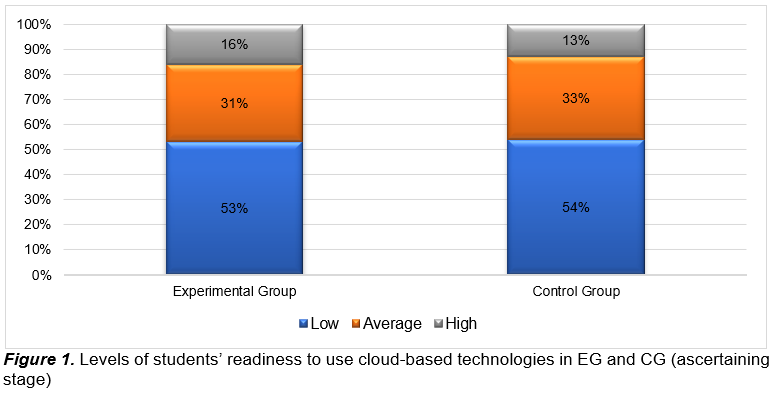
Diagnostics of the levels of formation of future specialists' readiness to work in a cloud-based environment at the stage of ascertaining the cut-off showed insufficient effectiveness of this process.
The experiment proved that it is possible to treat modern applicants' readiness to master cloud technologies as an object of study. It showed that it is necessary to develop and implement pedagogical conditions for organizing a cloud-based learning environment and an author's methodology for applying cloud technologies in higher education to develop the professional competencies of future specialists.
The results of the ascertaining experiment. determined the course of the formative experiment. The quantitative composition of the respondents remained unchanged.
The formative experiment was conducted to test the developed pedagogical conditions, special course, and methodology.
System criterion. CG (formative stage of the study)
System criterion. EG (formative stage of the study)
Table 1.
Changes in the System Criterion (Formative Stage)

Let us describe the generalized data of the formative stage of the study regarding the levels of assimilation of the basics of cloud technologies by EG and CG students and the readiness of future specialists to work in a cloud-based environment in the control and experimental groups (Fig. 2):
Criterion of readiness for interaction in a cloud-based environment of higher education students. CG (formative stage of the study)
Criterion of readiness for interaction in a cloud-based environment of higher education students. EG (formative stage of the study)
Criterion of the level of student satisfaction with the functioning of the cloud-based environment. CG (formative stage of the study)
The criterion of the level of satisfaction of students with the functioning of the cloud-based environment. EG (formative stage of the study)
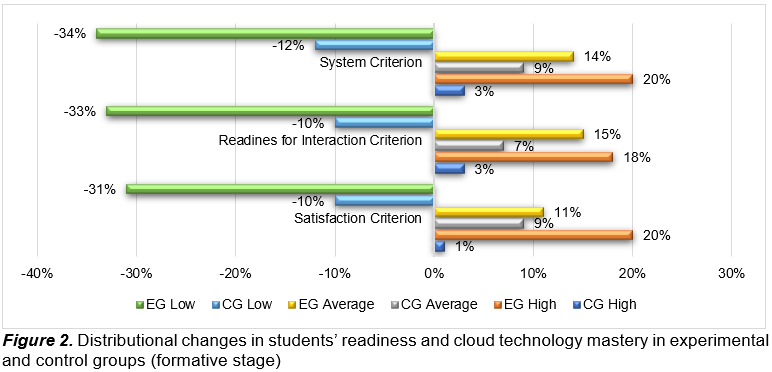
Thus, the results of the research and experimental work at the formative stage of the study showed that the number of EG students who reached a high level, the mastery by future specialists of the basics of cloud technologies, and their readiness to work in a cloud-based environment increased significantly in accordance with the established levels. In the CG, we see a non-significant increase.
In RStudio, statistical analysis of experimental data was performed. We assessed the scores' compliance with a normal distribution at each stage of the study to select the data processing method. The Lilliefors normality criterion was used for this.
All distributions can be considered normal. The samples should be considered dependent because the study was conducted in compliance with the above requirements and in the same groups of respondents. The method for statistical processing. In this case, in order to identify differences between the samples,
Analysis of variance for repeated measurements is used.
Let us formulate the null hypothesis (H0) for the selected statistical method and the alternative (H1) hypothesis:
An alternative hypothesis about the homogeneity of the groups at the ascertaining stage of the study should be accepted, taking into account the p-values obtained.
We tested the sample size for the following input parameters of the experiment:
The value n = 14 obtained from the experiment is less than the number of applicants. Using the summary function, the following statistical significance values were obtained for the number of degrees of freedom, df = 2:
Therefore, we conclude that we can talk about reliable statistical differences between the estimates, that is, accept the alternative hypothesis, for applicants at the formative and ascertaining stages of the study.
Cloud laboratory, pedagogical conditions, and special courses are factors that caused these differences and implement the main provisions of the cloud-based learning environment.
Based on the obtained p-values, we conclude that, for the components, the alternative hypothesis should be accepted and the null hypothesis rejected.
Two-sided asymptotic significance for CG and EG. We found, using the Kolmogorov-Smirnov criterion, that the estimates are distributed according to the normal law. Student's t-test was used for independent samples, provided that the following assumptions were met, and given the small sample size, to verify statistical differences between groups.
The groups had approximately normal distributions, were independent, and had approximately equal variances. Statistical testing of equality of variances was performed in SPSS, confirming the appropriateness of the chosen statistical method.
It can be stated that after the ascertaining cut, the respondents in the control and experimental groups did not show statistically significant differences in their educational achievements. The content of training at the ascertaining stage was the same for both groups, and the same teacher conducted the educational process.
Subsequently, the students in the experimental group studied a special course on organizing a cloud-based learning environment and on readiness to work in such an environment under the established pedagogical conditions. Students in the control group continued to follow the usual educational process, as in the previous case. In the experimental group, the author's methodology was implemented. After that, a second Kolmogorov-Smirnov test was conducted, and a Student's t-test was used for dependent samples. The differences in test scores were compared separately for the control and experimental groups.
It can be stated, taking into account the (α<0.05) level of significance, that there are statistical differences between the scores obtained by respondents for completing the first and second EG test. However, such a conclusion cannot be made regarding the CG respondents. Therefore, we state the effectiveness of the developed and implemented in EG pedagogical conditions for organizing a cloud-based learning environment and the author's methodology, the application and impact of the cloud-based environment of the educational space of higher education on the formation of professional competencies of future specialists applied in the experimental group at the second stage of the study. Comparing the results of the experiment – the formative stage and the ascertaining stage of the experiment- we determined that the developed innovations implemented in EG are sufficiently effective in higher education.
The effectiveness of the cloud-based learning environment (CBLE) was evaluated by comparing the results of the control group (CG) and experimental group (EG) across three criteria: system criterion, readiness for interaction, and level of satisfaction.
Table 2.
Changes in students’ readiness levels in EG (formative vs. ascertaining stage)

The results demonstrate a substantial increase in the proportion of students with a high level of readiness (+20%) and a significant decrease in the low level (–34%) in the experimental group.
Table 3.
Comparative changes in CG and EG across criteria

The experimental group consistently outperformed the control group across all criteria, indicating the effectiveness of the implemented pedagogical conditions and methodology.
Statistical analysis confirmed these findings. The ANOVA results (F = 32.17; p < 0.001) indicate statistically significant differences between the groups. The null hypothesis (H0) was rejected, and the alternative hypothesis (H1) was accepted, confirming the effectiveness of the CBLE implementation.
The results of the study provide strong empirical evidence that the integration of a cloud-based learning environment, supported by targeted pedagogical conditions, significantly enhances the professional training of future specialists.
The observed improvements in the experimental group can be explained by several factors. First, the systematic integration of cloud technologies created a flexible and interactive learning environment that facilitated active student engagement and collaboration. Second, the introduction of a specialized course and cloud laboratories contributed to the development of both theoretical knowledge and practical skills. Third, the use of digital tools, including virtual and augmented reality technologies, supported deeper understanding and increased motivation.
Importantly, the multidimensional assessment (system criterion, interaction readiness, and satisfaction) confirms that the impact of CBLEs extends beyond technical skills to include behavioral and motivational aspects of learning. This supports the view that cloud-based environments should be considered not only as technological tools but as comprehensive pedagogical systems.
Comparison with Previous Studies
The findings of this study are consistent with previous research emphasizing the positive impact of cloud technologies on learning outcomes. For example, Carreón (2025) reported improved usability and reduced cognitive load in cloud-based systems, which aligns with the increased satisfaction levels observed in this study. Similarly, Vargas & Virtanen (2023) demonstrated that structured cloud-based tasks enhance student performance, supporting the improvements in interaction readiness identified in the experimental group.
At the same time, the results extend the findings of Larcher et al. (2021) and Nascimento et al. (2019), which focused primarily on technological efficiency, by demonstrating the pedagogical effectiveness of cloud environments in real educational settings.
Unlike previous studies, which often examined isolated aspects of cloud technologies, this research provides a comprehensive evaluation of CBLEs as integrated systems. In particular, it confirms the importance of pedagogical conditions, as suggested by Tenorio-Sepúlveda et al. (2021), but goes further by offering experimental validation of their impact.
However, some discrepancies with existing literature should be noted. While earlier studies often reported moderate improvements, the significant effect sizes observed in this study may be attributed to the комплексна інтеграція cloud technologies with structured pedagogical interventions, rather than their isolated use.
Critical Interpretation
Despite the positive results, several limitations should be considered. The study was conducted within a specific educational context (pedagogical specialties), which may limit the generalizability of the findings. Additionally, the duration of the experiment, although sufficient to detect significant changes, may not fully capture long-term effects.
Nevertheless, the study provides robust evidence that the effectiveness of cloud-based learning environments depends not only on technological infrastructure but also on the presence of clearly defined pedagogical conditions and methodologies.
Conclusions
This study provides empirical evidence of the effectiveness of a cloud-based learning environment (CBLE) in the professional training of future specialists under specifically designed pedagogical conditions.
The results demonstrate that the systematic integration of cloud technologies, including cloud laboratories, a specialized course, and collaborative learning practices, leads to statistically significant improvements in students’ professional readiness. The experimental group showed substantial positive dynamics across all criteria (system, interaction readiness, and satisfaction), particularly in the increase of high-level indicators and reduction of low-level ones. Statistical analysis (ANOVA, F = 32.17; p < 0.001) confirmed the reliability of these differences.
The study makes several important contributions to the field: provides a comprehensive, experimentally validated model of a cloud-based learning environment as an integrated pedagogical system; identifies and substantiates specific pedagogical conditions that ensure the effectiveness of CBLE implementation; expands the understanding of multidimensional assessment of professional competencies, incorporating cognitive, behavioral, and motivational components; offers quasi-experimental evidence addressing a gap in previous research, which often lacked rigorous empirical validation.
The findings have direct implications for higher education practice: CBLEs can be effectively implemented to enhance the quality of professional training; the integration of cloud laboratories and specialized courses supports the development of both theoretical knowledge and practical skills; the use of interactive and immersive technologies (e.g., VR/AR) increases student engagement and learning motivation; the proposed pedagogical conditions can serve as a framework for curriculum design and digital transformation strategies in universities.
Despite its contributions, the study has several limitations: the sample was limited to students of pedagogical specialties, which may restrict generalizability to other disciplines; the quasi-experimental design, although robust, does not fully eliminate the influence of external variables; the duration of the study did not allow for the assessment of long-term effects of CBLE implementation.
Further research should focus on: testing the proposed model in different academic disciplines and institutional contexts; conducting longitudinal studies to evaluate the sustainability of learning outcomes; exploring the role of individual learner characteristics (e.g., digital competence, motivation); investigating the integration of CBLEs with emerging technologies such as artificial intelligence and learning analytics.
Bibliographic references
Ariza, J., Jimeno, M., Villanueva-Polanco, R., & Capacho, J. (2021). Provisioning computational resources for cloud-based e-learning platforms using deep learning techniques. IEEE Access, 9, 89798–89811. https://doi.org/10.1109/ACCESS.2021.3090366
Carreón, G. G. (2025). Evaluating usability and cognitive load: A comparative study of cloud-based and local database systems in higher education. Journal of Information Technology Education: Innovations in Practice, 24, 3. https://doi.org/10.28945/5435
Carvalho, D. S., Castro, P. A. de, & Fernandes Sobrinho, M. (2024). Cloud tools in higher education: Literature review. Cadernos de Educação, Tecnologia e Sociedade, 17(2), 663–674. https://doi.org/10.14571/brajets.v17.n2.663-674
Gamboa-Cruzado, J., Espinoza-Garate, A., Julca-Zeña, J., Nuñez Meza, A., Durán Carhuamaca, A., & Amayo-Gamboa, F. (2025). Impact of cloud computing on higher education institutions: A comprehensive systematic review. International Journal of Online and Biomedical Engineering (iJOE), 21(12), 154–181. https://doi.org/10.3991/ijoe.v21i12.56811
Heck, T., Peters, I., Mazarakis, A., Scherp, A., & Blümel, I. (2020). Open science practices in higher education: Discussion of survey results from research and teaching staff in Germany. Education for Information, 36(3), 301–323. https://doi.org/10.3233/EFI-190272
Ignat, T., & Ayris, P. (2020). Built to last! Embedding open science principles and practice into European universities. Insights, 33(1), 9. https://doi.org/10.1629/uksg.501
Kalogiannakis, M., Papadakis, S., & Zourmpakis, A.-I. (2021). Gamification in science education: A systematic review of the literature. Education Sciences, 11(1), 22. https://doi.org/10.3390/educsci11010022
Kim, T., & Lim, J. (2019). Designing an efficient cloud management architecture for sustainable online lifelong education. Sustainability, 11(6), 1523. https://doi.org/10.3390/su11061523
Kotsev, A., Minghini, M., Tomas, R., Cetl, V., & Lutz, M. (2020). From spatial data infrastructures to data spaces: A technological perspective on the evolution of European SDIs. ISPRS International Journal of Geo-Information, 9(3), 176. https://doi.org/10.3390/ijgi9030176
Larcher, L., Ströele, V., & Dantas, M. (2021). A cloud based system for distance learning supported by Fog Cloud cooperation. International Journal of Grid and Utility Computing, 12(5/6), 618–634. https://doi.org/10.1504/IJGUC.2021.120113
Li, Y., Wang, K., Xiao, Y., & Froyd, J. E. (2020). Research and trends in STEM education: A systematic review of journal publications. International Journal of STEM Education, 7, 11. https://doi.org/10.1186/s40594-020-00207-6
Nascimento, A., Olimpio, V., Silva, V., Paes, A., & de Oliveira, D. (2019). A reinforcement learning scheduling strategy for parallel cloud-based workflows. In Proceedings of the 2019 IEEE International Parallel and Distributed Processing Symposium Workshops (IPDPSW) (pp. 817–824). https://doi.org/10.1109/IPDPSW.2019.00134
Ramírez-Donoso, L., Rojas-Riethmuller, J. S., Pérez-Sanagustín, M., Neyem, A., & Alario-Hoyos, C. (2017). MyMOOCSpace: A cloud-based mobile system to support effective collaboration in higher education online courses. Computers Applications in Engineering Education, 25(5), 910–926. https://doi.org/10.1002/cae.21843
Rivera, L. F. Z., Larrondo-Petrie, M. M., & Da Silva, L. R. (2017). Implementation of cloud based smart adaptive remote laboratories for education. In 2017 IEEE Frontiers in Education Conference (FIE) (pp. 1–5). https://doi.org/10.1109/FIE.2017.8190473
Shuliak, A., Hedzyk, A., Tverezovska, N., Fenchak, L., Lalak, N., Ratsul, A., & Kuchai, O. (2022). Organization of Educational Space Using Cloud Computing in the Professional Training of Specialists. International Journal of Computer Science and Network Security, 22(9), 447-454. https://doi.org/10.22937/IJCSNS.2022.22.9.58
Tenorio-Sepúlveda, G. C., Muñoz-Ortiz, K. d. P., Nova-Nova, C. A., & Ramírez-Montoya, M. S. (2021). Diagnostic instrument of the level of competencies in cloud computing for teachers in Education 4.0. In L. M. Camarinha Matos, X. Boucher, & H. Afsarmanesh (Eds.), Smart and sustainable collaborative networks 4.0. PRO VE 2021 (IFIP Advances in Information and Communication Technology, Vol. 629, pp. 724–736). Springer, Cham. https://doi.org/10.1007/978-3-030-85969-5_62
Vargas, B. C., & Virtanen, S. (2023). A cloud-based systematic cyber security teaching and learning framework for high school students. International Journal of Knowledge and Learning, 16(3), 316–339. https://doi.org/10.1504/IJKL.2023.132163

Este artículo no presenta ningún conflicto de intereses. Este artículo está bajo la licencia Creative Commons Atribución 4.0 Internacional (CC BY 4.0). Se permite la reproducción, distribución y comunicación pública de la obra, así como la creación de obras derivadas, siempre que se cite la fuente original.