
Original Article
Eduweb, 2026, abril-junio, v.20, n.2. ISSN: 1856-7576
Doi: https://doi.org/10.46502/issn.1856-7576/2026.20.02.10
Developing readiness for SMART technology use in future professionals: A quasi-experimental approach
Ruslana Vlasenko
Candidate of Biological Sciences, Associate Professor of The Department of Ecology and Geography, Faculty of Natural Sciences, Zhytomyr Ivan Franko State University, Ukraine.
https://orcid.org/0000-0002-3743-4406
Olena Bukhniieva
Candidate of Pedagogical Sciences, Associate Professor, Izmail State University of Humanities, Ukraine.
https://orcid.org/0000-0001-9997-5796
Ellina Panasenko
Doctor of Pedagogical Sciences, Professor, Head of the Practical Psychology Department, State Higher Educational Institution «Donbas State Pedagogical University», Ukraine.
https://orcid.org/0009-0005-7855-7006
Nadiia Oliinyk
Ph.D. in Pedagogy, Associate Professor, Department of Management, Kamianets-Podilskyi Ivan Ohiienko National University, Ukraine.
https://orcid.org/0000-0001-6978-6863
Tetiana Stoliarova
Candidate of Pedagogical Sciences, Associate Professor, Department of Computer Science and Information Systems, State University of Trade and Economics, Ukraine.
https://orcid.org/0009-0006-8463-495X
Cómo citar:
Vlasenko, R., Bukhniieva, O., Panasenko, E., Oliinyk, N., & Stoliarova, T. (2026). Developing readiness for SMART technology use in future professionals: A quasi-experimental approach. Revista Eduweb, 20(2), 157-175. https://doi.org/10.46502/issn.1856-7576/2026.20.02.10
Recibido: 11/01/26 Aceptado: 28/04/26
Resumen
La rápida transformación digital de la educación superior exige la integración de herramientas innovadoras que potencien la formación profesional de los futuros profesionales. Este estudio tiene como objetivo verificar experimentalmente la efectividad de las condiciones pedagógicas y un sistema de formación estructurado diseñado para desarrollar la preparación de los estudiantes para la aplicación de herramientas digitales inteligentes en sus actividades profesionales. Se empleó un diseño cuasiexperimental de métodos mixtos, con la participación de 174 estudiantes divididos en un grupo experimental (n=88) y un grupo de control (n=86). Los datos se recopilaron mediante cuestionarios, observaciones, entrevistas y tareas diagnósticas, y se analizaron mediante estadística descriptiva y pruebas t de Student. La intervención incluyó la implementación de un entorno educativo orientado a las herramientas inteligentes (SMART) que integra laboratorios virtuales, plataformas en la nube y estrategias de aprendizaje interactivas como la gamificación y el aprendizaje basado en proyectos. Los resultados indican una mejora estadísticamente significativa en el grupo experimental, con un aumento en la proporción de estudiantes que demostraron un alto nivel de preparación, del 21,5% al 51,3%, mientras que la proporción con un bajo nivel disminuyó sustancialmente. Este estudio contribuye al campo al proporcionar validación empírica de un modelo con fundamento pedagógico que integra herramientas digitales con condiciones de instrucción específicas para potenciar los componentes motivacionales, cognitivos y basados en la actividad de la preparación profesional. Los resultados destacan que la eficacia de los entornos de aprendizaje inteligentes depende no solo de la infraestructura tecnológica, sino también de un diseño pedagógico sistemático. Estos hallazgos tienen implicaciones prácticas para la modernización de la educación superior y el desarrollo de las competencias digitales de los estudiantes, en consonancia con las demandas del mercado laboral.
Palabras clave: especialistas del futuro, tecnologías SMART, laboratorios virtuales, tecnologías SMART en la nube, entorno SMART.
Abstract
The rapid digital transformation of higher education necessitates the integration of innovative tools that enhance the professional training of future professionals. This study aims to experimentally verify the effectiveness of pedagogical conditions and a structured training system designed to develop students’ readiness to apply smart digital tools in professional activities. A mixed-methods quasi-experimental design was employed, involving 174 students divided into experimental (n=88) and control (n=86) groups. Data were collected through questionnaires, observations, interviews, and diagnostic tasks, and analyzed using descriptive statistics and Student’s t-tests. The intervention included the implementation of a SMART-oriented educational environment integrating virtual laboratories, cloud-based platforms, and interactive learning strategies such as gamification and project-based learning. The findings indicate a statistically significant improvement in the experimental group, with the proportion of students demonstrating a high level of readiness increasing from 21.5% to 51.3%, while the share with a low level decreased substantially. The study contributes to the field by providing empirical validation of a pedagogically grounded model that integrates digital tools with targeted instructional conditions to enhance motivational, cognitive, and activity-based components of professional readiness. The results highlight that the effectiveness of smart learning environments depends not only on technological infrastructure but also on systematic pedagogical design. These findings have practical implications for modernizing higher education and developing students’ digital competencies in line with labor market demands.
Keywords: future specialists, SMART technologies, virtual laboratories, cloud SMART technologies, SMART environment.
Introduction
The integration of digital technologies into higher education has become a defining feature of contemporary educational systems. Among these innovations, SMART technologies – encompassing intelligent devices, cloud-based platforms, interactive tools, and data-driven environments – offer significant potential for enhancing the quality of professional training. Their application enables flexible, personalized, and collaborative learning experiences that align with the demands of modern labor markets.
Despite the growing adoption of digital tools in higher education, their effective pedagogical integration remains a critical challenge. Existing research predominantly focuses on the technological capabilities of SMART environments or their general impact on learning outcomes. However, such approaches often overlook a key issue: students’ readiness to meaningfully apply these technologies in real professional contexts. In practice, the mere availability of digital tools does not ensure their effective use, as students frequently lack the necessary motivation, structured knowledge, and practical skills.
Furthermore, current studies rarely provide empirically validated models that systematically integrate pedagogical conditions, instructional strategies, and digital tools into a coherent training system. The lack of experimental research examining how SMART-oriented environments influence the formation of students’ readiness – particularly across motivational, cognitive, and activity-based dimensions – represents a significant gap in the literature.
Addressing this gap requires a shift from descriptive analyses of digital technologies toward evidence-based pedagogical frameworks that support their effective implementation in professional training. In particular, there is a need to identify and experimentally verify the pedagogical conditions that facilitate the development of students’ readiness to apply SMART technologies in professional activities.
The present study aims to fill this gap by developing and empirically validating a structured training system based on a SMART-oriented educational environment. The research focuses on identifying key pedagogical conditions and assessing their impact on the formation of students’ readiness to use digital tools in professional contexts through a quasi-experimental design.
The novelty of the study lies in: the integration of SMART technologies within a pedagogically grounded framework; the operationalization of readiness as a multidimensional construct (motivational, cognitive, and activity-based); the experimental verification of the effectiveness of the proposed approach in higher education settings.
Literature Review
The development of SMART technologies has generated a substantial body of research focused on their role in transforming higher education. However, despite the diversity of approaches, existing studies demonstrate significant fragmentation, methodological limitations, and a predominance of descriptive analyses over theoretically grounded and empirically validated models.
Early studies on SMART education primarily focus on its conceptualization as a technology-driven paradigm. For instance, Ţălu (2020) emphasizes the systemic transformation of educational environments through digitalization, while Budhrani et al. (2018) interpret SMART learning as a flexible, personalized, and location-independent model. Although both approaches highlight accessibility and scalability, they remain largely declarative and lack operationalization of key constructs, particularly regarding learning outcomes and professional readiness. In contrast, Yamao & Lescano (2020) extend this perspective by linking SMART education to Industry 4.0 competencies, suggesting its alignment with socio-economic demands. However, their work, similar to earlier studies, does not provide a clear pedagogical framework for implementation. Thus, a key limitation across conceptual studies is the absence of a unified theoretical model that connects technological affordances with pedagogical processes and measurable educational outcomes.
A significant research strand explores the integration of SMART technologies within STEM/STEAM education. Gao et al. (2020) conceptualizes STEAM as an interdisciplinary framework. Belbase et al. (2021) further emphasize the role of project-based and inquiry-based learning in developing practical competencies. Despite these contributions, a comparative analysis reveals that these studies prioritize methodological integration (interdisciplinarity, project-based learning) over technological readiness. In other words, while SMART tools are implicitly present, they are not the central object of analysis. Moreover, the focus remains on learning outcomes rather than on the formation of students’ ability to effectively apply SMART technologies in professional contexts. Thus, a conceptual gap emerges between technology-enhanced learning and readiness for technology application, which is insufficiently addressed in existing research.
Numerous studies highlight the positive pedagogical effects of SMART technologies. Costley & Lange (2017) demonstrate that well-designed digital environments reduce cognitive load and improve learning efficiency. Similarly, Zawacki-Richter et al. (2019) identify the transformative potential of artificial intelligence in enabling adaptive and personalized learning. At the same time, Marutschke et al. (2019) and Reyes et al. (2021) emphasize collaborative and project-based SMART environments as key factors in preparing students for globalized professional contexts. These findings are consistent in recognizing the importance of interaction, engagement, and flexibility.
However, a critical comparison reveals an important limitation:
most studies examine isolated elements (e.g., AI tools, virtual environments, collaboration) rather than integrated pedagogical systems. As a result, the cumulative impact of SMART technologies on the holistic development of professional competencies remains underexplored. Furthermore, Shernof et al. (2017) argue that the effectiveness of innovative technologies is contingent upon teacher readiness and pedagogical support, thereby challenging the implicit assumption in many studies that technology alone drives educational improvement.
Recent research increasingly focuses on technological ecosystems, including IoT, smart classrooms, and cloud-based platforms (Ferreira et al., 2024; 2025; Aguilera et al., 2025). These studies provide valuable insights into infrastructure development and user experience, highlighting the potential of SMART environments for interactive and inclusive learning. Nevertheless, compared to earlier pedagogical studies, this body of research demonstrates a shift toward technological determinism, where educational effectiveness is primarily attributed to technological innovation. In contrast, pedagogical variables – such as instructional design, motivation, and assessment – are often underrepresented.
This imbalance creates a theoretical inconsistency: while technology is increasingly sophisticated, its pedagogical integration remains insufficiently theorized and empirically validated.
A cross-analysis of the reviewed literature allows for the identification of several key trends and contradictions:
Importantly, existing studies rarely conceptualize readiness as a holistic construct that includes motivational, cognitive, and activity-based components, nor do they empirically test conditions for its development.
To address these limitations, the present study is grounded in an integrative theoretical framework that combines: сompetency-based approach – emphasizing the development of practical and transferable skills required for professional activity; activity theory – focusing on the role of active engagement and practice in mastering SMART technologies; constructivist learning theory – highlighting the importance of learner-centered, interactive, and collaborative environments; systemic approach – ensuring the integration of technological, pedagogical, and organizational components into a coherent educational model.
Within this framework, readiness to use SMART technologies is conceptualized as a multidimensional construct comprising: motivational component (values, attitudes, and interest); cognitive component (knowledge and understanding); activity-based component (practical skills and application). Such an approach allows for overcoming the fragmentation observed in previous studies and provides a basis for the experimental validation of pedagogical conditions and training systems.
The aim of this study is to experimentally verify the effectiveness of pedagogical conditions and a SMART-oriented training system in developing future professionals’ readiness to apply digital technologies in their professional activities.
Methodology
Research Design
This study employed a mixed-methods research design, integrating both qualitative and quantitative approaches to ensure a comprehensive analysis of the process of training future specialists to use SMART technologies. The research was conducted as a quasi-experimental study with control (CG) and experimental groups (EG), enabling the evaluation of the effectiveness of the proposed pedagogical conditions and training system.
The experimental design included three consecutive stages: ascertaining (diagnostic), formative (intervention), and control (evaluation), conducted during 2023–2025. This longitudinal structure ensured the consistency and reliability of the obtained results.
Participants
The study involved 174 students enrolled in higher education institutions. The participants were divided into two groups:
The groups were tested for initial homogeneity using an independent samples Student’s t-test, confirming no statistically significant differences at the baseline (p > 0.05). This ensured comparability and internal validity of the experiment.
Procedure
The research procedure consisted of three stages:
At this stage, the initial level of students’ readiness was assessed. The results indicated that the majority of students demonstrated a low level of readiness (56.1%), highlighting the need for targeted pedagogical intervention.
During this phase, the experimental group was exposed to a SMART-oriented educational environment, which included:
The control group continued learning through traditional instructional methods.
Pedagogical conditions implemented in the EG included:
At the final stage, the effectiveness of the intervention was assessed by comparing pre- and post-experimental results in both groups.
Instruments and Data Collection (Revised and Expanded)
To ensure the accuracy and methodological rigor of the study, a set of validated and reliable instruments was developed and applied to assess students’ readiness to use SMART technologies.
Questionnaire Design and Measurement Scales. A structured questionnaire consisting of 10 items was developed to measure the motivational and cognitive components of readiness. The instrument employed a five-point Likert scale (1 = strongly disagree to 5 = strongly agree), allowing for the quantification of students’ attitudes, perceptions, and self-reported knowledge. The items were grouped into two subscales:
The activity-based component was assessed through performance-based diagnostic tasks, evaluated using an analytic rubric with three levels (low, average, high), based on predefined criteria such as task completion accuracy, independence, and appropriateness of tool use.
Observations and Interviews. Structured observation protocols were used to assess behavioral indicators of students’ engagement and practical use of SMART technologies during classroom and independent activities. Semi-structured interviews were conducted to triangulate quantitative findings and clarify students’ experiences, difficulties, and attitudes.
Validity Procedures
Several procedures were employed to ensure the validity of the instruments:
Reliability Analysis
The internal consistency of the questionnaire was assessed using Cronbach’s alpha:
These values indicate a high level of reliability.
For the assessment of the activity-based component, inter-rater reliability was ensured by involving two independent evaluators. The level of agreement, calculated using Cohen’s kappa, was κ = 0.81, indicating strong agreement.
A pilot study (n = 30) was conducted prior to the main experiment to test the clarity and reliability of the instruments. Minor revisions were made based on the pilot results.
Data Interpretation and Scaling
Based on the collected data, students’ readiness levels were classified into three categories (low, average, high) using threshold values derived from normalized scores:
This scaling approach ensured consistency across different measurement tools and enabled comparative analysis between groups.
Revised Validity and Reliability Statement
To enhance the robustness of the study, methodological triangulation was applied by combining quantitative (questionnaires, statistical analysis) and qualitative methods (observations, interviews). The use of validated instruments, standardized measurement scales, and reliability testing ensured the accuracy, consistency, and reproducibility of the findings.
Ethical Considerations
Participation in the study was voluntary. Students were informed about the purpose of the research, and confidentiality of responses was ensured. The study adhered to general ethical standards of educational research.
Methodological Contribution
Unlike many previous studies that focus primarily on descriptive analysis of SMART technologies, this research provides:
This methodological approach enhances the reliability of findings and contributes to evidence-based implementation of SMART technologies in higher education.
Results and Discussion
The content and advantages of SMART technologies in the educational and professional activities of specialists.
A significant role in the conditions of global economic change is played by innovations aimed at qualitative change and the resolution of a range of issues related to the activation and introduction of innovations across all sectors of society. SMART technologies are currently the driving force behind economic growth, rapidly and purposefully implemented across all areas, taking into account global societal trends (Aguilera et al., 2025). We include in the concept of “SMART technologies” technologies designed for classes with students, using digital educational resources, a complex of interactive equipment, innovative teaching tools, and smart devices (gadgets, AI) in a digital environment, which ensures the interactivity of educational processes. SMART technologies in teaching help teachers organize students' active learning activities and create digital educational resources during and outside classes (Bautista, 2021).
The analysis of scientific literature showed that social services Instagram, Twitter, Facebook, Wiki website, Google services and tools, videos on the Internet and podcasts for distributing audio files, Youtube video hosting, blogs are SMART technologies that need to and can be used in higher education, pedagogical practice for the exchange of professional experience, professional development, communication, enrichment of the content of classes with new material, increasing students' motivation to study.
Thus, the SMART approach inspires innovations in education, a transformational approach to education, and societal development, and is an educational strategy (Yamao & Lescano, 2020).
Let us reveal the advantages of SMART technologies in the educational and professional activities of specialists. Modern SMART technologies make it possible for those thousands of kilometers away from a higher education institution to study. This was the first moving element that prompted the further development of modern SMART education worldwide, and the development of digital technologies made this possible more productively, more interestingly, and faster (Marutschke et al., 2019).
SMART technologies in the educational sector significantly enhance the training of future specialists by enabling the activation of innovative learning processes through digital platforms and visualization tools that support error analysis and self-correction. They promote personalized learning by allowing students to access educational content flexibly in terms of time, pace, and learning needs.
In addition, multimedia and interactive tools facilitate the integration of disciplines and the practical application of knowledge in professional contexts. SMART education also redefines the teacher’s role as a facilitator or navigator who guides students in accessing relevant information and applying modern educational approaches (Díaz-Parra et al., 2022).
Furthermore, the use of gamification increases student motivation, while adaptive learning environments support inclusivity and individualization. The expansion of digital resources, including electronic materials and video courses, enhances learning accessibility and continuity.
Overall, SMART technologies contribute not only to knowledge acquisition but to the creation of an innovative digital learning environment that fosters broad, interdisciplinary thinking rather than linear knowledge accumulation (Hernandez-de-Menendez et al., 2020).
The main components of SMART technologies and the role of research, virtual laboratories, and cloud SMART technologies in the training of future specialists – formation of an integrated intellectual virtual environment of higher education.
The main component of SMART technologies in the training of modern specialists is the use of SMART boards (interactive touch screens) connected to a media projector and a personal computer, as well as tablets (Aguayo et al., 2023).
Recently, higher education teachers have increasingly resorted to virtual laboratories. Therefore, the number of virtual classes or laboratories has increased significantly, we observe a small increase in the number of videos created for the educational process in higher education personally by teachers, which is associated with the capabilities and use of Skype, Zoom, Microsoft Teams, Google Meet, Intermedia AnyMeeting, GoToMeeting, Webex, RingCentral, etc. (Domínguez & Ochoa, 2017).
The main condition for using SMART technologies in higher education is the formation of a virtual, integrated intellectual environment that can be improved by all participants in the educational space and provided with appropriate educational content by both teachers and students. Such an innovative environment should evolve dynamically, taking into account progressive digital technologies in both communication and learning (Ferreira et al., 2025).
Recently, there has been an increase in interactive technologies associated with the use of various educational electronic resources. These are online boards that activate students' cognitive activity, provide a wide range of functionality for teachers and support their creativity, and contribute to the formation of digital, socially significant, professional competencies. An effective tool for improving the quality of education is deservedly considered to be game-based educational tools – gamification, which involves learning in the process of playing, when students use game rules to achieve real professional goals (Santana et al., 2022).
One of the first innovative such platforms was SMART amp – software, which appeared first and later became SMART Learning Suite Online. Today, it has been modernized into SMART Lumio – a cloud version of the software. Working with the tools and functionality of the SMART Notebook program is the basis of this technology, but in a cloud format. This significantly optimizes the use of a student's study time and simplifies teachers' work with an already familiar resource. Students can complete homework outside the educational institution at a time that is convenient for them, using any device. Students who cannot be in the classroom have the opportunity to complete tasks alongside those who are, under the teacher's guidance (Reyes et al., 2021).
SMART technologies are successfully integrated today into the two leading video conferencing platforms: Google Classroom (Google Meet) and Microsoft Teams. Such integration allows them to expand their functionality further and provides the opportunity to work with technologies familiar to teachers (Ferreira et al., 2024).
Organization and methodology of the pedagogical experiment.
The continuation of theoretical research involved conducting a pedagogical experiment, which is the main means of verifying the reliability of the research results and assessing the practical significance and effectiveness of the developed pedagogically justified conditions and the proposed system for training future specialists to use SMART technologies in professional activities.
The main goal of the experimental work is to verify the effectiveness of implementing pedagogical conditions and the system for training future specialists to use SMART technologies in professional activities.
The respondents' level of readiness to use SMART technologies was assessed. According to the results of the questionnaire at the experiment's ascertaining stage, we observe a low level of cognitive interest in the phenomenon outlined among the majority of EG and CG respondents. Pedagogical conditions were outlined, and an innovative training system for future specialists in the use of SMART technologies in professional activities was developed. It was decided to create an educational SMART environment that would enable students to work with SMART technologies.
At the ascertaining stage of the experiment, a questionnaire was administered to the same students, comprising 10 questions that reflected the indicators of the level of formation of the problem outlined.
The results of the study showed the following:
Diagnostics of EG and CG students showed that:
Table 1.
Levels of students’ readiness to use SMART technologies in professional activities (ascertaining stage)

In the process of ascertaining the experiment, only 11.2% of respondents indicated that they are considering the possibility of using SMART technologies in classes in professional disciplines; 9% of respondents indicated that they independently perform exercises created using SMART technologies; 61% of respondents indicated that they want to master SMART technologies in classes in higher education. Students noted that while performing tasks, they encountered difficulties created by the use of SMART technologies.
At the formative stage of the study, an experimental verification of pedagogical conditions and the training system for future specialists to use SMART technologies in professional activities was conducted.
Taking into account the results of the experiment's ascertaining stage, a program to prepare future teachers of philological specialties to use SMART technologies was developed.
In order to work successfully in the field of SMART-technologies, we developed an innovative SMART -complex of e-learning systems for EG students, which included:
SMART-education itself serves to use information combined with technologies that can be integrated into each other, namely mobile learning (m-learning), a combination of electronic educational process technologies (e-learning), flipped learning (f-learning), and ubiquitous learning (u-learning), which, based on a mixed model, fit into the traditional learning system (blended learning).
To introduce SMART learning in EG, we implemented SMART education paradigms to develop competencies, knowledge, and skills for interaction with the technical, social, and economic environment, grounded in pedagogical, organizational, and technological components.
When creating a space for SMART education of EG students, the main task was the resourceful use of SMART education, the formation of a higher-level personality – SMART person, the transformation of new knowledge, students' mastery of digital technologies, the ability to adapt to the external environment, innovative means of communication, skills in analyzing and generating information, the use of platforms, services, portals of the global Internet network and the formation of an integrated intellectual virtual environment where EG students were engaged.
In EG, training took place through the use of methodological techniques that, in our opinion, are the most effective in the process of preparing future specialists for the application of SMART technologies in professional activities, namely: the project method, storytelling, gamification, role-playing games, analysis of video situations, the method of independent creative activity, educational discussions, and the research method.
In the context of our study, the group of methods for organizing and implementing educational activities in the EG of students includes such methodological techniques and methods as: educational discussions, analysis of video situations, research method, method of independent creative activity, which are implemented using SMART -technology tools, such as: blogs, programs for conducting webinars, Facebook, YouTube, Word it out, Twitter, Instagram, SMART -textbook, LinguaLab, Kahoot, WiseMapping, Lyricstraining.
The group of methods for motivating and stimulating educational activities includes methodological techniques proposed by the EG, such as storytelling, role-playing games, and gamification, which can be implemented using Quizlet, Kahoot, Instagram, Lyricstraining, YouTube, Facebook, Twitter, and Learning Apps.
The group of methods for controlling and self-control includes the Method of Projects for the effective implementation of educational activities, and we offer SMART technology tools, such as Kahoot, ThingLink, and Learning Apps, to support their implementation.
In preparing EG students to use SMART technologies, we have chosen the following forms of instruction: training, lectures, research, practical classes, independent work, educational practice, group work, meetings with specialists, and individual consultations.
Implementing the developed pedagogical conditions in EG involves determining the requirements for students' knowledge, skills, and abilities.
Studies have shown that:
Another effective tool for SMART materials is the use of Learning Apps to develop interactive electronic educational materials.
EG users who use Learning Apps to create electronic educational materials 100 percent agree that all users can use its materials free of charge and without indicating a link to the author, which is important during experimental research, for the development of interactive tasks in various subject disciplines, their storage, with the help of which you can check, train, consolidate knowledge in a game form in classes, during individual activities and the organization of independent work, in joint project and research activities.
Traditional methods of conducting classes were used in the CG.
Analysis of the results of the pedagogical experiment.
Using MS Excel and SPSS (Statistical Package for the Social Sciences), statistical calculations were performed during the formative stage. Statistical processing of empirical data was enabled by the use of the SPSS software package during experimental work, including creating and modifying databases, generating reports, and performing basic analyses, providing a wide range of options for presenting results in graphical, text, and tabular forms.
At the beginning of the formative stage of the experimental study, the correctness of the sample homogeneity of the CG (86 respondents) and the EG (88 respondents) was checked based on a statistical analysis of student results using the unpaired parametric Student's t-test, in order to compare the average score in two independent groups. The null hypothesis H0 is that the EG and CG are homogeneous at the 5% significance level (p<0.05).
We adhered to the following conditions for using the unpaired Student's t-test:
We conclude that for CG, the standard error of deviation (Std. Error Mean) is 0.60; the standard deviation (Std. Deviation) is 0.657; and the mean score (Mean) is 3.95.
We conclude that for EG, the standard error of deviation (Std. Error Mean) is 0.59; the standard deviation (Std. Deviation) is 0.637; and the mean score (Mean) is 3.74. The level of statistical significance is 0.06>0.05 for the Livin criterion (Sig).
Statistical calculations using the parametric Student's t-test indicated that the CG and the EG belong to the same general population (homogeneous) at the 5% significance level.
At the beginning of the formative stage of the experiment, a comparison of the survey results showed that the CG and EG students had insufficiently formed educational and cognitive motives (8% and 9%), there were practically no motives for creative self-realization of students – the respondents did not show interest in the use of SMART technologies (5% and 4%). Motives for implementing SMART technologies in future professional activities were not formed (10% and 11%).
At the end of the formative stage of the experiment, the survey results showed that among EG students who had been working with SMART technologies for a long time, professional motives came to the fore – 44%, educational and cognitive motives – 38%, and motives for creative self-realization – 29%.
In CG students, the motives for using SMART technologies at the beginning and end of the formative stage remained practically unchanged.
At the end of the formative stage of the experiment, the reliability of the results was assessed by comparing two dependent samples using the paired Student's t-test.
The statement for H0 was accepted that the discrepancy at the beginning and end of the formative stage between the average results of the CG and EG of the experiment, that is, the influence of the independent variable is random, and H1 – an alternative hypothesis that this discrepancy is caused by the implementation of the developed pedagogical conditions and the system of training future specialists for the use of SMART technologies in professional activities.
Using the SPSS 16.0 program (for analysis of results), the standard deviation of the difference in values ("Std. Deviation") of the analyzed variables and the arithmetic mean ("Mean"), the number of degrees of freedom ("df"), the value of the paired Student's t-test and the level ("Sig. (2-tailed) of statistical significance p for the CG and for the EG before and after the experiment were calculated.
Since for the EG Sig = 0.000 according to the results of the Student's t-test, which is significantly less than 0.05, we reject the null hypothesis H0 and accept the alternative hypothesis H1, which is that with a confidence level of 95%, the differences in the average values of the GPA of EG students are not random, which is caused by the implementation of the developed pedagogical conditions and the system of training future specialists for the use of SMART technologies in professional activities.
In Table 2 and Fig. 1, we present the general level of readiness of future specialists to use SMART technologies in professional activities across motivational, cognitive, and reflective components.
Table 2.
General level of readiness of future specialists to use SMART technologies in professional activities

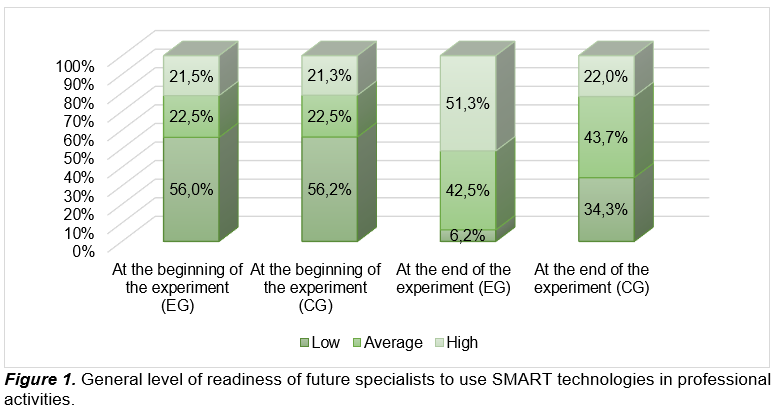
Analysis of the experimental study results shows that by the end of the study, the readiness indicators of future specialists to use SMART technologies in professional activities in the EG increased significantly.
In particular, the proportion of students with a low level has significantly decreased in the EG, while the proportion with an average level has increased. The number of students with a high level of readiness has increased significantly, whereas in the CG, the indicators have improved only slightly.
The results show that the developed and proposed pedagogical conditions and system of training future specialists for the use of SMART technologies in professional activities implemented in the EG stimulate the restructuring of the structure of motives of students' professional and educational activities, which contributes to the mastery of practical skills and theoretical knowledge through the use of SMART technologies in the educational process, provides self-determination, the development of self-analysis and reflection skills.
At the generalization stage, experimental data were systematized and interpreted using statistical methods; the materials of the experimental work were theoretically generalized and substantiated; conclusions and prospects for further research were drawn up.
The results of the present study demonstrate a statistically significant improvement in the readiness of future specialists to use SMART technologies in professional activities within the experimental group. While these findings generally align with prior research emphasizing the positive impact of digital and SMART environments on learning outcomes, a deeper critical analysis reveals several important nuances that both support and problematize existing assumptions.
The obtained results confirm the conclusions of Gao et al. (2020) and Costley & Lange (2017), who argue that interactive and well-designed digital environments enhance cognitive performance and learning efficiency. However, unlike these studies, which tend to treat technology as a primary driver of improvement, the present findings indicate that pedagogical structuring plays a more decisive role than the technology itself. The significant increase in readiness levels was not merely a result of exposure to SMART tools, but rather of their systematic integration within a pedagogically grounded framework. This suggests that prior research may overestimate the autonomous effect of technology, underestimating the importance of instructional design.
While Zawacki-Richter et al. (2019) highlight the transformative potential of intelligent technologies such as artificial intelligence, their conclusions are largely based on macro-level analyses of technological trends. In contrast, the current study provides micro-level empirical evidence showing that students initially demonstrate low readiness (56.1%) despite the availability of digital tools. This discrepancy points to a critical gap between technological potential and actual educational outcomes, indicating that accessibility does not equate to effective use. Thus, the findings challenge the implicit technological determinism present in part of the literature.
The results extend the work of Marutschke et al. (2019) and Reyes et al. (2021), who emphasize collaboration and project-based learning as key features of SMART environments. While their studies conceptually advocate for these approaches, they provide limited empirical validation. The present study not only supports their claims but also demonstrates that collaborative and interactive strategies are effective only when aligned with clearly defined pedagogical conditions, including motivation enhancement, structured guidance, and reflective practice. Without these conditions, the impact of such approaches may remain superficial.
At the same time, the findings partially contradict studies that assume rapid and universal adoption of SMART technologies by students. The low baseline readiness identified in this study supports the position of Shernof et al. (2017), who argue that both students and educators require targeted support for effective technology integration. This highlights an often-overlooked issue in the literature: the readiness gap, which acts as a mediating factor between technological innovation and educational effectiveness.
Another important insight concerns the multidimensional nature of readiness. While Belbase et al. (2021) focus primarily on interdisciplinary and methodological integration in STEM/STEAM education, their framework does not explicitly address the internal structure of readiness. The present study contributes to this discussion by empirically demonstrating that motivational, cognitive, and activity-based components develop unevenly and require differentiated pedagogical interventions. In particular, the rapid growth of motivational indicators compared to slower development of practical skills suggests that engagement alone is insufficient for ensuring competence.
Moreover, the findings reveal a potential limitation of SMART-based learning environments that is rarely discussed in previous studies. While most research highlights increased motivation and engagement, the current results suggest that initial exposure to SMART technologies may generate cognitive overload or resistance, especially among students with low prior experience. This implies that the effectiveness of SMART environments may be non-linear and dependent on gradual adaptation, a factor that is largely absent in existing models.
From a broader perspective, the study challenges the prevailing fragmentation in the literature, where technologies, pedagogical strategies, and learning outcomes are often examined in isolation. The results demonstrate that the effectiveness of SMART technologies emerges only within an integrated system that combines technological tools with pedagogical conditions and structured learning processes. This systemic interaction appears to be the key mechanism underlying the observed improvements.
However, despite these contributions, the findings should be interpreted with caution. The quasi-experimental design, while robust, does not fully eliminate the influence of external variables such as individual differences in digital literacy or instructor competence. Additionally, the relatively short duration of the intervention limits the ability to assess long-term effects, particularly regarding the sustainability of the acquired competencies.
In this context, the study not only confirms but also critically reinterprets existing research by demonstrating that:
Thus, the findings contribute to a more nuanced understanding of SMART education, shifting the focus from technological innovation to pedagogically grounded and empirically validated systems of professional training.
Conclusions
This study provides empirical evidence on the effectiveness of a pedagogically grounded system for developing future specialists’ readiness to use SMART technologies in professional activities. The findings confirm that the integration of SMART technologies alone does not ensure educational effectiveness; rather, their impact depends on the systematic implementation of pedagogical conditions that structure students’ learning experiences.
The results of the quasi-experimental study demonstrate statistically significant improvements in the experimental group across motivational, cognitive, and activity-based components of readiness. In particular, the proportion of students with a high level of readiness increased substantially, while the share of those with a low level decreased. These findings validate the effectiveness of the proposed SMART-oriented educational environment and confirm the importance of combining interactive tools, cloud technologies, virtual laboratories, and student-centered instructional strategies.
From a theoretical perspective, the study contributes to the advancement of SMART education research by addressing the fragmentation observed in existing literature. It proposes and empirically supports a multidimensional conceptualization of readiness as an integrative construct that includes motivational, cognitive, and activity-based components. Furthermore, the study demonstrates that the effectiveness of SMART technologies should be understood within a systemic framework that integrates technological, pedagogical, and organizational dimensions, thereby moving beyond technology-centered approaches.
At the methodological level, the research contributes by applying a mixed-methods quasi-experimental design, validated measurement instruments, and statistical analysis to assess changes in students’ readiness. This approach strengthens the evidence base for the pedagogical integration of SMART technologies and provides a replicable model for future studies.
From a practical standpoint, the findings offer actionable insights for higher education institutions. The proposed pedagogical conditions – enhancing motivation, developing digital competencies through interactive tasks, and creating an integrated SMART learning environment – can be effectively implemented to improve the quality of professional training and align educational outcomes with labor market demands.
However, several limitations should be acknowledged. The study was conducted within a specific institutional and disciplinary context, which may limit the generalizability of the findings. Additionally, the duration of the intervention was relatively limited, restricting the ability to assess long-term effects and sustainability of the acquired competencies. The reliance on a quasi-experimental design also implies potential influence of uncontrolled external variables.
Future research should focus on expanding the sample across diverse educational contexts and disciplines, as well as conducting longitudinal studies to evaluate the long-term impact of SMART-oriented learning environments. Further investigation is also needed to explore the role of emerging technologies, such as artificial intelligence and learning analytics, in enhancing adaptive and personalized learning. In addition, more attention should be given to the interaction between student readiness and teacher competencies as a critical factor in the effective implementation of SMART technologies.
In conclusion, the study substantiates that the effectiveness of SMART technologies in higher education is not determined by technological innovation alone, but by their integration into a coherent pedagogical system. This finding has important implications for both theory and practice, emphasizing the need for a shift from technology-driven to pedagogy-driven models of digital transformation in education.
Bibliographic references
Aguayo, C., Videla, R., López-Cortés, F., Rossel, S., & Ibacache, C. (2023). Ethical enactivism for smart and inclusive STEAM learning design. Heliyon, 9(9), e19205. https://doi.org/10.1016/j.heliyon.2023.e19205
Aguilera, R. C., Mosqueda, M. A. A., Mosqueda, M. E. A., & Beltran, S. V. (2025). Artificial intelligence, Internet of Things, and blockchain in education: Towards personalized, inclusive, and sustainable learning with social impact. Fractals, 33(01), 1–11. https://doi.org/10.1142/S0218348X25500100
Bautista, A. (2021). STEAM education: Contributing evidence of validity and effectiveness. Journal for the Study of Education and Development, 44(4), 755–768. https://doi.org/10.1080/02103702.2021.1926678
Belbase, S., Mainali, B. R., Kasemsukpipat, W., Tairab, H., Gochoo, M., & Jarrah, A. (2021). At the dawn of science, technology, engineering, arts, and mathematics (STEAM) education: Prospects, priorities, processes, and problems. International Journal of Mathematical Education in Science and Technology, 53(11), 2919–2955. https://doi.org/10.1080/0020739X.2021.1922943
Budhrani, K., Ji, Y., & Lim, J. H. (2018). Unpacking conceptual elements of smart learning in the Korean scholarly discourse. Smart Learning Environments, 5, 23. https://doi.org/10.1186/s40561-018-0069-7
Costley, J., & Lange, C. (2017). The mediating effects of germane cognitive load on the relationship between instructional design and students’ future behavioral intention. The Electronic Journal of e-Learning, 15(2), 174–187. https://eric.ed.gov/?id=EJ1141882
Díaz-Parra, O., Fuentes-Penna, A., Barrera-Cámara, R. A., Trejo-Macotela, F. R., Ramos Fernández, J. C., Ruiz Vanoye, J. A., Zezzatti, A. O., & Rodríguez Flores, J. (2022). Smart education and future trends. International Journal of Combinatorial Optimization Problems and Informatics, 13(1), 65–74. https://ijcopi.org/ojs/article/view/294
Domínguez, F., & Ochoa, X. (2017). Smart objects in education: An early survey to assess opportunities and challenges. In 2017 Fourth International Conference on eDemocracy & eGovernment (ICEDEG) (pp. 216–220). IEEE. https://doi.org/10.1109/ICEDEG.2017.7962537
Ferreira, A., Lima, D. A., Oliveira, W., Bittencourt, I. I., Dermeval, D., Reimers, F., & Isotani, S. (2025). Exploring Brazilian teachers’ perceptions and a priori needs to design smart classrooms. International Journal of Artificial Intelligence in Education, 35, 914–965. https://doi.org/10.1007/s40593-024-00410-4
Ferreira, A., Oliveira, W., De Amorim Silva, R., Hamari, J., & Isotani, S. (2024). Internet of Things for smart education: A systematic literature review. In 2024 IEEE International Conference on Advanced Learning Technologies (ICALT) (pp. 179–181). IEEE. https://doi.org/10.1109/ICALT61570.2024.00058
Gao, X., Li, P., Shen, J., & Sun, H. (2020). Reviewing assessment of student learning in interdisciplinary STEM education. International Journal of STEM Education, 7(1), 24. https://doi.org/10.1186/s40594-020-00225-4
Hernandez-de-Menendez, M., Escobar Díaz, C. A., & Morales-Menendez, R. (2020). Engineering education for smart 4.0 technology: A review. International Journal of Interactive Design and Manufacturing, 14, 789–803. https://doi.org/10.1007/s12008-020-00672-x
Marutschke, D. M., Kryssanov, V., Chaminda, H. T., & Brockmann, P. (2019). Smart education in an interconnected world: Virtual, collaborative, project-based courses to teach global software engineering. In V. Uskov, R. Howlett, & L. Jain (Eds.), Smart Education and e-Learning 2019 (Smart Innovation, Systems and Technologies, Vol. 144, pp. 33–52). Springer. https://doi.org/10.1007/978-981-13-8260-4_4
Reyes, V., McLay, K., Thomasse, L., Olave-Encina, K., Karimi, A., Rahman, M. T., Seneviratne, L., & Tran, T. L. N. (2021). Enacting smart pedagogy in higher education contexts: Sensemaking through collaborative biography. Technology, Knowledge and Learning, 26, 1153–1168. https://doi.org/10.1007/s10758-021-09495-5
Santana, R., Rodríguez, A., Rybarczyk, Y., Méndez, G. G., Vera, F., & Rossi, G. (2022). A study on user experience of smart glasses for higher education students. In 2022 17th Iberian Conference on Information Systems and Technologies (CISTI) (pp. 179–181). IEEE. https://doi.org/10.23919/CISTI54924.2022.9820326
Shernof, D. J., Sinha, S., Bressler, D. M., & Ginsburg, L. (2017). Assessing teacher education and professional development needs for the implementation of integrated approaches to STEM education. International Journal of STEM Education, 4(1), 1–16. https://doi.org/10.1186/s40594-017-0068-1
Ţălu, Ş. (2020). New perspectives in the implementation of smart technologies in higher education. Advances in Economics, Business and Management Research, 138, 253–257. https://doi.org/10.2991/aebmr.k.200502.042
Yamao, E., & Lescano, N. L. (2020). Smart Campus as a learning platform for Industry 4.0 and IoT ready students in higher education. In Proceedings of the 2020 IEEE International Symposium on Accreditation of Engineering and Computing Education (ICACIT) (pp. 1–4). IEEE. https://doi.org/10.1109/ICACIT50253.2020.9277679
Zawacki-Richter, O., Marín, V. I., Bond, M., & Gouverneur, F. (2019). Systematic review of research on artificial intelligence applications in higher education: Where are the educators? International Journal of Educational Technology in Higher Education, 16(1), 39. https://doi.org/10.1186/s41239-019-0171-0

Este artículo no presenta ningún conflicto de intereses. Este artículo está bajo la licencia Creative Commons Atribución 4.0 Internacional (CC BY 4.0). Se permite la reproducción, distribución y comunicación pública de la obra, así como la creación de obras derivadas, siempre que se cite la fuente original.