
Original Article
Eduweb, 2026, abril-junio, v.20, n.2. ISSN: 1856-7576
Doi: https://doi.org/10.46502/issn.1856-7576/2026.20.02.15
Educational strategies mediated by AI avatars to strengthen listening and speaking in higher education
Olha Hvozdyak
Candidate of Pedagogical Sciences, Professor, Professor of the Department of German Philology, Faculty of Foreign Philology, Uzhhorod National University, Uzhhorod, Ukraine.
https://orcid.org/0000-0002-5760-576X
Viktoriia Sikorska
Senior Lecturer at the Department of Language Training, Odesa State University of Internal Affairs, Odesa, Ukraine.
https://orcid.org/0000-0003-3392-7518
Daria Kharytonova
PhD (Philological Sciences), Associate Professor, Department of Foreign Philology and Translation, Faculty of Trade and Marketing, State University of Trade and Economics, Kyiv, Ukraine.
https://orcid.org/0000-0003-4806-3572
Tamila Dovhaliuk
Candidate of Pedagogical Sciences, Associate Professor, Associate Professor, Foreign Languages Department, English Language and Teaching Methodology Department, Vinnytsia Mykhailo Kotsiubynskyi State Pedagogical University, Vinnytsia, Ukraine.
https://orcid.org/0000-0003-1489-3930
Svitlana Kozak
PhD, Associate Professor, English Department in Marine Engineering, National University “Odessa Maritime Academy”, Odessa, Ukraine.
https://orcid.org/0009-0002-5764-2920
Cómo citar:
Hvozdyak, O., Sikorska, V., Kharytonova, D., Dovhaliuk, T., & Kozak, S. (2026). Educational strategies mediated by AI avatars to strengthen listening and speaking in higher education. Revista Eduweb, 20(2), 253-271. https://doi.org/10.46502/issn.1856-7576/2026.20.02.15
Recibido: 10/03/26 Aceptado: 30/04/26
Resumen
El artículo explora el papel de los avatares digitales como herramienta para aumentar la efectividad del aprendizaje de lenguas extranjeras entre los estudiantes y describe estrategias educativas efectivas para su integración. El estudio se realizó sobre la base de un diseño empírico cuantitativo con elementos de un cuasi-experimento. Un grupo experimental (n = 80) que estudió utilizando avatares digitales y un grupo de control (n = 80) que estudió utilizando métodos tradicionales se utilizaron para la comparación. La muestra incluyó estudiantes que estudiaban inglés (n = 84) y alemán (n = 76). Los resultados mostraron una ventaja estadísticamente significativa del grupo experimental en términos del nivel de competencia comunicativa (p < 0,001; d = 0,68). También se demostró un efecto principal significativo del uso de avatares (η² = 0,11) sin interacción con la lengua de instrucción. La intensidad del uso de avatares tuvo un efecto positivo en los aspectos de la motivación (r = 0,42) y el compromiso (r = 0,38). Se observó que el uso de avatares fue un predictor de competencia (β = 0,31). Los resultados resumieron que los efectos más pronunciados se observaron en la escucha y el habla.
Palabras clave: avatares digitales, competencia comunicativa, educación superior, lengua extranjera, motivación.
Abstract
The article explores the role of digital avatars as a tool to enhance the effectiveness of foreign language learning among university students and outlines effective educational strategies for their integration. The quantitative empirical design with elements of a quasi-experiment was used. An experimental group (n = 80) that studied using digital avatars and a control group (n = 80) that studied using traditional methods were used for comparison. The sample included students studying English (n = 84) and German (n = 76). The findings showed a significant advantage for the experimental group in communicative competence in a foreign language (p < 0.001; d = 0.68). A significant main effect of the use of avatars (η² = 0.11) without interaction with the language of instruction was also demonstrated. The intensity of the use of avatars had a positive effect on the aspects of motivation (r = 0.42) and engagement (r = 0.38). It was noted that the use of avatars was a predictor of competence (β = 0.31). The findings summarized that the most pronounced effects were found for listening and speaking.
Keywords: foreign language communicative competence, digital avatars, foreign language, higher education, motivation.
Introduction
The development of higher education has led to an active search for innovative tools to increase the effectiveness of foreign language learning by students. One such tool is digital avatars, which act as interactive virtual agents that allow simulating speech and social interaction. Accordingly, they are used in educational platforms, virtual simulations, and blended learning environments. In the language education system, digital avatars are used to model communicative situations, develop oral and listening skills, and form intercultural communication. At the same time, an important pedagogical explanation for the effectiveness of digital avatars is the concept of social presence in a digital learning environment. In particular, it has been proven that digital avatars can create the illusion of interpersonal interaction, but do not provide for a direct evaluative reaction from the teacher or other students. This format of interaction helps to reduce the affective filter and reduces speech anxiety and fear of making mistakes. Thus, it has been proven that students can get the opportunity to repeatedly practice speaking in a safe and controlled environment, experiment with language constructions, and participate more actively in communicative situations. This creates favorable conditions for the development of foreign language forein communicative competence and learning autonomy. Therefore, the relevance of this study is that despite the increasing number of practical examples of the use of digital avatars in foreign language learning, their real impact on students' academic performance remains insufficiently quantified. At the same time, most of the available studies were descriptive or experimentally limited in nature and did not provide a specific idea of the role of digital avatars in the development of language skills (Laurens-Arredondo, 2024).
The scientific value of this work lies in establishing the relationship between the use of digital avatars and key indicators of the effectiveness of foreign language learning in higher education institutions. In addition, the study is aimed at bridging the gap between the technological capabilities of digital avatars and the evidence base of their pedagogical effectiveness (Canto & Jauregi-Ondarra, 2021; Jauregi-Ondarra & Canto, 2022). The scientific problem of the study is the lack of empirically confirmed data on which aspects of language learning (foreign language communicative competence, motivation, autonomy of learning, reduction of speech anxiety) most depend on the use of digital avatars. Thus, the purpose of the study is to determine the impact of the use of digital avatars on the results of foreign language learning by students and to indicate effective educational strategies for their integration into the learning process.
To achieve the goal, the following tasks have been defined:
Research hypotheses
H1. The using of avatars has a positive impact on the level of foreign language communicative competence of students compared to traditional teaching methods.
H2. There is a positive and statistically significant relationship between the intensity of the use of digital avatars and the level of students' learning motivation and involvement in learning a foreign language.
H3. Educational strategies that involve the interactive use of digital avatars are more effective in terms of students' learning outcomes.
Literature Review
Digital avatars in foreign language teaching in modern research are considered as a tool that combines the visual “embodiment” of a participant (student or teacher) with the capabilities of digital environments for communication, situation modeling, and personalized feedback (Marín Rodriguez et al., 2023). In the existing scientific discourse, “digital avatars” most often appeared within two interrelated approaches: (1) avatars as a form of user presence in VR systems; (2) avatars as a shell for virtual or embodied conversational agents that imitated the interlocutor/mentor and supported language interaction. It is this terminological framework that became productive for further scientific research, as it made it possible to connect the “avatar” phenomenon with established research areas.
In general, the authors proved that digital avatars play the role of important virtual characters (2D or 3D), which are based on artificial intelligence or software algorithms. In language education, they can be used as virtual interlocutors (Torija & Torija, 2024).
As a rule, the authors indicated that digital avatars integrate several technologies: speech recognition: the system understands what the student says, analysis of the content of the response (Gu et al., 2023). In addition, there are special animated models that can create the effect of a real conversation.
Accordingly, in modern systems, avatars can support a dialogue in real time and correct grammatical and phonetic errors
Avatar VR environments as a space for communicative practice
During 2021–2025, many researchers focused on the extent to which social VR has changed the conditions of language practice. In particular, there was a process of increasing tangible presence, increased interaction, which made it possible to reproduce communicative situations in the format of role-playing scenarios. It was especially evident to what extent VR research considered opportunities as an “environment” or “gamification” (Alam & Mohanty, 2022; Wang & Zou, 2025). At the same time, scientists drew attention to avatars as a space for the formation of interactional competence (the ability to interact in real dialogue - to initiate a conversation, respond, clarify, maintain social roles and politeness) (Torija & Torija, 2024). Highly immersive VR sessions in training demonstrated that avatar interaction supported the development of precisely this “pragmatic-interactional” component of language training, which was often poorly formed in traditional classroom formats.
In parallel, a line of research developed where social VR was used in virtual exchange (VE) models as a form of intercultural interaction (Hensen, 2023). Such works emphasized that the virtual space with avatars changed the communicative dynamics compared to video communication: participants demonstrated a different level of social involvement, built joint activities differently and more often moved to spontaneous interactions, which is valuable for the development of oral speech and intercultural competence (Barráez-Herrera, 2022; Chen, 2021). Thus, avatar practices were associated with the transition from “reproductive” approaches (exercise performance) to strategies where learning took place through interaction, cooperation and joint solving of communicative tasks. It is important that researchers used systematic syntheses to substantiate the effectiveness of digital avatars (González Vallejo, 2024; Laura-De La Cruz et al., 2023). PRISMA reviews or analysis of empirical studies summarized the existing experience of using immersive VR in foreign language teaching (Peixoto et al., 2021). This showed that positive effects were most often recorded in the areas of motivation, engagement and satisfaction with learning, as well as in creating conditions for communicative practice. At the same time, the review highlighted typical methodological limitations (Peredo-Alarcon, 2025): small samples, diverse measurement tools, and different VR usage scenarios, which make more detailed comparisons difficult.
Avatars as “virtual agents”: personalization and pedagogical support in learning
A separate direction of modern research has formed the idea of digital avatars as embodied conversational agents. They acted as active participants in the learning process, were visual representations of users. Such studies analyzed how avatars interacted with students in the format of dialogue, role-playing or instruction, modeling communicative situations and supporting learning interaction (Taguchi & Hanks, 2025). Scoping reviews have shown that studies of this type focus not only on the final learning outcomes, but also on intermediate mechanisms, in particular the quality of interaction between the student and the agent, types of prompts and feedback, levels of engagement, trust in the digital interlocutor and reduction of speech anxiety (Gu et al., 2023). Besides, the authors emphasized the importance of further systematic research aimed at analyzing the learning process itself, comparing "before" and "after" indicators, using comparable and methodologically consistent assessment tools (Gu et al., 2023).
In the context of the formation of new educational strategies, this approach made it possible to consider a digital avatar as a multifunctional pedagogical tool that can simultaneously perform the role of a virtual interlocutor for training dialogical speech, support repetition and consolidation of material, accompany the performance of tasks through explanation of instructions and structuring the scenario, provide adaptive feedback in the form of prompts, corrections and recommendations (Muñoz-Arteaga, 2021; Thrasher et al., 2024). In a broader perspective, avatar technologies fit into the general trend of personalization and automated pedagogical support, which has become particularly relevant in the conditions of mass higher education, large study groups and limited opportunities for individual feedback with teachers (Yang et al., 2025; Vazquez-Calvo et al., 2020).
Research gaps
Despite the increase in the number of publications, several important gaps have been demonstrated in the literature. First, studies often differed in the level of immersion (desktop VR vs HMD), the type of avatar interaction (peer-to-peer vs agent-learner), and the task scenarios, making it difficult to directly compare results. Second, studies with a strong focus on VR often focused on motivational and subjective metrics (satisfaction, engagement), while language outcomes required more robust measurement tools.
Methodology
Research design
The study was conducted using a quantitative empirical design with elements of a quasi-experimental approach. This design made it possible to indicate the influence of digital avatars on the results of foreign language learning by students based on the comparison of educational indicators between the experimental and control groups, as well as taking into account the language factor.
The independent variable was the use of digital avatars in the learning process (experimental / control group). At the same time, the main dependent variables were the level of foreign language communicative competence, learning motivation and student involvement. An additional factor variable was the study of a specific foreign language (English or German). This, in turn, affected the consideration of possible differences between language groups. The control variables were the course of study and the initial level of foreign language proficiency.
Participants and sample
160 students of higher education institutions who studied a foreign language within the framework of their educational programs participated in the study. The sample was formed on the principle of accessible sampling, taking into account the comparability of the learning environment.
Participants were divided into two groups:
experimental group - 80 students, whose training was carried out using digital avatars;
control group - 80 students who studied using traditional methods.
By language component, the sample included:
students who studied English (n = 84);
students who studied German (n = 76).
In general, the distribution of students by language was proportionally represented in both groups. All participants participated in the study on a voluntary basis, observing the ethical principles of scientific research and ensuring data anonymity (See Table 1).
Table 1.
Demographic сharacteristics of the sample
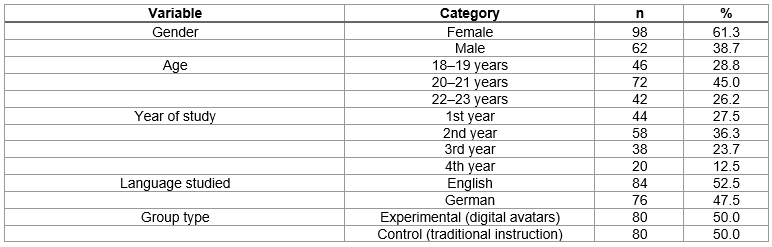
As shown in Table 1, the sample was dominated by women (61.3%). The majority of respondents were students aged 20–21 (45.0%). These data correspond to the typical age profile of bachelor’s degree applicants.
By year of study, the most represented were 2nd year students (36.3%), followed by 1st year students (27.5%), 3rd year students (23.7%) and 4th year students (12.5%). By language, the sample was almost evenly distributed among students. The experimental and control groups were quantitatively balanced (80 people each).
It should be noted that the sampling procedure was based on availability (convenience sampling), which may limit the generalizability of the results to the broader population of higher education students. Participants were recruited from institutions that agreed to participate in the study and had access to the technological infrastructure. Therefore, the results should be interpreted primarily in the context of similar educational settings. Future studies could expand the sample and use randomized or multi-institutional sampling strategies to increase external validity.
Instruments and procedure
The work used various tools aimed at measuring students' foreign language communicative competence, their learning motivation, engagement and features of using digital avatars.
The level of foreign language communicative competence was measured on the basis of standardized final testing adapted to the language of instruction (English or German). The test included three structural components:
listening;
speaking;
lexical and grammatical correctness.
The content of the test tasks was aligned with the CEFR levels (A2–B2) and the curricula of the relevant courses. To ensure validity, the tool was expertly evaluated by foreign language teachers (n = 3). They checked the correspondence of the tasks to the learning objectives and the level of complexity.
The reliability of the test was checked by calculating the internal consistency coefficient (Cronbach's α). Accordingly, the indicator α = 0.82 was obtained - good reliability of the tool.
Students’ learning motivation and engagement were determined using a structured questionnaire, which was compiled on the basis of previous empirical research in the field of language education and adapted to the goals of this study. The questionnaire consisted of 18 statements grouped into two scales:
motivation to learn a foreign language;
learning engagement.
Moreover, responses were recorded on a five-point scale. To check the construct validity, an exploratory factor analysis with varimax rotation was conducted, the results of which confirmed the two-factor structure of the questionnaire. Overall, the internal consistency indicators were high for motivation, in particular: α = 0.85; engagement: α = 0.83.
At the same time, the intensity of use of digital avatars was measured based on students' self-assessment (frequency and duration of interaction) and data from educational platforms (number of sessions, types of completed tasks, interaction time).
Based on these indicators, an index of intensity of use of digital avatars was formed, which was used in correlation and regression analysis.
The study was conducted during an 8-week educational cycle in the usual conditions of the educational process. At the initial stage, participants were informed about the purpose of the study, the principles of voluntary participation, and data confidentiality.
The experimental group implemented the integration of digital avatars into language classes.
Avatars were created based on the use of artificial intelligence and natural language processing technologies.
The digital avatars were implemented using an AI-based conversational engine based on the Large Language Model (LLM) architecture combined with natural language processing (NLP) technologies. The system integrated automatic speech recognition (ASR) to process students’ spoken input and text-to-speech (TTS) synthesis to generate natural-sounding avatar responses.
The dialogue system operated through an intent recognition engine. This enabled the avatar to respond to students’ questions and statements within predefined communicative scenarios. The platform also consisted of adaptive language modules that adjusted lexical and grammatical complexity according to the learner’s level of language proficiency. Interaction logs (number of sessions, duration of interaction, tasks completed) were automatically recorded by the learning platform and used as indicators of the intensity of avatar use.
Digital avatars were used for:
modeling typical communicative situations (everyday communication, educational and professional contexts);
training oral speech through dialogic scenarios;
practicing lexical and grammatical structures in context;
developing listening skills and speech response.
Avatars had a human-like visual image, synthesized speech and the ability to adapt language complexity according to the student's level. For students studying English and German, appropriate language modules with authentic pronunciation samples were used.
Interaction with digital avatars took place during regular classes and within the framework of independent work. Students in the experimental group performed tasks with avatars at least 2 times a week, each session lasted an average of 10–15 minutes.
The control group was trained using traditional methods without the use of digital avatars.
Later, after the end of the training period, all participants took a final test in a foreign language and filled out a questionnaire on motivation and involvement. Data collection was carried out in an online format with subsequent statistical processing of the results.
To increase internal validity, the same learning conditions, course duration, and learning material were provided for both groups. External validity was supported by including students who studied different foreign languages (English and German).
The reliability of the results was ensured by using standardized instruments, checking the internal consistency of the scales, and applying several data collection methods. In particular, the content validity index (CVI) was calculated based on the results of the expert assessment. For the foreign language communicative competence test: CVI = 0.89;
for the motivation and engagement questionnaire: CVI = 0.91 (recommended threshold 0.80).
To determine the construct validity of the motivation and engagement questionnaire, an exploratory factor analysis (EFA) with varimax rotation was conducted. The Kaiser–Meyer–Olkin (KMO) index was 0.86, indicating a high adequacy of the sample. Bartlett's test of sphericity was statistically significant (χ² = 742.36, p < 0.001).
Data Analysis
The empirical data analysis was carried out in stages using descriptive and inferential statistics. Statistical data processing was carried out on the basis of SPSS.
At the first stage, data cleaning and completeness checking were carried out. Cases with missing values did not exceed 5% of the total sample. Next, descriptive statistics of the main study variables were carried out, in particular, average values, standard deviations and minimum and maximum indicators were calculated. At the same time, for hypothesis H1 regarding the impact of the use of digital avatars on the level of foreign language communicative competence, a t-test for independent samples was applied.
In order to take into account the language factor (English / German), a two-factor analysis of variance (ANOVA) was additionally conducted, which allowed to evaluate the effect of the use of digital avatars.
The effect size was determined using the indicators η² (eta squared) and Cohen’s d.
To test hypothesis H2, a correlation analysis was conducted between the intensity of digital avatar use and indicators of students' learning motivation and engagement.
To test hypothesis H3 and assess the contribution of digital avatar use to the formation of foreign language communicative competence, a multivariate linear regression analysis was applied.
The regression model included:
intensity of digital avatar use;
learning motivation;
learning engagement;
language of instruction (dichotomous variable);
initial level of foreign language proficiency (control variable).
Before building the models, the absence of multicollinearity was checked using VIF (Variance Inflation Factor) indicators, the values of which did not exceed the permissible threshold.
Results and Discussion
The results indicated that students in the experimental group who were trained using digital avatars had higher average communicative competence in a foreign language compared to students in the control group who were trained using traditional methods. Students who studied with digital avatars (M = 78.42, SD = 8.15) had higher scores compared to those who studied with traditional methods (M = 72.36, SD = 9.04 (see Table 2).
Table 2.
Comparison of foreign language communicative competence between groups

The results of the ANOVA revealed a statistically significant main effect of the use of digital avatars, F(1, 156) = 18.47, p < 0.001, η² = 0.11. Therefore, regardless of the language of instruction, students who studied using digital avatars had a higher level of language communicative competence compared to students in the control group.
Analysis of the interaction of the factors “digital avatars × language of instruction” also did not reveal a statistically significant effect, F(1, 156) = 0.84, p = 0.361.
Table 3.
Two-way ANOVA data for foreign language communicative competence

Besides, the main effect of the language of instruction (English / German) was statistically insignificant, F(1, 156) = 1.92, p = 0.168. Therefore, there were no significant differences in the level of foreign language communicative competence between students.

The digital avatar intensity index was calculated for students in the experimental group (N = 80) based on aggregated avatar interaction logs over an 8-week study period. Two indicators were included in the calculation of the index: the total number of interaction sessions and the total time of interaction with avatars (See Appendix 1).
To ensure comparability of the indicators, each of them was standardized (z-transformed), and then integrated into a single index according to the formula:
Avatar Use Intensity Index=2z(Total sessions)+z(Total minutes)
Thus, the digital avatar intensity index indicated that the average index value in the experimental group was equal to SD = 0.96, which is the expected result of standardization of indicators. The index values ranged from −1.46 to 1.67, which indicates the presence of significant interindividual variability. In addition, the study also conducted a Pearson correlation analysis. The results of the analysis showed a positive relationship between the intensity of digital avatar use and the level of students' academic motivation (r = 0.42, p < 0.001), as well as between the intensity of digital avatar use and the level of academic engagement (r = 0.38, p < 0.001).
Table 4.
Correlations between digital avatar use intensity, learning motivation, and engagement

The last stage of the study involved conducting a multivariate linear regression analysis. It was aimed at determining the contribution of the use of digital avatars to the formation of foreign language communicative competence of students, considering motivation, involvement and language factors.
In particular, the main dependent variable in the model was the level of foreign language communicative competence, while the independent variables were the index of the intensity of use of digital avatars; learning motivation; learning involvement; language of instruction (English / German, dichotomous variable). Before building the regression model, the linear regression assumptions were checked. Multicollinearity analysis did not reveal critical violations (all VIF values < 2.0). Therefore, the data from the regression analysis indicated that the model is statistically significant (F(4, 155) = 19.36, p < 0.001) and explained 42% of the variation in the level of foreign language communicative competence of students (R² = 0.42).
The index of intensity of use of digital avatars turned out to be a significant positive predictor of foreign language communicative competence (β = 0.31). Also, learning motivation (β = 0.29, p < 0.001) and learning engagement (β = 0.21, p = 0.004) made significant contributions to the model (See Table 5).
Table 5.
Multiple Regression Predicting Foreign language communicative competence

Thus, the data from the regression analysis indicated that the use of digital avatars has an independent and significant impact on the level of foreign language communicative competence of students even after controlling for motivational and learning factors.
At the same time, to determine the mechanisms of influence of digital avatars on foreign language communicative competence of students, the results were analyzed by individual language skills.
The data indicated that the most pronounced influence of digital avatars is observed in listening and speaking skills. Students in the experimental group had statistically significantly higher results in listening (p < 0.001) and speaking (p < 0.001) compared to students in the control group (See Figure 2).

In contrast, for lexical and grammatical correctness, only moderate differences were recorded between the groups, which did not have a statistical significance level (p > 0.05). Therefore, digital avatars had a greater influence on communicative and receptive skills than on formal and structural aspects of foreign language communicative competence (See Table 6).
At the same time, the study indicated an improvement in grammatical correctness (p = 0.062), which requires a separate explanation. This is probably due to the different nature of the formation of communicative and formal language skills. Digital avatars primarily formed an environment for interactive speech practice, which stimulated the development of receptive and productive oral skills - listening and speaking. In such conditions, students focused on conveying content and maintaining a dialogue. This, in turn, contributes to the development of communicative competence in foreign language, but does not always involve focused work on grammatical accuracy. In addition, grammatical correctness is usually formed through another type of learning activity, which consists of systematic exercises in the analysis of language structures and written practice (Aliyeva et al., 2023). In the study, the use of avatars was primarily aimed at modeling communicative situations and developing spontaneous speech. Accordingly, this could reduce the emphasis on formal grammar control. Therefore, the results indicated that digital avatars are particularly effective for developing communicative skills; however, increasing grammatical accuracy may require additional pedagogical strategies focused on explicit grammar instruction.
Table 6.
Comparison of skill scores

This study aimed to determine the role of digital avatars in foreign language learning by students. The data obtained made it possible to explain the impact of digital avatars through three analytical blocks that corresponded to the formulated tasks and hypotheses (H1–H3).
The first task was to assess the impact of digital avatars on the level of language communicative competence of students. In particular, the data obtained from the t-test and two-factor ANOVA confirmed H1, that students in the experimental group had statistically significantly higher foreign language communicative competence compared to the control group. At the same time, the main effect of using avatars was significant even when taking into account the language factor. The absence of a significant interaction of “avatars × language (English/German)” indicated the presence of a positive effect that was relatively universal and not limited to the specifics of a particular language.
Compared with previous studies in the field of language learning technologies, the obtained data agreed with the positions of scientists (Harbord et al., 2021; Kaplan-Rakowski & Gruber, 2023; Bohomaz et al., 2023). In particular, scientists have indicated that digital interlocutors (virtual agents/avatars) have increased the effectiveness of learning based on technologies of interactivity, imitation of communicative situations (Anacona Ortiz et al., 2022). Others have also pointed out the importance of the digital environment for language practice. It is especially important that avatars indicated the conditions for repeated repetition of communicative actions without social pressure. Our results added an empirical argument to this discussion. In particular, the effect of avatars was not reduced to an “interesting tool” (Gruber et al., 2023). It was manifested in a measurable improvement in competence.
At the same time, it is worth emphasizing that the growth of foreign language communicative competence in the case of using avatars may be associated with technology and with the pedagogical organization of interaction. In particular, this is associated with the regularity of practice, scenario-based construction of dialogues, adaptation of complexity and the presence of feedback (Jerez-Rodríguez & Díaz-Borja, 2023; Li et al., 2021).
The second task involved determining the relationship between the use of digital avatars and learning motivation and engagement. The positive correlations found between the intensity of digital avatar use and motivation/engagement confirmed H2. This was consistent with studies that consider digital interactive agents as an important factor in modern language education (Silveira et al., 2025; Turchyn et al., 2023). In particular, the authors indicated that they supported learning autonomy, a sense of control over the pace of learning. Other authors indicated that they influenced the personalization of practice and increased engagement. Importantly, in our case, the effect appeared to be a relationship, that is, the more intense the interaction, the higher the motivation and engagement” (Tarouco et al., 2024; Marenco Domínguez & Marín Juanías, 2024). However, these results should be interpreted with caution given the possibility of a bidirectional relationship. For example, more motivated students could use digital avatars more often. Therefore, further studies should strengthen the evidence by experimentally controlling intensity.
The third task was aimed at assessing the effectiveness of educational strategies with digital avatars. Thus, the regression data confirmed H3. Thus, the intensity of the use of digital avatars was a significant predictor of foreign language communicative competence even after controlling for motivation, engagement, and language factors. This is an important contribution to the discussion on whether the effect of digital technologies is mediated only by motivational mechanisms or has an independent “educational” contribution (Peña Arcila, 2020; Ribeiro et al., 2024). Moreover, when compared with other studies, it becomes clear that the results of this study support the “pragmatic” approach (Guerra-Tamez, 2025). In particular, the digital avatar works as a practice environment that increased the number and quality of communicative attempts, and this is what explained the increase in competence. At the same time, motivation and engagement also remain significant predictors. Such data are consistent with other works (Antón-Sancho et al., 2023; Cabrera-Duffaut et al., 2024). Thus, in our model, digital avatars interacted with motivation.
Thus, the integration of digital avatars into the learning process led to improved academic performance of students. One possible explanation for this effect is the increased level of interactivity and personalization of learning. Thus, unlike traditional learning environments, avatar environments created an important effect of social presence and imitation of interpersonal interaction. As a result, this had a positive effect on motivation and cognitive activity.
Additional analysis by individual skills showed that digital avatars have the most pronounced impact on listening and speaking. This result is consistent with the research logic of using digital technologies (Bucchiarone, 2022; Jauregi-Ondarra et al., 2022). In particular, the authors indicated that they form live communication situations, train the speed of speech reaction, and listening comprehension. In contrast, grammatical accuracy often requires specially designed exercises with an explicit focus on form (Boichenko et al., 2023). Thus, avatars have become the most effective for developing foreign language communicative competence. However, despite the results obtained, the study has certain limitations. First, the sample was formed on the principle of accessibility and included students of only two foreign languages. This may limit the generalizability of the results. On the other hand, some indicators are based on self-reported data. In addition, the duration of the intervention was limited in time. This did not allow assessing the long-term impact of digital avatars.
Therefore, further research should be directed towards the use of long-term experimental designs, the inclusion of objective logs of interaction with digital avatars, and the expansion of the spectrum of languages and educational contexts.
Conclusions
The results of the proposed study established the effectiveness of digital avatars as a tool for supporting and developing foreign language training of students. It was shown that the use of digital avatars significantly increased the level of foreign language communicative competence, which confirmed the main hypothesis of the study. The influence of avatars became stable regardless of the language of instruction, which indicated the universal educational potential of this approach.
It was also found that the intensity of interaction with digital avatars was positively correlated with students' learning motivation and involvement. This indicated that digital avatars strengthened communicative practice, created a favorable psychological environment for active participation in the educational process.
The proposed results of the regression analysis confirmed that the intensity of avatar use was an independent predictor of foreign language communicative competence even after controlling for motivational and educational factors. This indicated the existence of a real pedagogical effect of the use of digital avatars, which goes beyond simply increasing interest or emotional involvement.
Additional analysis of individual language skills showed that the greatest increase was observed in the field of listening and speaking, while the impact on lexical and grammatical correctness became less pronounced. Thus, digital avatars became effective in the development of communicative aspects of speech activity.
In summary, the study confirmed the feasibility of integrating digital avatars into foreign language courses in higher education institutions. Their use contributed to increasing the efficiency of the educational process, the formation of positive learning strategies and the creation of an innovative educational environment.
Bibliographic references
Alam, A., & Mohanty, A. (2022). Metaverse and Posthuman Animated Avatars for Teaching-Learning Process: Interperception in Virtual Universe for Educational Transformation. En M. Panda et al. (Eds.), Innovaciones en computación y comunicación inteligentes: ICIICC 2022 (pp. 47–61). Cham, Suiza: Springer. https://doi.org/10.1007/978-3-031-23233-6_4
Aliyeva, G. B., Honcharuk, V., Pavliuk, N., Zinchenko, V., & Sivachenko, I. (2023). Review of modern pedagogical technologies and methods in the field of philology according to European standards. Revista on line de Política e Gestão Educacional, 27(esp.2), e023049. https://doi.org/10.22633/rpge.v27iesp.2.18778
Anacona Ortiz, J. D., Millán Rojas, E. E., & Gómez Cano, C. A. (2022). Application of Metaverse and virtual reality in education. Metaverse, 3(2). https://doi.org/10.54517/m.v3i2.2154
Antón-Sancho, Á., Fernández-Arias, P., & Vergara, D. (2023). Higher Education in the Pacific Alliance: Descriptive and Exploratory Analysis of the Didactic Potential of Virtual Reality. Multimodal Technologies and Interaction, 7(3), 30. https://doi.org/10.3390/mti7030030
Barráez-Herrera, D. P. (2022). Metaverse in a virtual education context. Metaverse, 3(1), 10. https://doi.org/10.54517/m.v3i1.1807
Bohomaz, O., Koreneva, I., Lihus, V., Kambalova, Y., Shevchuk, V., & Tolchieva, H. (2023). Regarding the development of educational and scientific potential in the 21st century: technological challenges. Conhecimento & Diversidade, 15(38), 479–495. https://doi.org/10.18316/rcd.v15i38.11100
Boichenko, M., Churychkanych, I., Kulichenko, A., Shramko, R., & Rakhno, M. (2023). Mind maps to boost the learning of English as L2 at higher education institutions in Ukraine. Amazonia Investiga, 12(70), 229–240. https://doi.org/10.34069/AI/2023.70.10.21
Bucchiarone, A. (2022). Gamification and Virtual Reality for Digital Twins Learning and Training: Architecture and Challenges. Virtual Reality & Intelligent Hardware, 4(6), 471–486. https://doi.org/10.1016/j.vrih.2022.08.001
Cabrera-Duffaut, A., Pinto-Llorente, A. M., & Iglesias-Rodríguez, A. (2024). Immersive learning platforms: analyzing virtual reality contribution to competence development in higher education—a systematic literature review. Frontiers in Education, 9, 1391560. https://doi.org/10.3389/feduc.2024.1391560
Canto, S., & Jauregi-Ondarra, K. (2021). Interaction games to boost students’ engagement in foreign language virtual exchanges: the case of virtual worlds and video-communication. In N. Zoghlami, C. Brudermann, C. Sarré, M. Grosbois, L. Bradley, & S. Thouësny (Eds), CALL and professionalisation: short papers from EUROCALL 2021 (pp. 41-45). Dublin, Ireland: Research-publishing.net. https://doi.org/10.14705/rpnet.2021.54.1306
Chen, J.C.C. (2021). The interplay of avatar identities, self-efficacy, and language practices. Australian Review of Applied Linguistics, 44(1), 65-81. https://doi.org/10.1075/aral.19032.che
González Vallejo, R. (2024). The Role of Avatars in Language Learning in the Metaverse. Metaverse Basic and Applied Research, 3, 62. https://doi.org/10.56294/mr202462
Gruber, A., Canto, S., & Jauregi-Ondarra, K. (2023). Exploring the use of social virtual reality for virtual exchange. ReCALL, 35(3), 258–273. https://doi.org/10.1017/s0958344023000125
Gu, X., Yu, T., Huang, J., Wang, F., Zheng, X., Sun, M., Ye, Z., & Li, Q. (2023). Virtual-Agent-Based Language Learning: A Scoping Review of Journal Publications from 2012 to 2022. Sustainability, 15(18), 13479. https://doi.org/10.3390/su151813479
Guerra-Tamez, C. R. (2025). Flow-mediated effects of virtual reality on post-pandemic resilience in Mexican university students: a cross-sectional PLS-SEM study. Frontiers in Education, 10, 1618968. https://doi.org/10.3389/feduc.2025.1618968
Harbord, C., Dempster, E., & Jayemanne, D. (2021). The use of avatars in digital role-playing games (RPGs) in computer-assisted language learning (CALL). Mark Peterson, Kasumi Yamazaki and Michael Thomas (eds) In Digital Games and Language Learning. 137-162. London: Bloomsbury Academic. https://doi.org/10.5040/9781350133037.ch-007
Hensen, B. (2023). A systematic literature review of mixed reality learning approaches. En L. T. De Paolis, P. Arpaia, & M. Sacco (Eds.), Extended reality: XR Salento 2023 (Lecture Notes in Computer Science, Vol. 14219) (pp. 15–34). Cham, Suiza: Springer. https://doi.org/10.1007/978-3-031-43404-4_2
Jauregi-Ondarra, K., Canto, S., & Melchor-Couto, S. (2022). Virtual Worlds and Second Language Acquisition. In The Routledge Handbook of Second Language Acquisition and Technology (pp. 311–325). New York, NY: Routledge. https://doi.org/10.4324/9781351117586-27
Jauregi-Ondarra, K., & Canto, S. (2022). Interaction games to boost intercultural communication in virtual worlds and video-communication. In Digital Games in Language Learning (pp. 158–182). New York, NY: Routledge. https://doi.org/10.4324/9781003240075-9
Jerez-Rodríguez, S., & Díaz-Borja, G. (2023). Foreign language teachers’ living and learning in affinity spaces. Saber, Ciencia y Libertad, 18(2), 313–350. https://doi.org/10.18041/2382-3240/saber.2023v18n2.10590
Kaplan-Rakowski, R., & Gruber, A. (2023). The impact of high-immersion virtual reality on foreign language anxiety. Smart Learning Environments, 10(1), 46. https://doi.org/10.1186/s40561-023-00263-9
Laura-De La Cruz, K. M., Noa-Copaja, S. J., Turpo-Gebera, O., Montesinos-Valencia, C. C., Bazán-Velasquez, S. M., & Pérez-Postigo, G. S. (2023). Use of gamification in English learning in Higher Education: A systematic review. Journal of Technology and Science Education, 13(2), 480. https://doi.org/10.3926/jotse.1740
Laurens-Arredondo, L.-A. (2024). Metaversity as the Learning Ecology in the Age of the Metaverse: A Systematic Review. Comunicar, 32(79), 10–22. https://doi.org/10.58262/v33279.2
Li, M., Pan, Z., Sun, Y., & Yao, Z. (2021). Virtual Reality in Foreign Language Learning: A Review of the Literature. In 2021 IEEE 7th International Conference on Virtual Reality (ICVR). (pp. 302-307). IEEE. https://doi.org/10.1109/icvr51878.2021.9483842
Marenco Domínguez, J. M., & Marín Juanías, J. (2024). Language learning strategies research in English as foreign language contexts: A systematic literature review. Journal of Education and Learning (EduLearn), 18(2), 471–479. https://doi.org/10.11591/edulearn.v18i2.21144
Marín Rodriguez, W. J., Andrade Girón, D. C., Zúñiga Rojas, Z. R., Susanibar Ramirez, E. T., Calvo Rivera, I. P., Ausejo Sanchez, J. L., & Caro Soto, F. G (2023). Artificial Intelligence and Augmented Reality in Higher Education: a systematic review. Data and Metadata, 2, 121. https://doi.org/10.56294/dm2023121
Muñoz-Arteaga, J. (2021). Collaborative Production Model of Educational Resources for Human-Computer Interaction Community in Latino America. In Human 4.0 - From Biology to Cybernetic. IntechOpen. https://doi.org/10.5772/intechopen.90992
Peña Arcila, J. B. (2020). Master of Ibero American virtual environment education. Metaverse, 1(1), 11. https://doi.org/10.54517/m.v1i1.1779
Peredo-Alarcon, K. (2025). Exploring the Capabilities of a Virtual Learning Environment to Enhance Spanish Language Skills and Cultural Understanding. Digital Society, 4(3), 74. https://doi.org/10.1007/s44206-025-00216-4
Peixoto, B., Pinto, R., Melo, M., Cabral, L., & Bessa, M. (2021). Immersive Virtual Reality for Foreign Language Education: A PRISMA Systematic Review. IEEE Access, 9, 48952–48962. https://doi.org/10.1109/access.2021.3068858
Ribeiro, A., Arouca, M. G., Amorim, A. M., Pestana, M. C., & Vieira, V. (2024). Towards inclusive avatars: a study on self-representation in virtual environments. In Anais do XIX Simpósio Brasileiro de Sistemas Colaborativos, (pp. 13-27). Porto Alegre: SBC. https://doi.org/10.5753/sbsc.2024.238056
Silveira, I. F., Cardoso, A., & Martins, V. F. (2025). Simulation in education and training: from virtual reality to digital twins. En A. B. Lliteras, A. S. Sprock, & V. Agredo-Delgado (Eds.), Proceedings of the 19th Latin American Conference on Learning Technologies (LACLO 2024) (Lecture Notes in Educational Technology) (pp 373–387). Singapore: Springer Nature Singapore. https://doi.org/10.1007/978-981-96-3698-3_27
Taguchi, N., & Hanks, E. (2025). Potential of Social VR for Learning Spanish Conversation Opening and Closing. CALICO Journal, 42(2), 191–214. https://doi.org/10.3138/calico-2024-0019
Tarouco, L. M. R., Machado, L. A. L. M., da Silva, P. F., Herpich, F., Soares, F., & Fracaro, A. R. (2024). Collaboration and assessment in educational practices with virtual reality. En Proceedings of the 10th International Conference of the Immersive Learning Research Network (iLRN 2024) (pp. 297–305). Immersive Learning Research Network. https://doi.org/10.56198/U6C0W654K
Thrasher, T., Kaplan-Rakowski, R., Ovsiannikova, U., Meyr, J., & Yuan, Y. (2024). “I can talk to Spanish speakers in Illinois!”: Student perspectives on AI-avatar role plays in virtual reality. En WorldCALL 2023: CALL in Critical Times – Conference Proceedings (pp. 157–165). The International Academic Forum (IAFOR). https://doi.org/10.22492/issn.2759-1182.2024.18
Torija, C. S. T., & Torija, M. S. T. (2024). The VR research on educational contexts in Mexico, a critical review of the literature. En E. Guarcello & A. Longo (Eds.), School children and the challenge of managing AI technologies: Fostering a critical relationship through aesthetic experiences (pp. 246–260). London, UK: Routledge. https://doi.org/10.4324/9781032694283-25
Turchyn, I., Zaitseva, S., Rudenko, N., Saienko, V., Kuzemko, N., & Denefil, O. (2023). Using distance learning models as opportunities for blended learning for foreigners. Revista Romaneasca Pentru Educatie Multidimensionala, 15(4), 178–191. https://doi.org/10.18662/rrem/15.4/787
Vazquez-Calvo, B., Elf, N., & Gewerc, A. (2020). Catalan Teenagers’ Identity, Literacy and Language Practices on YouTube. In: Freiermuth, M.R., Zarrinabadi, N. (eds) Technology and the Psychology of Second Language Learners and Users. New Language Learning and Teaching Environments. Cham: Palgrave Macmillan, https://doi.org/10.1007/978-3-030-34212-8_10
Wang, C., & Zou, B. (2025). D‐ID Studio: Empowering Language Teaching With AI Avatars. TESOL Journal, 16(2), e70034. https://doi.org/10.1002/tesj.70034
Yang, F.-C., Acevedo, P., Guo, S., Choi, M., & Mousas, C. (2025). Embodied Conversational Agents in Extended Reality: A Systematic Review. IEEE Access, 13, 79805–79824. https://doi.org/10.1109/access.2025.3566698

Este artículo no presenta ningún conflicto de intereses. Este artículo está bajo la licencia Creative Commons Atribución 4.0 Internacional (CC BY 4.0). Se permite la reproducción, distribución y comunicación pública de la obra, así como la creación de obras derivadas, siempre que se cite la fuente original.