Artículo de investigación
IA como andamiaje cognitivo en la educación bilingüe: Impacto en la comunicación lingüística y literaria de estudiantes no filológicos
AI as cognitive scaffolding in bilingual education: Impact on linguistic and literary communication of non-philological students
Recibido: · Aceptado: · Publicado:
Cómo citar: Suprun, V., Suprun, L., Mazur, N., Liulka, V., & Klym, M. (2026). AI as cognitive scaffolding in bilingual education: Impact on linguistic and literary communication of non-philological students. Revista Eduweb, 20(3), 96–110. https://doi.org/10.46502/issn.1856-7576/2026.20.03.6
Resumen
El objetivo del artículo fue evaluar el efecto de la integración didáctica guiada de IA como andamiaje cognitivo y dilucidar el mecanismo de este efecto. Se realizó un experimento en un diseño de preprueba/postprueba con grupos de control (GC): total N=132; 16 semanas; grupo experimental total (GE) = 66, GC = 66). El GE utilizó el uso regulado pedagógicamente de ChatGPT, lectura asistida por IA, Google Translate y Grammarly. Los resultados mostraron la superioridad del GE sobre el GC en todos los componentes. La lectura de textos profesionales aumentó en el GE al 82-85% (del 65-69%), mientras que en el GC, al 66-72%. El TTR aumentó en el GE a 0,51-0,54 (de 0,37-0,46), en el GC, a 0,40-0,47. En la tarea escrita, el GE demostró el mayor aumento en los criterios de interpretación (psicología: 3,0→4,3) y lógica de la argumentación (3,1→4,1; 3,3→4,2), mientras que la precisión gramatical aumentó de forma más moderada (GE: aproximadamente 59–66%→74–80%). El análisis de correlación confirmó el mecanismo mediado: la relación entre IA×interpretación fue r=0,49–0,74, IA×escritura académica – r=0,58–0,71, IA×gramática – r=0,55–0,62; también se registraron las relaciones entre TTR×interpretación r=0,58–0,73, y lectura×argumentación r=0,61–0,72 (p<0,05–0,01). Las perspectivas de investigación incluyen comparar el uso guiado y autónomo de herramientas de IA y probar los efectos a largo plazo de su integración en el aprendizaje del idioma inglés.
Palabras clave: enseñanza de lenguas extranjeras; apoyo cognitivo para el aprendizaje; interpretación de textos; discurso argumentativo.
Abstract
The aim of the article was to assess the effect of guided didactic integration of AI as cognitive scaffolding and to elucidate the mechanism of this effect. An experiment was conducted in a pre-test/post-test design with control groups (CG): total N=132; 16 weeks; total experimental group (EG) = 66, CG = 66). The EG used pedagogically regulated use of ChatGPT, AI-assisted reading, Google Translate and Grammarly. The results showed the superiority of the EG over the CG in all components. Reading of professional texts increased in the EG to 82–85% (from 65–69%), while in the CG – to 66–72%. TTR increased in the EG to 0.51–0.54 (from 0.37–0.46), in the CG – to 0.40–0.47. In the written task, the EG demonstrated the greatest increase in the criteria of interpretation (psychology: 3.0→4.3) and logic of argumentation (3.1→4.1; 3.3→4.2), while grammatical accuracy increased more moderately (EG: approximately 59–66%→74–80%). Correlation analysis confirmed a mediated mechanism: gains in linguistic resources were associated with higher-order outcomes, including TTR×interpretation (r=0.58–0.73) and reading×argumentation (r=0.61–0.72) (p<0.05–0.01). The research prospects include comparing the guided and autonomous use of AI tools and testing the long-term effects of their integration into English language learning. Overall, the findings suggest that AI-based cognitive scaffolding strengthens linguistic resources (reading and lexical diversity), which in turn supports clearer logical structuring of arguments and more grounded text interpretation in bilingual non-philological students.
Keywords: foreign language education; cognitive support for learning; text interpretation; argumentative speech.
Introduction
AI has become a visible and almost familiar part of the higher education space. In English language learning, students increasingly rely on AI every day. It helps them to process texts, search for information, and explain complex passages in accessible language (Lo et al., 2024; Zhu & Wang, 2025). AI assistants support academic writing by suggesting wording, helping to structure the text, and providing feedback (Ali, 2024; Wah, 2025). Other artificial tools help train reading, vocabulary, grammar, and pronunciation in a self-learning mode (Behforouz & Al Ghaithi, 2025; Yang & Li, 2024).
Reviews show a generally positive but uneven impact of AI on English learning outcomes (Xu et al., 2025; Zhu & Wang, 2025). Text comprehension, vocabulary, and written work quality are most often improved. At the same time, the effect of AI varies depending on the tasks given by the teacher and the imposed constraints. As Rivero and Yin (2025) point out, the same tools can either develop autonomy or increase dependence on prompts. Therefore, it is important to investigate not only whether AI “works”, but also how it changes academic communication. The data on the impact of AI on students’ text interpretation and argumentation logic remain particularly controversial. The number of controlled empirical studies on bilingual non-philological students, in particular in Ukrainian higher education institutions (HEIs), is limited.
The concept of cognitive scaffolding originates from socio-cognitive learning theory and refers to the temporary support provided to learners to facilitate the performance of tasks that would otherwise exceed their current level of competence (Lo et al., 2024; Zhu & Wang, 2025). Traditionally, scaffolding is associated with teacher guidance, structured prompts, and mediated learning interactions that gradually foster learner autonomy. In contemporary digital learning environments, technological tools can also function as scaffolding mechanisms by supporting comprehension, reducing cognitive load, and structuring complex cognitive operations (Hong et al., 2025; Godwin-Jones, 2023; Yao & Fan, 2025). From this perspective, AI systems may be interpreted not merely as sources of information or automation, but as dynamic cognitive supports capable of mediating linguistic processing, interpretation, and argument construction (Barrot, 2024; Yang & Li, 2024; Zhang, 2025).
The aim of this study is to test the effect of guided integration of AI tools as cognitive scaffolding for the development of linguistic and literary English-language communication of bilingual non-philology students. The study is aimed at clarifying the mechanism of influence of the use of AI (through linguistic resources) on the results of English-language communication of bilingual students and at substantiating a pedagogically appropriate model of its integration into higher education.
The aim involves the fulfilment of the following research objectives:
1. Analyse the dynamics of linguistic and literary English-language communication of non-philological students using AI tools.
2. Establish the differentiated influence of AI on formal language indicators (grammatical accuracy, lexical diversity, reading of professional texts) and cognitive-speech components (text interpretation, logic of argumentation, academic writing).
3. Substantiate the mechanism of indirect influence of AI on the development of argumentative and interpretive competence of bilingual students.
The practical significance of the study is to determine the real effect of the guided integration of AI tools in teaching English. The obtained results help teachers to reasonably use AI as cognitive scaffolding in linguistic and literary communication. The proposed approaches can be integrated into curricula for bilingual non-philological students.
Literature review
The integration of AI into language education is changing traditional pedagogical practices, shifting learning from teacher-centered approaches to more adaptive educational ecosystems. Academic reviews document a general trend toward increased student engagement and autonomy with AI, but emphasize that the effect depends on context, access, and methodological support. There is no clear consensus in the current literature on which components of foreign language competence AI best supports. Research results vary by task type, specific tool, and level of didactic regulation. Earlier CALL-based interventions also demonstrated that structured integration of computer-assisted learning environments can produce measurable improvements in students’ English achievement, particularly when digital tools are embedded within pedagogically regulated instructional models (Al-Khayyat, 2015).
On the one hand, a number of studies demonstrate tangible positive effects of AI interventions on specific skills. For example, positive dynamics of results under AI support is shown for reading in English as a Foreign Language (EFL) (Behforouz & Al Ghaithi, 2025). In the area of literary competence and analytical writing, some authors note additional benefits when AI is combined with learning models that involve high levels of student engagement (Jadwe et al., 2025), with the effect of “flipped learning” in EFL being interpreted as enhancing cognitive engagement and autonomy (Lee & Wallace, 2018). At the same time, these positive findings contrast with the caveats of Fang and Han (2025). On the material of genre- and culturally complex texts, AI more often produces simplified or falsely convincing interpretations. Therefore, the effect of using AI depends on the type of text and the cognitive complexity of the assignment.
There are also contradictions in the theoretical and methodological explanations of the mechanisms of AI influence. Early research in Computer-Assisted Language Learning conceptualized digital technologies as mechanisms of structured learner support, adaptive feedback, and guided development of language competence (Beatty, 2010). Contemporary CALL and second language acquisition research emphasizes that technological assistance does not automatically result in learning outcomes without cognitive engagement and internalization processes (Godwin-Jones, 2023). Recent developments in AI-driven language technologies have significantly expanded possibilities for text generation, feedback, and linguistic mediation in educational contexts, raising new questions about pedagogical boundaries and quality control (Barrot, 2024).
The empirical results on writing and communication are also interpreted ambiguously. It was shown that the interaction of humans and generative AI in academic writing can be complementary, but requires developed skills in critically evaluating machine responses (Ali, 2024). At the same time, it was proven that learning outcomes depend not so much on the “availability of AI” as on the intensity and nature of interaction with it, which makes pedagogical design a key variable (Alhamam, 2025). At the emotional level, systematization shows that AI support can be accompanied by heterogeneous emotional reactions that affect the stability of effects (Zhang & Liu, 2025), while reviews of ChatGPT emphasize methodological and research “blank spots” (Lo et al., 2024). The generalized data of meta-analysis, despite the generally positive trend, emphasize the variability of effects and the dependence on the conditions of implementation (Xu et al., 2025).
In the bilingual aspect, another “break” of interpretations is observed. On the one hand, a framework was proposed where AI influences through autonomous learning, administrative processes and teaching support – but with a warning about the risks of bias and limitations of teacher autonomy (Escobar Alméciga et al., 2025). On the other hand, it was shown that interaction with GenAI can activate translinguistic strategies in writing, when the native language is used as a resource for finding solutions to ideas, rather than as an “obstacle” (Yang & Lin, 2025). Empirical data indicate an increase in learning outcomes, motivation and self-regulated AI-mediated learning (Wei, 2023). In the field of translation, there is also no one-dimensional conclusion.
So, recent studies show a field of methodological and pedagogical contradictions rather than a coherent consensus. AI can enhance individual language resources (reading, vocabulary, writing), but its impact on “higher” components (interpretation, argumentation, literary communication) is uneven, context-dependent, and mediated by pedagogical design. This discrepancy in results and explanations leads to an academic gap. There is a lack of controlled empirical data on the integrated impact of AI on the linguistic and literary communication of bilingual non-philological students— and on the mechanism through which this impact is realized.
Methods and Materials
The study is based on an experimental design and quantitative data analysis to assess the impact of AI on linguistic and literary English-language communication; the following methods were used:
1. A pedagogical experiment (pre-test/post-test with a CG) was used to test the effect of guided integration of AI on English-language communication indicators and to compare the dynamics between the EG and CG.
2. Quantitative testing of language competence (grammatical accuracy, Type–Token Ratio, comprehension of professional texts) was used to record changes in students’ linguistic resources during the semester.
3. Analytical assessment of argumentative writing by rubric (comprehension, interpretation, logic of argumentation, linguistic design) was used to measure the “higher” cognitive-speech components of literary English-language communication.
4. The correlation method (Pearson r) was used to identify relationships between the intensity of AI use and language/cognitive-speech indicators, as well as to test the mediated mechanism of influence through language resources.
5. Statistical t-tests were used to statistically test changes (paired t-tests: pre→post within groups) and differences between groups (independent t-tests for post–pre increments) in order to clearly and transparently assess the effect of the intervention.
Participants and sampling.
The study included undergraduate non-philological students (N = 132) studying at three HEIs in Ukraine:
1) Psychology (National Pirogov Memorial Medical University, Vinnytsia);
2) Agroengineering (Poltava State Agrarian University);
3) Ecology (National University of Water Management and Environmental Management).
All participants were classified as academic bilinguals who use EFL (L2) in an educational context. Inclusion criteria were:
1) Age 18–22 years;
2) Status as an undergraduate non-philological student;
3) Completion of a relevant English/English for Specific Purposes (ESP) course in the specified semester;
4) Absence of participation in parallel intensive English programmes outside the course (according to self-assessment/questionnaire data).
Students were informed about the experiment through an announcement by the instructor in class and an official group chat, after which they were given an information sheet and a voluntary consent form. All participants were classified as academic bilinguals using English as an L2 in an educational context. The gender composition of the sample was mixed: women made up 60%, men 40% of the total sample.
Each institution formed two groups — EG and CG — with 22 participants each (a total of 44 students per major; total N = 132, EG = 66, CG = 66). Randomization was carried out by generating random numbers and assigning participants a group code (EG/CG) after pre-testing. This approach ensured comparability of groups within each HEI, not between institutions. The comparability of the baseline level between EG and CG within each HEI was confirmed by the pre-test results (p > 0.05).
“Academic bilinguals” in this study were defined as students who (1) had a B1–B2 or higher level on an English pre-test, (2) had studied English in formal education for at least 5–10 years (self-report), and (3) regularly used English as an L2 for academic purposes (reading/working with professional materials, completing written assignments), as confirmed by a short frequency questionnaire (weekly self-report). Students who did not meet these criteria were not included in the sample.
Research procedure
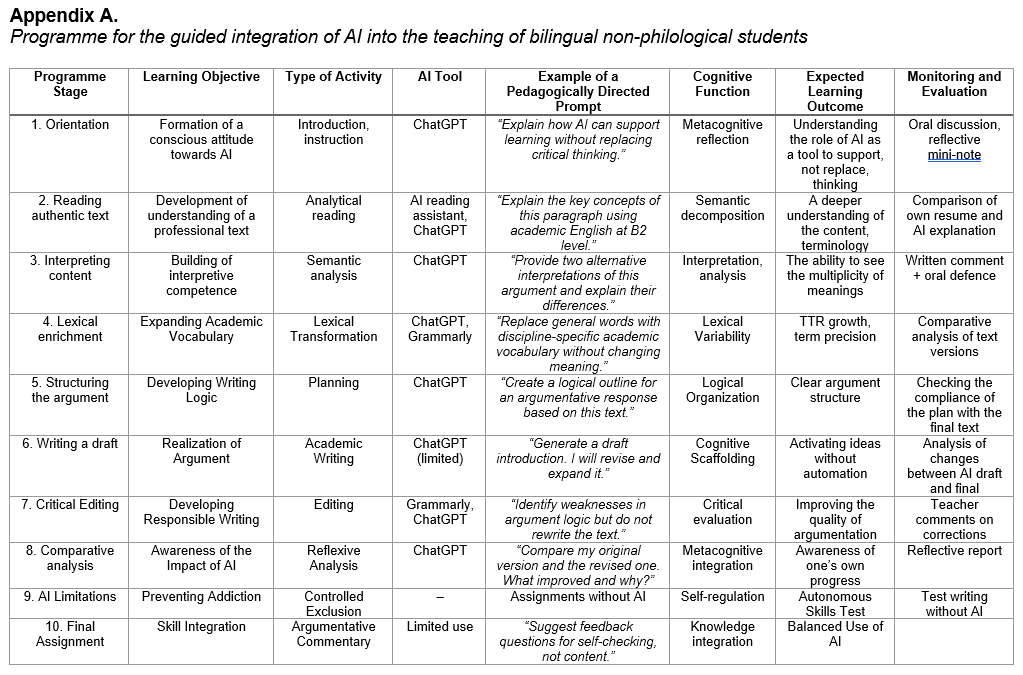
Educational materials and assessment criteria were standardized for all three HEIs. To minimize uncontrolled AI use, both groups were provided with explicit academic integrity guidelines. Students in the control group were instructed to complete all course-related tasks without the use of AI tools. Compliance was monitored through a brief academic integrity checklist administered periodically during the semester, in which students confirmed adherence to the experimental conditions. Additionally, AI tools were strictly prohibited during pre-test and post-test assessments, which were conducted under supervised classroom conditions. While complete control of students’ out-of-class behaviour is methodologically unattainable, this procedure ensured reasonable regulation of AI exposure within the experimental design. The experimental phase lasted one academic semester (16 weeks) offline. Training in both groups was carried out according to the same programme using identical authentic English-language academic (ESP) texts selected according to the majors (psychology, agricultural engineering, ecology). The texts were informative and argumentative in nature, contained professional terminology, and were comparable in volume and complexity to ensure correct comparison of results between groups. The difference was in the controlled integration of AI tools into EG. The experimental AI integration programme was developed taking into account the principles of controlled cognitive support and aimed at developing linguistic and literary English-language communication of bilingual non-philological students. The programme was implemented during one academic semester and combined classroom and independent work of students (Appendix A). The AI was used according to clearly defined pedagogical scenarios, which allowed directing students’ work not to mechanically obtain ready-made answers, but to support higher-level thinking operations, in particular analysis, interpretation, and argumentation. All AI-generated results were subject to mandatory analysis, refinement and rethinking by students, which ensured active cognitive involvement and preservation of academic integrity. Different AI tools were used within the programme depending on the type of educational task: ChatGPT was used to analyse English-language texts, generate ideas and structure arguments; Google Translate – to compare translation options and identify semantic discrepancies; Grammarly – to edit the language design of written works; AI reading assistants – to explain terminology and paraphrase complex fragments of text. At the same time, the programme clearly limited the excessive use of AI: copying ready-made answers without own intellectual processing was prohibited, and the final result had to reflect the student’s independent interpretative and analytical work.
The intensity of AI use during the experiment was determined by a standardized self-report (a short weekly report), in which students recorded the frequency of using ChatGPT / AI-assistant for reading / Google Translate / Grammarly specifically for course tasks (reading, interpretation, lexical transformation, argument planning, editing). The frequency was assessed on a scale (0 = did not use, 1 = 1 time/week, 2 = 2–3 times/week, 3 = 4–5 times/week, 4 = daily); an integral intensity index (0–16) was formed based on the total score, which was used in the correlation analysis and to construct low/moderate/high intensity groups.
The EG students systematically used AI tools to understand texts, expand their vocabulary, as well as create and edit written responses. The CG performed similar tasks without the use of AI, relying on traditional teaching methods. It is important to note that students were not allowed to use AI tools during the pre-test and post-test assignments. Literary English communication was assessed in a complete autonomy in order to identify the level of interpretative and argumentative skills internalized in the process of earlier work with AI tools. Within the framework of this study, linguistic communication was considered as a set of formal and receptive language skills (grammatical accuracy, lexical diversity, reading of professional texts). Literary communication was interpreted as the semantic implementation of these resources in the process of interpreting an English text and constructing an argumentative written statement.
Instruments and data collection
Language communication was assessed using pre-test and post-test results, which included indicators of grammatical accuracy (percentage of correct forms), lexical diversity (Type–Token Ratio, TTR), and comprehension of professional English texts. Literary English communication was investigated using an argumentative writing task based on an authentic academic text of 400–450 words. Students' written works (200–250 words) were assessed using four criteria: understanding of the content, interpretation of ideas, logic of argumentation, and linguistic design. The assessment was carried out on a five-point scale. The written works were assessed by two independent experts using an analytical rubric; calibration was carried out before the assessment, and inter-expert agreement was checked using Intraclass Correlation Coefficient (ICC): absolute agreement. A blind assessments were performed to group and stage (pre/post), and discrepancies were reconciled by re-review.
Data analysis
Quantitative data were processed in SPSS. Descriptive statistics, paired Student t-tests (pre-test → post-test), and Pearson correlation analysis were used. Independent t-tests for the magnitude of the increase (post–pre) were used to compare the EG and CG. The statistical significance level was set at p < 0.05. Additionally, an analysis of the relationship between the intensity of AI use and language and cognitive-speech indicators was conducted. The use of t-tests and correlations meets the objectives of the study (assess pre/post changes and relationships between indicators) and is sufficient to interpret the effects within the chosen design and sample size. In this study, the priority was to provide transparent interpretation of changes and comparability of results across the three educational contexts; the application of more sophisticated models is planned for a larger sample and in longitudinal designs.
Research limitations
The limitations include a relatively small sample
size, a focus exclusively on non-philological majors, and the short duration of
the experiment, which did not allow for the assessment of long-term effects of
AI use. A particular difficulty was the control of individual strategies for
using AI tools, despite the guided pedagogical design.
Results and discussion
Analysis of the pre-test and post-test results showed positive dynamics of the level of English proficiency in all study groups. At the same time, the EG of students majoring in Psychology, Agroengineering, and Ecology of three different HEIs demonstrated significantly higher rates of growth of language indicators compared to the CG.
The growth was recorded for all measured components, but its intensity varied depending on the type of language activity. The greatest increase was observed in those types of tasks that involved understanding the content of the English text, its interpretation and construction of one’s own reasoned statement, while changes in grammatical accuracy were more moderate in nature (see Table 1). This configuration of results is consistent with prior studies demonstrating that AI-supported learning environments tend to produce stronger effects on meaning-related and organizational aspects of language use than on formal grammatical accuracy. Zhang (2025), for example, reported substantial improvements in argument structuring and content development, while grammatical gains remained comparatively limited. A similar interpretation is supported by Hong et al. (2025), who argue that AI tools facilitate cognitive resource redistribution rather than direct correction of linguistic form.
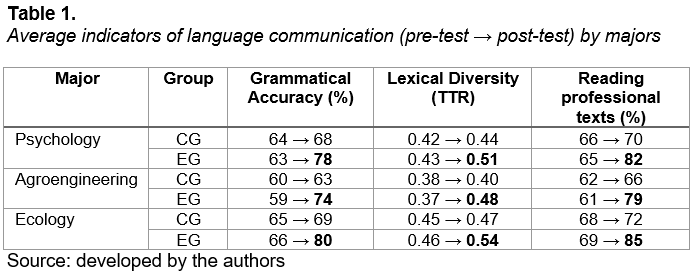
Quantitative analysis showed that in all EGs the increase in indicators was statistically significant (p < 0.05). The largest changes were recorded in the indicators of reading professional texts and lexical diversity of written speech. This was observed regardless of the major, although the absolute values varied. Comparable tendencies have been observed in vocabulary-oriented AI research. Pryma et al. (2025) found that AI-assisted writing contributed to measurable expansion of students’ lexical repertoires and improved textual coherence. Our results replicate this pattern: AI integration was associated with more active use of academic and professional terminology. At the same time, Pryma et al. (2025) note potential risks, including the emergence of mechanical phrasing and reduced originality, which reinforces the importance of balanced AI usage.
Literary English communication was assessed by offering students the task: to read a short academic text in English (400–450 words) and write a reasoned comment (200–250 words) based on the content of the text. The assessment was carried out according to the criteria: understanding of the content, interpretation of ideas, logic of argumentation, language design (see Table 2).
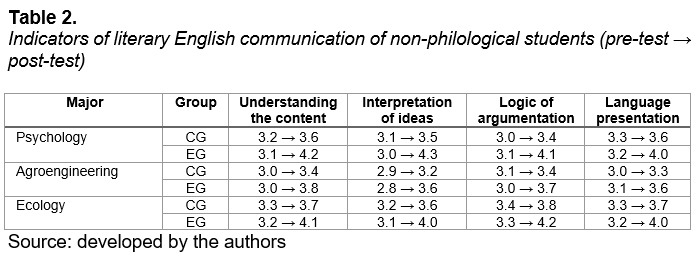
In all majors, the EG demonstrated a more intensive increase in the criteria of literary English communication compared to the CG. The most sensitive to the controlled integration of AI were the interpretation of ideas and the logic of argumentation: in psychology, the increase in interpretation was +1.3 (3.0→4.3) and argumentation +1.0 (3.1→4.1), while in the CG these changes were more moderate (mainly +0.3–0.4). In terms of the final level of logic of argumentation, the highest values were demonstrated by students of Ecology (EG: 4.2), while the growth was stable but less intense in all components in Agroengineering. In general, the differences between the EG and CG are interpreted as the result of an internalized (not “instant”) effect: during the pre/post assessment, AI was not used, therefore the recorded changes reflect mediated cognitive-linguistic development due to the controlled integration of AI into the learning process. This predominance of gains in interpretation and argumentation aligns with empirical findings indicating that AI support strengthens higher-order cognitive processes involved in analytical writing. Zhang (2025) similarly observed that AI assistance most strongly affected argument organization, whereas grammatical components demonstrated only moderate growth. Such dynamics may be explained by the cognitively indirect nature of AI influence: generative systems create hybrid writing environments requiring learners to evaluate, refine, and critically interpret machine-generated outputs (Yao & Fan, 2025).
Correlation analysis showed that the relationship between the intensity of AI use and the indicators of interpretation and academic writing is stronger than between the use of AI and formal grammatical skills (see Table 3).
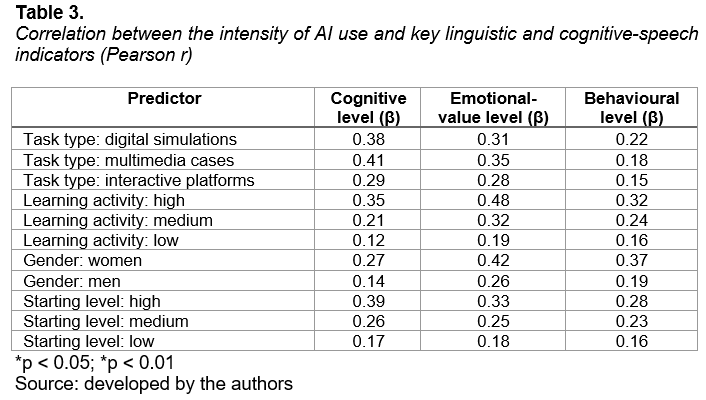
Table 3 shows that AI most effectively affects the complex cognitive-speech components of English-language communication. At the same time, the correlation between the intensity of AI use and the logic of argumentation turned out to be weaker compared to the correlations with language resources, in particular lexical diversity and text interpretation. This indicates that the formation of an argumentative written expression is not reduced to the direct influence of technological tools. Instead, it is mediated by the level of development of language resources and cognitive text processing. This interpretation is theoretically compatible with the concept of cognitive offloading. Hong et al. (2025) suggest that delegating routine operations to AI frees cognitive resources for interpretation and evaluation. Simultaneously, Yao and Fan (2025) emphasize that AI-supported writing introduces additional cognitive demands associated with prompting and verification. Together, these mechanisms help explain why AI effects are stronger in interpretive and lexical-semantic dimensions.
In order to explain the mechanism of the influence of AI on literary and interpretive English-language communication, an additional correlation analysis was conducted between the language indicators that underwent changes as a result of the use of AI and the indicators of interpretation and argumentation of written speech (Table 4).
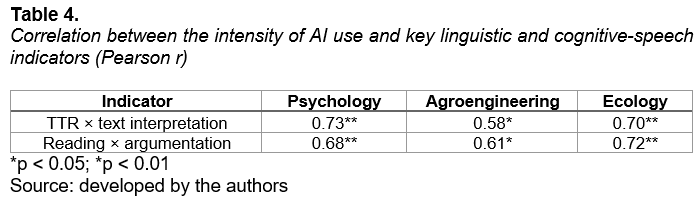
The results showed a moderate to strong relationship between the level of lexical diversity of written speech and the ability to interpret English texts (r = 0.66–0.73; p < 0.01 depending on the specialty). A similar trend was observed between the results of reading professional texts and the logic of argumentation in written works (r = 0.61–0.70; p < 0.01).
The obtained results indicate that the impact of AI on literary and interpretive English-language communication is indirect and is realized through the strengthening of linguistic resources, in particular lexical diversity and skills of reading professional texts in English. Similar effects have been documented in AI-assisted reading research. Studies report significantly higher comprehension outcomes when AI tools are incorporated into text-processing activities (Doğan & Talan, 2025). The present data extend this observation by demonstrating that improvements in reading professional texts are closely linked with the development of argumentative writing logic.
The intensity of AI use was assessed by the frequency of use of AI tools during the course tasks. Based on these data, an integral intensity indicator was calculated. Next, students were divided into three intensity levels (low/moderate/high) and the average increase in results (post–pre) was compared. In order to test the assumption of the nonlinear nature of the impact of AI, it was analysed how the increase in linguistic and literary indicators changes depending on the level of intensity of AI use (Figure 1).
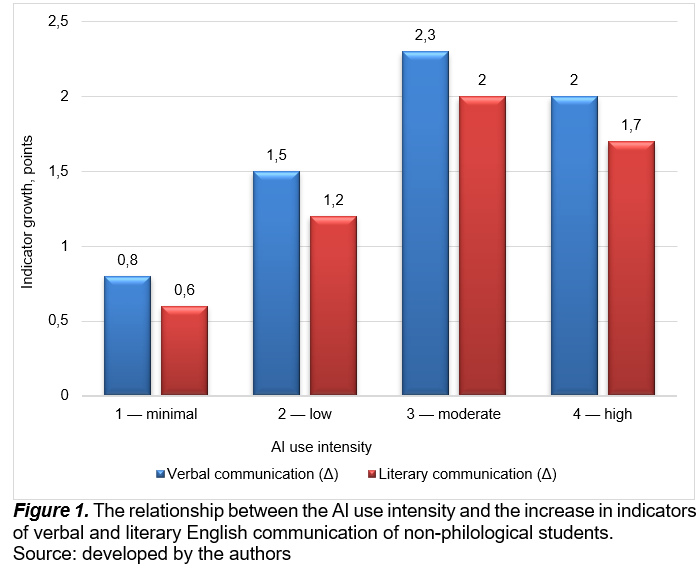
Figure 1 shows a nonlinear relationship between the AI use intensity and the growth of indicators of verbal and literary English-language communication. In both dimensions, a gradual increase in results was recorded under conditions of minimal and low intensity of AI use, with maximum values achieved at a moderate level of its use. The nonlinear nature of this relationship confirms that pedagogical effectiveness depends not on the intensity of AI usage per se, but on its structured integration. Excessive reliance may reduce cognitive engagement, a concern also reflected in recent AI-in-education analyses (Deep & Chen, 2025). These findings reinforce the argument that AI functions most effectively as a cognitive support rather than a substitute for learner effort.
Under high AI use intensity, a decrease in the average growth of both verbal and literary communication is observed. This indicates the absence of a direct proportional relationship between the frequency of technology use and the educational effect. At the same time, the dynamics of verbal communication is somewhat higher compared to literary communication at all levels of intensity, which reflects the different degree of sensitivity of these components to the pedagogical implementation of AI tools.
Overall, the obtained results indicate that the impact of AI on linguistic and literary English communication is systemic but mediated. AI does not act as a direct means of increasing formal linguistic accuracy, but primarily activates higher-level cognitive and speech processes.
From a theoretical perspective, the obtained results are best explained as part of the socio-cognitive concept of mediated learning. According to it, digital tools function as cognitive mediators that redistribute the learning load between technical and mental operations. In this context, AI acts as a dynamic scaffolding, enhancing access to language resources while requiring the student to actively participate in evaluating, interpreting, and editing the results.
Conclusions
The study (N=132; 16 weeks) found that guided integration of AI into English language learning for non-philological students is associated with higher gains in language and literature scores compared to traditional learning. In the EG, the gains were greatest in reading specialized texts and lexical diversity (TTR): for example, reading increased by +17–18 pp. (EG: 65→82; 61→79; 69→85), while in the CG — by +4 pp. (66→70; 62→66; 68→72). TTR in the EG increased by +0.08–0.11 (0.43→0.51; 0.37→0.48; 0.46→0.54), in the CG — by only +0.02.
According to the criteria of argumentative writing, the EG showed more noticeable changes in the “higher” components: interpretation increased to +0.8–1.3 points (e.g., 3.0→4.3), and logic of argumentation to +0.7–1.0 points (e.g., 3.1→4.1), while in the CG the increases were mostly +0.3–0.4 points. Grammatical accuracy also increased, but more moderately than other components (e.g., EG: 63→78; CG: 64→68). Correlation data support the mediated nature of the changes: the relationship “intensity of AI use × interpretation” was higher (r≈0.49–0.74) compared to “AI × grammar” (r≈0.55–0.62), and strong relationships were also recorded between language resources and “higher” indicators (e.g., TTR × interpretation r≈0.58–0.73).
The obtained results serve as the basis for the pedagogical design of classes using AI. These include the scenario-based implementation of tools such as ChatGPT, AI-assistant readers, Google Translate, and Grammarly in working with authentic professional texts, lexical enrichment, and structured argumentative writing with control of academic integrity and intensity dosage. Further research may be focused on comparing guided and autonomous models of using AI tools. It is also important to study the long-term effects of integrating AI into English language teaching. Particular prospects for further research include comparative studies examining the effects of AI-assisted learning across different levels of language proficiency (e.g., B1 vs. C1), which may clarify the role of linguistic competence in mediating AI-related learning outcomes.
Bibliographic references