
Artículo de investigación
Chatbots en la educación superior: Mejorando la competencia digital de los estudiantes
Chatbots in higher education: Enhancing students' digital competence
Recibido: · Aceptado: · Publicado:
Cómo citar: Titarchuk, V., Iliichuk, L., & Vakulenko, S. (2026). Chatbots en la educación superior: Mejorando la competencia digital de los estudiantes. Revista Eduweb, 20(3), 206–224. https://doi.org/10.46502/issn.1856-7576/2026.20.03.12
Resumen
El artículo presenta el contenido y revela la importancia de los chatbots en el entorno de la educación superior. Se consideran las categorías de chatbots con capacidades crecientes (sistemas basados en inteligencia artificial). Para desarrollar la competencia digital de los futuros especialistas y lograr la integración efectiva de los chatbots en el proceso educativo de la educación superior y en sus actividades profesionales, lo que mejora significativamente la calidad de la educación superior, las actividades profesionales y la vida de cada persona, realizamos un estudio experimental. Se utilizó la prueba t de Student para variables independientes con el fin de identificar diferencias entre los grupos experimental y de control, y la prueba de Fisher para comparar los resultados del diagnóstico. Al finalizar la etapa formativa del estudio experimental, todos los indicadores descritos difirieron de los resultados de la etapa de determinación del estudio experimental. En el grupo experimental, observamos cambios significativos en el alto nivel de formación de la competencia digital de los estudiantes, lo que introduce cualitativamente los chatbots en el proceso educativo de la educación superior y en las actividades profesionales de los futuros especialistas. En el grupo de control, también hay cambios, pero no significativos. El análisis de los resultados experimentales obtenidos demuestra la eficacia del innovador sistema desarrollado e implementado por nosotros y las condiciones pedagógicas propuestas para el fenómeno descrito.
Palabras clave: chatbots; categorías de chatbots; inteligencia artificial; entorno digital de la educación superior; competencia digital.
Abstract
The article presents the content and reveals the significance of chatbots in the higher education environment. The categories of chatbots with growing capabilities (systems based on artificial intelligence) are considered. To develop the digital competence of future specialists for the effective integration of chatbots into the educational process of higher education and into the professional activities of future specialists, which significantly improve the quality of higher education, professional activities, and the life of each person, we conducted an experimental study. Student's t-test was used for independent variables to identify differences between the experimental and control groups, and Fisher's multiple-test to compare the results of the diagnosis. Upon completion of the formative stage of the experimental study, all the outlined indicators differed from the results of the ascertaining stage of the experimental study. In the EG, we see significant changes in the high level of formation of students' digital competence, which qualitatively introduces chatbots into the educational process of higher education and into the professional activities of future specialists in students. In the control group, there are also changes, but not significant. Analysis of the obtained experimental results proves the effectiveness of the innovative system developed and implemented by us and the proposed pedagogical conditions of the outlined phenomenon.
Keywords: chatbots; categories of chatbots; artificial intelligence; digital environment of higher education; digital competence.
Introduction
To ensure an adequate level of support and improve communication between students and teachers in distance learning, it is necessary to find effective tools, and modern trends in the digitalization of education are precisely necessary in this process. The use of AI chatbots is one of the promising solutions in this area, because they can automate several administrative and educational processes, increasing the availability of educational resources and reducing the burden on teachers.
The digital technology market offers a wide range of opportunities for the transformation of educational institutions of each type of activity. Today's realities have proven the significance and relevance of the process of digitalization of the educational process, when the educational process cannot do without digital methods. The effective operation of universities in general depends on such a process (Vanichvasin, 2022). In modern conditions, an urgent problem is determining the forms of transformation of education and real ways of involving new technical developments for productive growth and systematic improvement of the educational potential of a higher educational institution.
In the era of the Internet, virtual communication is considered the next stage aimed at the development of mediated forms of personal communication, the development of social communications of a person, the expansion of the cultural background and range of communication, methods of obtaining and attracting new sources, and the production of information (Zhang, 2023).
The modification of artificial intelligence is behind each of the listed features of virtual communication. The integration of artificial intelligence into the educational process is actively studied in world research. The integration of digital learning tools into the educational process is due to the personalization and accessibility of education, the completeness and speed of information processing, which is facilitated by the use of chatbots – virtual assistants.
Building on the identified research gap, this study addresses the insufficient empirical evidence regarding the effectiveness of AI-powered chatbots as pedagogical tools for developing students' digital competence in higher education. While previous studies have demonstrated the educational potential of chatbots, limited attention has been devoted to experimentally validating comprehensive pedagogical systems that integrate AI chatbots into university teaching and learning.
Therefore, the objective of this study is to examine the effectiveness of integrating AI-powered chatbots into the higher education learning environment for enhancing students' digital competence.
The following hypotheses were formulated:
H1: Students participating in the AI chatbot-supported educational intervention will demonstrate significantly higher levels of digital competence than students receiving traditional instruction.
H0: There will be no statistically significant differences in the levels of digital competence between students participating in the AI chatbot-supported educational intervention and those receiving traditional instruction.
Literature Review
Modern scientific research indicates a growing interest in generative language models in the digital educational environment and in the use of chatbots, in particular in the context of assessing the results of educational interaction and their pedagogical feasibility.
Labadze et al. (2023), in a systematic review of literature sources, emphasize that the pedagogical advantages of chatbots in higher education are related to the support of teaching activities and personalization of learning, while the issues of accuracy, reliability, and ethical responsibility of their use in the educational process of higher education remain relevant.
A study by Knoth et al. (2025) found that, beyond static traditional learning support tools, educational chatbots can significantly increase students' skills in critically evaluating information.
Debets et al. (2025) note that chatbot evaluation is largely limited to subjective perception indicators, and many educational chatbots are integrated into student education without a proper pedagogical theoretical basis. Baig & Yadegaridehkordi conduct similar studies. The scientists point to the fragmentation of approaches in higher education to assessing the use of ChatGPT and prove the lack of consistency of methodological foundations in the studies (Baig & Yadegaridehkordi, 2024).
The empirical results of the study by Alenezi and Alenezi (2025) show the positive impact of chatbots on the growth of learning motivation and engagement of students in the educational space and on the development of their communication skills, which confirms the educational potential of such tools in various educational contexts.
A significant contribution to the formation of an analytical approach to assessment was made by Qiu et al. (2025), who proved the need to integrate data on the nature of interaction, learning outcomes, and level of involvement into a single system for analyzing education seekers. At the same time, Jauhiainen and Garagorry Guerra (2025) in their study show possible ways for pedagogically correct assessment of written works and prove the possibility of using generative language models in higher education, provided that certain methodological requirements and criteria are strictly observed.
As a social phenomenon, a chatbot is a computer program that imitates human communication using text or voice, helps automate tasks, and serves as an interlocutor that, working according to a given algorithm, conducts a dialogue with the user, fulfills requests, and responds to requests. Most chatbots work on popular messenger platforms: Viber, Telegram, Facebook Messenger, Skype, Slack. Chatbots allow people to communicate using electronic devices as if they were talking to a live agent.
To provide the highest level of personalization by collecting and processing data, chatbots can range from simple programs that clearly respond to a single instance to advanced virtual assistants that can improve and learn (Munaye et al., 2025).
Chatbots can be defined as software that generates natural language as output, accepts natural language as input, and participates in a conversation. Chatbots can be built into search engine functionality and operate as separate programs (Palshkov et al., 2026).
They are also capable of providing useful information and can multitask based on user requests. In particular, they can provide the latest news, posters, weather forecasts, word translation, currency exchange rates, help booking a ticket, choosing the right flight, ordering a taxi, etc.
Systems with growing capabilities based on artificial intelligence are one of the main categories of chatbots, which have many potential applications in production automation, decision support, training, communication, etc.
The chatbot industry, according to Bloomberg, is developing faster than the mobile application industry during its heyday. One example of technology currently used in (computer-mediated) communication is a chatbot, where artificial intelligence agents are increasingly performing the roles that people once served. Not all chatbots are designed based on artificial intelligence, such as machine learning. However, the advantage of chatbots based on artificial intelligence is that they become smarter through increased interaction and data with the user.
Many popular chatbots can entertain; educational chatbots help with learning foreign languages; they can work as quizzes, online games, puzzles, and send quotes, photos, etc.
Chatbots can be divided into simple and self-learning:
- Simple chatbots can interact with students in higher education through pictures and buttons or accept text commands, highlighting keywords, recognizing language or text, and translating them into commands. Simple chatbots respond according to a given program and may have instructions with keywords and a list of commands.
- Self-learning chatbots, adapting to the individual characteristics of users and analyzing dialogues and working on the principle of artificial intelligence, allow them to learn in the process of communicating with users (Rudolph et al., 2023).
Self-taught chatbots participate in dialogues with students on abstract topics and have several advantages: they do not require switching between different menu tabs; they allow convenient work in one window; they allow students to work even at low Internet speeds; they work with messengers on all platforms, and they consume little traffic. It is convenient to transfer information through chatbots.
AI is increasingly integrated into various aspects of learning in the modern educational space, particularly in higher education. AI systems contribute to improving knowledge assessment and learning quality, creating an individualized educational experience. Those countries that actively implement AI technologies have achieved significant progress in reforming educational processes (Ait Baha et al., 2024).
Multimedia elements, high-quality graphics, and animation make it possible to present a distance course in the form of dynamic images, which greatly facilitates the assimilation of the studied material. Chatbots with AI, contributing to improved communication between students and teachers and providing necessary educational support, are becoming an important part of mobile applications for distance learning (Kohnke, 2023).
Chatbot structure can be of different types, which differ in purpose; format of contact (interface, communication, dialogue) with the user; algorithm of work; functional content; scope of application (Liu et al., 2022). Communication by selecting alternative query buttons is a common type of chatbot operation. This process is influenced by the selection of the response text that the student enters into the appropriate field. Based on the analysis of the functional and communication work of chatbots, the Master24 bot algorithm was developed to support students' research and provide educational consultations to higher education applicants (Alsanousi et al., 2023).
The chatbot is developed using artificial intelligence to support text and voice messages, significantly improving the personalization of communication and the psychological climate. To help students write their master's thesis, a chatbot can be created on the SendPulse website and activated on the Telegram channel to help students (Panok et al., 2025).
Recently, AI-based chatbots have become wildly popular worldwide: Jasper Chat, ChatSonic, Bard, DialogGPT, BingAI, Tabnin, etc., which is due to the ability of modern chatbots based on generative AI to exceed the capabilities and potential of human resources significantly (Pentina et al., 2023).
Chatbots can respond to user requests more conveniently and naturally, process large amounts of data faster and more accurately, have access to a wider range of data on the global Internet and knowledge sources, can adapt their responses accordingly, understand the context of the conversation, and provide personalized suggestions and recommendations to the interlocutor, which is an innovation today. (Adamopoulou & Moussiades, 2020).
The most popular are educational and psychological chatbots that provide support to students and psychological assistance. The psychoanalytic effect of chatbots is enhanced by dialogue with students and teachers, which simulates live communication. Examples of such chatbots are CareBot21, Aquabot25, Woebot23, Vik26, Wysa2224.
Therefore, the use of chatbots with artificial intelligence in the higher education environment is one of the promising solutions for automating several educational and administrative processes, increasing the availability of educational resources.
Methodology
Research Design
This study employed a quasi-experimental research design aimed at examining the effectiveness of an innovative educational system for developing the digital competence of future specialists through the integration of AI-powered chatbots into the higher education learning environment. The research consisted of two consecutive stages: the ascertaining stage, during which the initial level of students' digital competence was determined, and the formative stage, during which the proposed pedagogical intervention was implemented and evaluated.
Participants
The experimental study involved 80 undergraduate students from higher education institutions. Participants were divided into an experimental group (EG,n= 42) and a control group (CG,n= 38). The allocation of participants ensured sample homogeneity, which was confirmed statistically before the intervention. The experimental group studied using the proposed innovative system integrating AI-based chatbots into the educational process, whereas the control group followed the traditional instructional approach.
Instrument Validity and Reliability
The diagnostic questionnaire consisted of 10 open-ended questions designed to assess students' digital competence in the educational use of AI-powered chatbots. To establish content validity, the instrument was evaluated by a panel of seven experts in educational technology, pedagogy, and digital learning. Each expert independently assessed the relevance, clarity, and representativeness of every item using a four-point rating scale. The Scale Content Validity Index demonstrated excellent agreement among the experts (S-CVI = 0.93), confirming satisfactory content validity. The internal consistency of the questionnaire was examined prior to the experimental study using Cronbach's alpha coefficient. The obtained reliability coefficient (Cronbach's α = 0.86) indicates good internal consistency of the instrument. These psychometric characteristics confirm that the questionnaire provides reliable and valid measurements of students' digital competence and is suitable for research purposes.
Educational Intervention
The educational intervention was based on an author-developed pedagogical system designed to enhance students' digital competence through the educational use of artificial intelligence chatbots. The intervention incorporated contemporary AI tools, including ChatGPT, Microsoft Copilot, Gemini, and Perplexity AI, into classroom instruction, independent learning, research activities, and academic communication.
The implementation relied on three pedagogical conditions:
- Creation of a digital innovative educational environment.
- Development of students' digital competence through blended and distance learning.
- Methodological support based on AI-powered educational chatbots.
These pedagogical conditions were implemented only within the experimental group throughout the formative stage of the study.
Instruments
Students' digital competence was assessed using an author-developed diagnostic questionnaire consisting of ten open-ended questions evaluating theoretical knowledge and practical understanding of chatbot technologies, artificial intelligence, chatbot typology, educational applications, and digital competence.
The diagnostic framework assessed three structural components of digital competence:
- Motivational
- Cognitive
- Creative
Corresponding indicators were defined for each component, allowing students to be classified into three levels of competence development: high, sufficient, and low.
Data Collection Procedure
Data collection was conducted in two phases.
During the ascertaining stage, baseline measurements of students' digital competence were obtained for both groups. After the implementation of the educational intervention in the experimental group, identical diagnostic procedures were administered during the formative stage to evaluate changes in competence levels.
To ensure methodological rigor, all diagnostic instruments satisfied the requirements of validity, reliability, representativeness, objectivity, and clarity of administration.
Statistical Analysis
Statistical analysis was performed using inferential statistical methods.
Student's independent samplest-test was applied to verify the equivalence of the experimental and control groups before the intervention. The null hypothesis assumed no statistically significant differences between the two groups (p= 0.05).
To evaluate the effectiveness of the pedagogical intervention, Fisher's angular transformation criterion (φ*) was used to compare the proportions of students demonstrating high levels of digital competence before and after the formative experiment.
Descriptive statistics were additionally employed to analyse changes in competence levels across both groups. Statistical significance was established atp< 0.05.
Ethical Considerations
The study was conducted in accordance with the ethical principles of research involving human participants. Participation in the study was voluntary, and all participants were informed about the purpose of the research and the procedures involved. Informed consent was obtained from all participants prior to data collection. Participation was anonymous, confidentiality was maintained throughout the study, and the collected data were used exclusively for scientific purposes. Participants were informed of their right to withdraw from the study at any stage without any negative consequences.
Results and Discussion
To substantiate the digital competence of future specialists, we have identified its components, indicators, and levels.
The components of the formation of digital competence of future specialists have been selected and identified: motivational, cognitive, and creative.
We have identified indicators of the formation of digital competence of future specialists based on the analysis of the content characteristics of the components.
The motivational component is represented by indicators: motivation for professional activity, value orientations.
The set of theoretical knowledge about digital competence is an indicator of the cognitive component.
The creative component is represented by an indicator such as the ability to creative self-development.
The identified indicators are objects of qualitative and quantitative analysis. The selected indicators are sufficient and necessary to determine the level of formation of digital competence of students.
Having identified the components and indicators of digital competence, it is necessary to characterize the levels of its formation. We have identified the following levels: low, sufficient, high.
The completed definition of components, indicators, and levels of digital competence formation will contribute to the implementation of the goal of the process that we studied, which is reflected in the expected result – verification of the effectiveness of the developed system and pedagogical conditions for the formation of students' digital competence.
In accordance with the above, we have determined the following pedagogical conditions:
- Creation of a digital innovative educational environment in higher education.
- Ensuring the development of students' digital competence in the format of distance and blended learning.
- Educational and methodological support for students, taking into account the category of chatbots with the growing capabilities of the education system based on artificial intelligence.
All conditions are interconnected and interdependent.
Organization of experimental research.
An experimental study was conducted to verify the effectiveness of the proposed innovative system of training students for professional activity and the developed pedagogical conditions for the formation of students' digital competence to qualitatively introduce chatbots into the educational process of higher education and into the professional activity of future specialists. As a complex multi-component research method, a pedagogical experiment was used for this purpose, which is a controlled process of scientific and pedagogical activity, hierarchically organized and used by us for evidential verification and objective probability of the hypotheses and theoretical propositions under study, clarification of conclusions and certain assumptions.
The experimental study was carried out in a certain sequence:
- Preparation of the experiment.
- Actual experimental study.
We took into account the requirements when developing and selecting diagnostic tools: sufficient objectivity, compliance with the purpose of the study; reliability, validity, representativeness; clarity and unambiguousness of instructions within the framework of the experimental study and the process of its conduct.
Student's t-test was used for independent variables in order to identify differences between the experimental and control groups.
Fisher's multifactorial test was used to compare the results of the diagnosis.
At the ascertaining stage of the experimental study, in order to conduct and prepare the formative stage of the experiment and for comparison, statistical processing and analysis of the results of the study, the respondents of the experiment were divided into experimental and control groups. When distributing, the homogeneity of the sample was ensured, because the absence of differences between the experimental and control groups made it possible to obtain objective results already at the ascertaining stage of the experimental study.
The study used Student's t-test – the most optimal method (mathematical processing) for independent variables.
Student's t-test in the study made it possible to find out how much the indicators of one sample of subjects differ from another.
We used the results of the author's questionnaire as independent variables. The questionnaire consisted of 10 open-ended questions. 1 point was assigned for each correct answer. 10 is the maximum number of points.
The questionnaire was conducted at the ascertaining stage of the experiment to determine the level of formation of students' digital competence and showed the following results:
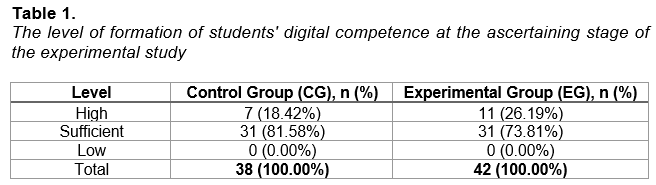
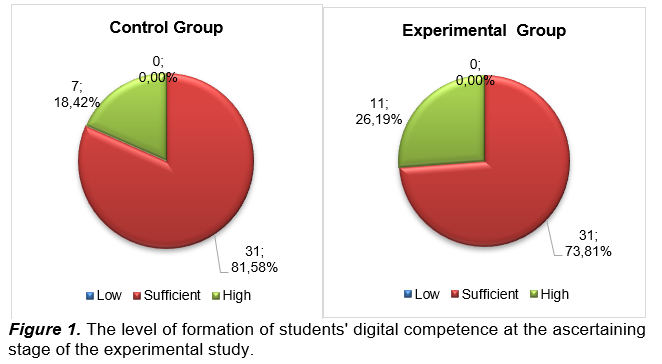
18% (7 respondents of the CG) and 26% (11 respondents of the EG) correctly answered more than 8 questions of the questionnaire, the questions of which concerned the content and significance of chatbots in the educational environment of higher education; categories of chatbots with increasing capabilities of the system based on artificial intelligence; typologies of chatbots, chatbot structure, knew popular AI chatbots on a global scale, etc. The answers of these students were complete and reasoned. Respondents were aware of the importance of developing digital competence in professional activities.
82% (31 respondents of the CG) and 74% (31 respondents of the EG) have a sufficient level of theoretical knowledge about digital competence and current issues of chatbots with increasing capabilities of the system based on artificial intelligence, typologies of chatbots, chatbot structures, popular AI chatbots on a global scale.
So we see that the students who participated in the experiment did not show a low level at the ascertaining stage. However, they also showed a high level at a low position in both groups: EG and CG, which requires improving the system of preparing students for professional activity and the developed pedagogical conditions for the formation of students' digital competence in order to qualitatively introduce chatbots into the educational process of higher education and into the professional activity of future specialists.
We put forward a null hypothesis (H0) that there is no dependence on the belonging of the survey results to the experimental or control group, and an alternative hypothesis (H1) that there is a dependence.
We put forward a null hypothesis (H0) that there is no dependence on the belonging of the survey results to the experimental or control group, and an alternative hypothesis (H1) that there is a dependence.
We compared the results in two groups – EG and CG. For this purpose, we determined the number of points scored – the sum of the observed features according to formula 1.
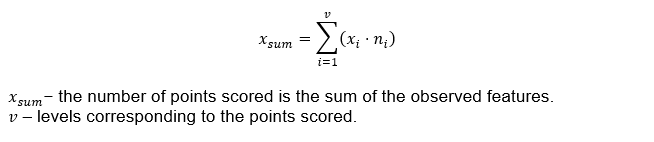
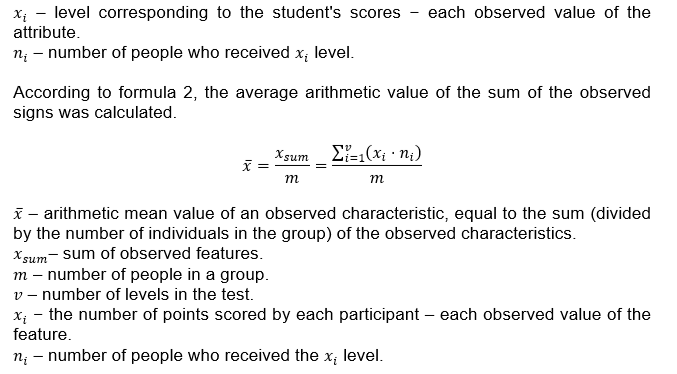
For the control group and for the experimental group, the arithmetic mean of the sum of the observed characteristics was determined.
According to formula 3, the calculation of the mean square error was performed based on the arithmetic mean value of the observed characteristic.
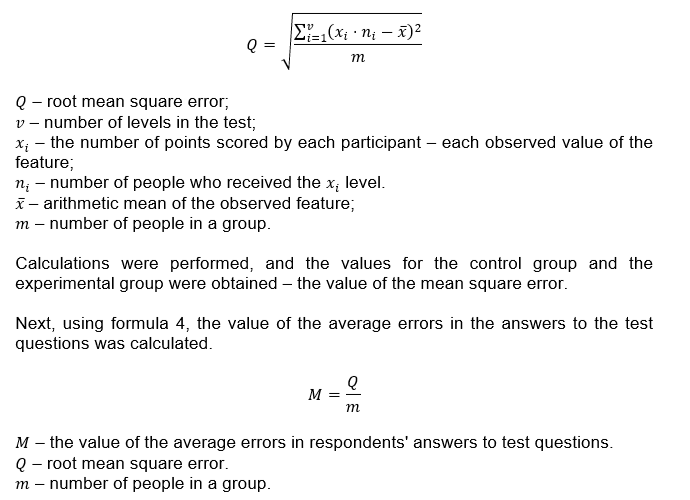
The calculation of the mean error values for the experimental group and for the control group in the answers to the test questions yielded the following results.
The data obtained in the control and experimental groups on the values of the arithmetic mean of the observed features provide the possibility of calculating the Student's t-test – numerical value according to formula 5:
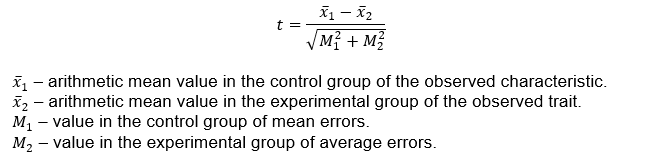
We calculate the Student's t-test – a numerical value. This allows you to compare the obtained value of the Student's t-test with the tabular value to determine the level of reliability of the calculated t-value.
The calculated Student's t-test value, which is greater than or equal to the critical value, indicates that there is a statistical difference between the compared values. If the calculated Student's t-test value is less than the tabular value, then the difference between the compared values is not statistically significant.
For the selected level of reliability, the tabular value (p=0.05) and the number of degrees of freedom were selected. Using the number of degrees of freedom, we find the sample size in the Student distribution method. The number of freely selected observations shows the number of degrees of freedom after finding out the values that are important in this case. As a result of the calculations, we obtain the number of degrees of freedom according to formula 6:

The critical value of the Student's t-test is found for the selected (p=0.05) value level, taking into account (U=78) the calculated value of the degrees of freedom. It was found that the calculated t-value is less than the critical t-value when comparing the Student's t-criterion calculated by us (0.55<1.990). The obtained result confirms the hypothesis H0, because it indicates that the test results are not dependent on whether respondents belong to the experimental or control group.
The calculation results obtained by the chosen method of mathematical statistics for Student's t-criteria – independent variables allowed us, as a result of the comparison of the test results for both studied samples, to conclude that the respondents of the experimental and control groups belong to the same general population, because the results do not differ.
Analysis and comparison of the levels of formation of students' digital competence at the ascertainment and formative stage of experimental research.
The results of the ascertaining stage of the experimental study showed the need to develop an innovative system for preparing students for professional activities and developed pedagogical conditions for the formation of students' digital competence in order to qualitatively introduce chatbots into the educational process of higher education and into the professional activities of future specialists.
Therefore, we implemented such a system and pedagogical conditions in the EG, and the CG students studied according to the standard methodology.
Chatbots created on modern AI models were used in the EG educational process, which significantly facilitated students' learning by allowing respondents to quickly and accurately answer questions that arose during the mastering of professional material. Gemini from Google is an example of such a chatbot. It can offer additional resources for a deeper understanding of the topic and create interactive tasks and games. Studying at the university for EG students became more interesting, and not only more accessible, thanks to such tools. By adapting educational materials to the individual needs of each student, this technology contributed to better student learning, made it possible to set up personalized support, and to learn at a pace convenient for each individual. Thus, chatbots supported EG students even outside the traditional classroom, encouraged them to be more independent in their studies, and offered individual support to higher education students by adapting the proposed materials to their level of knowledge and needs. Chatbots automatically adjusted the pace of teaching in EG and provided additional resources or explanations for deeper mastery of professional material. They provided continuous support to students, helped them overcome difficult tasks thanks to an individualized approach, and reduced their dependence on the teacher.
An effective tool for EG students was ChatGPT, which can generate answers to questions in various fields of knowledge and conduct dialogues in natural languages thanks to the ChatGPT language model, which assisted EG students in the learning process and made it possible to use the chatbot effectively.
Another effective example is Microsoft Copilot, which is based on GPT-4 and was developed in collaboration with OpenAI by Microsoft Corporation. To automate everyday tasks, this tool uses natural language. It allows you to focus on visualization, editing, and text creation in various environments (Windows 10 and 11 operating systems), including the Microsoft 365 service, Android and iOS mobile platforms, and the Microsoft Edge web browser. Copilot is an indispensable, convenient, and useful tool for increasing productivity in education.
An important chatbot is Google's Gemini, which uses artificial intelligence to translate text, generate creative content, and answer user questions, and is based on Google’s LaMDA language model. Gemini promotes interactive learning by creating learning tasks and exercises, providing students with additional explanations and resources for a deeper understanding of the material, and also increases the efficiency of the educational process in higher education.
For processing text queries, Perplexity AI is of great importance in the professional training of students – an innovative tool capable of using Internet sources, generating answers, and citing relevant links. This opens up new opportunities for students and teachers, making it effective for information processing and search, which is especially important when analyzing information and research.
The use of chatbots based on artificial intelligence has the potential to increase the efficiency of the educational process, helping to change the student’s thinking and behavior. Ease of use and personalization are considered the most useful factors in student-teacher interaction, as communication is crucial to achieving goals.
Therefore, for modern education, chatbots are an important component of the methodology. Effective communication skills in higher education, such as social dialogue, empathy, and immediacy, can be embedded in digital systems through social interaction signals and communication strategies, contributing to strong relationships between the learning system and the user. Chatbot-based interventions are one of the most innovative forms that can significantly expand access to professional education.
In the EG, the chatbot made it possible to explain to the EG students the problems they need at the moment and what is relevant for them. In addition to its educational and reference function, the educational chatbot system included feedback for students, because each chain was recorded and tracked. Based on the number of links and open reference buttons, it was possible to determine the systematicity of the work on the research, the level of implementation of the considered questions, track the activity of the participants in the educational chat, and the pace of task processing. Chatbots using AI for EG students significantly facilitated student communication, contributed to the development of individual learning trajectories, increased motivation and overall success, significantly facilitated the advisory work of teachers, and allowed them to pay more attention to the creative aspects of the work done.
For EG students, two formats for implementing the educational process were proposed: a channel for supporting educational actions and quick communication – Telegram-bot (convenient for short consultations and home training); Web-bot (browser interface) as an environment for extended work. This approach strengthened the educational activity of EG students, rather than replacing it, and corresponded to the competency-based logic of assessment.
The architecture of the educational bot in the educational environment provided three key characteristics: manageability (the teacher set the framework), verifiability (reproduction of the process of obtaining an answer), and security (responsible and private use).
As a result of introducing modern digital technologies in the EG to form the digital competence of future specialists, we concluded that the use of chatbots significantly improves the quality of higher education. The functions of chatbots make student learning more exciting, facilitate access to educational resources, provide students with individualized support, and improve their communication.
We have developed and implemented pedagogical conditions for the formation of students' digital competence in the EG. In accordance with the above, we have defined the following pedagogical conditions:
- Creation of a digital innovative educational environment in higher education.
- Ensuring the development of students' digital competence in the format of distance and blended learning.
- Educational and methodological support for students, taking into account the category of chatbots with the growing capabilities of the education system based on artificial intelligence. All conditions are interconnected and interdependent.
The formative stage of the experimental study was aimed at determining the respondents' levels (high, sufficient and low) of students' digital competence formation in order to qualitatively introduce chatbots into the educational process of higher education and into the professional activities of future specialists and to verify the effectiveness of the proposed innovative system of training students for professional activities and the developed pedagogical conditions of the outlined phenomenon.
Upon completion of the formative stage of the experimental study, all the outlined indicators differed from the results of the ascertaining stage of the experimental study.
Let us analyze the results of the obtained data.
The results of the correlation of the levels of students' digital competence formation at the ascertaining and formative stages are presented in Table 2. As can be seen from the table, a low level of students' digital competence formation was not detected either at the ascertaining stage, at the research stage, or at the formative stage of the experiment.
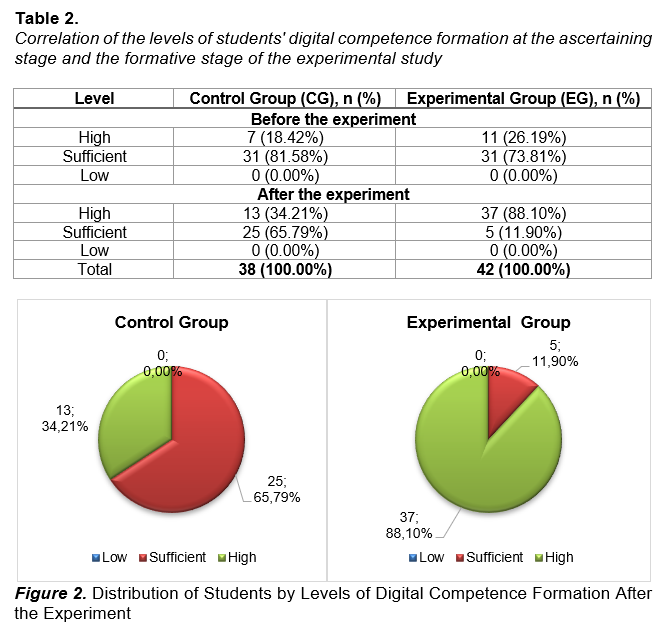
In the EG, we see significant changes, with an increase in the high level of digital competence formation among students for the qualitative implementation of chatbots in the educational process of higher education and in the professional activities of future specialists. In the control group, there are also changes, but not significant.
The number of students with a high level of digital competence formation in the CG increased from 18.42% (7 students) at the ascertaining stage to 34.21% (13 students) at the formative stage. The proportion of students with a high level of digital competence in the control group increased from 18.42% (7 students) before the intervention to 34.21% (13 students) after the intervention, representing an increase of 15.79 percentage points (34.21% − 18.42% = 15.79 percentage points).
In the EG, the proportion of students with a high level increased from 26.19% (11 students) at the ascertaining stage to 88.10% (37 students) at the formative stage, representing an increase of 61.91 percentage points. At the same time, the proportion of students with a sufficient level in the EG significantly decreased from 73.81% (31 students) to 11.90% (5 students). In contrast, in the CG, the proportion of students with a sufficient level decreased from 81.58% (31 students) at the ascertaining stage to 65.79% (25 students) at the formative stage, representing a decrease of 15.79 percentage points. Thus, the changes in the CG were considerably less pronounced than those observed in the EG.
Individuals with a low level of formation of students' digital competence for qualitative implementation of chatbots in the educational process of higher education and in the professional activities of future specialists in the experimental group were also not identified, as in the CG.
Analysis of the obtained experimental results proves the effectiveness of the innovative system of training students for professional activities developed and implemented by us and the proposed pedagogical conditions for the formation of students' digital competence for qualitative implementation of chatbots in the educational process of higher education and in the professional activities of future specialists in the educational process of group.
We used the multifunctional Fisher criterion to determine the effectiveness of the results obtained in the experimental group.
The dynamics in the levels of formation of digital competence of students to introduce chatbots into the educational process of higher education and into the professional activities of future specialists made it possible to formulate the following hypotheses:
H0: The number of respondents in the experimental group at the ascertaining stage of the experimental study with a high level of development is less than at the final stage of the experimental study, which proves that the formative stage of the experimental study is effective.
H1: The number of respondents in the experimental group at the ascertaining stage of the experimental study with a high level of development is not significantly greater or the same as at the final stage of the experimental study, which proves that the formative stage is not effective in the experimental study.
Referring to the table of Fisher's exact test φ* critical values, we determine the percentages of the "effect" of the value φ* in each of the groups.
The empirical value of φ* is determined by formula 7:

Substituting the post-test data into Formula (7), the empirical value of Fisher's angular transformation criterion was calculated as φemp = 5.30. Since φemp exceeded the critical value (φ*crit = 2.31, p < 0.01), the null hypothesis was rejected. Therefore, the difference between the experimental group (88.10%, 37/42 students) and the control group (34.21%, 13/38 students) after the intervention was statistically significant, confirming the effectiveness of the proposed educational intervention.
To compare the identified levels and their final results of the formation of students' digital competence, we used Fisher's multifactorial criterion. Thus, the indicators of (empirical) high and sufficient levels after the formative stage of the study are greater than the critical value (2.31), adopted in psychology as the level of statistical significance.
The scientific validity and reliability of the conclusions and provisions of the study were ensured by the reliability and validity of standardized psychodiagnostic methods.
Thus, the results of the experiment showed positive dynamics in the levels of formation of students' digital competence for qualitatively introducing chatbots into the educational process of higher education and into the professional activities of future specialists, so we have reason to assert that the assumption expressed regarding the need for the proposed innovative system of training students for professional activities and the developed pedagogical conditions for the formation of students' digital competence was confirmed.
Conclusions
This study investigated the effectiveness of integrating AI-powered chatbots into the higher education learning environment for enhancing students' digital competence. The findings demonstrate that the proposed pedagogical system, based on the creation of an innovative digital educational environment, blended learning, and methodological support through AI-powered chatbots, contributes significantly to the development of students' digital competence.
The quasi-experimental study confirmed that the experimental and control groups were statistically equivalent before the intervention (Student's t = 0.55, p > 0.05), ensuring the comparability of the groups. Following the implementation of the intervention, the proportion of students demonstrating a high level of digital competence increased from 26.19% to 88.10% in the experimental group, whereas the corresponding increase in the control group was from 18.42% to 34.21%. Fisher's angular transformation criterion confirmed the statistical significance of the post-test differences between the groups (φemp = 5.30 > φcrit = 2.31, p < 0.01), providing empirical evidence for the effectiveness of the proposed educational intervention.
The study contributes to the growing body of research on artificial intelligence in higher education by providing experimental evidence that the systematic pedagogical integration of AI-powered chatbots enhances students' digital competence beyond the outcomes achieved through traditional instruction. Unlike studies that primarily examine learners' perceptions or isolated chatbot applications, the present research evaluates a comprehensive pedagogical model implemented under controlled educational conditions.
The practical significance of the study lies in the possibility of integrating AI-powered chatbots such as ChatGPT, Microsoft Copilot, Gemini, and Perplexity AI into university teaching, independent learning, research activities, and academic communication. The proposed pedagogical conditions may be adapted for higher education institutions seeking to improve students' digital competence and promote the responsible educational use of artificial intelligence technologies.
Several limitations should be acknowledged. The study was conducted within a relatively limited sample of undergraduate students from higher education institutions, which may restrict the generalizability of the findings. In addition, the intervention evaluated short-term learning outcomes, whereas the long-term sustainability of digital competence development was beyond the scope of the present research.
Future research should investigate the long-term effects of AI-supported learning environments, compare different categories of educational chatbots across academic disciplines, examine their influence on additional learning outcomes such as critical thinking, problem-solving, and self-regulated learning, and validate the proposed pedagogical model using larger, multicenter, and cross-cultural samples.