
Artículo de investigación
El componente interactivo de la transformación digital en la educación superior: Un estudio experimental
The interactive component of digital transformation in higher education: An experimental study
Recibido: · Aceptado: · Publicado:
Cómo citar: Tesliuk, V., Biletska, M., Pidvarko Т., Yevtushenko, N., & Kotova, L. (2026). El componente interactivo de la transformación digital en la educación superior: Un estudio experimental. Revista Eduweb, 20(3), 225–241. https://doi.org/10.46502/issn.1856-7576/2026.20.03.13
Resumen
La transformación digital de la educación superior ha generado nuevas oportunidades para potenciar la participación estudiantil mediante entornos de aprendizaje interactivos. Este estudio examinó la efectividad de un sistema pedagógico diseñado para mejorar la participación interactiva del estudiante mediante la integración de tecnologías digitales en la educación superior. Se empleó un diseño cuasiexperimental con 174 estudiantes de pregrado, divididos en un grupo de control (n = 86) y un grupo experimental (n = 88). Se realizó un cuestionario, observación y entrevista para evaluar la disposición de los estudiantes para la interacción interactiva en parámetros motivacionales, de actividad y reflexivos. El grupo experimental contó con un sistema especialmente diseñado que combinaba estrategias de aprendizaje, plataformas de comunicación digital, herramientas de evaluación interactiva, tecnologías de colaboración en línea y aplicaciones de realidad virtual y aumentada. Los resultados mostraron una gran mejora en la disposición de los estudiantes para la interacción interactiva en el grupo experimental en comparación con el grupo de control. También se observaron cambios en todas las dimensiones (motivación para el aprendizaje, participación colaborativa y prácticas reflexivas). El análisis estadístico demostró la efectividad de la intervención. La prueba de chi-cuadrado de Pearson (χ²) mostró diferencias entre los grupos, mientras que la prueba t de Student confirmó la fiabilidad de los resultados. En consecuencia, se demostró que las tecnologías digitales pueden mejorar eficazmente la interacción interactiva de los estudiantes y fomentar la participación activa en un entorno de educación superior transformado digitalmente.
Palabras clave: interacción educativa interactiva; estudiantes; digitalización; educación superior; herramientas digitales.
Abstract
The digital transformation of higher education has created new opportunities to enhance student engagement through interactive learning environments. This study examined the effectiveness of a pedagogical system designed to enhance interactive student engagement by integrating digital technologies in higher education. A quasi-experimental design was employed, involving 174 undergraduate students divided into a control group (n = 86) and an experimental group (n = 88). A questionnaire, observation and interview were conducted to assess students’ readiness for interactive interaction on motivational, activity and reflective parameters. The experimental group had a specially designed system that combined learning strategies, digital communication platforms, interactive assessment tools, online collaboration technologies and virtual and augmented reality applications. The results showed a great improvement in students’ readiness for interactive interaction in the experimental group compared to the control group. Changes were also observed on all dimensions (motivation for learning, collaborative participation and reflective practices). Statistical analysis proved the effectiveness of the intervention. Pearson’s chi-square (χ²) test showed differences between groups, while Student’s t-test confirmed the reliability of the results. As a result, it turned out that digital technologies can effectively improve students’ interactive interaction and support active participation in a digitally transformed higher education environment.
Keywords: interactive educational interaction; students; digitalization; higher education; digital tools.
Introduction
The contemporary education system is undergoing profound social, technological, and organizational transformations. One of the key drivers of these changes is digitalization, which permeates all sectors of society and significantly influences the functioning of higher education institutions (HEIs). As education becomes increasingly integrated into the digital ecosystem, traditional approaches to organizing teaching, learning, and institutional management require fundamental reconsideration.
Global trends in higher education and institutional governance are increasingly oriented toward comprehensive digital transformation. This process extends beyond the adoption of digital technologies for teaching and learning to encompass the digitalization of educational, research, administrative, and managerial processes across the entire institution. Without a comprehensive digital transformation strategy, higher education institutions cannot effectively ensure the quality of educational provision, support remote administrative operations and document management, or maintain competitiveness in an evolving academic environment. Consequently, the absence of such transformation negatively affects students, faculty members, and administrative staff alike.
Traditional approaches to the automation of higher education management have largely exhausted their potential and no longer meet the demands of contemporary digital ecosystems. Conventional automated systems for learning management, administration, and record-keeping address only isolated institutional functions while fragmenting the information environment into separate, function-specific domains. These disconnected systems operate independently rather than as components of an integrated digital infrastructure, limiting data interoperability and institutional efficiency. Such fragmentation hinders the implementation of comprehensive digitalization initiatives and prevents the development of fully integrated digital universities. Consequently, new conceptual approaches to the digital transformation of higher education institutions are required – approaches capable of integrating all institutional processes, software solutions, and information resources within a unified digital ecosystem that supports the development of sustainable digital universities.
Accordingly, a significant scientific and practical challenge lies in developing innovative methods and models for the digital transformation of higher education institutions through the integration of institutional functions, procedures, and information repositories into a unified, concentric information technology framework that supports the digital transformation of educational activities.
Recent research has demonstrated that digital technologies create favorable conditions for collaboration, communication, and active learning in higher education. Nevertheless, most existing studies have focused primarily on evaluating individual digital tools or isolated instructional approaches. Considerably less attention has been devoted to understanding how these technologies can be systematically integrated into a coherent pedagogical framework that consistently enhances students' readiness for interactive educational engagement. Consequently, empirical evidence regarding the effectiveness of comprehensive pedagogical systems that combine digital technologies with collaborative learning, formative assessment, reflective practice, and project-based learning within a unified instructional model remains limited.
Against this background, the present study aims to provide empirical evidence of the educational value of a pedagogically structured approach to digital transformation in higher education.
The aim of this study was to examine whether the systematic pedagogical integration of digital technologies can enhance students' readiness for interactive educational engagement in higher education. To achieve this, the study evaluated the effectiveness of an author-developed pedagogical system that combines collaborative learning, digital communication tools, formative assessment, reflective activities, and immersive technologies within a digitally transformed learning environment.
Literature Review
Recent research has demonstrated that the successful digital transformation of higher education depends on the integration of digital technologies with student-centred pedagogical approaches. Studies by Chiang and Wu (2021), Onyishi and Sefotho (2020), Meşe and Mede (2023), Ramírez Hernández et al. (2025), Saqib et al. (2021), Surjawan et al. (2025), and Hashim et al. (2022) highlight the importance of collaborative learning, digital competence, interactive educational environments, and institutional digital transformation for improving student engagement and learning outcomes.
The theoretical foundations of modeling open systems in the field of science and education, pedagogical systems for the formation and development of competencies, cloud-based learning support systems, as well as the implementation of interactive methodological systems are thoroughly substantiated in the works of Meşe and Mede (2023), who investigated the issues of digitalization of the educational environment, the development of cloud technologies and methodological learning systems.
Current studies suggest that students' engagement in digital learning depends on more than access to technology alone.Their readiness to contribute, assurance in their own skills, and the method instruction is systematized all play an central role. The authors Ramírez Hernándezet al. (2025), Saqib et al. (2021), Surjawan et al. (2025), and Hashim, et al. (2022) examine the interrelationships in digital transformation, digital agility, and the implementation of smart technology models. They outline the main challenges and opportunities that universities face when implementing new technologies. They explore a comprehensive analysis that outlines the critical elements of effective smart management, including resource management, institutional collaboration, and increasing digital competencies among teachers, emphasizing the importance of implementing digital transformation to increase the effectiveness of the educational process in higher education institutions.
While important study has examined digital learning technologies and interactive pedagogical approaches, central gaps persist. Most existing studies focus on individual digital tools, teaching methods, or learner characteristics. Comparatively little attention has been paid to the development and experimental validation of integrated pedagogical systems that combine digital technologies, interactive instructional strategies, and purposeful development of students’ readiness for active participation. Addressing this gap is particularly important in the context of ongoing digital transformation in higher education. Therefore, the present study aims to investigate the effectiveness of a comprehensive pedagogical system designed to enhance students’ readiness for interactive engagement within digitally transformed higher education environments.
Methodology
Research Design
A quasi-experimental pretest–posttest control group design was employed to evaluate the effectiveness of the proposed pedagogical system for enhancing students' interactive educational engagement in digitally transformed higher education. Before the intervention, all participants completed baseline measurements using the same assessment instruments to establish the initial equivalence of the experimental (EG, n = 88) and control groups (CG, n = 86). Pearson's chi-square test revealed no statistically significant differences between the groups across the motivational, activity-based, and reflective dimensions of interactive readiness (p > .05 for all comparisons), confirming their initial homogeneity and ensuring the comparability of subsequent experimental results.
Participants
The participants were 174 undergraduate students from higher education institutions. The sample included a control group (CG, n = 86) and an experimental group (EG, n = 88). While the control group studied according to the standard curriculum, students in the experimental group completed a learning program based on the proposed pedagogical system, which integrated collaborative activities and interactive digital technologies into the educational process. Comparing the two groups allowed the effectiveness of this approach in developing students' readiness for interactive educational engagement to be assessed.
Instruments
Information about students' readiness for interactive educational engagement was gathered from three sources: questionnaire responses, classroom observations, and semi-structured interviews. Using these methods made it possible to obtain a broader picture of students' learning experiences and participation.
The questionnaire consisted of 30 items distributed across three dimensions: motivational readiness (10 items), activity-based readiness (10 items), and reflective readiness (10 items). Responses were recorded using a five-point Likert scale ranging from 1 ("strongly disagree") to 5 ("strongly agree"). Higher scores indicated greater readiness for interactive educational engagement.
Previous to the key study, the questionnaire was led with 32 undergraduate students who did not participate in the experiment. Internal consistency demonstrated satisfactory reliability (Cronbach's α = 0.91 for the overall scale; motivational dimension α = 0.88; activity-based dimension α = 0.90; reflective dimension α = 0.86). Content legitimacy was recognized through expert assessment by five specialists in higher education pedagogy and digital learning, who complete the importance, precision, and representativeness of all questionnaire items. Minor linguistic revisions were introduced following the pilot testing without changing the theoretical structure of the instrument.
Observation Protocol
Quantitative and social indicators were considered in the students' interactive participation. An observation checklist was developed with 12 behavioral indicators to assess participation in collaborative discussions, peer interaction, initiative during group activities, use of digital tools for collaborative learning, and response to formative feedback.
The indicators were rated on a four-point scale from 0 (not observed) to 3 (consistently demonstrated). Two independent observers rated approximately 20% of the training sessions. Inter-rater agreement reached Cohen's κ = 0.84, indicating the reliability of the observational coding.
Experimental Procedure
The study had two stages. The first was to establish the initial level of readiness for interactive educational participation in a digital environment. The result is that most participants did not yet have a sufficiently high level of readiness, most participants demonstrated a low or moderate level of success. Therefore, the results confirmed the need to introduce different approaches to learning that should promote more active participation and interaction throughout the educational process.
The second stage showed that the experimental group completed the curriculum made on the proposed pedagogical system, while the control group continued their studies on the regular curriculum used in their institutions. The intervention was introduced into regular courses and was not conducted as a separate course. The main objective was to increase student engagement through the use of digital technologies together with interactive teaching methods.
Throughout the experiment, students worked on collaborative projects, discussed them in groups, solved various practical tasks in teams and communicated through online learning environments. Digital platforms, shared online workspaces, interactive assessment services, educational games and virtual and augmented reality applications were actively introduced into classroom activities when they supported learning objectives and encouraged active participation.
The pedagogical system was guided by three interrelated principles:
- Involved creating a digital learning environment in which students were encouraged to take initiative, work independently, and participate actively in educational activities.
- Focused on enriching learning experiences through the use of virtual and augmented reality technologies where appropriate.
- Emphasized continuous interaction supported by digital communication and learning tools, enabling students to exchange ideas, collaborate on educational tasks, and develop skills through sustained peer interaction.
Interview Procedure
After the experimental phase, semi-structured interviews were conducted with 24 students, including 12 participants from the experimental group and 12 from the control group. The interviews covered students’ learning through digital technologies, their participation in collaborative activities, changes in motivation, approaches to independent learning, and their overall perceptions of engagement during the course.
The interview data were analysed using thematic analysis. Each transcript was independently reviewed by two members of the research team, who brainstormed and assigned preliminary codes. After comparison, the research team members agreed on one common coding scheme. This resulted in four main themes: motivation to learn, participation in collaborative activities, digital learning experiences, and reflective self-regulation. Any differences in coding were discussed together until a common interpretation was reached.
Data Analysis
Quantitative data were processed using statistical methods and Pearson's chi-square (χ²) test. This allowed us to compare the levels, their distribution, and readiness in the experimental and control groups before and after the introduction of the pedagogical system. The primary analysis did not show any differences between the groups, which indicates comparable initial conditions. After the intervention, statistically significant differences were made, which indicates a good effect of the proposed educational approach.
Qualitative data that we obtained as a result of classroom observations and interviews were made by us together with statistical results. These data were used to explain the quantitative results and for a broader understanding of the students' educational experience.
Ethical Considerations
The conduct of the experiment is permitted by the scientific councils of the universities in order not to violate ethical considerations in institutions of higher education. Ethical requirements were taken into account at each stage of the study. Before the start of the experiment, all participants were informed about its purpose, procedure, and use of the collected data. Respondent participation was voluntary, and each student could withdraw from the study without any consequences. To protect the confidentiality of the participants, their personal information was removed from the research materials before analysis.
Limitations
The study was conducted with the participation of undergraduate students from a limited number of higher education institutions. The effectiveness of the system was evaluated at a specific educational institution and during a short period of the experiment.
Results and Discussion
Among the innovations is the possibility of implementing high-quality interactive educational interaction of students through the digitalization of higher education even in the absence of direct contact between the student and the teacher; increasing the degree of visibility of educational material, giving it the properties of interactivity and dynamism, making any sources of information available to students, presented in any form convenient for the education student; the ability to perceive professional educational material that is inaccessible without digital means (virtual excursions, virtual experiments, communication with historical figures, modeling of phenomena and processes, etc.); activation of all cognitive mental processes (perception, sensations, imagination, thinking, memory, attention) in higher education students; creation of an emotional bright attitude towards educational digital information by adding elements of competition and game; provision of innovations for all participants in the educational process for implementing high-quality interactive educational interaction of students.
Digital educational tools are universal for implementing high-quality interactive educational interactions with students. They can be used effectively in distance learning (where they are indispensable and mandatory) and in offline learning, provided that appropriate multimedia interactive devices are available. A modern specialist, regardless of the profile, must have a sufficient level of digital educational tools and apply them methodically correctly in their work, be competent with the help of these tools in organizing interactive interaction of participants in the educational process.
Digital tools that provide opportunities for organizing interactive educational interactions.
A high level of interactive educational interaction through the digitalization of higher education is ensured by an orientation to the value system and personal motivation of all those involved in this process.
A high level of interactive educational engagement among students in the educational process, enabled by the digitalization of higher education, is associated with acquiring knowledge that forms the basis of professional skills.
Digitalization involves saturating the educational environment with systems and devices for electronic communication, and the widespread use of information and communication technologies and multimedia educational technologies, which entails significant changes in the organization of the educational process (Chiang & Wu, 2021).
To do this, the teacher offers students interactive electronic didactic materials and can create them themselves using online services and various software tools. Many digital platforms have already developed lessons and certain templates. Examples of such platforms include WorldWall, Quizlet, Kahoot!, Liveworksheets, and Prosvita (Jennek et al., 2019; Knaut et al., 2022).
Active use of communication tools: social networks (Viber, Telegram, WhatsApp), e-mail, provides opportunities for maintaining interactive learning interaction between students in the digital educational environment. At the same time, the organization within the platform of independent activity requires constant pedagogical support and modern approaches. Otherwise, there is a risk of reducing educational tasks to reproductive fulfillment (Liou et al., 2023).
The possibility of parallel student interaction, joint work on content, and saving results for further use in professional activities – all of this provides a new level of organization in the virtual space of the educational process. One such tool is diagrams – knowledge maps that reflect the relationships between concepts and ideas (Yuen et al., 2023).
Ready-made knowledge map templates are provided by the online service MindMeister. The Thinglink tool is focused on creating interactive didactic materials: interactive labels are added to images that open tests, text, audio, and video elements. This is how thematic posters, multimedia summaries, videos, and interactive maps are created.
Educational materials in PDF format are converted into interactive digital tasks by the Liveworksheets, JPG, or DOCX service.
The Quizlet platform is an effective tool for working with lexical material (Tajik et al., 2024).
The integration of artificial intelligence (AI) is attracting special attention in teaching. Such technologies, by providing personalized learning, transform the educational environment. AI algorithms allow you to create adaptive tasks tailored to a particular student’s needs, which positively affect the assimilation of the material (Moallemi, 2024).
The state of students' preparation for organizing interactive educational interaction.
To determine the indicators of readiness for organizing interactive educational interaction, observations, questionnaires, and individual interviews were used. Using the questionnaire, we identified students' readiness to organize interactive educational interactions.
Questioning students at the ascertaining stage of the study allowed us to conclude that mainly during the organization of interactive educational interaction, significant attention is paid to pedagogical partnership, the introduction of ideas of humanism, and active cooperation of all participants in the educational process of higher education, but there were also such students (41.1%) who were not motivated enough for such activities.
In order to objectively clarify the formation of students' readiness to organize educational interactive interaction, the following criteria and their indicators have been defined:
- Motivational, the essence of which is the awareness by students of humanistic value orientations, cooperation, partnership pedagogy, the significance of the ideas of child-centrism, and the prospects of the ability to organize educational interactive interaction in the educational environment.
- Activity that ensures students master methodological and didactic skills and knowledge to carry out professional activities based on subject-subject interaction.
- Reflective-evaluative, which characterizes the ability of respondents to model and organize educational interactive interaction; students' desire for professional growth, self-improvement, and self-development.
Thus, we consider the proposed criteria and outlined indicators of students' readiness to organize interactive educational interaction through the digitalization of higher education.
The study characterized four levels of students' readiness to engage in interactive educational interaction: high, sufficient, average, and low.
In Table 1 and Fig. 1, we present the results of measuring students' readiness to organize interactive educational interactions at the ascertaining-experiment stage in the experimental and control groups.
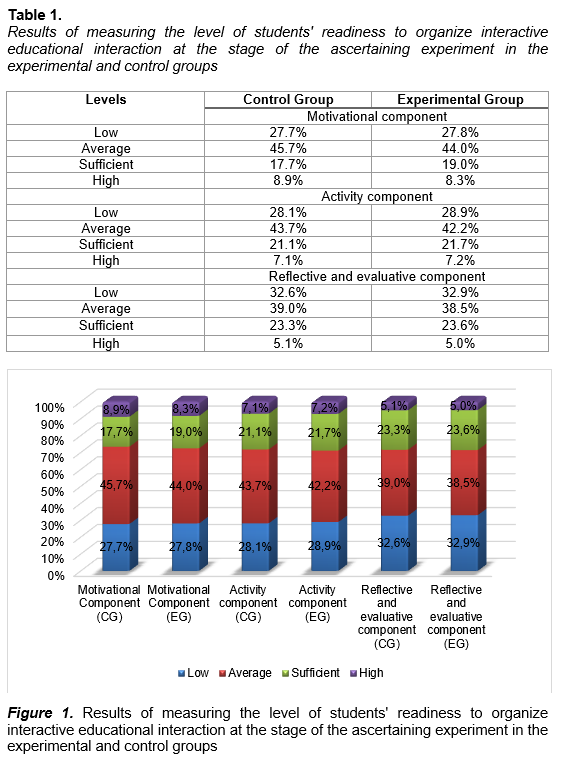
Thus, the basis for further research and solution of the outlined problem was the study of the motivational, activity, and reflective-evaluative components of students' readiness to organize interactive educational interaction, which indicates the need to improve students' professional training.
In general, the study of the state of students' preparation for organizing interactive educational interaction allowed us to state the need to develop an author's system and pedagogical conditions for updating this process, which will ensure the formation of students' readiness for organizing interactive educational interaction through the digitalization of higher education, as an important prerequisite for conducting a formative experiment.
Let us reveal the methods and techniques of interactive educational interaction of students that were used in EG in the developed educational system in the process of teaching professional disciplines:
- Group thematic discussions that used technologies to process discussion questions influenced the positions and opinions of EG students and enabled the adoption of optimal, productive collective decisions.
- By creating speech situations, situational modeling technologies, such as “Professional Dialogue”, “Communication in the Educational Process”, etc., were implemented in order to form and develop professional speech skills.
- Visual dictation − for analyzing the spelling aspect of professional speech − as an interactive teaching method during student interaction, which allowed them to acquire knowledge of the norms of the written form of professional speech.
- Business games − for solving specific tasks and modeling specific situations by students, for training professional skills by practicing professional techniques and performing various professional roles in order to facilitate the acquisition of communicative tactics using mobile applications.
- Implementation of interactive educational interaction of students during collective and group learning.
- Field trips − the method of an active form of conducting classes (interactive excursions) was implemented in the form of an excursion, which made it possible to study realities in natural conditions and conduct observations, which were a favorite interactive activity of students. In such classes, students interactively modeled situations, interacted with each other, exchanged information, evaluated their own actions and those of others, and immersed themselves in the real atmosphere of business cooperation – interactive educational interaction while solving the problem.
- The use of the mind map method during terminological work contributed to the expansion of students' communicative abilities: the formation of linguistic guesswork, the systematization and consolidation of material, and the development of students' productive lexical skills.
All digital interactive technologies used during interactive educational interactions by EG students were divided into hardware and software.
We included devices with touch screens, computers – interactive boards, technical means for immersion in virtual reality, tablets, smartphones, interactive panels, interactive tables/desks, as well as specific multimedia means for rehabilitation, development, relaxation, learning in the process of outdoor games – interactive floor/wall, etc.
Because there are many interactive digital software tools, we divided them into certain categories:
- Interactive visual aids, interactive presentations, diagrams, maps, posters, infographics.
- Interactive online boards – which allowed all participants in the EG educational process to work together on the same information via the Internet in real time (to conduct joint brainstorming sessions, create virtual moodboards, and systematize information in the form of mind maps).
- Interactive books, textbooks, textbook supplements, manuals that contained interactive tasks, quests, exercises, tests, games, as well as animation, audio, video, and other elements, and were not just electronic books;
- Interactive videos are videos (video lessons), while watching which EG students performed interactive exercises added to them
- Interactive websites – sites whose content, during interactive educational interactions with students, is formed in real time based on data received from the user – contain various elements of interaction: interactive tasks, feedback forms, game elements, and online surveys.
- Interactive applications – programs that were installed on a mobile device or a computer and allowed users to learn educational material more effectively and develop professional skills through practical application of knowledge, training, and interaction.
- Interactive games – computer programs that allowed students to create their own game world, interact interactively with the game world and perform professional tasks aimed at achieving the set didactic goal.
- Webquests – interactive, based on the use of Internet resources, quests with elements of a role-playing game, in the process of which EG students independently obtained the knowledge necessary to perform the tasks set.
- Technologies of virtual reality (VR) and augmented reality (AR) allowed EG students to supplement the real world with computer-modeled objects (AR) and interact with the digital environment (VR).
- Means of interactive survey – EG students were offered online services, programs for creating quizzes, tests, games, and questionnaires, with the help of which information from students was quickly collected, presented in a convenient graphic form, and reflection was carried out.
Also, in order to organize effective interactive educational interaction of EG students, the following digital and software hardware tools were offered:
- "Interactive floor/wall" – a multimedia system that has software and allowed EG students to work in groups, pairs, collective competitions and games, which will be aimed at the development of coordination, concentration of attention, general motor skills, visual stimulation, contributed to the development of important communicative and social skills in the process of joint interactive educational interaction – the ability to enjoy joint activities, respect game partners, establish friendly relationships.
- Software platforms for video conferences (Google Meet, Zoom, Skype, WebEx, Microsoft Teams) enabled oral communication among EG participants, demonstrations and discussions of various materials, and the organization of online, collective group work.
- Software tools for performing joint educational tasks, collective projects form relationships of responsible interdependence, when each member of the group tries to perform their part of the task as best as possible, understanding that the overall success of their group depends on it.
- Quests and didactic games made it possible to organize emotionally rich, interactive educational interactions among EG students in groups, face-to-face or in pairs, add a competitive element to learning, involve all participants in active cooperation, and increase interest in the educational material.
- Software tools for interactive survey (Wordwall, Kahoot!, Mentimeter, Edpuzzle, Socrative, OnlineTestPad, Puzzlecup, Plickers, Google Forms) allowed EG students to determine the degree of assimilation of the educational material quickly, the level of understanding of the material, or collect information from the group at once, conduct reflection, determine the general emotional mood, and visualize the results.
- The use of the E-front network project enabled the directing of educational activities to improve self-education and the use of the Internet to acquire the skills of a scientific researcher.
By implementing the system proposed by the EG for preparing students for the organization of interactive educational interaction through digitalization of higher education, we saw real positive results of the educational process in higher education: students of higher education learn more quickly how to perform an effective search for the necessary professional information, learn how to work safely on the Internet, know more about the development of the Internet network, and know how to clearly work with social services that are used in the process of communication and learning. We made the following conclusions: the use of digital technologies in the system of preparing students for the organization of interactive educational interaction in the form of Internet projects allows, during interactive educational interaction, to solve the educational tasks of organizing joint activities through the digitization of higher education with students of higher education and with teachers and Internet resources, to create conditions for the development of professional competences, to promote the ability to work in interaction and to expand the boundaries of educational spaces.
For EG students, we defined and characterized the pedagogical conditions that contributed to the formation of students' readiness for the organization of interactive educational interaction:
- Creation of a student-centered digital environment while preparing students for the organization of interactive educational interactions.
- The focus of the teacher's activities on virtual (VR) and augmented reality (AR) technologies is to interact with the digital environment (VR) and teach students to supplement the real world with computer-modeled objects (AR), taking into account the practice-oriented nature of preparing students for the organization of interactive educational interaction
- Involving students in the organization of joint activities with teachers and Internet resources through digitalization of higher education, creating conditions for the development of professional competencies, promoting the ability to work in interaction, and expanding the boundaries of educational spaces during their training.
Analysis of the results of the experimental study.
The experimental data obtained on positive changes in the formation of students' readiness to organize interactive educational interaction through the digitalization of higher education indicate the effectiveness of the developed system and pedagogical conditions.
The generalized results on the levels of formation of students with the specified readiness at the formative stage of the experiment are presented in Table 2 and Fig. 2.
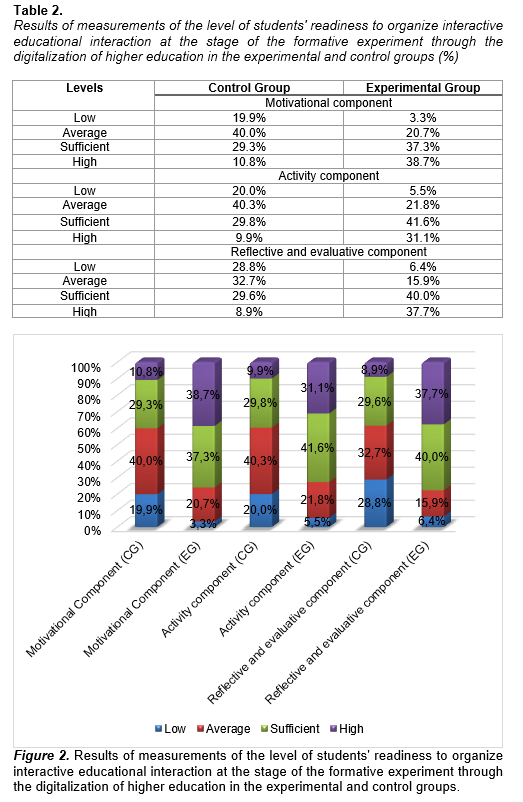
Analysis of experimental data at the stage of the formative experiment through the digitalization of higher education showed significant qualitative changes in the EG at low and average levels of students' readiness to organize interactive educational interaction, and this was due to a slight decrease in the number of students during the pedagogical experiment in the CG. Sufficient and high levels of students' readiness to organize interactive educational interactions through the digitalization of higher education also demonstrated significant positive qualitative changes in both the EG and the CG, though insignificant in the latter.
Comparative analysis of the values of the average absolute value of qualitative changes in the level of students' readiness to organize interactive educational interaction in the experimental and control groups allowed us to say that the positive dynamics of qualitative changes in the CG is due to the traditional professional training of students, and in the EG – the result of students' professional training according to the developed system and implemented pedagogical conditions.
Using mathematical statistics methods, the results of the experimental study were confirmed, in particular through the calculation of the non-parametric Pearson χ² criterion.
To evaluate the effectiveness of the proposed pedagogical system, post-intervention outcomes were compared between the experimental and control groups using Pearson's chi-square (χ²) test. The analysis revealed statistically significant differences in the distribution of students' readiness levels in favour of the experimental group (p < .001), indicating that the observed improvements were unlikely to have occurred by chance.
The comparison confirmed statistically significant differences between the experimental and control groups. Pearson's χ² test showed large advantages in the distribution of readiness levels (p < 0.001), while Student's t-test had large differences in mean scores between the groups (t = 12.79, p < 0.001). In this regard, we emphasize that together these results have strong statistical evidence confirming the effectiveness of the proposed pedagogical system.
The baseline assessment did not have statistically significant changes between the experimental and control groups on the motivational, activity and reflective criteria of interactive educational interaction (χ², p > 0.05), which confirms the initial equivalence of the groups.
After the intervention, we had statistically significant differences in favor of the experimental group. Some students showing sufficient and high levels of readiness increased on all three criteria, while others with low readiness decreased significantly. Pearson’s chi-square test showed that these differences were statistically significant (p < 0.001), which has the effectiveness of the proposed pedagogical approach.
Large changes were observed in the motivational dimension, where students showed greater readiness and interaction with digital support. Improvements were also seen in activities reflecting their confidence in using digital technologies for communication, teamwork and collaborative problem solving. In addition, students in the experimental group showed high levels of reflective readiness, indicating better self-esteem, self-regulation and more critical reflection on their learning experience.
Qualitative results
The qualitative results complemented the quantitative results and provided additional evidence for the implementation of the pedagogical intervention.
Observations showed that students in the experimental group became more active in learning together. During the intervention, students frequently participated in group discussions, demonstrated greater initiative in completing joint tasks, and took greater responsibility for collective decision-making. Compared with the control group, teachers also had more frequent peer interaction, more balanced participation in teams, and higher levels of collaboration.
Qualitative data show that positive changes were associated not only with the use of digital technologies, but also with their introduction into the educational process. In the experimental group, digital tools improved collaborative learning, project activities, ongoing feedback, and reflective practice. But in the control group, digital technologies were used mainly to provide educational content and support regular educational activities.
The results of the study show that collaborative digital tasks improved active participation, forced students to exchange ideas, work together to solve real educational problems. Continuous formative assessment allowed students to assess their improvement and respond to feedback during the learning process, while project-based learning strengthened students’ autonomy, linking theoretical knowledge with practice. Reflective activities also had the advantage of developing self-regulation and critical evaluation of individual and group activities.
Thus, the qualitative results highlight the improvements that were identified in the quantitative analysis.They indicate that the effectiveness of the intervention was determined by the pedagogical organization of the learning process rather than by the introduction of digital technologies themselves. Digital tools served as instructional resources that facilitated collaboration, communication, feedback, and reflective learning within a structured educational environment.
These results are consistent with previous studies emphasizing that digital technologies produce stronger educational outcomes when incorporated into student-centred instructional approaches rather than used as independent technological solutions. Similar conclusions have been reported by Chiang and Wu (2021), who highlighted the importance of collaborative learning environments, and by Krishan and Al-rsa'i (2023), who demonstrated that technology-supported instruction enhances student motivation when integrated into appropriate pedagogical practices. The present findings also support the conclusions of Meşe and Mede (2023), who emphasized the role of learner readiness, self-regulation, and collaborative learning in digitally supported education.
By comparing previous studies that assessed individual digital tools, our study demonstrates the effectiveness of an integrated pedagogical system that incorporates collaborative learning, project-based activities, formative assessment, reflective practice, and digital technologies within a single learning framework. This approach explains the observed improvements in students’ motivational, performance, and reflective readiness for interactive educational engagement.
Conclusions
The study presented that this pedagogical system improved the development of students’ readiness for interactive educational participation in a digital learning environment. After the intervention, the experimental group showed a better level of motivational, activity and reflective readiness than the control group, while qualitative data highlighted greater participation in collaborative learning, peer interaction and reflective practice. The results show that the educational significance of digital technologies depends on their purposeful integration into the educational process, rather than on their use as independent learning tools.
The study improves the contribution to the current research on digital transformation in higher education, which has empirical evidence that the combination of collaborative learning, formative assessment, project-based activities, reflective practice and digital technologies in a single pedagogical structure creates good conditions for increasing student engagement. The results of the study emphasize that instructional design plays a major role in improving the educational effectiveness of digital learning environments.
This pedagogical framework has a place in higher education to support the development of student-centered courses, improve different teaching methods, and integrate digital technologies into professional training programs.
We had several limitations in determining the results. The study included students from a small number of higher education institutions, and the impact of the intervention was demonstrated over a relatively short period of time.
Further research should investigate the long-term effectiveness of integrated pedagogical systems in different academic disciplines and institutional settings. Future studies may also examine the use of artificial intelligence–supported learning environments and analyse their influence on student engagement, self-regulation, academic achievement, and professional competence development.