
Artículo de investigación
Fomento de la competencia digital entre estudiantes de filología de educación superior
Fostering digital competence among philology students in higher education
Recibido: · Aceptado: · Publicado:
Cómo citar: Shynkaruk, V., Liakhovska, Y., Marieiev, D., Nazarov, B., & Krokhmal, A. (2026). Fomento de la competencia digital entre estudiantes de filología de educación superior. Revista Eduweb, 20(3), 242–256. https://doi.org/10.46502/issn.1856-7576/2026.20.03.14
Resumen
La transformación digital de la educación superior ha incrementado la necesidad de desarrollar competencias digitales entre los futuros filólogos. Este estudio tuvo como objetivo evaluar la efectividad de un sistema pedagógico para el desarrollo de competencias digitales en estudiantes de filología mediante una intervención cuasiexperimental. La investigación empleó un diseño cuasiexperimental con 126 estudiantes de filología de pregrado, incluyendo un grupo experimental (n = 62) y un grupo de control (n = 64). La intervención constó de tres etapas: de evaluación, formativa y de control. Los datos se recopilaron mediante un cuestionario estructurado de competencias digitales desarrollado a partir del Marco Europeo de Competencias Digitales para la Ciudadanía (DigComp 2.2). La competencia digital se evaluó según tres dimensiones (motivacional, de contenido y de actividad), y se utilizó la prueba χ² de Pearson para determinar la significación estadística de las diferencias observadas entre los grupos. Los resultados demostraron que el sistema pedagógico propuesto mejoró significativamente la competencia digital de los estudiantes en el grupo experimental en comparación con el grupo de control. Según el criterio motivacional, la proporción de estudiantes con un alto nivel de competencia digital aumentó del 8,1% al 40,3%, mientras que la proporción con un nivel bajo disminuyó del 40,3% al 4,8%. Se observaron cambios positivos similares para el criterio de contenido (nivel alto: del 8,1% al 41,9%; nivel bajo: del 38,7% al 4,8%) y el criterio de actividad (nivel alto: del 9,7% al 50,0%; nivel bajo: del 50,0% al 4,8%). El análisis estadístico confirmó la significancia de las mejoras observadas. El estudio concluye que la integración de recursos educativos digitales, tecnologías de inteligencia artificial y enfoques pedagógicos interactivos mejora eficazmente la competencia digital de los estudiantes de filología.
Palabras clave: competencia digital; estudiantes de filología; inteligencia artificial; educación superior e intervención pedagógica.
Abstract
The digital transformation of higher education has increased the need to develop digital competence among future philologists. This study aimed to evaluate the effectiveness of a pedagogical system for developing digital competence in philology students through a quasi-experimental intervention. The research employed a quasi-experimental design involving 126 undergraduate philology students, including an experimental group (n = 62) and a control group (n = 64). The intervention included three stages: ascertaining, formative, and control. Data were collected using a structured Digital Competence Questionnaire developed on the basis of the European Digital Competence Framework for Citizens (DigComp 2.2). Digital competence was evaluated according to three dimensions (motivational, content, and activity), and Pearson's χ² test was used to determine the statistical significance of the observed between-group differences. The findings demonstrated that the proposed pedagogical system significantly improved students' digital competence in the experimental group compared with the control group. According to the motivational criterion, the proportion of students with a high level of digital competence increased from 8.1% to 40.3%, while the proportion with a low level decreased from 40.3% to 4.8%. Similar positive changes were observed for the content criterion (high level: 8.1% to 41.9%; low level: 38.7% to 4.8%) and the activity criterion (high level: 9.7% to 50.0%; low level: 50.0% to 4.8%). Statistical analysis confirmed the significance of the observed improvements. The study concludes that integrating digital educational resources, artificial intelligence technologies, and interactive pedagogical approaches effectively enhances the digital competence of philology students.
Keywords: digital competence; philology students; artificial intelligence; higher education; and pedagogical intervention.
Introduction
The digital transformation of higher education has fundamentally changed the requirements for the professional preparation of future philologists. Digital competence has become a core professional competence, encompassing not only the ability to use digital technologies but also to critically evaluate digital information, create digital content, collaborate in online environments, and effectively integrate artificial intelligence (AI) tools into professional practice. Consequently, higher education institutions are expected to provide learning environments that systematically develop these competencies alongside subject-specific knowledge (Díaz-Noguera et al., 2022).
Despite these advances, the existing literature reveals several important limitations. First, most studies investigate digital competence among university students in general or focus primarily on pre-service teachers, while considerably less attention has been paid to students of philological specialties whose professional activities require the integration of digital communication, language technologies, AI-assisted translation, digital content creation, and intercultural interaction (Horváthová, 2023). Second, previous research has predominantly examined individual digital tools or isolated instructional approaches rather than comprehensive pedagogical systems capable of fostering digital competence through coordinated educational interventions (Falloon, 2020). Third, although artificial intelligence has recently become an important component of digital education, empirical evidence regarding its systematic integration into the professional training of Although digital competence has become a strategic priority in higher education, preliminary diagnostic assessments conducted at the participating Ukrainian higher education institutions before the intervention revealed several persistent challenges (Redecker, 2017).
Most philology students demonstrated only basic digital skills, while experiencing difficulties in the pedagogically meaningful use of digital educational resources, critical evaluation of AI-generated content, collaborative online learning, and discipline-specific digital communication. The baseline assessment further indicated that digital technologies were primarily employed for information retrieval and routine academic tasks rather than for authentic professional activities such as AI-assisted translation, multilingual content creation, corpus analysis, or collaborative language projects. These institutional observations suggested a discrepancy between the digital demands of contemporary philological professions and the competencies developed through existing instructional practices (Hazari, 2024).
This empirical context highlights the need for comprehensive pedagogical interventions tailored specifically to philological education. While previous studies have identified the importance of digital competence in higher education, they have rarely examined how integrated pedagogical systems can address the specific professional requirements of future philologists within the context of Ukrainian universities. Consequently, the present study is motivated not only by an identified research gap in the international literature but also by documented educational needs observed in the participating institutions prior to the implementation of the intervention.
The scientific contribution of this study lies in providing experimental evidence for the effectiveness of an integrated pedagogical system that combines digital educational resources, artificial intelligence technologies, collaborative learning, project-based activities, and competency-based assessment to foster digital competence among philology students. Unlike previous investigations focusing on isolated technologies, this study evaluates a comprehensive instructional model implemented under authentic educational conditions in Ukrainian higher education institutions.
Accordingly, the purpose of this study was to evaluate the effectiveness of an integrated pedagogical system for developing digital competence among philology students through a quantitative quasi-experimental intervention.
Literature Review
Current scholarship recognizes digital competence as one of the key learning outcomes in higher education; however, most empirical studies have concentrated on teacher education, engineering, STEM disciplines, or multidisciplinary university populations (Falloon, 2020; Haleem et al., 2022; Ng et al., 2023). Comparatively little attention has been devoted to philology students, although their future professional activities increasingly depend on digital communication, corpus linguistics, computer-assisted translation, multilingual content creation, artificial intelligence, and online intercultural collaboration.
Recent research in Computer-Assisted Language Learning (CALL) demonstrates that digital technologies substantially improve language acquisition when they are integrated into pedagogically meaningful learning activities rather than used as isolated technological tools (Beatty, 2013; Hubbard & Levy, 2016). Digital language learning environments promote learner autonomy, collaborative interaction, critical thinking, and authentic communication, all of which constitute essential components of professional philological education.
An important direction of contemporary philological education is corpus linguistics. Corpus-based language learning enables students to investigate authentic language use, analyze lexical and grammatical patterns, develop translation strategies, and improve academic writing through evidence-based linguistic analysis (Boulton & Cobb, 2017; McEnery & Hardie, 2011). Corpus technologies therefore represent one of the essential digital competencies required of future philologists.
Another rapidly developing area concerns computer-assisted translation (CAT) and language technologies. Professional translators increasingly rely on translation memory systems, terminology databases, machine translation, and post-editing tools rather than traditional translation methods. Research demonstrates that integrating CAT technologies into university curricula significantly improves students' professional readiness and digital competence (Bowker & Fisher, 2010; O'Hagan, 2019). Consequently, digital competence for philology students should include the ability to critically evaluate AI-generated translations, manage multilingual resources, and effectively combine human expertise with intelligent language technologies.
The emergence of generative artificial intelligence has fundamentally transformed language education. Large Language Models such as ChatGPT are increasingly employed for academic writing, language practice, automated feedback, translation support, vocabulary development, and discourse analysis. Nevertheless, recent studies emphasize that effective educational use of generative AI requires AI literacy, critical evaluation of generated outputs, ethical awareness, and responsible academic practice (Kasneci et al., 2023; Tlili et al., 2023; Zawacki-Richter et al., 2019). Rather than replacing traditional linguistic training, AI should support higher-order cognitive processes and professional decision-making.
Although these studies demonstrate the educational potential of digital technologies, they mainly investigate individual tools or separate technological solutions. Comprehensive pedagogical systems integrating artificial intelligence, corpus technologies, collaborative digital environments, project-based learning, authentic professional tasks, and competency-based assessment remain insufficiently investigated, particularly within philological education. Consequently, there is limited experimental evidence regarding the effectiveness of integrated pedagogical system for systematically developing discipline-specific digital competence among future philologists.
The conceptual framework of the present study combines the European Digital Competence Framework for Citizens (DigComp 2.2) (Vuorikari et al., 2022) with competence-based pedagogical theory. DigComp 2.2 served as the theoretical basis for defining the domains of student digital competence (information and data literacy, communication and collaboration, digital content creation, safety, and problem-solving). In contrast, DigCompEdu (Redecker, 2017) was applied exclusively as a pedagogical framework guiding the design of instructional activities implemented by university teachers during the intervention. Thus, DigComp 2.2 informed competence assessment, whereas DigCompEdu supported instructional design.
Based on this theoretical synthesis, digital competence was operationalized through three interconnected dimensions. The motivational dimension reflects students' readiness to engage with digital technologies, professional attitudes toward innovation, and motivation for continuous digital development. The content dimension encompasses theoretical knowledge of digital resources, artificial intelligence, corpus technologies, language technologies, and multilingual communication. The activity dimension represents the practical application of these competencies through authentic professional tasks, including corpus analysis, AI-assisted translation, multilingual content creation, collaborative online interaction, and critical evaluation of AI-generated information. Together, these dimensions establish a theoretically coherent model linking pedagogical theory, DigComp 2.2 domains, and the profession-specific digital competencies required of future philologists.
Methodology
Research Design
This study employed a quasi-experimental quantitative research design aimed at evaluating the effectiveness of an integrated pedagogical system for developing digital competence among undergraduate philology students.
The study was conducted between September 2022 and May 2025 and consisted of three stages.
Ascertaining stage (September–October 2022): baseline assessment of students' digital competence and verification of group equivalence.
Formative stage: during the overall study period, preparatory activities, curriculum planning, teacher training, and organizational support were carried out. The educational intervention itself was implemented as a standardized 16-week programme (64 contact hours) during one academic semester.
Control stage (immediately after completion of the 16-week intervention): participants completed the post-intervention assessment using the same Digital Competence Questionnaire. Additional organizational activities related to data verification, statistical analysis, and reporting continued until May 2025.
Research Setting and Participants
The research was carried out in three Ukrainian higher education institutions offering bachelor’s degree programs in Philology (specialties: English Philology, Germanic Philology, and Translation Studies). Participants were second- and third-year undergraduate students because these semesters include courses involving digital language resources, translation technologies, academic communication, and project-based learning.
A total of 126 students participated in the study: 62 students in the experimental group (EG) and 64 students in the control group (CG). Group assignment was based on existing academic groups; therefore, random assignment was not possible, which justifies the quasi-experimental design.
Inclusion criterio
- Enrolment in a bachelor’s program in Philology or Translation Studies.
- Second or third year of study.
- Regular attendance of language and methodology courses.
- Consent to participate in the research.
Exclusion criterio
- Students on academic leave.
- Students who participated in less than 80% of intervention sessions.
- Incomplete questionnaire data.
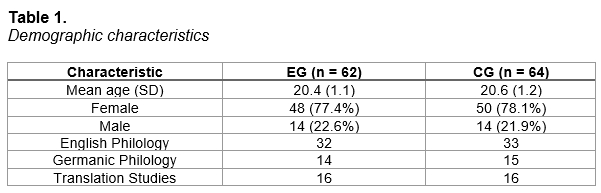
No statistically significant differences were found between groups at baseline regarding age, gender distribution, academic specialization, or initial digital competence (p > .05).
Sample Size and Statistical Power
An a priori power analysis was conducted using GPower 3.1 for a chi-square test with a medium effect size (w = 0.30), alpha = .05, and power = .80. The required minimum sample size was 108 participants. The final sample of 126 students exceeded this threshold and was considered sufficient to detect statistically significant differences between groups.
Quantitative Instruments
Digital Competence Questionnaire
The main instrument was a 32-item questionnaire developed on the basis of the European Digital Competence Framework for Citizens (DigComp 2.2) (Vuorikari et al., 2022). Items were distributed across three theoretically justified dimensions.
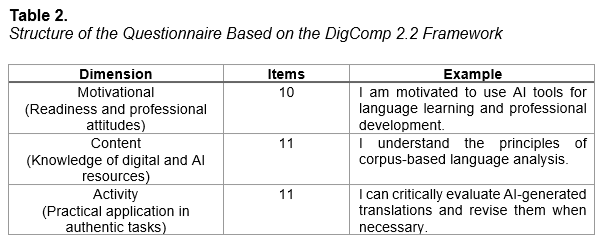
Responses were recorded on a 5-point Likert scale (1 = strongly disagree, 5 = strongly agree). Total scores ranged from 32 to 160.
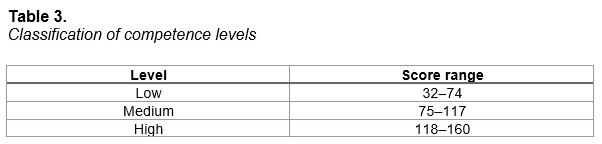
of competence levels
Cut-off points were established using a percentage-based interpretation of the maximum possible score (<47%, 47–73%, ≥74%).
The questionnaire comprised three dimensions containing different numbers of items, competence levels were classified separately for each dimension using the same percentage-based approach that was applied to the total questionnaire score. Specifically, scores below 47% of the maximum possible score for a given dimension were classified as low, scores between 47% and 73% as medium, and scores of 74% or higher as high. Accordingly, the score ranges were as follows:
- Motivational dimension (10 items; score range 10–50): Low = 10–23; Medium = 24–36; High = 37–50.
- Content dimension (11 items; score range 11–55): Low = 11–25; Medium = 26–40; High = 41–55.
- Activity dimension (11 items; score range 11–55): Low = 11–25; Medium = 26–40; High = 41–55.
These predefined score ranges were applied consistently throughout the study to classify participants' competence levels for each dimension and to generate the categorical distributions presented in the Results section.
Content Validity and Reliability
The questionnaire underwent expert validation by seven specialists in educational technology, digital pedagogy, applied linguistics, and language education. Experts evaluated each item for relevance, clarity, and representativeness using a 4-point scale.
Item-level Content Validity Index (I-CVI): 0.86–1.00
Scale-level Content Validity Index (S-CVI/Ave): 0.94
A pilot study involving 30 philology students not included in the main sample was conducted to test clarity and reliability. Minor wording revisions were introduced after the pilot phase.
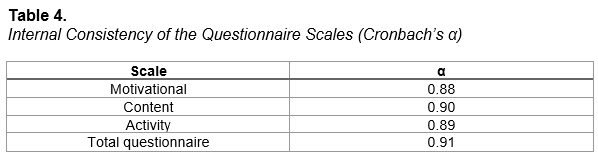
Cronbach’s alpha coefficients reported below refer to the final study sample (N = 126).
During the implementation of the intervention, teachers conducted classroom observations and maintained reflective notes regarding students' participation and engagement. Informal discussions with students were also used to monitor the instructional process and identify possible organizational difficulties. These procedures served exclusively to support the implementation of the intervention and were not designed as independent sources of research data. Therefore, they were not subjected to formal qualitative analysis and are not reported in the Results section.
Educational Intervention
The intervention lasted 16 weeks (64 contact hours) and was implemented by three university teachers previously trained to ensure procedural consistency.
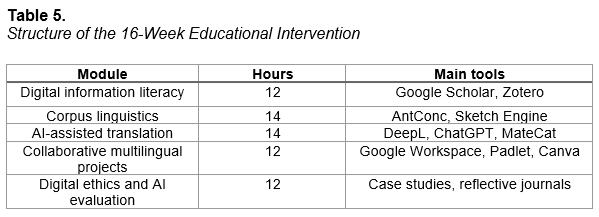
Instructional sequence
Each module followed a standardized sequence:
- Introduction and modeling (15 min).
- Guided practice (25 min).
- Collaborative task (30 min).
- Reflection and formative feedback (20 min).
Fidelity of implementation
To ensure consistent implementation:
- Teachers used common lesson plans.
- Researchers conducted monthly monitoring meetings.
- 20% of sessions were audited using a fidelity checklist.
- Average fidelity score was 91%.
The control group studied according to the standard curriculum without the systematic integration of AI tools, corpus technologies, collaborative digital projects, or gamified activities.
Data Analysis
Data were analyzed using IBM SPSS Statistics 29.0. Descriptive statistics (frequencies, percentages, means, and standard deviations) were first calculated to summarize participants' demographic characteristics and digital competence scores.
The primary outcome variable was students' level of digital competence, classified into three ordinal categories (low, medium, and high) according to the predefined questionnaire score ranges.
Because the study employed a quasi-experimental design with experimental and control groups, Pearson's chi-square (χ²) test of independence was used to compare the distributions of competence levels between the experimental and control groups at each measurement point (baseline and post-intervention). The χ² test was not used as a measure of correlation but as a test of association between group membership and competence level. For each analysis, the χ² statistic, degrees of freedom (df), exact p value, and Cramer's V were reported to indicate both statistical significance and effect size. Effect sizes were interpreted according to Cohen's recommendations (0.10 = small, 0.30 = medium, 0.50 = large).
To assess baseline comparability, Pearson’s chi-square tests of independence were used to compare the distributions of competence levels between the experimental and control groups. No statistically significant baseline differences were detected across the motivational, content, or activity dimensions (all p > .05), indicating that the groups had similar initial distributions of digital competence. Post-intervention Pearson’s chi-square tests were subsequently conducted to determine whether the distributions of competence levels differed significantly between the groups following implementation of the pedagogical system.
The study included repeated measurements of the same participants; however, the available dataset used for inferential analysis consisted of aggregated categorical distributions rather than individual paired observations. Consequently, paired statistical procedures for repeated measurements (e.g., McNemar's test, Stuart–Maxwell test, generalized estimating equations, or ordinal mixed-effects models) could not be validly applied. This represents a methodological limitation and should be considered when interpreting the findings.
Statistical analyses were performed exclusively on questionnaire-derived quantitative data. Classroom observations and informal student discussions were used only to facilitate implementation of the intervention and were not analysed using formal qualitative procedures. Consequently, no qualitative findings are presented in the Results section.
Statistical significance was established at p < .05 for all quantitative analyses.
All quantitative ratings and competence levels reported in this study were derived exclusively from the Digital Competence Questionnaire. Classroom observations, teachers' reflective notes, and informal student discussions were used solely to support the implementation and monitoring of the educational intervention. These procedures were not standardized research instruments, were not included in the statistical analyses, and did not contribute to the calculation of students' competence scores. Consequently, no weighting procedure across multiple data sources was applied, as all reported quantitative outcomes were based exclusively on questionnaire data.
Ethical Considerations
According to the institutional regulations of the participating universities, formal ethical committee approval was not required for this educational study involving voluntary participation, anonymous questionnaire data, and no medical or psychological intervention. Participation was voluntary, written informed consent was obtained from all participants, questionnaire responses were anonymized prior to analysis, and participants were informed of their right to withdraw from the study at any time without academic consequences.
Results and Discussion
The effectiveness of the proposed pedagogical system was evaluated by comparing the distribution of digital competence levels between the experimental and control groups at the ascertaining and post-intervention stages. Digital competence was assessed according to three dimensions: motivational, content, and activity. Baseline analyses confirmed that no statistically significant differences existed between the groups before the intervention (p > .05), indicating their initial equivalence. The post-intervention findings are presented below.
The results of assessing respondents' digital competence levels at the control stage of the experiment, using the motivational criterion, are presented in Table 6.
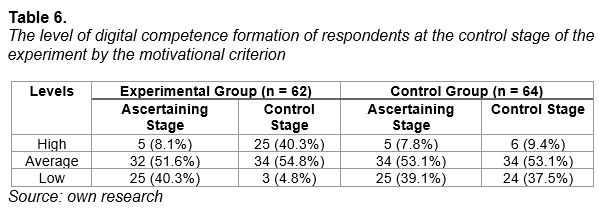
The descriptive distributions indicate that, at the post-intervention assessment, a larger proportion of students in the experimental group achieved a high level of motivational digital competence and a smaller proportion remained at the low level compared with the control group. Because the available data consisted of aggregated categorical frequencies rather than paired individual observations, these descriptive differences should not be interpreted as statistically significant within-group improvements.
At baseline, no statistically significant differences were observed between the experimental and control groups (p > .05), confirming their initial equivalence. Following the intervention, Pearson's chi-square test demonstrated statistically significant between-group differences in motivational competence, χ²(2) = 27.95, p < .001, with Cramer's V = 0.47, indicating a moderate-to-large effect size.
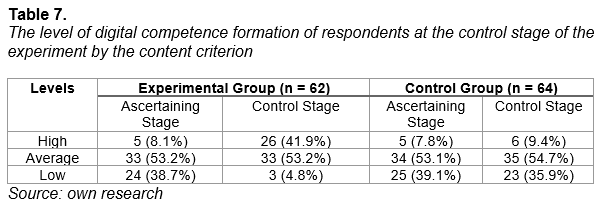
Descriptive comparisons show that the post-intervention distribution of content competence levels differed between the experimental and control groups, with a greater proportion of students classified at the high level in the experimental group. These descriptive differences should not be interpreted as evidence of statistically significant within-group change because paired individual data were unavailable.
At baseline, no statistically significant differences were found between the groups (p > .05). Following the intervention, Pearson's chi-square test demonstrated statistically significant differences in the distribution of content competence levels between the experimental and control groups, χ²(2) = 27.92, p < .001, with Cramer's V = 0.47, indicating a moderate-to-large effect size.
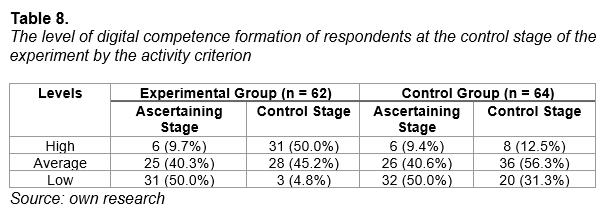
Descriptive statistics indicate that the experimental group demonstrated a more favourable post-intervention distribution of activity competence levels than the control group. However, because only aggregated frequencies were available, these results should be interpreted as between-group differences rather than statistically verified within-group improvements.
Between-group differences in the distribution of digital competence levels were evaluated using Pearson's chi-square (χ²) test of independence. Effect sizes were estimated using Cramer's V.
Baseline differences between the groups were not statistically significant (p > .05). After completion of the intervention, Pearson's chi-square test showed significant between-group differences in the activity criterion, χ²(2) = 27.10, p < .001, with Cramer's V = 0.46, indicating a moderate effect size.
Post-intervention differences between the experimental and control groups were examined using Pearson’s chi-square test of independence, with Cramer’s V used to estimate effect size. Statistically significant between-group differences were identified across all three dimensions of digital competence (motivational: χ²(2) = 27.95, p < .001, Cramer’s V = .47; content: χ²(2) = 27.92, p < .001, Cramer’s V = .47; activity: χ²(2) = 27.10, p < .001, Cramer’s V = .46). The experimental group exhibited more favourable post-intervention distributions of self-reported digital competence levels than the control group across all three dimensions.
Because the inferential analyses were based on aggregated categorical data rather than paired individual observations, these findings should be interpreted as statistically significant between-group differences at the post-intervention measurement, rather than as statistically verified within-group changes over time. Overall, the results suggest a positive association between participation in the proposed pedagogical system and students’ self-reported digital competence, but they do not by themselves establish definitive causal effectiveness.
The findings demonstrate that the proposed pedagogical system significantly improved the digital competence of philology students across the motivational, content, and activity dimensions. The most substantial progress was observed in students' ability to apply digital technologies in authentic professional contexts, indicating that the intervention promoted not only theoretical knowledge but also practical digital competence. These findings suggest that sustainable competence development is achieved through the systematic integration of digital educational resources, artificial intelligence (AI) tools, collaborative learning, and competency-based instructional strategies rather than through the isolated use of individual digital technologies.
The results are consistent with previous studies reporting that digital technologies enhance student engagement, learning motivation, and academic performance in higher education (Haleem et al., 2022). Similar to these studies, the present research confirms that technology-supported learning environments create favourable conditions for developing digital competence. Likewise, the multidimensional improvements identified in this study support the conceptual frameworks proposed by Falloon (2020), who argue that digital competence encompasses content, technological, communicative, and ethical dimensions rather than simple technical proficiency.
However, the present findings also extend previous research in several important respects. Many earlier investigations primarily evaluated the effectiveness of individual digital tools, online platforms, or isolated instructional technologies. Although such studies reported positive effects on students' digital literacy and motivation, they often demonstrated improvements limited to specific competencies or short-term educational outcomes. In contrast, the current study examined an integrated pedagogical systems that combine AI-supported learning, digital educational resources, collaborative activities, project-based learning, and continuous formative assessment. The positive changes observed simultaneously across all three competence dimensions suggest that comprehensive pedagogical design may produce broader and more sustainable educational effects than isolated technological interventions.
The findings also address an important gap in the literature concerning discipline-specific digital competence. Existing empirical evidence has largely focused on pre-service teachers, engineering students, or multidisciplinary university populations, whereas philology students have received comparatively limited scholarly attention despite the increasing digitalization of language professions. Unlike many previous studies, the present research demonstrates that digital competence in philological education should incorporate AI-assisted language technologies, digital communication, multilingual content creation, collaborative online interaction, and critical evaluation of AI-generated information. Consequently, the proposed pedagogical system expands current understanding of digital competence by adapting its development to the professional requirements of future philologists.
Several factors may explain the positive outcomes observed in the experimental group. First, the intervention integrated multiple complementary instructional approaches rather than relying on a single educational technology. Second, AI-supported learning activities enabled students to receive immediate feedback, personalise learning processes, and engage with authentic professional tasks. Third, collaborative learning promoted communication, reflection, and peer support, facilitating deeper knowledge construction. Finally, continuous formative assessment encouraged students to monitor their own learning progress and progressively develop higher levels of digital competence. These pedagogical mechanisms likely acted synergistically, explaining the greater improvements observed in comparison with traditional instructional approaches.
The educational implications of these findings are significant. The results indicate that higher education institutions should move beyond teaching isolated digital skills and instead adopt integrated pedagogical system that combine digital educational resources, AI technologies, collaborative learning environments, and authentic profession-oriented tasks. Such an approach better prepares future philologists for professional activities requiring digital communication, computer-assisted translation, digital content creation, intercultural collaboration, and responsible use of artificial intelligence. Furthermore, the proposed pedagogical system may serve as a practical framework for curriculum redesign, professional development of university teachers, and modernization of digital learning environments within humanities education.
Despite these positive findings, several limitations should be acknowledged. The study involved students from a limited number of higher education institutions, which may restrict the generalisability of the results to other educational contexts. In addition, the intervention evaluated medium-term educational outcomes; therefore, further longitudinal studies are needed to determine whether the observed improvements remain stable over time. Future research should also investigate the effectiveness of the proposed pedagogical system in other humanities disciplines, compare different AI-supported instructional models, and examine additional factors influencing the long-term development of digital competence.
Overall, the study contributes to the growing body of evidence supporting integrated approaches to digital competence development. By providing experimental evidence from the context of philological education, it extends existing theoretical models and demonstrates that the combination of pedagogically grounded digital technologies, artificial intelligence, and collaborative learning strategies represents a promising direction for the digital transformation of higher education.
These findings suggest that integrating digital educational technologies into university curricula can substantially improve students' professional readiness for technology-rich educational environments. The proposed pedagogical system may therefore be recommended for implementation in higher education institutions preparing future specialists.
One limitation of this study is that classroom observations and informal student discussions were employed solely as supportive pedagogical procedures during the implementation of the intervention and were not subjected to systematic qualitative analysis. Consequently, the conclusions are based primarily on quantitative questionnaire data. Because the quantitative findings were based exclusively on questionnaire data, future studies should employ validated observation protocols, structured interviews, and performance-based assessment rubrics as additional sources of evidence. Such triangulation would enable cross-validation of the questionnaire results and provide a more comprehensive assessment of students' digital competence.
Conclusions
This study examined the implementation of an integrated pedagogical system designed to support the development of digital competence among undergraduate philology students within a quantitative quasi-experimental research design. The intervention combined digital educational resources, artificial intelligence technologies, collaborative learning activities, and competency-oriented instructional strategies in order to enhance students' motivational, content, and activity dimensions of digital competence.
The questionnaire-based findings demonstrated more favourable post-intervention distributions of digital competence levels in the experimental group than in the control group. Pearson's χ² analyses identified statistically significant between-group differences across the motivational, content, and activity dimensions following implementation of the intervention. These findings indicate that the proposed integrated pedagogical system was associated with higher levels of self-reported digital competence among students in the experimental group.
The study contributes to the literature by providing empirical evidence on the application of an integrated pedagogical system in philological education, an area that has received comparatively limited attention in previous research. The results also demonstrate the potential of combining digital educational resources, artificial intelligence tools, collaborative learning, and competency-oriented instruction within the professional preparation of future philologists.
From a practical perspective, the proposed integrated pedagogical system may serve as a useful framework for curriculum modernization in higher education institutions preparing future philologists. The integration of artificial intelligence technologies, authentic professional tasks, collaborative digital environments, and competency-oriented assessment offers a promising approach to supporting students' readiness for professional activity in digitally transformed educational and linguistic contexts.
The findings suggest that integrating digital educational resources, artificial intelligence technologies, collaborative learning activities, and competency-oriented instructional strategies may support the development of students' digital competence in higher education. However, these conclusions should be interpreted in light of the study's methodological limitations, including reliance on self-report questionnaire data, the use of aggregated rather than paired individual observations, and the absence of long-term follow-up or independent performance-based measures.
Consequently, although the results indicate the potential educational value of the proposed integrated pedagogical system, additional research employing longitudinal designs, paired individual analyses, performance-based assessments, and multiple validated data collection methods is required to confirm the durability, generalisability, and broader applicability of the observed effects.