
Artículo de investigación
Preparación del profesorado para la integración de la IA: Cerrando la brecha entre la competencia digital y el uso pedagógico de la IA
Teacher readiness for AI integration: Bridging the gap between digital competence and pedagogical use of AI
Recibido: · Aceptado: · Publicado:
Cómo citar: Yashanov, S., Trobiuk, D., Lazirko, N., Manko, R., & Ivanyshyn, M. (2026). Preparación del profesorado para la integración de la IA: Cerrando la brecha entre la competencia digital y el uso pedagógico de la IA. Revista Eduweb, 20(3), 257–275. https://doi.org/10.46502/issn.1856-7576/2026.20.03.15
Resumen
El objetivo del estudio fue desarrollar y validar un modelo estructural de la preparación del profesorado de educación superior para la integración pedagógica de la inteligencia artificial, que constaba de seis componentes interrelacionados: competencia digital, actitudes pedagógicas hacia la IA, autoeficacia, prácticas reales de uso de la IA, apoyo institucional y barreras percibidas. El estudio se llevó a cabo dentro del marco de una estrategia cuantitativa utilizando un diseño descriptivo correlacional. Al mismo tiempo, los datos se recopilaron mediante un cuestionario mixto entre 278 docentes de educación superior. Se utilizaron estadísticas descriptivas, análisis de correlación, análisis factorial confirmatorio (AFC) y modelado estructural (MEE) para analizar los datos. Los resultados indicaron características psicométricas satisfactorias del instrumento desarrollado (α = .76–.89; CFI = .96; RMSEA = .041). Los datos también confirmaron la existencia de una brecha entre el nivel de competencia digital del profesorado y las prácticas reales de uso de la IA. El modelado estructural mostró que la autoeficacia es el predictor más fuerte del uso pedagógico de la IA (β = .42). Sin embargo, el impacto de la competencia digital está mediado principalmente por la autoeficacia y las actitudes pedagógicas. La relevancia práctica del estudio radica en que la herramienta APRS desarrollada puede ser utilizada por las instituciones de educación superior para diagnosticar la preparación del profesorado y diseñar programas de desarrollo profesional específicos.
Palabras clave: inteligencia artificial en la educación; competencia digital; educación superior; autoeficacia; modelado estructural; preparación docente.
Abstract
The study aimed to develop and validate a structural model of higher education teachers’ readiness for pedagogical integration of artificial intelligence, which consisted of six interrelated components: digital competence, pedagogical attitudes towards AI, self-efficacy, real practices of using AI, institutional support and perceived barriers. The study was conducted within the framework of a quantitative strategy using a descriptive correlational design. At the same time, the data were collected based on a mixed questionnaire among 278 higher education teachers. Descriptive statistics, correlation analysis, confirmatory factor analysis (CFA) and structural modeling (SEM) were used to analyze the data. The results indicated satisfactory psychometric characteristics of the developed instrument (α = .76–.89; CFI = .96; RMSEA = .041). The data also confirmed the existence of a gap between teachers' levels of digital competence and their actual use of AI. Structural modeling showed that self-efficacy is the strongest predictor of pedagogical use of AI (β = .42). However, the impact of digital competence is mainly mediated by self-efficacy and pedagogical attitudes. The practical significance of the study is that the developed APRS tool can be used by higher education institutions to diagnose the readiness of teaching staff and design targeted professional programs.
Keywords: artificial intelligence in education; digital competence; higher education; self-efficacy; structural modeling; teacher readiness.
Introduction
The active use of artificial intelligence (AI) in the first quarter of the 21st century has changed the nature of professional activity in the educational sphere. The introduction of generative models, intelligent learning systems, automated assessment tools and personalized learning have become an important part of the educational space of higher education institutions (HEIs) around the world. However, it has been proven that the effectiveness of integrating AI into the educational process is determined by the availability of technologies and the readiness of teaching staff to use them meaningfully, methodically justified. Accordingly, the phenomenon of readiness is one of the least studied constructs of modern pedagogical science. In addition, teachers' readiness to use AI is multidimensional. In particular, it covered the level of digital competence, that is, the skills to navigate the technological environment and critically evaluate digital tools. On the other hand, readiness for AI integration also requires a structured pedagogical dimension, in particular, an understanding of when, how and for what educational purpose it is appropriate to use artificial intelligence in teaching practice. Modern research has shown that digital literacy alone does not guarantee the effective implementation of educational technologies (Guppy et al., 2022). The authors have proven that the decisive role was played by teachers' attitudes towards AI, their self-efficacy, pedagogical beliefs and the level of institutional support (Buchan et al., 2024).
In addition, despite the significant attention of the scientific community to the topic of AI in education, most of the existing research is focused on the student perspective. Therefore, there is little research conducted in the teaching environment. In addition, many scientists have drawn attention to the fact that the study of individual technological tools (Gutierrez et al., 2022). Accordingly, the analysis of the readiness of scientific and pedagogical workers as a holistic category is ignored. In addition, it should be recognized that the connection between the measured level of digital competence and the actual pedagogical use of AI is mostly postulated theoretically, but rarely verified empirically in large-scale quantitative studies. This raises the main question: does a higher level of digital competence of a teacher really lead to a more frequent and pedagogically appropriate use of artificial intelligence tools?
The answer to this question required the development of a theoretically grounded and empirically validated toolkit — a model that would reflect the structure of teachers’ readiness for AI integration and allow measuring its key components. It is this gap that the proposed study seeks to fill.
Therefore, the aim of the article will be to develop and analyze a structural model of the readiness of HEI teachers for the pedagogical integration of AI. This model will reflect the relationship between digital competence, pedagogical attitudes, self-efficacy regarding AI and practices of its use. The tasks are as follows:
1. To characterize the profile of digital competence of HEI teachers and identify which components of readiness for integration were the most developed in the studied sample.
2. To find out whether there is a gap between the level of digital competence of teachers and the intensity of their pedagogical use of AI.
3. To determine which factors predict the actual frequency and pedagogical appropriateness of using AI in teaching practice.
4. To establish whether the profiles of readiness for AI integration differ depending on the demographic and professional characteristics of teachers.
Theoretical Framework or Literature Review
Digital competence of higher education teachers: status and challenges
The digital competence of teaching staff is one of the most studied constructs in modern educational science, however, the operationalization of this phenomenon and its measurement remain a subject of debate. A systematic literature review by Basilotta-Gómez-Pablos et al. (2022) indicated that despite the attention paid to the study of digital competence of higher education teachers, most studies contain significant variability between its individual components. In particular, the authors indicated that technical skills are better developed than the pedagogical application of digital tools. Cobena et al. (2023) found that effective improvement of digital competence requires systematic, long-term interventions that are focused on practical application. Masoumi and Noroozi (2025) specified this conclusion for novice teachers and indicated the need to integrate the development of digital competence into initial teacher training programs. Regalado-Pezua et al. (2025) identified that digital competencies have become important drivers of digital transformation in the Ibero-American educational space. However, their development in this region has been uneven. In addition, Rodríguez-Cisneros et al. (2026) demonstrated the existence of such an unevenness using the example of technical and technological education in Ecuador, in which a significant part of teachers had only a basic level of digital competencies. In addition, Alderete (2025) analyzed the dynamics of gaps in access, use and mastery of ICT in Latin American countries during 2008–2022. The author indicated that the gap in the use and pedagogical mastery of technologies increased even with improved physical access to them.
Integration of artificial intelligence into pedagogical practice in higher education
The problem of qualitative integration of AI into higher education is becoming relevant in the international scientific discourse. In particular, Flores and Chiappe (2025) found that teachers’ readiness to integrate AI is determined by various training factors and digital competencies. In particular, the authors highlighted that pedagogical attitudes and experience in the practical application of technologies play a decisive role. In addition, Gutierrez et al. (2022) analyzed scenarios for the use of AI in e-learning in the Latin American space. The authors identified new competencies of graduates that should be formed in an AI-saturated educational environment. The authors also proved that there are currently special requirements for the pedagogical training of teachers. In addition, Deroncele-Acosta et al. (2025) in a review of research on generative AI in higher education pointed out the potential of these technologies for the development of transversal competencies. The researchers also emphasized that the realization of this potential depends on the pedagogical skills of the teacher and his readiness for the meaningful use of AI.
In addition, Molina-Soria et al. (2026) described the process of combining AI and formative assessment in teacher education. The authors concluded that despite the obvious synergistic potential, most teachers were unprepared for such integration due to a lack of technical knowledge. Also, Patiño Barriga et al. (2025) formed an AI-oriented model to stimulate international cooperation in open education and indicated the need for systemic institutional solutions to support pedagogical innovations based on AI. This work became important for this study. In addition, Nnaji et al. (2026) pointed to the experience of Nigerian universities and determined that AI-oriented digital transformation of HEIs requires technological and managerial and pedagogical restructuring.
An important aspect of AI integration has been the issue of pedagogical innovation and the transformation of traditional approaches to teaching. Cano et al. (2026) identified that the most effective approaches consist of technological solutions and a rethinking of pedagogical roles and methods. Godinez-Flores et al. (2025) identified the need for educational transformation based on digital humanities as a conceptual framework for understanding the place of AI in pedagogical practice. Furthermore, Patiño Barriga et al. (2025) identified that gamification and AI have become important catalysts for such transformation, as they have reduced psychological barriers and increased teachers' motivation to master new technologies.
2.3. Professional development of teachers in the field of digital technologies.Osorio Vanegas et al. (2025) identified a consistent trend: the most effective professional development programs are based on the principles of practice-oriented learning, peer support and reflection. At the same time, Basantes-Andrade et al. (2025) confirmed that effective digital integration required targeted methodological training. In addition, Masoumi and Noroozi (2025) specified the conditions for the effective development of digital competence of novice teachers and highlighted the role of mentoring, institutional support for practical experimentation.
At the same time, Hernandez-Pozas (2025) analyzed the transformation of the roles of students and teachers in the context of a continuous process of digital learning. The authors also determined that the traditional dichotomy “digital immigrant - digital native” is an oversimplification. In particular, real digital competence and readiness to use AI were determined mainly by the experience of purposeful learning. Rodas-Coloma et al. (2026) identified the pedagogical potential of new digital platforms and pointed out the importance of critical pedagogical reflection of any technological tools, which is especially relevant in the context of AI. Regalado-Pezua et al. (2025) also indicated that digital competences have become an important organizational resource, the development of which requires a strategic management approach at the HEI level. The digital competence component in the proposed model was based primarily on the European conceptual frameworks DigComp and DigCompEdu. DigComp defined digital competence through such areas as information literacy and data work, communication and collaboration, digital content creation, security and problem solving. DigCompEdu specified such areas according to the professional activities of teachers and covered work with digital resources, organization of teaching and learning, digital assessment, empowering learners and promoting the development of their digital competence. In this study, the mentioned framework was used to distinguish between the general technological literacy of teachers and their ability to pedagogically appropriate use of digital and AI-based tools. Such a distinction was fundamental, since the possession of digital skills in itself did not guarantee the regular, conscious and methodologically justified use of AI in teaching. The proposed APRM model combined complementary, rather than competing, theoretical approaches (Al-Abdullatif, 2024). DigCompEdu explained the structure of teachers’ professional digital competence. The TPACK(Technological Pedagogical Content Knowledge) model allowed us to determine the extent to which technological knowledge was integrated with pedagogical and subject knowledge. Technology acceptance models explained the role of perceived usefulness, ease of use, attitudes, and behavioral intentions. Self-efficacy theory revealed teachers’ confidence in their own ability to perform pedagogical tasks with the help of AI. Institutional support and perceived barriers complemented these individually focused approaches, as they took into account the organizational, technical, ethical, and psychological conditions under which teachers’ readiness was or was not realized in actual pedagogical practice (Ayanwale et al., 2024). This is confirmed by the studies of Flores and Chiappe (2025) and Cobena et al. (2023). At the same time, technology acceptance models identified the role of perceived usefulness and ease of use in shaping behavioral intentions towards new technologies. The integration of these theoretical approaches allows us to formulate the basic theoretical position of the study: a teacher’s readiness for pedagogical integration of AI is a dynamic construct that is formed at the intersection of individual characteristics and organizational context (institutional support).
Accordingly, the six APRM constructs reflected interrelated levels of readiness for pedagogical integration of AI. Digital competence characterized the teacher’s available technological resource; pedagogical attitudes reflected the assessment of the educational appropriateness of AI; self-efficacy determined subjective confidence in the ability to apply AI (Collie et al., 2024); AI use practices represented the behavioral realization of readiness; institutional support reflected the favorableness of the organizational environment; perceived barriers and anxiety captured factors that could inhibit the transition from competence and positive intentions to actual pedagogical behavior.
Despite the significant body of research on teachers’ digital competence and AI integration in higher education, a review of the existing literature has identified a number of gaps. In particular, most of the existing work has defined digital competence and AI readiness as separate, autonomous constructs, and has not examined the mechanisms of their interaction. In particular, Basilotta-Gómez-Pablos et al. (2022), Cobena et al. (2023), and Masoumi and Noroozi (2025) have focused exclusively on digital competence and have not considered how it is transformed. Flores and Chiappe (2025) are one of the few exceptions, but their study did not verify the mediation mechanisms between competence and behavior through structural modeling. In addition, there is a lack of research that offers a validated instrument to comprehensively measure teachers’ readiness for pedagogical integration of AI. This work will fill these gaps.
Methodology
Research design
The work is based on a quantitative strategy using a descriptive correlational design and cross-sectional data. This design was important for studying the structure of the latent construct - teachers' readiness for pedagogical integration of artificial intelligence. This design was also chosen from the point of view that it is important for verifying the connections between AI components. The study did not involve experimental intervention, since the main goal was to build and statistically validate the measurement model.
Participants
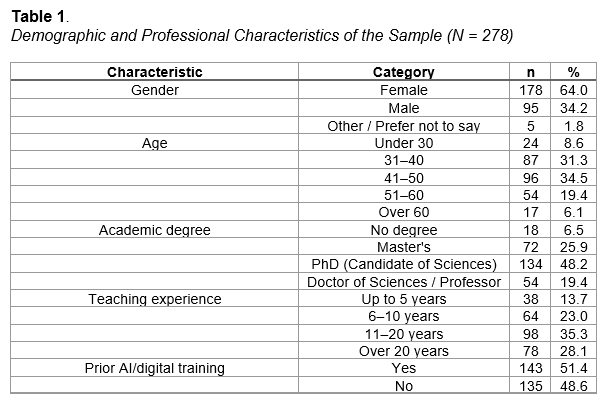
278 teachers of higher education institutions participated in the study. The inclusion criteria were: having experience in teaching at a higher education institution for at least one academic year and directly implementing the educational process at the time of the study. The selection of participants was implemented based on the method of purposive sampling with elements of snow sampling - by contacting university departments and distributing invitations to participate through academic networks. The main characteristics of the participants are presented in Table 1.
Teacher readiness model for AI integration
The theoretical basis of the study was the author's structural model of the readiness of teachers of higher education institutions for the pedagogical integration of artificial intelligence (AI Pedagogical Readiness Model, APRM). This model was formed on the basis of the intersection of the conceptual provisions of the DigComp digital competence framework, the TPACK model and Bandura's self-efficacy theory. The model consisted of six interrelated latent constructs:
1. Digital competence - the level of technological literacy of the teacher and confidence in working with digital tools;
2. Pedagogical attitudes towards AI - the teacher's basic beliefs about the educational value and appropriateness of using artificial intelligence;
3. Self-efficacy towards AI - subjective confidence in the ability to effectively apply AI in the educational process;
4. AI use practices - the frequency and pedagogical focus of using AI tools in teaching activities;
5. Institutional support - perceived availability of technical infrastructure, training and organizational encouragement from the HEI;
6. Perceived barriers and anxiety - subjective obstacles of a technical, ethical and psychological nature that hinder the integration of AI.
Procedure and tools
Data collection was implemented during November 2025 - March 2026 based on a mixed questionnaire. In particular, some participants filled out the questionnaire in electronic form via the Google Forms platform, others in paper format during face-to-face meetings at departments of higher education institutions. The use of two data collection formats is due to the desire to minimize selection bias and cover teachers with different levels of digital engagement. Before starting to fill out the questionnaire, each participant received an information letter with a detailed explanation of the purpose, objectives and procedure of the study, guarantees of anonymity and confidentiality of the data obtained. Participation in the study was exclusively voluntary; all participants confirmed their consent before starting to fill out the questionnaire.
The main research instrument was the author's questionnaire "Teachers' Readiness Scale for Pedagogical Integration of Artificial Intelligence". This tool was developed specifically for this study. The questionnaire consists of two parts. The first part consisted of questions about the demographic and professional characteristics of the participants and their experience of digital training or education in the field of AI. The second part consisted of statements distributed across six scales according to the components of the author's APRM model: digital competence, pedagogical attitudes towards AI, self-efficacy in using AI, real-life practices of AI application, institutional support and perceived barriers and anxiety about AI. All statements were formulated in the format of a five-point Likert scale.
The formation and development of the instrument was carried out in several consecutive stages. In particular, at the first stage, an analysis of existing validated instruments in related fields was conducted - scales of digital competence, readiness to use educational technologies and attitudes towards AI. At the same time, in the second stage, the content validity of the instrument was ensured through expert assessment: seven specialists in the field of educational technology, higher education pedagogy and applied statistics independently assessed each statement according to the criteria of relevance, clarity of formulation and correspondence to the theoretical construct. Statements that did not gain a sufficient level of agreement between experts (content validity index CVI < 0.78) were reformulated or even excluded from the instrument. In the third stage, the instrument was pilot tested on a small sample (n = 30 teachers who were not included in the main sample) in order to check the clarity of the statements, the average time of completion and a preliminary assessment of the internal consistency of the scales. Based on the results of the piloting, a number of editorial clarifications were made to the instrument. The final version of the questionnaire was tested for reliability (Cronbach's α) and construct validity (confirmatory factor analysis) on the data of the main sample. This confirmed its psychometric suitability for use in the study.
Data analysis
Statistical data analysis was implemented using the IBM SPSS Statistics 26 and IBM AMOS 26 software packages.
First, descriptive statistics were used and reliability assessment was performed. Descriptive statistics indicators were calculated for the scale and the total sample: mean values (M), standard deviations (SD), minimum and maximum values, as well as skewness and kurtosis indicators to check the normality of the distribution. The internal consistency of each scale was assessed using Cronbach's α coefficient;α ≥ 0.70 was considered acceptable, and α ≥ 0.80 was considered good. Additionally, the average variance and reliability indicators (CR ≥ 0.70) were calculated as criteria for convergent validity of the constructs.
Next, a correlation analysis was performed. Pearson's correlation analysis was used to establish relationships between the six components of the model. Bivariate correlations between individual scales and statistical significance (p < .05; p < .01) were tested. Confirmatory factor analysis (CFA) was also implemented. Confirmatory factor analysis using the Maximum Likelihood Estimation method was used to verify the factor structure of the instrument and assess the correspondence of the theoretical model to the empirical data. The quality of the model fit was determined by a set of indices: absolute (χ²/df < 3.0; RMSEA < 0.08; SRMR < 0.08) and incremental (CFI ≥ 0.95; TLI ≥ 0.95). Structural modeling (SEM) was also performed. Structural modeling was used to test the causal relationships between the latent variables of the model and identify significant predictors of the pedagogical use of AI. Standardized regression coefficients (β), their statistical significance (p < .05), and the explanatory power of the model (R²) on the dependent variable — real-world AI practices — were assessed. To test indirect effects (in particular, mediational relationships through self-efficacy), the bootstrap resampling method was used (n = 5000 samples, 95% confidence interval). The overall quality of the structural model was assessed using the same fit indices as in CFA.
Results and Discussion
Profile of digital competence and readiness of teachers for AI integration
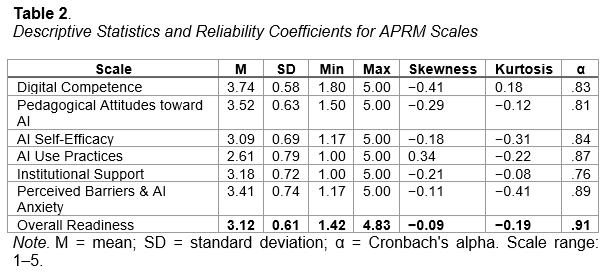
The results of descriptive statistics indicated that the average readiness indicator for the sample was M = 3.12 (SD = 0.61). This indicator corresponded to the average level on the five-point Likert scale. At the same time, the analysis of the profiles of individual components indicated variability between scales, that is, there is an uneven development of different aspects of teachers' readiness for pedagogical integration of artificial intelligence.
The highest indicators are noticeable on the digital competence scale (M = 3.74, SD = 0.58). This determined a sufficient level of technological literacy among teachers of higher education institutions. The indicators of pedagogical attitudes towards AI (M = 3.52, SD = 0.63) were also relatively high: most participants had a positive attitude towards the potential of artificial intelligence in education. The indicators of institutional support (M = 3.18, SD = 0.72) and self-efficacy regarding AI (M = 3.09, SD = 0.69) were at an average level. The lowest indicators were recorded on the scale of real practices of using AI (M = 2.61, SD = 0.79) - this result became important for interpretation and indicated the presence of a gap between digital competence and real pedagogical use of AI. The internal consistency indicators of all scales are acceptable (Cronbach's α from 0.76 to 0.89).
The obtained data are clearly illustrated in Figure 1, which presents a comparative profile of the average values for the six scales of the model. At the same time, Figure 2 shows a radar diagram of the component profile of readiness for the sample as a whole.
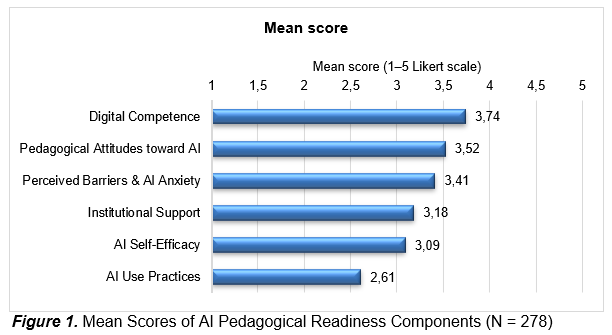
As can be seen from Figure 1, the highest average indicators were recorded for the Digital Competence component (M = 3.74, SD = 0.58). This determined a relatively high level of digital training of respondents. At the same time, lower values were found for AI Self-Efficacy (M = 3.09, SD = 0.69) and especially for AI Use Practices (M = 2.61, SD = 0.79). Such indicators indicated insufficient integration of AI use practices into professional activities.
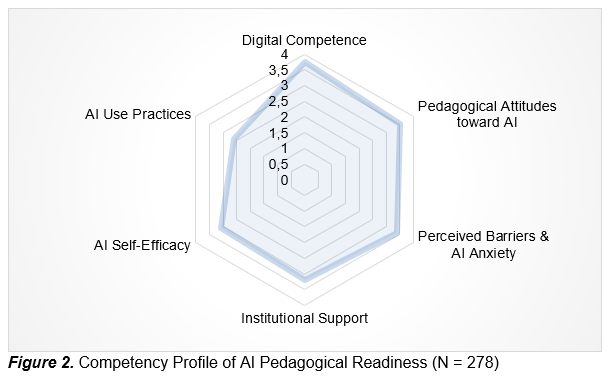
As can be seen from Figure 2, the AI pedagogical
readiness profile had an asymmetrical structure: the most strongly developed
components were Digital Competence and Pedagogical Attitudes toward AI. The
weakest were the indicators of AI Use Practices and AI Self-Efficacy.
Comparison with the reference contour of the neutral level (3.0) showed
that most indicators were at an above-average level.
However, the practical application of AI and confidence in one’s own abilities to work with it remained insufficiently formed.
Relationships between the components of the readiness model
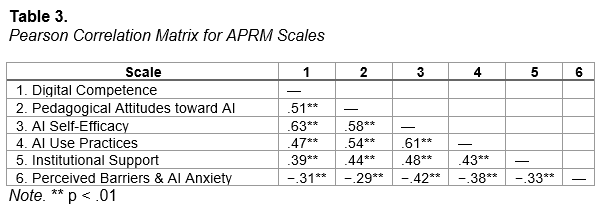
The data from the correlation analysis (Pearson's r) for the six components of the APRM model are shown in Table 3. Thus, all the identified correlations were significant at the p < .01 level. This indicator indicated the interconnectedness of the constructs within the proposed model.
The strongest positive relationship with actual practices of using AI was found for self-efficacy regarding AI (r = .61, p < .001). Thus, the teacher's subjective confidence in his own ability to use AI became a strong correlate of his actual activity. A noticeable relationship was also recorded between pedagogical attitudes and practices of using AI (r = .54, p < .001) and between digital competence and practices (r = .47, p < .001). However, although digital competence correlated moderately with actual practices, its relationship with self-efficacy was higher (r = .63, p < .001). This situation indicated an indirect, rather than direct, role of digital literacy in shaping AI usage practices. It is also worth noting that institutional support was also positively associated with practices (r = .43, p < .001). However, perceived barriers and anxiety about AI had a negative relationship with actual practices (r = −.38, p < .001). This indicated the restraining role of subjective barriers. The discriminant validity test using the Fornell-Larker criterion indicated that the AVE of each construct exceeded the square of its correlation with any other construct in the model. Such data indicated sufficient differentiation of the measured latent variables.
Confirmatory factor analysis data
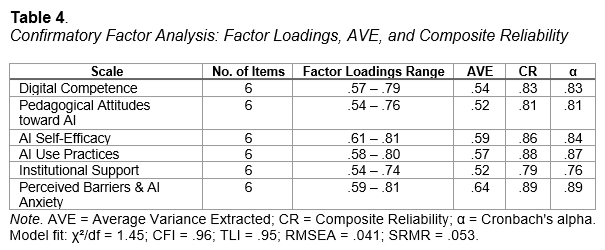
The study conducted a confirmatory factor analysis (CFA) using the maximum likelihood method. The obtained data indicated a satisfactory fit of the model to the data according to the set of indices: χ²(df) = 412.3 (df = 284), χ²/df = 1.45, CFI = .96, TLI = .95, RMSEA = .041 (90% CI [.032, .049]), SRMR = .053. In particular, all the obtained values met the recommended acceptance thresholds. This confirms the adequacy of the proposed six-factor structure of the readiness model.
The standardized factor loadings of all statements were statistically significant (p < .001) and exceeded the recommended threshold of 0.50, varying in the range from 0.54 to 0.81. The average variance extracted (AVE) values for all six factors exceeded the critical value of 0.50 (from 0.52 to 0.64). At the same time, the composite reliability (CR) values were 0.70 (from 0.76 to 0.89). This confirmed the convergent validity of all constructs of the model. The data from the CFA fit indices and psychometric indices of the scales are summarized in Table 4.
Structural modeling
To determine the causal relationships between the latent variables of the APRM model and the predictors of real AI practices, structural modeling (SEM) was used. The overall fit of the structural model to the data is satisfactory: χ²/df = 1.52, CFI = .95, TLI = .94, RMSEA = .044 (90% CI [.035, .053]), SRMR = .057. These data met the recommended acceptance criteria.
The standardized regression coefficients for the direct effects on the dependent variable — real AI practices — are shown in Table 5. In particular, as can be seen in the table, the strongest direct predictor was self-efficacy regarding AI (β = .42, p < .001). This determined the important role of the teacher's subjective confidence in shaping his practical activity in the field of AI. At the same time, pedagogical attitudes towards AI (β = .31, p < .001) and institutional support (β = .19, p < .01) also had a significant positive impact. Perceived barriers and anxiety towards AI had a significant negative direct impact on practices (β = −.22, p < .001). Such indicators indicated the deterrent function of this component. In contrast, the direct impact of digital competence on actual practices of using AI was statistically insignificant (β = .11, p = .09).
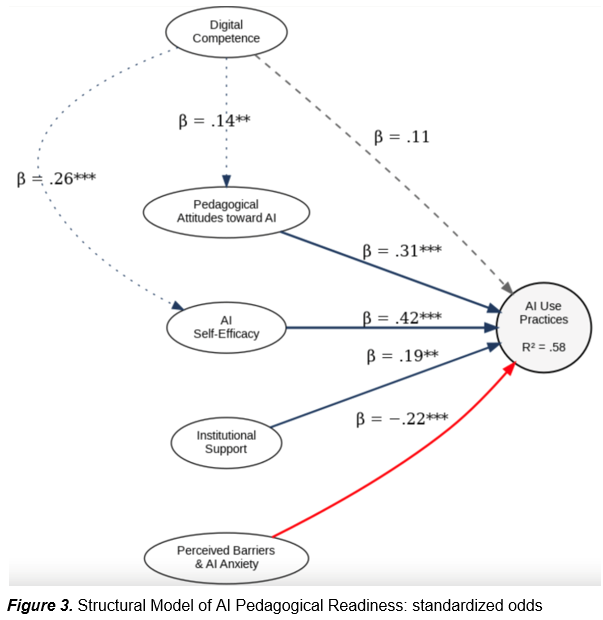
Testing indirect effects using bootstrap resampling (n = 5000) indicated that digital literacy had an indirect effect on AI use practices through self-efficacy (β = .26, 95% CI [.18, .35], p < .001) and through pedagogical attitudes (β = .14, 95% CI [.08, .21], p < .01). Thus, the relationship between digital literacy and actual pedagogical use of AI was mainly mediated through the development of self-efficacy and the formation of positive attitudes. The formed model explained 58% of the variance of the dependent variable (R² = .58).
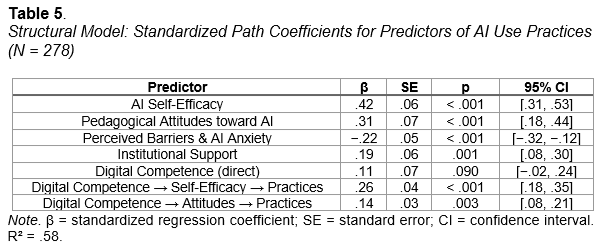
Figure 3 shows the structural model of AI pedagogical readiness with standardized path coefficients between the main latent variables. The data from the SEM analysis indicated that the strongest direct effect on AI Use Practices was AI Self-Efficacy (β = .42, p < .001). This determined the crucial role of respondents’ confidence in their own abilities to use AI technologies.
Differences in readiness profiles depending on teacher characteristics
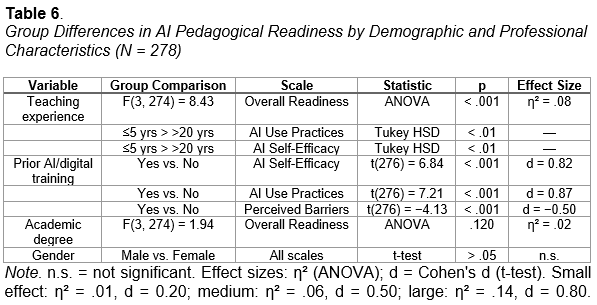
An important part of the study was to determine the readiness profiles for AI integration depending on the demographic and professional characteristics of the participants. To do this, a comparative analysis was conducted using one-way analysis of variance (ANOVA) for variables with three or more groups and Student's t-test for independent samples for dichotomous variables. Note that the effect size was estimated using η² (for ANOVA) and Cohen's d (for t-test). The results of the comparative analysis by key characteristics are presented in Table 6.
Analysis of variance indicated significant differences in the overall readiness index depending on teaching experience (F(3, 274) = 8.43, p < .001, η² = .08). At the same time, post-hoc analysis (Tukey HSD) indicated that teachers with less than 5 years of experience had higher scores on the scales of real-world AI practices and self-efficacy. In contrast, more experienced teachers had higher scores on digital competence. However, this difference did not reach statistical significance (p = .12).
The presence of prior digital training indicated significant differences between teachers who had prior digital training experience and those who did not. For example, teachers with prior AI training had higher scores on self-efficacy (t(276) = 6.84, p < .001, d = 0.82), real-world AI practices (t(276) = 7.21, p < .001, d = 0.87).
Analysis of variance did not indicate statistically significant differences in the overall readiness score depending on the scientific degree (F(3, 274) = 1.94, p = .12, η² = .02). Only on the scale of pedagogical attitudes towards AI was there a trend towards higher scores among doctors of science. However, this indicator did not reach the accepted threshold of significance.
In addition, the t-test did not indicate statistically significant gender differences in any of the components of the model (p > .05 for all scales).
Teacher readiness for AI integration
The results obtained made it possible to determine the readiness of HEI teachers for the pedagogical integration of artificial intelligence as a multidimensional construct. In particular, all components were in complex interdependencies and did not reduce to the sum of technological skills. Active research searches have generated significant interest in the role of AI in higher education (do Lago et al., 2026; Selmi et al., 2025; Khumalo et al., 2025). This, in turn, has highlighted the need to study the capabilities of technologies and the real readiness of teaching staff for their meaningful application.
The absence of significant gender and degree differences indicated that readiness to integrate AI is determined primarily by individual experiences of interaction with technology and institutional space.
AI literacy
The study indicated a noticeable asymmetry between the relatively high level of digital competence and low indicators of real practices of using AI. This became the central result of the study.
The teacher had to assess the reliability of the generated content, adapt it to educational goals, anticipate possible ethical risks, and maintain control over the learning outcomes.
It has also become important to work with psychological barriers and anxiety about AI. This should become an independent and necessary component of such programs (Patiño Barriga et al., 2025).
Digital competence in higher education
This gap was generally consistent with the conclusions of Basilotta-Gómez-Pablos et al. (2022), who indicated that the digital competence of higher education teachers cannot always be transformed into innovative pedagogical practice. At the same time, structural modeling data indicated that digital competence became a necessary, but not sufficient, condition for active pedagogical use of AI. It was shown that its impact on practices was mainly mediated, in particular through self-efficacy and pedagogical attitudes.
The revealed indirect nature of the relationship between digital competence and AI practices was explained by the fact that general digital skills created only a potential opportunity for the application of technology. They did not automatically determine the pedagogical behavior of the teacher. The teacher could confidently use digital platforms, create content and work with information. However, he was not convinced of his own ability to integrate AI into specific educational scenarios (Mah & Groß, 2024).
Thus, digital competence in the proposed model performed the function of a basic resource, while self-efficacy and pedagogical attitudes acted as mechanisms that transformed this resource into real practice.
This explained why teachers with similar levels of digital competence demonstrated significantly different intensities of AI use in teaching.
DigCompEdu and TPACK
The results obtained have implications for the development of professional development systems for academic staff. In particular, AI training programs should not be limited to the formation of technical skills.
However, despite the importance of the results obtained, the study has a number of limitations. In particular, the use of a self-report method may lead to socially desirable responses, especially regarding digital competence scales and AI usage practices.
The transition from technological competence to practical use probably occurred only when the teacher perceived AI as a pedagogically useful tool and had sufficient confidence that he could apply it without losing the quality of teaching, control over the educational process or professional autonomy.
The leading role of self-efficacy could be related to the specifics of the pedagogical use of AI, which involved technical mastery of the tool and decision-making under conditions of uncertainty.
In addition, Godinez-Flores et al. (2025) and Hernandez-Pozas (2025) pointed out the need to rethink pedagogical roles in the context of digital transformation. This situation involves not only technical, but also conceptual retraining of teachers.
Technology Acceptance Model (TAM)
The mediation mechanism made it possible to expand existing theoretical models of technology adoption in education and supplement them with the role of self-efficacy as the main transmission mechanism between competence and behavior.
Such data were consistent with the position of Hernandez-Pozas (2025) on the transformation of teachers' roles in the context of digitalization of education.
The significant negative impact of perceived barriers (β = −.22) can be compared with the observations of Molina-Soria et al. (2026). In particular, these authors recorded that the combination of AI and assessment in teacher education is hampered primarily by psychological and organizational barriers.
The positive role of institutional support (β = .19) was consistent with the findings of Khumalo et al. (2025) and Alaba and Ajibola (2026). These autho rs indicated that the successful integration of AI into HEIs is determined mainly by organizational and managerial factors. At the same time, individual characteristics of teachers took a secondary place (Kurebay et al., 2023). At the same time, this study, on the contrary, proved that experience in using technology is important.
The relatively weaker direct relationship of institutional support with AI practices did not mean that the organizational context was secondary. Rather, institutional support created favorable conditions. However, its effect was realized through individual mechanisms.
The availability of access to tools, training, methodological recommendations, and administrative support did not guarantee the use of AI if the teacher did not have positive pedagogical beliefs or doubted his own ability to apply the technology. Therefore, institutional support in APRM was appropriate to consider as a contextual resource, the effectiveness of which depended on its transformation into personal experience, confidence, and pedagogically sound intentions.
Teacher self-efficacy
The indicator of self-efficacy regarding AI became the strongest direct predictor of real practices (β = .42). This result can be compared with the findings of Deroncele-Acosta et al. (2025). These authors indicated that the subjective confidence of teachers played an important role in shaping their ability to integrate AI for the development of transversal competencies.
The article proves that they should purposefully develop teachers' self-efficacy based on practical experience of applying AI in educational scenarios.
Under such conditions, it was confidence in one’s own ability to manage these processes that could determine behavior more than the formal level of digital skills (Wang et al., 2023).
Professional development for AI integration
The most practical result of the comparative analysis was the large effect size of prior training in the field of AI. This indicated that targeted training can indeed change the behavior of teachers. This view is supported by research in the field of technology-enriched learning (Ogwo, 2026; Salas‐Pilco et al., 2022).
Higher education administrations should also consider institutional support as a strategic factor in the readiness of teaching staff. Institutional support should develop technical infrastructure, encourage innovation, and allocate time for the development of new technologies (do Lago et al., 2026; Cano et al., 2026). In addition, the verified APRS tool can be used by higher education institutions as a diagnostic tool to assess the current state of teacher readiness and plan targeted professional development activities (Deroncele-Acosta et al., 2025; Feitosa et al., 2025; Selmi et al., 2025).
It is also worth noting that the cross-sectional design did not allow conclusions to be drawn about causal relationships over time. At the same time, the structural relationships between the components of the model that were identified were correlational in nature.
Conclusions
Thus, the diagnostics of the readiness profile indicated an asymmetry between the components of the model. In particular, teachers demonstrated a relatively high level of digital competence and positive pedagogical attitudes towards AI, but real practices of its use were the least developed component of readiness. Thus, there is a real gap between technological literacy and its pedagogical implementation in higher education practice.
The data from structural modeling indicated that digital competence became a necessary, but not sufficient condition for the pedagogical application of AI. Its impact on real practices was realized mainly indirectly - on the basis of the development of self-efficacy (β = .26) and the formation of positive pedagogical attitudes (β = .14). This finding became fundamentally important for the design of professional development programs for teachers.
The article proves that self-efficacy towards AI was the strongest direct predictor of real practices of using AI (β = .42). However, perceived barriers and anxiety had a negative impact (β = −.22). These results identified specific areas for effort to increase readiness: developing self-efficacy, addressing psychological barriers, and creating a supportive organizational environment.
Previous AI training experience was the most important demographic predictor of readiness with a large effect size. This indicated that readiness to integrate AI is an acquired rather than an innate characteristic.
Overall, the study indicated that bridging the gap between digital competence and pedagogical use of AI requires a systemic approach that involves developing self-efficacy, transforming pedagogical beliefs, and creating a supportive institutional environment. The proposed APRM model and the verified APRS tool provided the necessary theoretical and diagnostic foundation for this. Therefore, the results can serve as a basis for developing scientifically sound professional development programs for scientific and pedagogical workers.