
Artículo de investigación
Recursos digitales para mejorar la competencia pragmática de los estudiantes en el aprendizaje de lenguas extranjeras
Digital resources for enhancing students' pragmatic competence in foreign language learning
Recibido: · Aceptado: · Publicado:
Cómo citar: Yakymenko, P., Orlova, N., Ketsyk-Zinchenko, U., Ababilova, N., & Chaika, O. (2026). Digital resources for enhancing students' pragmatic competence in foreign language learning. Revista Eduweb, 20(3), 276–295. https://doi.org/10.46502/issn.1856-7576/2026.20.03.16
Resumen
Se revelan el contenido y los componentes de la competencia pragmática de los estudiantes al aprender una lengua extranjera. Se fundamenta el contenido de la competencia sociopragmática y pragmalingüística. Se identifican las principales tareas de los recursos digitales que aseguran el desarrollo de la competencia pragmática en términos de contenido. Los resultados de la etapa de evaluación del experimento mostraron un nivel insuficiente de formación de la competencia pragmática de los estudiantes, lo que permitió establecer factores que influyen en la formación y el desarrollo de la competencia pragmática de los estudiantes, delinear una serie de problemas prácticos y teóricos, desarrollar un sistema, determinar y fundamentar las condiciones pedagógicas e implementar un curso especial. Después de la etapa formativa del experimento, los indicadores del alto nivel de formación de la competencia pragmática de los estudiantes que utilizan recursos digitales al aprender una lengua extranjera aumentaron significativamente en los estudiantes del grupo experimental; en consecuencia, los indicadores del bajo nivel disminuyeron significativamente. En el grupo de control, estos cambios no son significativos. De este modo, los resultados de la fase formativa del experimento confirmaron la eficacia del sistema desarrollado para la formación de la competencia pragmática mediante el uso de recursos digitales en el aprendizaje de una lengua extranjera, las condiciones pedagógicas propuestas y fundamentadas, y el curso especial desarrollado e implementado.
Palabras clave: competencia pragmática; estudiantes; aprendizaje de un idioma extranjero; recursos digitales; plataformas digitales.
Abstract
The content and components of pragmatic competence of students when learning a foreign language are revealed. The content of sociopragmatic and pragmalinguistic competence is substantiated. The main tasks of digital resources that ensure the development of pragmatic competence are identified in terms of content. The results of the ascertaining stage of the experiment showed an insufficient level of formation of pragmatic competence of students, which made it possible to establish factors that influence the formation and development of pragmatic competence of students, outline a range of practical and theoretical problems, develop a system, determine and substantiate pedagogical conditions, and implement a special course. After the formative stage of the experiment, the indicators of the high level of formation of pragmatic competence of students using digital resources when learning a foreign language significantly increased in EG students; respectively, the indicators of the low level significantly decreased. In CG, these changes are not significant. Thus, the results of the formative stage of the experiment confirmed the effectiveness of the developed system for the formation of pragmatic competence using digital resources when learning a foreign language, the proposed and substantiated p edagogical conditions, and the developed and implemented special course.
Keywords: pragmatic competence; students; learning a foreign language; digital resources; digital platforms.
Introduction
The digital transformation of higher education has substantially changed approaches to foreign language teaching, creating new opportunities for the development of students' communicative competence (Harvey Arce & Cuadros Valdivia, 2020). Universities increasingly integrate digital learning environments, online communication platforms, artificial intelligence tools, and authentic multimedia resources into language instruction. Despite these advances, the development of pragmatic competence remains one of the least systematically addressed components of university foreign language education.
Content and components of students' pragmatic competence when learning a foreign language. Sociopragmatic and pragmatic competence. The main goal of high-quality foreign language learning is the formation of students' pragmatic competence using digital resources, necessary for the successful performance of professional and academic activities in a foreign language environment. Pragmatic competence is a systemic, complex formation, among which the main ones are linguistic, sociolinguistic, and pragmatic models.
In order to be able to interpret and achieve a communicative goal, using communication models, necessary interaction schemes, adhering to the logical organization of thoughts, a certain register and style of speech, and etiquette norms, it is the pragmatic competence of students when learning a foreign language that involves independently generating statements and coherent discourses. The correct choice of the conditions of the communicative act, communication strategies, and language units depending on the context is especially important for the effective interaction of students in professionally oriented communication, which is status-regulated by its nature.
Pragmatic competence is a combination of sociopragmatic and pragmatic linguistic competences and, in the context of learning a foreign language, means the ability to act correctly in communicative foreign language situations (Mugford, 2022).
Therefore, the study of pragmatics of business speech in learning a foreign language should be integrated at all levels by creating communicative situations in the form of cases, projects, discussions, business and role-playing games, and problem situations, developed based on authentic materials (multimedia, audio, video, Internet resources) (Jacome Paredes et al., 2025).
Traditionally, pragmatics was oriented towards intercultural pragmatics within the framework of the study of a foreign language as a research field, which led to one-sided and relatively narrow attention to socio-pragmatic aspects and related speech acts. Within the framework of a broad definition of pragmatics, this concept, at the junction of pragmatics and grammar, is based on the example of pragmalinguistic aspects of language use.
In general, pragmatic competence is formed only in the process of developing socio-cultural and linguistic competence; therefore, it is often not singled out as a separate educational aspect. However, the lack of knowledge of pragmatics in professional communication in a foreign language can lead to significant communicative failures (Niño Molina & Torres Sánchez, 2026). Unlike errors in grammar, vocabulary, and pronunciation, which are quite expected for a person who speaks a non-native language, errors are often perceived in speech behavior as deliberate rudeness, inappropriateness, and make a negative impression on the interlocutor.
Pragmatic competence is a combination of sociopragmatic (refers to the assessment of the social distance between communicants, and the norms of language use and social rules in a particular group), which includes the study of the features of embodiment in the expression of speech acts, which are intended to greet, complain, apologize, invite, request, make proposals, etc. and pragmatic linguistic competence (studies the ways of using language in order to embody a certain communicative intention in a message), which involves familiarization with the mastery of communicative strategies and communication theory, and sociopragmatic competence.
Blogs and social networks are popular today. Many students maintain their own page on a social network. The use of social networks by a teacher allows for continuous learning of a foreign language, taking students' foreign language learning beyond classroom lessons. Therefore, digital resources should be used to form students' pragmatic competence (Palshkov et al., 2026).
Students can listen to native speakers of a foreign language using the YouTube Internet resource, which allows them to observe the position of the vocal apparatus, facial expressions, and pay attention to the pronunciation of words. Online dictionary simulators are also quite interesting tools that allow them to learn foreign words, their pronunciation, and spelling (Ou-sekou et al., 2021). For students, this is a convenient way to memorize words and learn foreign languages.
In many higher education institutions, foreign language instruction continues to emphasize grammatical accuracy, vocabulary acquisition, and the development of receptive language skills (Heiser, 2019). Although these components are essential, they do not sufficiently prepare students to use language appropriately in authentic communicative situations. As a result, students often demonstrate satisfactory linguistic knowledge while experiencing difficulties in selecting contextually appropriate expressions, interpreting communicative intentions, and adapting their speech to different sociocultural contexts.
This discrepancy represents a significant challenge for contemporary university language education. Current instructional practice lacks evidence-based pedagogical models that systematically integrate digital resources into the development of pragmatic competence. Existing digital technologies are frequently employed to support grammar, vocabulary, and general language practice rather than to facilitate authentic pragmatic interaction, sociopragmatic awareness, and pragmalinguistic development (Panero et al., 2017).
Previous studies have confirmed the educational potential of digital technologies for language learning; however, considerably less attention has been devoted to the design and experimental validation of pedagogical systems specifically aimed at developing pragmatic competence through digital resources in higher education. Consequently, the effectiveness of such approaches remains insufficiently investigated.
Addressing this gap, the present study examines whether the systematic integration of digital resources into foreign language instruction can enhance university students' pragmatic competence. The study aims to develop and experimentally evaluate a pedagogical system that combines digital educational resources, targeted instructional conditions, and a specially designed course to improve students' ability to communicate appropriately and effectively in authentic foreign-language contexts.
Literature Review
Pragmatic competence is recognized as one of the key components of communicative competence because it enables language learners to interpret communicative intentions and produce contextually appropriate utterances in authentic social interaction. Contemporary research distinguishes two complementary dimensions of pragmatic competence: pragmalinguistic competence, which concerns the linguistic realization of communicative intentions, and sociopragmatic competence, which involves selecting language that is socially appropriate in specific communicative contexts (Moghaddam et al., 2020; Mugford, 2022). Recent studies demonstrate that insufficient pragmatic competence often results in communication breakdowns even when learners possess advanced grammatical and lexical knowledge.
The rapid development of digital technologies has substantially transformed foreign language education. Research in computer-assisted language learning (CALL) and technology-enhanced language learning (TELL) indicates that digital platforms, virtual learning environments, multimedia resources, mobile applications, and artificial intelligence provide learners with authentic communicative experiences that facilitate the development of pragmatic competence. These technologies promote learner autonomy, individualized instruction, immediate feedback, and meaningful interaction in real-life communicative contexts (Belda-Medina & Calvo-Ferrer, 2022).
Artificial intelligence has become an important component of contemporary foreign language instruction. Systematic reviews demonstrate that AI-powered chatbots improve speaking performance, writing, interaction quality, learner engagement, and communicative confidence through personalized learning pathways and real-time feedback (Belda-Medina & Kokošková, 2023). At the same time, researchers emphasize that AI should complement rather than replace pedagogically structured instruction, particularly in developing sociopragmatic awareness and intercultural communicative competence.
Another important research direction concerns the integration of digital technologies into intercultural communication. Virtual exchanges, online collaboration, videoconferencing, and multimedia communication provide authentic opportunities for learners to practice speech acts while interacting with speakers from different cultural backgrounds. Such learning environments contribute simultaneously to the development of pragmatic competence, intercultural communicative competence, and digital competence, thereby preparing students for communication in multilingual professional settings (Jacome Paredes et al., 2025; Jin et al., 2025).
Despite the increasing number of studies devoted to digital language learning, important research gaps remain. Most previous investigations have focused on vocabulary acquisition, grammar instruction, pronunciation, or general communicative competence, whereas considerably fewer experimental studies have examined comprehensive pedagogical systems specifically designed to develop pragmatic competence through the systematic integration of digital educational resources. Existing systematic reviews also indicate the need for longitudinal quasi-experimental research that evaluates the effectiveness of integrated pedagogical models combining digital technologies, authentic communication, and structured instructional interventions.
Therefore, the present study addresses this research gap by developing and experimentally validating a pedagogical system that integrates digital educational resources into foreign language instruction to enhance university students' pragmatic competence. Unlike previous studies focusing on individual technologies or isolated pragmatic skills, the proposed model combines digital resources, pedagogical conditions, and a specially designed instructional course to promote sustainable development of students' sociopragmatic and pragmalinguistic competence in authentic intercultural communication.
Research objective. Developing students' pragmatic competence in learning a foreign language using digital resources.
Methodology
Research Design
The study employed a quasi-experimental research design to investigate the effectiveness of a system for developing students' pragmatic competence in foreign language learning through the use of digital resources. The research was based on the hypothesis that the formation and development of students' pragmatic competence would be more effective through the implementation of an innovative pedagogical system, a set of theoretically substantiated pedagogical conditions, and a specially designed course integrating digital resources into foreign language learning.
The experimental study was conducted between 2022 and 2025 and consisted of three stages: search, ascertaining, and formative.
Participants
A total of 478 students participated in the experimental study. The participants were divided into an experimental group (EG; n = 235) and a control group (CG; n = 243). The experimental group participated in the implementation of the proposed pedagogical system, pedagogical conditions, and special course, while the control group continued their foreign language learning within the traditional educational framework.
Research Methods
The study employed a combination of theoretical, empirical, and statistical research methods.
Theoretical methods included analysis, systematization, synthesis, generalization, and comparison of scientific and methodological literature to examine the problem of developing students' pragmatic competence in foreign language learning through digital resources, clarify the conceptual foundations of the study, and substantiate the proposed pedagogical system and conditions.
Empirical methods included pedagogical observation, testing, surveys, analysis of pedagogical activities, and analysis of students' educational activity outcomes. A pedagogical experiment was conducted to assess the effectiveness of the proposed pedagogical conditions and the special course aimed at developing students' pragmatic competence through digital resources.
Assessment Framework
Students' pragmatic competence was assessed based on three interrelated components: motivational-value, cognitive, and activity. A diagnostic framework was developed to determine the level of pragmatic competence formation, including specific criteria and indicators corresponding to each component.
The motivational-value component reflected students' values, motivation, interest, and self-reflection regarding the development of pragmatic competence in foreign language learning. The cognitive component focused on students' knowledge and understanding of pragmatic phenomena and the appropriate use of language in different communicative contexts. The activity component assessed students' ability to apply pragmatic knowledge and skills in practical foreign language communication.
The level of students' pragmatic competence was determined according to the established criteria and indicators.
Experimental Procedure
The experimental study was conducted in three stages.
During the search stage, the theoretical and methodological foundations of developing students' pragmatic competence in foreign language learning through digital resources were examined. The factors influencing the formation and development of pragmatic competence were identified, and the conceptual foundations of the pedagogical system were developed.
During the ascertaining stage, the initial level of students' pragmatic competence was assessed using the developed diagnostic tools. The criteria, indicators, and levels of pragmatic competence formation were determined, and the initial equivalence of the experimental and control groups was examined.
During the formative stage, the proposed system for developing students' pragmatic competence through digital resources was implemented in the experimental group. The intervention involved the introduction of the substantiated pedagogical conditions and a specially developed course aimed at enhancing students' pragmatic competence in foreign language learning. Digital resources were integrated into the educational process to support students' pragmatic knowledge, motivation, self-reflection, and practical ability to use language appropriately in different communicative situations.
The control group continued its educational activities according to the established approach to foreign language instruction without the targeted implementation of the proposed pedagogical system and pedagogical conditions.
At the end of the formative stage, the level of students' pragmatic competence was reassessed using the same criteria and indicators applied during the ascertaining stage. The results obtained in the experimental and control groups were subsequently compared to determine the effectiveness of the implemented intervention.
Research Instruments
The diagnostic instruments used in this study were developed based on established theoretical frameworks of pragmatic competence and adapted from questionnaires and assessment tools previously validated in the literature. Prior to their administration, the instruments were reviewed to ensure that the items corresponded to the research objectives and the content of the educational intervention. The final version of the questionnaire included items assessing the motivational, cognitive, and activity components of students' pragmatic competence. Since the study employed adapted rather than newly developed instruments, no additional psychometric validation, such as expert content validation or reliability testing, was conducted within the present research. This methodological aspect should be considered when interpreting the findings.
Data Analysis
The collected data were analyzed using qualitative and quantitative approaches. Descriptive analysis was used to determine the distribution of students according to the established levels of pragmatic competence formation.
To verify the comparability of the experimental and control groups at the beginning of the experiment and to determine the statistical significance of differences between the empirical distributions after the formative intervention, Pearson's chi-square (χ²) test was applied. The null hypothesis (H₀) assumed that there were no statistically significant differences between the compared distributions, whereas the alternative hypothesis (H₁) assumed that statistically significant differences existed.
The statistical significance of the obtained differences was assessed at significance levels ofp< .05 andp< .01. The results of the statistical analysis were used to determine whether the implementation of the proposed pedagogical system, pedagogical conditions, and special course had a statistically significant effect on the formation of students' pragmatic competence in foreign language learning through digital resources.
Ethical Considerations
The study was conducted in accordance with the ethical principles applicable to educational research. Participation in the study was voluntary, and all participants were informed about the purpose and procedures of the research. Participants provided informed consent before taking part in the experimental activities. The confidentiality and anonymity of the participants were ensured throughout the research process, and the collected data were used exclusively for scientific and research purposes. Participants were informed of their right to withdraw from the study at any stage without any negative consequences.
Results and Discussion
The experiment is based on the hypothesis that the formation and development of students' pragmatic competence in learning a foreign language using digital resources, as a developmental process, will be effective if such an innovative system for forming students' pragmatic competence in learning a foreign language using digital resources and the pedagogical conditions we have identified are introduced into the process of preparing students for professional activity, and a special course is implemented.
At the ascertainment stage of the experiment, to assess students' motivation for developing pragmatic competence when learning a foreign language using digital resources, a survey of students in the control and experimental groups was conducted, in which students expressed their views on the outlined phenomenon. It should be noted that the students' answers were mostly inaccurate and incomplete. The initial survey revealed students' level of pragmatic competence, their self-motivation, and their self-reflection regarding the possession of pragmatic competence.
95% of respondents have a positive attitude towards the formation of pragmatic competence of students using digital resources when learning a foreign language. However, only 18% of respondents have a full understanding of the essence and importance of this competence for professional specificity.
Thus, students are ready to form pragmatic competence and are positively motivated by the described phenomenon.
The assessment of the level of formation of pragmatic competence was based on three components: motivational and value; cognitive; activity:
-Motivational and value – a questionnaire, which takes into account the concept of internal and external motivation.
-Cognitive – diagnostics regarding awareness of the outlined competence and the features of its implementation.
-Activity – in the process of passing pedagogical practice, an analysis of the results of students' practical activities was carried out.
To determine pragmatic competence, a diagnostic toolkit was developed and indicators of each component were determined (development of active independence; assimilation of content, a set of concepts, properties, features, relationships, patterns, as well as digital processes in modern education, stimulation of cognitive activity of respondents, a conscious attitude to future professional activity and to the educational digital process), which enabled qualitative analysis and quantitative analysis of the effectiveness of the system and pedagogical conditions, special course developed by us.
Indicators of mastering the content of the system, conditions, and special course were determined in terms of completeness of mastery using a coefficient; this is the ratio of actually mastered elements of knowledge that students need to master to the elements of knowledge that were at a certain stage of training. For this, the formula was used:
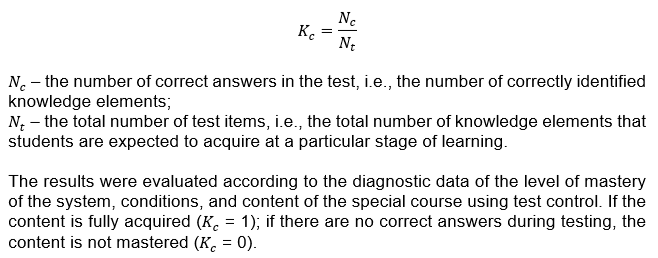

The overall indicator of the effectiveness of the entire system is considered to be the integrated indicator, which was determined before the beginning of the formative stage of the study as the difference between the total formation of the levels of educational activity and after its completion.
The effectiveness of the system, conditions, and special course was determined as the weighted average value, according to three degrees of importance of the components, of all efficiency indicators that determine the value of the integrated (general) indicator:
-High weight coefficient (k1 = 3 points).
-Medium weight coefficient (k2 = 2 points).
-Low weight coefficient, the least important (k3 = 1 point).
In this regard, the formula was used:

The first statistical alternative partial hypotheses for determining the effectiveness of the developed and implemented system, pedagogical conditions, and a special course for the formation of pragmatic competence of students using digital resources when learning a foreign language were defined as follows:
Н0 – a substantiated and developed system, pedagogical conditions and a special course using digital resources when learning a foreign language do not allow the formation of an appropriate level of pragmatic competence;
Н1 – a substantiated and developed system, pedagogical conditions and a special course using digital resources when learning a foreign language allow the formation of an appropriate level of pragmatic competence.
We used one of the non-parametric criteria; in particular, the Pearson χ² criterion was chosen.
The results of the ascertaining stage of the experiment showed an insufficient level of formation of students' pragmatic competence, which made it possible to establish factors that influence the formation and development of students' pragmatic competence, outline a range of practical and theoretical problems, develop a system, determine and substantiate pedagogical conditions, and implement a special course.
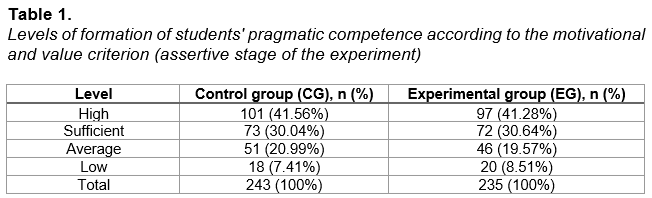
Results of the ascertaining stage of the experiment. To determine the
level of formation of students' pragmatic competence and the level of their
motivation according to the motivational and value criterion, we surveyed
students, the results of which are presented in Table 1:
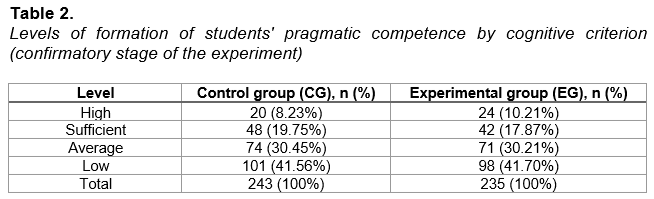
To determine the level of formation of students' pragmatic competence by cognitive criterion, we used student diagnostics (input, current, and output). The results of the assessment are presented in Table 2.
To determine the level of formation of students'
pragmatic competence according to the activity criterion, we used a package of
complex tasks to assess the levels of formation of the outlined competence. The
results of the assessment are presented in Table 3:
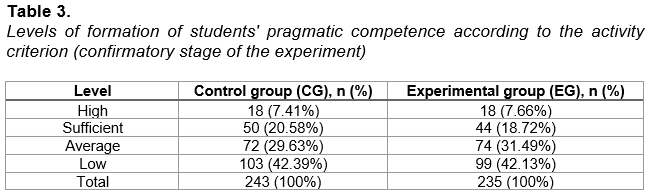
As can be seen from Tables 1-3, at the ascertaining stage, low and medium levels of pragmatic competence formation prevail among students according to all criteria.
Using the Pearson χ² criterion, the reliability of the obtained results was checked, in particular, to test the H0 hypothesis about the absence of differences between the two experimental (empirical) distributions: EG and CG.
χ²emp < χ²crit; therefore, we accept H0 – the null hypothesis that the initial level of pragmatic competence formation of students in the control and experimental groups does not differ significantly.
The results of the experiment showed that at the significance levels of 0.01 and 0.05 between the groups that directly participated in the experiment, there are no statistically significant differences in the level of pragmatic competence formation of students. This allows us to conclude about an equivalent and homogeneous contingent of students in the experimental and control groups.
The formative stage of the experiment. At the formative stage of the experiment, we outlined a range of practical and theoretical problems, developed a system for the formation of pragmatic competence, defined and justified pedagogical conditions, and implemented a special course.
A system for the formation of pragmatic competence was introduced into the educational process of the EG, which can be presented in general terms as a scheme of four consecutive milestones:
-Selection of units with pragmatic potential, formulation of the goal.
-Selection of approaches to learning and principles, theoretical justification of ways to develop students' pragmatic competence when learning a foreign language.
-Technological support using digital resources, selection of teaching aids and methods, etc.
-Assessment of the results of the formation of students' pragmatic competence when learning a foreign language.
Pragmatic meaning when studying a foreign language by EG students using digital resources was formed by various speech, language, and extra-linguistic means – by means of the language code of the phonological level (specificity of stress, special pronunciation, repetition of sounds), lexical-semantic level (professionalisms, dialectisms, non-normative words), morphological level (suffixes, pettiness, pettiness), syntactic level (special use of interjections, certain types of sentences, constructions), paralinguistic means (facial expressions, posture, facial expression, gestures), and speech means (intonation, tone, emphasis, pauses).
In the classes, we set the goal of teaching EG students to see and analyze pragmatic meanings as a manifestation of the speaker's intention. This was a primary task, carried out within the framework of the competency approach when studying a foreign language.
The development of pragmatic competence, regardless of the chosen teaching methods, was based on the principle of “input – interaction – output”, which aimed to:
-Perform exercises on the use of non-verbal means and necessary language means with a certain communicative conscious intention.
-Independent creation using the acquired pragmatic skills and knowledge of the act of communication.
-Familiarization with the text, audio, video plot – a real sample of speech, which contains an analysis of the communicative situation and pragmatic units.
Among the principles of the formation of pragmatic competence in EG, we have highlighted:
1.Step-by-step formation of pragmatic competence, where the principle of “input – interaction – output” lies. “Input” – familiarization with a speech sample, which includes an analysis of the communication situation and pragmatic units. “Interaction” – performing exercises with a specific communicative goal using the necessary linguistic/non-linguistic means. "Output" – independent creation of EG by students using pragmatic knowledge and skills of the act of communication;
2.Development of pragmatic awareness – the ability to use in various communication situations and recognize language tools and communicative strategies, taking into account their impact on the interaction of speakers, behavior, perception;
3.Explicit learning involves the teacher explaining, using digital resources, the rules for the conscious application and use of a specific pragmatic phenomenon by students during the performance of training exercises. Knowledge is reproduced according to the requirements of a specific speech situation and, using an explicit approach, is retained in the memory of students. Therefore, the development of students' English-language pragmatic competence using digital resources will be facilitated by step-by-step explicit learning and the development of students' conscious attitude to the studied speech and language units.
Using digital resources, EG students developed quizzes, online tests, and used auxiliary services such as JeopardyLabs, WordLearner, Kahoot, BrainFlips, etc. Digital resources in foreign languages are an effective tool for forming pragmatic competence.
The use of educational digital resources strengthened and increased the interest of EG students in learning a foreign language. The desire to obtain modern professional knowledge and motivation to study helped develop their pragmatic competence in a foreign language and, as a result, created a comfortable environment for modern learning.
Digital resources in the formation of students' pragmatic competence performed the following functions:
-Educational − with the help of digital resources, EG students practiced skills and used a large number of exercises with grammatical structures of a foreign language to automate actions.
-Informational, because digital resources fully provided EG students with material that included grammar rules, examples of typical errors, and suggested ways to avoid them.
-Motivational, because digital resources are a modern source of knowledge for EG students, which increases their interest in learning foreign languages.
-Visual, because digital resources provided EG students with illustrative material.
-Developing, because digital resources developed curiosity and interest, helped EG students in independent learning, and improved their knowledge of foreign language grammar.
EG students, in order to develop pragmatic competence in the context of studying a foreign language, had the opportunity to take various online tests in a foreign language. For example, they could check their level of a foreign language on sites such as EnglishLearner, Test-MyEnglish, OxfordEnglishTesting, BBC, LanguageLinN, as well as take tests in the ExamEnglish and A4ESL systems, which gave EG students the opportunity to prepare for international exams. At the same time, when studying a foreign language, interdisciplinary connections helped EG students expand the information space for the formation of pragmatic competence skills and foreign language communication.
CG students had the opportunity to create multimedia applications, collect and search for sources of professional information, use audio and video materials, electronic manuals (textbooks), electronic educational and methodological complexes, dictionaries, test tasks, webquests, educational blogs, individual communication projects, blogquests, which is an important component of the development of competencies of students of all specialties in foreign language classes.
In addition, digital resources provided EG students with the opportunity to contact colleagues in English-speaking countries, which ensured the participation of students in real situations, international scientific and technical conferences in English using interactive methods.
In EG, students used the following digital resources:
-Multimedia scrapbook – is a kind of collection of multimedia resources, which contains links to audio files, graphic information, text sites, photos, video clips, animated virtual tours.
-Treasure hunt – contains links to various sites on the topic being studied and directs search activities.
-Subject sampler – contains links to text and multimedia materials on the Internet, aimed at discussing debatable and socially sensitive topics, provides an opportunity to argue and express one’s own opinion on a discussion issue.
-Webquest – a scenario for organizing students’ project activities on any topic using Internet resources.
In order to study a foreign language in a structured way and develop pragmatic competence when studying a foreign language using digital resources, EG students used such publicly accessible educational platforms as: FutureLearn, Coursera, edX, Prometheus, Udemy, EdEra, which offered courses on English teaching methods, intercultural communication, academic writing, and also contained interactive video courses.
To study grammar and vocabulary, reading and listening skills, EG students used digital platforms such as LearningApps, Duolingo, Busuu, Blooke, Wordwall, Quizlet, Kahoot, and Memrise, which offered gamification in combination with classical study of the material.
Among the digital professional platforms for learning a foreign language, EG students were offered: Macmillan Education, Oxford University Press, Educational Testing Service, National Geographic Learning.
Students liked the use of communicative practice platforms: Italki, Speaky, Conversation Exchange, Tandem, HelloTalk, Mizou, Replika, TalkPal AI, which improve listening and intercultural communication skills.
For discussions, interactive classes, and debates, digital platforms such as Viber, Google Meet, Zoom, Microsoft Teams, and WhatsApp were also used.
For the development of critical thinking, the most effective digital platforms for learning a foreign language were: BBC Learning English, TED Talks, Cambridge English, VOA Learning English, British Council, Test English.
In the formation of academic writing skills, the development of reflection was supported by AI-based digital platforms (DeepL Write, ChatGPT, Grammarly, Gemini, QuillBot).
So, an innovative system for the formation of pragmatic competence of students was introduced into the educational process of EG, and we identified pedagogical conditions:
-Formation of positive motivation for mastering pragmatic competence of students in the process of their professional training.
-Updating the content of students' training by introducing a special course "Formation of pragmatic competence of students using digital resources in learning a foreign language".
-Creation of a digital environment of higher education in order to improve the practical training of students.
Analysis of the results of the formative stage of experimental work.
At the formative stage of the experiment, the level of formation of pragmatic competence of students was assessed similarly to the ascertaining stage of the experiment according to criteria (motivational-value, cognitive, and activity).
Assessment of motivation (motivational-value criterion) for professional training through the formation and development of students' pragmatic competence was carried out using a questionnaire, the results of which allowed determining the real professional interest of students in the specialty and their interest in studying the material.
To compare the survey results in the EG and CG regarding the level of development of students' pragmatic competence, their values, self-motivation, and self-reflection, the Pearson criterion was used – the χ² criterion:The formula was used:
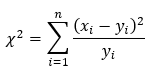
If the results of the ascertaining stage of the experiment showed that the development of the motivational and value component of the experimental and control groups is approximately the same and is mainly at a low and medium level, then as a result of the approbation of the system, justified pedagogical conditions, special course, the formative stage of the experiment showed a change in the level of formation of the motivational and value component in both the experimental and control groups. We observe a noticeable increase in motivational and value factors important for the formation of pragmatic competence of students and the general preparation of future specialists for professional activity in students of the experimental groups.
The results of the assessment at the formative stage of the experiment of the levels of formation of pragmatic competence of students by the motivational and value criterion are presented in Table 4.
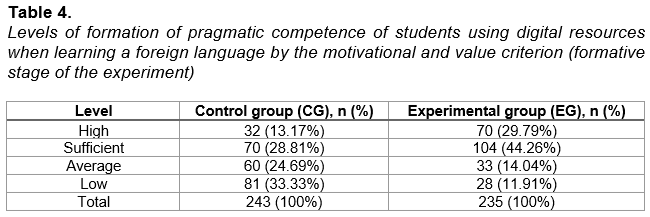
To compare the distributions of students' pragmatic competence levels between the experimental and control groups after the formative stage, Pearson's chi-square test was applied. For the motivational-value criterion, the analysis demonstrated statistically significant differences between the groups, χ²(3, N = 478) = 31.57, p < .001, with a small-to-moderate effect size (Cramer's V = 0.257). These results indicate that students in the experimental group achieved significantly higher levels of pragmatic competence than those in the control group.
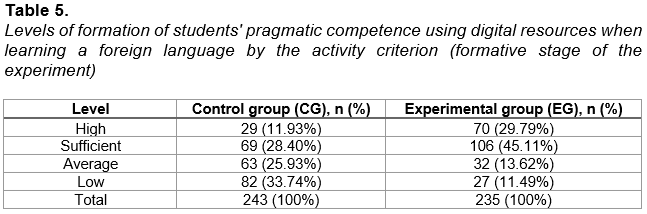
The results of assessing students' pragmatic competence according to the activity criterion are presented in Table 5.
The results of assessing the levels of formation of students' pragmatic competence using digital resources when learning a foreign language after the formative stage of the experiment by the cognitive criterion are presented in Table 6, which were obtained similarly to the activity criterion.
For the activity criterion, Pearson's chi-square test also revealed statistically significant differences between the experimental and control groups, χ²(3, N = 478) = 34.89, p < .001. The effect size was Cramer's V = 0.270, indicating a small-to-moderate practical effect of the implemented pedagogical intervention.
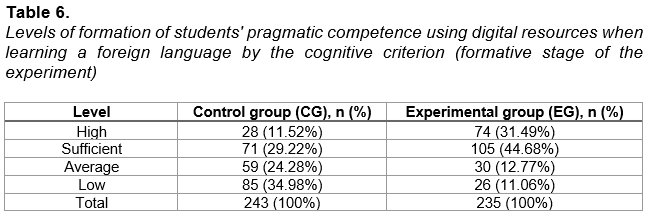
As the results of Tables 4-6 show, after the formative stage of the experiment, the indicators of the high level of formation of pragmatic competence of students using digital resources when learning a foreign language significantly increased in EG students; respectively, the indicators of the low level significantly decreased. In CG, these changes are not significant.
For the cognitive criterion, the difference between the experimental and control groups was statistically significant, χ²(3, N = 478) = 39.99, p < .001, with Cramer's V = 0.289. These findings confirm that the implementation of the proposed pedagogical system significantly improved students' pragmatic competence compared with the traditional instructional approach.
We checked the probability of the obtained results to test the hypothesis H1, using the Pearson criterion, in particular, the difference between the two experimental (empirical) distributions: CG and EG.
The obtained results (χ²emp > χ²crit) are significant at the level of 5% and 1%; therefore, the null hypothesis is rejected. The alternative hypothesis H1 is accepted at a high level of significance, that the level of formation of pragmatic competence of respondents in the experimental and control groups differs significantly, which indicates the effectiveness of the introduction of the author's system for the formation of pragmatic competence, justified pedagogical conditions, and a special course.
The results of the formative stage of the experiment confirmed the effectiveness of the developed system for the formation of pragmatic competence using digital resources in learning a foreign language, the proposed and substantiated pedagogical conditions, and the developed and implemented special course. This gives grounds to assert that the goal of the study has been achieved.
The diagnostic instruments were adapted from previously validated questionnaires reported in the literature and selected according to the objectives of the study. The items were reviewed for their relevance to the components of pragmatic competence (motivational, cognitive, and activity). Therefore, the study relied on instruments with previously established validity rather than conducting an independent psychometric validation.
The findings of the present study confirm that the systematic integration of digital educational resources into foreign language instruction contributes to the development of students' pragmatic competence. Following the implementation of the proposed pedagogical intervention, students in the experimental group demonstrated significantly higher levels of motivational, cognitive, and activity-related components of pragmatic competence than those in the control group. These findings support previous studies that emphasize the positive impact of technology-enhanced language learning on authentic communication and pragmatic development (Belda-Medina & Calvo-Ferrer, 2022).
The obtained results are consistent with research indicating that digital technologies create authentic communicative environments in which learners can practice speech acts, receive immediate feedback, and develop sociopragmatic awareness through meaningful interaction. Similarly, Jin et al. (2025) reported that technology-supported instruction enhances learners' ability to interpret and produce contextually appropriate utterances, particularly in intercultural communication. The present findings extend these conclusions by demonstrating that the effectiveness of digital resources increases when they are integrated into a comprehensive pedagogical system rather than used as isolated instructional tools.
The results also corroborate previous evidence regarding the educational potential of artificial intelligence and conversational technologies. Belda-Medina and Calvo-Ferrer (2022) found that AI-based conversational agents increase learner engagement and provide personalized opportunities for communicative practice. Likewise, the present study suggests that digital educational resources facilitate students' active participation in foreign language learning and promote the practical application of pragmatic knowledge in authentic communicative situations.
At the same time, the findings differ from some previous studies that evaluated the effectiveness of individual digital applications or short-term instructional interventions. Whereas many earlier investigations focused primarily on vocabulary acquisition, grammar instruction, or isolated pragmatic skills, the present research examined a comprehensive instructional model combining digital resources, pedagogical conditions, and structured learning activities. This integrated approach may explain the broader improvements observed across all components of pragmatic competence.
Despite these positive findings, several methodological limitations should be acknowledged. The study employed a quasi-experimental design, and the assessment relied primarily on questionnaire-based measures. Furthermore, the diagnostic instruments were adapted from previously published studies but did not undergo independent psychometric validation within the present research. Consequently, the results should be interpreted with caution. Future studies should incorporate validated performance-based assessment instruments, longitudinal research designs, and independent measures of pragmatic competence to strengthen the evidence base and improve the generalizability of the findings.
Overall, the findings contribute to the growing body of research on technology-enhanced foreign language learning by demonstrating that the systematic integration of digital educational resources can effectively support the development of pragmatic competence among university students. At the same time, they highlight the need for further experimental studies examining the long-term effectiveness of digitally supported pedagogical models across different educational contexts.
Conclusions
The content and components of students' pragmatic competence in learning a foreign language are revealed. The content of sociopragmatic and pragmalinguistic competence is substantiated. The main principles of students' pragmatic competence in learning a foreign language are grouped, and the directions of studying pragmatic phenomena are shown. The main tasks of digital resources that ensure the development of pragmatic competence are identified in terms of content.
The task of the scientific research is the formation and development of students' pragmatic competence using digital resources in learning a foreign language. The study made it possible to determine students' pragmatic competence as the basis for successful professional adaptation and the process of their professionalization, and to identify its components, criteria, indicators, and levels of formation.
Using a specially organized experiment, an experimental study was conducted to determine the effectiveness of implementing the developed system for the formation of pragmatic competence using digital resources in learning a foreign language, the proposed and substantiated pedagogical conditions, and the developed and implemented special course.
The experiment was based on the hypothesis that the formation and development of students' pragmatic competence when learning a foreign language using digital resources, as a developmental process, will be effective if such an innovative system for the formation of students' pragmatic competence when learning a foreign language using digital resources and the pedagogical conditions we have identified are introduced into the process of preparing students for professional activity, and a special course is implemented.
During 2022-2025, an experimental study was conducted, which covered the following stages of the experiment: search, ascertainment, and formative. 478 students were involved in the experimental work. An experimental (EG – 235 students) group and a control (CG – 243 students) group were formed.
The assessment of the level of formation of pragmatic competence was based on three components: motivational and value; cognitive; activity.
To determine pragmatic competence, a diagnostic tool was developed, and indicators of each component were determined. We used one of the non-parametric criteria; in particular, the Pearson χ² criterion was chosen.
The results of the ascertaining stage of the experiment showed an insufficient level of formation of pragmatic competence of students, which made it possible to establish factors that influence the formation and development of pragmatic competence of students, outline a range of practical and theoretical problems, develop a system, determine and substantiate pedagogical conditions, and implement a special course. At the ascertaining stage, low and medium levels of formation of pragmatic competence prevailed among students according to all criteria. Using the Pearson χ² criterion, the reliability of the obtained results was checked, in particular, to test the H0 hypothesis about the absence of differences between the two experimental (empirical) distributions: EG and CG. χ²emp < χ²crit; therefore, we accept the H0 − null hypothesis that the initial level of formation of pragmatic competence of students of the control and experimental groups does not differ significantly. This allows us to conclude about an equal and homogeneous contingent of students of the experimental and control groups. At the formative stage of the experiment, the level of formation of pragmatic competence of students was assessed similarly to the ascertaining stage of the experiment according to the criteria (motivational-value, cognitive, and activity).
To compare the results of the survey in the EG and CG regarding the level of formation of students' pragmatic competence, their values, self-motivation, and self-reflection, the Pearson criterion was used – the χ² criterion:After the formative stage of the experiment, the indicators of the high level of formation of students' pragmatic competence using digital resources when learning a foreign language significantly increased in EG students; respectively, the indicators of the low level significantly decreased. In the CG, these changes are not significant. We checked the probability of the obtained results to test the hypothesis H1, using the Pearson criterion, in particular, about the difference between the two experimental (empirical) distributions: CG and EG. The obtained results are significant (χ²emp > χ²crit) at the level of 5% and 1%; therefore, the null hypothesis is rejected. The alternative hypothesis H1 is accepted at a high level of significance: the level of formation of pragmatic competence of respondents in the experimental and control groups differs significantly, which indicates the effectiveness of the introduction of the author's system for the formation of pragmatic competence, justified pedagogical conditions, and a special course.
Thus, the results of the formative stage of the experiment confirmed the effectiveness of the developed system for the formation of pragmatic competence using digital resources in learning a foreign language, the proposed and justified pedagogical conditions, and the developed and implemented special course. This gives grounds to assert that the goal of the study has been achieved.
Further scientific explorations consist of developing pedagogical conditions for the integration of digital platforms into the educational process of higher education institutions in order to form the cognitive orientation of students in the context of blended and distance learning.