
Artículo de investigación
Herramientas digitales interactivas para el desarrollo de la competencia profesional de los estudiantes universitarios
Interactive digital tools for developing university students' professional competence
Recibido: · Aceptado: · Publicado:
Cómo citar: Romanyshyna, O., Stepanov, M., Antonov, Y., Konstantynenko, L., & Ieresko, O. (2026). Interactive digital tools for developing university students' professional competence. Revista Eduweb, 20(3), 296–317. https://doi.org/10.46502/issn.1856-7576/2026.20.03.17
Resumen
El artículo examina la efectividad de las herramientas digitales interactivas en el desarrollo de la competencia profesional de los estudiantes universitarios. El estudio analiza el potencial y las limitaciones de las plataformas digitales integradas en el entorno educativo digital de la universidad y fundamenta las condiciones pedagógicas para su uso sistemático en la formación profesional. Se realizó un estudio cuasiexperimental con 188 estudiantes de primer año de universidad, que incluyó un grupo experimental (GE; n = 93) y un grupo de control (GC; n = 95). En la etapa inicial, la mayoría de los estudiantes de ambos grupos demostraron un bajo nivel de competencia profesional, lo que confirmó la necesidad de una intervención pedagógica específica. Durante la etapa formativa, el grupo experimental participó en un curso especial impartido por el autor y en un sistema de condiciones pedagógicas que incluía la integración sistemática de herramientas digitales interactivas, aprendizaje colaborativo, comunicación digital, actividades independientes y evaluación interactiva, mientras que el grupo de control continuó sus estudios según el enfoque educativo tradicional. En la etapa de control, el grupo experimental demostró proporciones sustancialmente mayores de estudiantes con un alto nivel de competencia profesional en todos los criterios evaluados. Según el criterio cognitivo, el 60,22% de los estudiantes del grupo experimental (GE) alcanzó un nivel alto, en comparación con el 13,68 % del grupo de control (GC); según el criterio de actividad operativa, las proporciones correspondientes fueron del 59, 14% y del 18,95%; y según el criterio personal, del 53,76% y del 17,89%, respectivamente. La Figura 1 también muestra mayores incrementos en la proporción de estudiantes con un nivel alto en el GE en todos los criterios. Estos hallazgos indican que la integración pedagógica sistemática de herramientas digitales interactivas se asoció con mejoras sustancialmente mayores en la competencia profesional en el grupo experimental que en el grupo de control.
Palabras clave: herramientas digitales interactivas; la formación de competencias profesionales de los estudiantes; universidades; plataformas digitales; entorno educativo digital.
Abstract
The article examines the effectiveness of interactive digital tools in developing the professional competence of university students. The study analyzes the potential and limitations of digital platforms integrated into the university's educational digital environment and substantiates pedagogical conditions for their systematic use in professional training. A quasi-experimental study was conducted with 188 first-year university students, including an experimental group (EG; n = 93) and a control group (CG; n = 95). At the ascertaining stage, the majority of students in both groups demonstrated a low level of professional competence, confirming the need for targeted pedagogical intervention. During the formative stage, the experimental group participated in an author's special course and a system of pedagogical conditions involving the systematic integration of interactive digital tools, collaborative learning, digital communication, independent activities, and interactive assessment, whereas the control group continued studying according to the traditional educational approach. At the control stage, the experimental group demonstrated substantially higher proportions of students with a high level of professional competence across all assessed criteria. According to the cognitive criterion, 60.22% of EG students achieved a high level compared with 13.68% in CG; according to the activity-operational criterion, the corresponding proportions were 59.14% and 18.95%; and according to the personal criterion, 53.76% and 17.89%, respectively. Figure 1 also demonstrated greater increases in the proportion of students with a high level in EG across all criteria. These findings indicate that the systematic pedagogical integration of interactive digital tools was associated with substantially greater improvements in professional competence in the experimental group than in the control group.
Keywords: interactive digital tools; the formation of professional competence of students; universities; digital platforms; educational digital environment.
Introduction
The digital transformation of higher education has substantially changed the requirements for university students' professional preparation. Contemporary specialists are expected not only to possess disciplinary knowledge but also to communicate effectively in digital environments, collaborate through digital platforms, evaluate and process information, and apply digital technologies to professional tasks. Consequently, professional competence increasingly incorporates the ability to use digital tools purposefully, critically, and independently rather than merely demonstrate technical proficiency. Previous studies have emphasized the relationship between digital competence, professional activity, communication, and learning outcomes, as well as the importance of creating educational environments that support meaningful digital interaction (Aagaard & Lund, 2020; Dang et al., 2024; Fernández-Batanero et al., 2022).
However, the institutional problem addressed in the present study is more specific than the general digitalization of higher education. The initial diagnostic stage conducted among 188 first-year university students revealed insufficient development of professional competence in both the experimental and control groups. In particular, a low level was identified for 61.29% of students in the experimental group and 61.05% in the control group according to the cognitive criterion, indicating insufficient professional knowledge and mastery of relevant terminology. Similarly, a low level according to the activity-operational criterion was observed in 62.37% and 62.11% of students, respectively, indicating insufficient ability to perform professional tasks and apply digital tools systematically in professional learning activities. The personal criterion also demonstrated predominantly low results, accounting for 60.22% of students in the experimental group and 60.00% in the control group. These findings indicate that the problem was not simply limited access to digital technologies; rather, students experienced difficulties in transforming available digital resources into professional knowledge, practical skills, communication abilities, and professionally important personal qualities.
This situation also points to a limitation of approaches in which digital technologies are introduced primarily as additional technical resources without a coherent pedagogical framework. The use of individual platforms, multimedia materials, online communication tools, or digital assessment services does not automatically ensure the development of professional competence (Guillén-Gámez et al., 2023). Effective integration requires pedagogical support, purposeful learning activities, opportunities for collaboration and independent work, and a safe digital educational environment (Palshkov et al., 2026). The literature similarly indicates that professional digital competence depends on contextual and pedagogical conditions rather than on technological access alone (Carpenter et al., 2024; Ifenthaler & Egloffstein, 2020; Lindfors et al., 2021). Thus, the relevant educational problem is how to organize the systematic use of interactive digital tools so that they become an integral component of professional preparation rather than an isolated technological supplement.
Interactive digital tools provide a potentially appropriate response to this problem because they can combine several dimensions of professional learning within a single educational environment. Synchronous and asynchronous communication platforms can support professional dialogue and feedback; collaborative digital environments can facilitate teamwork and joint problem solving; interactive exercises and gamified activities can increase students' involvement; multimedia and visualization tools can support the understanding and presentation of professional content; and digital assessment tools can provide opportunities for continuous monitoring of learning outcomes. Research on digital competence and digital transformation has demonstrated the educational potential of such tools, while also emphasizing the need for their pedagogically justified integration into teaching and learning (López Simó et al., 2020; Pedersen et al., 2024; Zadorina et al., 2024).
The theoretical basis of the proposed intervention is therefore grounded in the systemic, competency-based, and student-oriented approaches to professional preparation. Within this framework, professional competence is considered as an integrated construct that includes cognitive knowledge, activity-operational skills, and professionally important personal qualities, with digital competence functioning as an important component of professional readiness for contemporary professional activity. This conceptualization is consistent with the study's assessment framework, which distinguishes cognitive, activity-operational, and personal criteria and evaluates their formation at high, medium, and low levels. The intervention consequently focuses not on the introduction of particular technologies for their own sake but on the purposeful integration of interactive digital tools into professional learning activities.
A further research gap concerns the limited empirical substantiation of how a systematically organized combination of interactive digital tools, pedagogical conditions, and specially designed instructional content can influence different dimensions of university students' professional competence. Existing research has established the importance of digital competence and described individual technologies or digital learning practices, but further empirical evidence is needed regarding the effectiveness of an integrated pedagogical system that connects digital tools with professional tasks, collaborative interaction, active learning, independent work, and structured assessment. The present study addresses this gap by examining an intervention that combines an author's special course, pedagogical conditions, and systematic use of interactive digital tools within the university's digital educational environment. The intervention included different models of student–teacher interaction, collaborative and independent activities, interactive assessment, project-based learning, gamification, multimedia resources, and other digital learning technologies.
Accordingly, the purpose of this study was to assess the effectiveness of a pedagogically structured integration of interactive digital tools in developing the professional competence of university students.
The study specifically examined whether the implementation of the proposed pedagogical system, special course, and pedagogical conditions would result in higher levels of professional competence among students in the experimental group compared with those following the traditional educational approach.
Literature Review
In the modern conditions of digitalization of education, to form the professional competence of students, the use of digital interactive tools is the focus of attention of scientists, both in the practical aspects of the introduction of digital technologies into the professional training of specialists and in the theoretical and methodological principles of the digital transformation of the educational process.
The work of Dang et al. (2024) substantiates the impact of digital competence of specialists on the learning outcome and on the development of their communication skills. Other scientists, Zadorina et al. (2024), analyze the role of artificial intelligence in creating a personalized educational environment, which provides new formats for educational interaction.
Ifenthaler and Egloffstein (2020) propose a model of digital maturity of students for the use of digital interactive tools, within the practical aspects of the implementation of digital technologies and outlining the importance of digital transformation for the formation of digital competence of education seekers.
López Simó et al. (2020) pay attention to the formation and development of ICT competence and digital competence when transferring education to a blended and distance format, during classroom and extracurricular work in the process of studying STEM disciplines, which is closely related to digital tools.
González-Rodríguez and Urbina-Ramírez (2020) reveal the role of ICT in the future activities of applicants and present the digitalization of studying STEM disciplines, provide innovative tasks for students to encourage them to form research digital competence, which takes into account factors such as enjoyment of technology and motivation, the quality of resources, which is not limited to knowledge, skills in the scientific process for managing digital resources.
Thus, the analysis of publications confirms the relevance of studying the use of interactive digital tools and platforms for the formation of professional competence of university students. Existing approaches in the context of modern challenges and needs of the educational industry require further generalization and improvement.
Research purpose: to assess the effectiveness of using interactive digital tools for the formation of professional competence of university students.
Methodology
Research Design
The study employed a quasi-experimental research design to investigate the effectiveness of interactive digital tools in developing the professional competence of university students. The research was based on the hypothesis that systematicallyintegrating interactive digital tools into the university digital educational environment, supported by appropriate pedagogical conditions and a specially designed instructional system, would significantly enhance students' professional competence.
The research combined theoretical, empirical, and statistical methods and was conducted in three consecutive stages: ascertaining, formative, and control.
Participants
The experimental study involved 188 first-year university students. The participants were divided into a control group (CG;n= 95) and an experimental group(EG;n= 93). The slight difference in the number of participants between the groups did not affect the validity or representativeness of the experimental results. Both groups participated in the study throughout the entire experimental period, while the experimental group received the educational intervention based on the proposed pedagogical system.
Research Methods
The study employed theoretical, empirical, and statistical research methods.
Theoretical methods included systematic analysis, comparison, generalization, systematization, specification, and instructional design. These methods were applied to analyze psychological, pedagogical, and methodological literature, clarify the conceptual framework of the study, and substantiate the pedagogical conditions for developing students' professional competence through interactive digital tools.
Empirical methods included questionnaires, pedagogical observation, interviews, and a pedagogical experiment. These methods were used to assess students' professional competence before and after the educational intervention and to evaluate the effectiveness of the developed pedagogical system and the author's special course.
Assessment Framework
Students’ professional competence was assessed using an integrated diagnostic framework comprising three criteria: cognitive, activity-operational, and personal. The cognitive criterion reflected the level of students’ professional knowledge, understanding of relevant concepts and terminology, and ability to apply theoretical knowledge in professional contexts. The activity-operational criterion concerned students’ ability to perform professional tasks, apply digital tools, solve practical problems, and independently organize professional activities. The personal criterion reflected professionally important qualities, including motivation, communication, responsibility, emotional stability, and readiness for professional interaction.
The assessment framework combined several sources of evidence, including pedagogical observation, interviews, and questionnaire-based assessment. The results were aggregated into three levels of professional competence: high, medium, and low. The level classification was based on predefined indicators associated with each criterion and was applied consistently at the ascertaining and control stages.
Because the available research dataset contains aggregated criterion-level results rather than individual item-level responses, internal-consistency coefficients such as Cronbach’s alpha and KR-20 could not be calculated retrospectively. Therefore, the present study does not claim psychometric reliability of the questionnaire scales. Instead, the assessment framework was grounded in theoretically defined criteria and indicators and applied consistently across the experimental and control groups.
Research Instruments
The study employed a structured assessment framework consisting of pedagogical observation, interviews, and questionnaire-based procedures. These instruments were used to obtain complementary information concerning students’ professional knowledge, practical performance, motivation, communication, and professionally important personal qualities. The assessment indicators were defined in accordance with the cognitive, activity-operational, and personal criteria established for the study.
The available dataset was retained in aggregated form at the criterion and competence-level categories. Consequently, item-level psychometric analysis was not possible, and coefficients of internal consistency, including Cronbach’s alpha or KR-20, were not calculated. This limitation is explicitly acknowledged because reliability coefficients require access to individual responses to the respective questionnaire items. Future studies should include item-level datasets and conduct formal reliability and validity analyses, including internal-consistency assessment and, where appropriate, exploratory or confirmatory factor analysis.
Experimental Procedure
The experimental research consisted of three consecutive stages.
During theascertaining stage, diagnostic instruments were selected, students were assigned to the experimental and control groups, and the initial level of professional competence was assessed.
During theformative stage, the proposed pedagogical system was implemented in the educational process of the experimental group. The intervention included the introduction of an author's special course and the implementation of pedagogical conditions designed to enhance students' professional competence through the systematic use of interactive digital tools within the university's digital educational environment.
The intervention emphasized three complementary models of student–teacher interaction based on the characteristics of educational communication: synchronicity versus diachronicity, communication types and channels, and individual versus collaborative learning. Interactive digital platforms, online communication tools, collaborative technologies, and other digital educational resources were integrated into learning activities to promote students' professional knowledge, practical skills, collaboration, and independent learning.
The control group continued studying according to the traditional educational approach without the targeted implementation of the proposed pedagogical system and pedagogical conditions.
During thecontrol stage, students' professional competence was reassessed using the same diagnostic instruments applied during the ascertaining stage. The obtained results were compared with the initial measurements to determine changes in the level of professional competence following the educational intervention.
Data Analysis
The collected data were analyzed using qualitative, quantitative, and statistical methods. Descriptive statistics were applied to determine the distribution of students according to the established levels of professional competence and to evaluate changes observed during the experimental study.
The statistical significance of differences between the experimental and control groups was determined using Pearson's chi-square (χ²) test. The null hypothesis (H₀) assumed that no statistically significant differences existed between the empirical distributions, whereas the alternative hypothesis (H₁) assumed the presence of statistically significant differences. Statistical significance was determined atp< .05.
Ethical Considerations
The study was conducted in accordance with the ethical principles governing educational research. Participation in the experiment was voluntary, and all participants were informed about the purpose, procedures, and expected outcomes of the study before providing informed consent. Participants' anonymity and confidentiality were maintained throughout the research process, and the collected data were used exclusively for scientific purposes. Participants were informed of their right to withdraw from the study at any stage without any negative consequences.
Results and Discussion
Content and significance of interactive digital tools for the formation of professional competence of university students.
In the process of professional training of specialists, increasing the share of digital content is a positive step: familiarizing oneself with digital technologies and tools fully corresponds to modern trends in the development of professional activity and various areas of science.
The formation of professional competence in university students is an integral part of their professional training for education seekers, since the ability to argue and present one's own thoughts, interact effectively, and engage in dialogue determines the competitiveness of the future specialist in the labor market. Professional competence includes the ability to use interactive digital tools to form students' professional competence in accordance with the situations of the professional context and the requirements of the digital society (García Chamorro & Rolong Gamboa, 2025).
The digital environment and interaction tools in it open up new opportunities for the development of professional skills, team interaction, and information analysis (Aagaard & Lund, 2020).
Analysis of the capabilities and limitations of digital platforms that are actively integrated into the educational digital environment. The most popular digital educational resources that can be effectively used to form the professional competence of university students.
During classes using interactive digital tools, in particular the Zoom or Padlet platforms, education students actively participate in discussions, which contributes to the development of group work and public speaking skills. Students' technical and communication skills are formed by participation in joint projects – active listening, argumentation, mutual respect. Digital tools must allow you to create a digital, communicative, safe environment where each person has the opportunity to express themselves, receive feedback, and gradually overcome communication barriers. The integration of chats and forums, gamification, and multimedia content increases participants' interest in the educational process and contributes to diversifying ways of interaction(Fernández-Batanero et al., 2022).
Thus, digital technologies form a new paradigm of digital culture, and not only expand the space of educational communication, but also contribute to open and adaptive changes in the digital society. In this context, for the active integration of students into the educational digital environment, the analysis of the limitations and opportunities of increasingly developed digital platforms becomes particularly relevant (Carpenter et al., 2024).
Digital platforms transform approaches to interaction between all participants in the educational process, communication, and learning. However, despite the obvious advantages for education and professional activity, digital platforms open up new horizons. However, their effective implementation requires digital culture, pedagogical support, a conscious approach to organizing the educational process, and not just technical support. For digital technologies to become a truly effective tool for the formation of university students' professional competence, it is necessary to provide a pedagogically sound, holistic digital environment for their application. The effectiveness of such activities largely depends on a set of favorable factors (Lindfors et al., 2021).
Among the most popular digital educational resources that can be effectively used to form the professional competence of university students in the training of future specialists are such tools as:
Canva – a powerful tool for creating visual content – educational materials, infographics, presentations, which contributes to the development of creativity of future specialists.
LearningApps helps create interactive exercises and games that can be adapted to professional activities or for students to consolidate theoretical material.
Kahoot! – through game elements stimulates motivation, which makes the educational process more interactive and dynamic.
Padlet – a convenient platform for ensuring student teamwork, creating joint projects, and exchanging ideas, which is important for the formation of students' professional competence.
Genially – offers a wide range of tools for creating educational resources and multimedia presentations using interactive elements and animation (Pedersen et al., 2024).
Experimental testing of the effectiveness of using digital interactive tools to form the professional competence of university students. Experimental work on the formation of professional competence in students was carried out in stages: The ascertaining stage involved selecting diagnostic tools, allocating a control group and an experimental group, and identifying the initial level of professional competence formation in students.
The formation stage involved the substantiation of the system, the implementation of an author's special course, and the identification of pedagogical conditions for the formation of professional competence in students and their introduction into the educational process of EG students.
The control stage involved the identification of the level of professional competence formation in students after the implementation of the system, the implementation of an author's special course and pedagogical conditions, and the determination of the effectiveness of their implementation, and the comparison of the results obtained with the initial results based on the results of pedagogical diagnostics.
The study identified criteria, indicators, and levels of professional competence formation in students.
The cognitive criterion reflects the mental and intellectual side of students' professional competence – a set of structured and organized scientific information that remains in the memory of the future specialist and allows establishing interdisciplinary connections between different processes and phenomena based on the formed professional thinking of the individual. Indicators of the cognitive criterion: assimilation of the system of knowledge and terminology by students in professional disciplines:
The activity-operational criterion reflects the level of specialized and fundamental, professional and applied preparedness in students; formation as future competitive specialists, their professional skills and abilities of professional activity, which are manifested in the speed and number of completed professional tasks, in the independence of their solution and the originality of the approach to them. Indicators of the activity-operational criterion – a certain level of ability to perform professional tasks and the development of skills in educational and content blocks of professional disciplines (the ability to solve professional tasks by creating digital applications; use elements of artificial intelligence, practical tasks of computer logic and structural theory of digital automata; use original, innovative methods and traditional and forms of work with purposeful, constant, systematic use of digital tools to form professional competence; classify problems of implementing information processes; perform a comparative analysis of various professional solutions; use the principle of program control to organize computational processes in a computer, etc.)
The personal criterion characterizes the personality of the future specialist as a specialist in students, reflects the formation of professional, professionally important qualities (communicative, intellectual, digital, moral, strong-willed, the ability to interact and cooperate with a team (group), with people; the ability to solve professional and social tasks; compliance with group (social), ethical, general cultural, norms and rules). Indicators of the personal criterion are manifested in the development of professionally important qualities: moral (decency, compliance with ethical rules, openness, honesty, attentiveness); digital (working with digital technologies in the digital environment of the university); communicative (overcoming barriers to communication, interaction and communication, ability to establish contact, tolerance); cognitive (creativity, volume and efficiency of memory, perception, analytical skills, flexibility of thinking using digital technologies); emotional and volitional (perseverance, professional determination, responsibility, discipline, organized self-control).
The use of the specified set of indicators allows for quantitative and qualitative assessment of the levels of formation of professional competence of specialists in a comprehensive manner. Accordingly, the levels characterizing the degree of formation of professional competence of students are determined: high, medium, low.
Thus, the specified criteria and indicators are the basis for experimental verification of the effectiveness of the system, the introduced author's special course, and pedagogical conditions for the formation of professional competence of students.
To determine the initial level of formation of professional competence of students, we used methods (observation, interviews) and questionnaires.
Statistical significance was assessed using Pearson's chi-square (χ²) test. The chi-square statistic was calculated as:
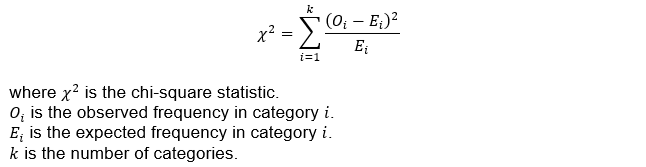
For the statistical analysis, Pearson’s chi-square (χ²) test was used to examine whether the distributions of students across the competence levels differed significantly between the experimental and control groups. The significance level was set at α = 0.05. The calculated χ² value was compared with the corresponding critical value based on the appropriate degrees of freedom. The null hypothesis (H₀) stated that there were no statistically significant differences between the distributions of competence levels in the experimental and control groups, whereas the alternative hypothesis (H₁) stated that statistically significant differences existed between the groups. The null hypothesis was rejected when the calculated χ² value exceeded the critical value at α = 0.05; otherwise, there was insufficient evidence to reject H₀. Effect size was additionally evaluated using Cramér’s V to assess the magnitude of the observed differences.
For conducting an ascertaining experiment, the choice of the above-mentioned methods is due to:
-Validity and content compliance with the research objectives of the method.
-Accessibility in the implementation, interpretation, and evaluation of the research results.
-The possibility of use in the university educational process.
The ascertaining stage of the experiment involved determining the initial level of formation of students' professional competence.
First-year students participated in the pedagogical experiment. 188 students were involved: 95 people made up the control group, 93 people – the experimental group.
The difference in the number of respondents between the control (n = 95) and experimental (n = 93) groups was minimal and did not affect the validity or representativeness of the study. The representativeness of the obtained data was ensured by the sample size of both groups. The following methods determined the composition of the experimental and control groups:
-Nested sampling (not only individual respondents were the units of the study, but also collectives (study groups – in our case) with further selection of respondents.
-Quota sampling (respondents were selected for the control and experimental groups in compliance with quotas: first year of study, the same direction of training).
The generalized results of the formation of professional competence of university students by the cognitive criterion at the ascertaining stage of the study are given in Table 1.
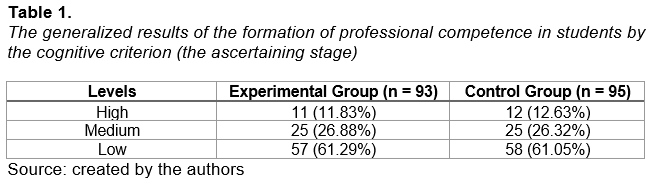
The generalized results of the study indicate that in CG and EG students, the formation of professional competence according to the cognitive criterion is mainly low (61.29% and 61.05%, respectively), that is, it is characterized by an insufficient amount of professional knowledge, mastery of terminology, which requires the improvement of students' educational activities through the use of interactive digital tools in the created digital environment of the university for the formation of students' professional competence.
The generalized results of the formation of professional competence of university students at the ascertaining stage of the study according to the activity-operational criterion are given in Table 2.
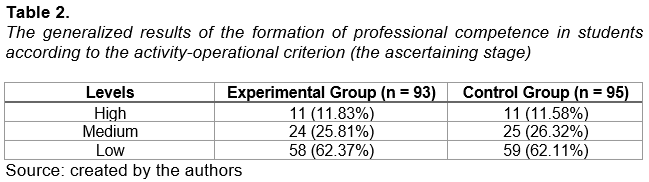
The generalized results of the study indicate that among students of the CG and EG, the formation of professional competence according to the activity-operational criterion is dominated by a low level (62.37% and 62.11%, respectively), that is, it is characterized by an insufficient level of skills to perform professional tasks, the development of skills in educational and content blocks of professional disciplines (the ability to solve professional tasks by creating digital applications; use elements of artificial intelligence, practical tasks of computer logic and structural theory of digital automata; use original, innovative methods and traditional and forms of work with the purposeful, constant, systematic use of digital tools for the formation of professional competence; classify problems of implementing information processes; perform a comparative analysis of various professional solutions; use the principle of program control to organize computational processes in a computer, etc.), which requires the improvement of students' educational activities through the use of interactive digital tools in the created digital environment of the university. for the formation of students' professional competence.
The generalized results of the formation of professional competence of university students at the ascertaining stage of the study by the personal criterion are given in Table 3.
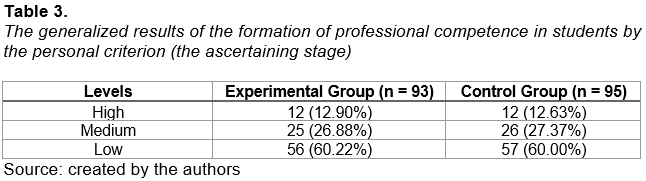
The generalized results of the study indicate that in CG and EG students, the formation of professional competence according to the personal criterion is mainly low (60.22% and 60.00%, respectively), that is, it is characterized by insufficient development of professionally important qualities: moral (decency, adherence to ethical rules, openness, honesty, attentiveness); digital (working with digital technologies in the digital environment of the university); communicative (overcoming barriers to communication, interaction and communication, ability to establish contact, tolerance); cognitive (creativity, memory volume and efficiency, perception, analytical skills, flexibility of thinking using digital technologies); emotional and volitional (perseverance, professional determination, responsibility, discipline, organized self-control), which requires improving students' educational activities through the use of interactive digital tools in the created digital environment of the university to form students' professional competence.
Thus, according to the data of the ascertaining experiment, the majority of EG and CG students have a low general level of professional competence formation, which showed the need for a formative experiment.
The formative stage of the experimental study. In the process of the experimental study, three models of student-teacher interaction using interactive digital tools were productive for EG students, which were identified taking into account several characteristic criteria for the formation of professional competence of university students (synchronicity/diachronicity; type and channels; individuality/collectivity):
-Interaction using private channels for communication (Facebook, e-mail, Viber), which could be individual, asynchronous and synchronous both with the team and with specific students, when participants in the educational process simultaneously communicate in social networks, chat, group conversation.
-Synchronous interaction in a single virtual space and in real time, which took place via video communication due to active online communication (all participants hear and see each other, have the opportunity to enter into discussions).
- Asynchronous (mediated) interaction, which becomes possible due to, as a rule, delayed, mainly written communication between students, and is also a system of tasks performed independently by students and evaluated by the teacher. CG students studied according to the standard methodology of the university's educational process.
During the establishment of the educational activities of EG students, the first model of interaction was effective and was used mainly to clarify and stipulate organizational aspects regarding the conduct of classes, their type and nature. Private communication is necessary for detailed explanations or discussions of the material, individual consultations, and approval of creative and scientific student projects. This model also makes collective communication between students possible and involves the active use of social networks.
The second model was updated when practical or lecture classes were held in accordance with the electronic schedule, and meetings with employers were organized. To organize video conferences, Internet resources (Zoom, Google Meet) were used, thanks to which students had the opportunity to record meetings, hold discussions and debates, express their own opinions, broadcast visual materials from their PC or smartphone, and communicate in chat. This format made it impossible to falsify learning, adhered to the principle of identification, strengthened control over students' task performance, and promoted each individual's independence. It was this model of distance learning that was closest in terms of digitalization to traditional learning, interaction between students and each other, and not only between the teacher and students, because the effectiveness of organizing pedagogical digital interaction of agents is determined by several factors: the content and purpose of learning (content of the discipline), background factors (level of intellectual development of students, size of the study group, ethnicity, etc.), means of communication (form and quality of communication, language of dialogue), form of control.
The third model was implemented when students completed tasks on each topic, worked independently with professional materials, and sent their work to the teacher for verification and evaluation. In particular, students completed testing, tasks for independent work (creating mind maps, interactive posters, writing essays, creating lapbooks, book trailers, video reviews; preparing projects and recommendation posters, creating interactive electronic exercises using the Learning Apps designer, etc.). To download lecture materials for students, the main platform for passing the test was d-learn – the university's distance learning system. Testing and surveys were conducted using Google Forms. Professional tasks were assigned to students in classrooms – specially created Google classes. The tasks were accompanied by instructions for completion, additional materials, samples of work, and references to Internet resources. This model of the educational process is ideal for presenting creative and written works, their evaluation, and verification by the teacher.
To achieve the set goal during the educational process, EG students used original, innovative methods and traditional forms of work with targeted, constant, systematic use of digital tools of all groups to form professional competence.
Digital tools for use by EG students belonging to the first group were: Google Meet, Zoom, Skype, Webex platforms (services for organizing video communication and online conferences), Moodle (an information environment focused on the learning management system, organizing interaction between students and the teacher, which provides the opportunity to create, design and manage information and educational resources), Google Classroom (a service for classifying, creating and distributing tasks, accelerating interaction between students and files), YouTube (a video service for viewing video lectures and video materials and downloading them), Ding Talk (a service for distance learning and video communication).
The second group of digital tools that we proposed for use by EG students included search engines: Yandex, Google, Bing, Yahoo, which were used very actively by students when conducting and organizing webquests, project-based and flipped learning.
The third group of digital tools that we proposed for use by EG students included computer programs and online services for creating didactic material (programs for generating QR codes, electronic interactive exercises, training laboratories, creating word clouds), multimedia support for studying professional material (multimedia presentations, video and audio programs, programs that provide visualization of professional material).
Effective for creating interactive, multimedia content for communication, visualization, collaboration, and the use of digital gaming tools were web services: for creating interactive posters – Glogster, Thinglink, Genially, for creating interactive timelines of events with the addition of audio, photos, and video materials – Timeline JS, Tiki-Toki, Time. Graphics, for creating mind maps – iMindMap, Spiderscribe, FreeMind, MindMeister, Mindomo, for creating video scribing and animation videos – Sparkol VideoScribe, Powtoon.com, for visualization, creating word clouds – Word it out, Mentimeter, Wordart.com, for creating quizzes and educational games – Plickers, Kahoot, for creating interactive tasks and exercises Learning Apps, Cosrative, for creating video scribing – PowToon, PowerPoint, Sparkol VideoScribe, GoAnimate, Animaker, etc.
The fourth group of digital tools that we proposed for assessing knowledge and skills is Google Forms, Plickers, Kahoot, Formative, and Quizizz.
For EG students, the online video communication mode made it possible to conduct lecture-conferences, lecture-visualizations, traditional lectures, and organize conversations. This format allowed EG students to implement, to a greater extent, the principle of visualization of distance learning and clarity: use available resources on the Internet.
Continues the formation of professional competence in the use of interactive digital tools. In particular, this included familiarization with the platform for blended and distance learning – the lCloud Cloud and acquiring skills in searching for and evaluating information and working with it. For this purpose, instructional and methodological materials were created. Opportunities were expanded by using collaborative services (IDroo, Padlet, Jamboard), simulators (Google 3D, Atom 3D, Simpop PheT), gamification (Kahoot, Learning Apps, Wordwall), smartphone sensors (using the Physics Suite, Phyphox, Arduino Science Journal platforms), augmented reality technologies, artificial intelligence tools, etc. During lectures and practical classes, instructional and methodological materials were offered to students.
EG students also had the opportunity to learn how to use elements of artificial intelligence in the educational process and in professional activities:
-Creating presentations (Tome, Gamma, Wepik, etc.).
-Working with text (Google Bard, chatgpt, Copilot).
-Creating videos (Myheritage, Runwayml, D-ID).
-Creating and processing images (Playground, Canva, Leonardo, etc.).
-Working with sound (Splitter, LANDR, Playbeat, etc.)
The educational process of EG students was accompanied by the use of innovative digital teaching methods, in particular, “flipped learning” technologies, interactive technologies, project-based learning, etc., which contribute to the development of critical thinking, creativity, and at the same time, they paid attention to the issues of academic integrity, copyright, and intellectual property.
Important for EG students was the issue of creating a safe, educational digital environment, which guarantees high-quality training of specialists. For this purpose, the following were held in the EG: a cycle of info-lessons "Media Literacy"; media educational challenge "Use of interactive digital tools for the formation of professional competence of the individual"; information and educational campaign "Safe Digital Space"; information cafe "Digital Applications in Professional Activities". The concept of a safe digital educational environment was considered "a systematically organized set of technical, digital, educational and methodological support for the educational process of the university".
Openness to the use of interactive digital tools and the perception of the new create all the conditions for setting students up for a constant search for digital tools and technologies that can be used in professional activities to increase their productivity and efficiency. Therefore, the process of forming professional competence from the standpoint of understanding its features of the formation of individual components and digital content requires the development of a system that will ensure the comprehensive formation of a system of professionally important qualities, skills, and knowledge, which is what the pedagogical conditions for the formation of professional competence of students proposed to EG students were aimed at.
The first pedagogical condition for the formation of professional competence of university students is the comprehensive formation of a system of professionally important qualities, knowledge, and skills for the development of digital competence, which is a component of professional competence. The outlined pedagogical condition for the formation of professional competence of students corresponds to the algorithm for the formation of digital competence of students developed by us in the process of research. It takes into account the objective need to clarify the content of professional training from the standpoint of its understanding as an integral set of special and general competencies, the list of which includes digital competence in the conditions of a higher education institution.
To ensure that students form an adaptive, flexible system of skills for using digital technologies and tools in the process of professional training, it is possible to use active learning methods.
Thus, the second pedagogical condition is the creation of a safe digital educational environment, which guarantees high-quality specialist training, because the formation of students' professional competence is possible in the process of professional training by introducing active learning methods using digital tools. The ability to use digital technologies is the result of their successful use, which indicates the expediency of introducing practical tasks into the educational process, the implementation of which will involve the use of digital technologies.
Therefore, the pedagogical conditions for the formation of professional competence of university students are the creation of a digital environment of the educational space, ensuring the comprehensive formation of a system of professionally important qualities, knowledge, skills, and digital competence, as components of professional competence, and the use of active learning methods in the process of professional training for mastering digital tools in professional activity. The jointly developed pedagogical conditions for the formation of professional competence of university students correspond to the systemic, competency-based, personality-oriented approaches in education and ensure a comprehensive introduction of changes into the process of professional training, consistently forming students' motivation to form professional competence, creating conditions for acquiring professional knowledge about innovative technologies and digital tools and methods of their use, and using digital tools for forming a system of skills for professional activity.
EG students were offered an integrated special course "Use of interactive digital tools for the formation of professional competence of university students", developed by integrating the content of academic disciplines and allowing the formation of specialized and general professional components of professional competence.
The purpose of creating an integrated special course was to form a basic set of knowledge, skills, and abilities that cover various aspects of educational work (design, organizational, calculation, etc.); to form a holistic expanded set of professional knowledge through the integration of the content of various academic disciplines.
The results of the control experiment were obtained after the introduction of the system, special course, and pedagogical conditions aimed at the formation of students' professional competence.
We present the results of the control experiment, which were obtained after the introduction of the system, special course, and pedagogical conditions aimed at the formation of students' professional competence.
At the control stage of the experiment, changes were found in the level of formation of professional competence according to the methods that were used at the ascertaining stage of the experiment for diagnostics.
According to the data presented, there is a positive dynamics among students of the experimental group in the level of formation of knowledge according to all criteria and their indicators, which is the basis for the formation of students' professional competence.
The average general indicators of the level of knowledge of students indicate that the average and high level of knowledge have significantly increased in EG students, and in CG students we observe a slight increase.
The generalized results of the formation of professional competence in students according to all criteria are presented in Tables 4-6.
The generalized results of the formation of professional competence of university students according to the cognitive criterion at the control stage of the study are given in Table 4.
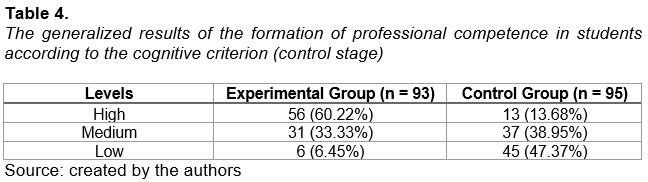
The generalized results of the study indicate that in EG students, the formation of professional competence according to the cognitive criterion is mainly at a high level. In CG students – we observe insignificant changes (60.22% and 13.68%, respectively), that is, EG students are characterized by a high, and CG students – by a small amount of professional knowledge and mastery of terminology, which occurred through the use of interactive digital tools in the created digital environment of the university for the formation of students' professional competence.
The generalized results of the formation of professional competence of university students at the control stage of the study according to the activity-operational criterion are given in Table 5.
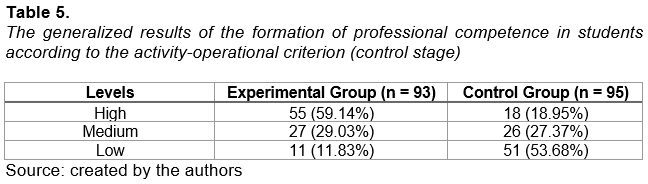
The generalized results of the study indicate that the formation of professional competence among EG students is significant according to the activity-operational criterion at the control stage – a high level prevails (59.14%, in contrast to the CG – 18.95%, respectively). That is, EG students, unlike CG students, are characterized by a sufficient level of skills to perform professional tasks, the development of skills in educational and content blocks of professional disciplines (the ability to solve professional tasks by creating digital applications; use elements of artificial intelligence, practical tasks of computer logic and structural theory of digital automata; use original, innovative methods and traditional and forms of work with purposeful, constant, systematic use of digital tools to form professional competence; classify problems of implementing information processes; perform a comparative analysis of various professional solutions; use the principle of program control to organize computational processes in a computer, etc.), which occurred through the use of interactive digital tools in the created digital environment of the university to form professional competence of students. The generalized results of the formation of professional competence of university students at the control stage of the study by the personal criterion are given in Table 6.
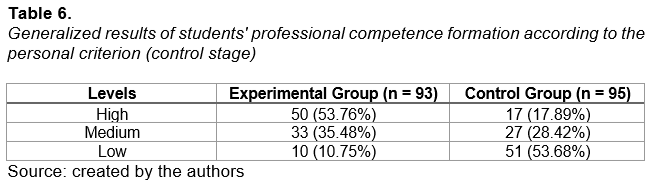
The generalized results of the study indicate that EG students show a high level of formation of professional competence according to the personal criterion at the control stage of the study, unlike CG (53.76% and 17.89%, respectively), that is, we can say that EG students are characterized by a high development of professionally important qualities: moral (decency, adherence to ethical rules, openness, honesty, attentiveness); digital (working with digital technologies in the digital environment of the university); communicative (overcoming barriers to communication, interaction and communication, ability to establish contact, tolerance); cognitive (creativity, memory volume and efficiency, perception, analytical skills, flexibility of thinking using digital technologies); emotional and volitional (perseverance, professional determination, responsibility, discipline, organized self-control), which occurred through the use of interactive digital tools in the created digital environment of the university to form the professional competence of students.
The differences between the experimental and control groups regarding the proportion of students who achieved a high level of professional competence after the formative experiment are presented in Figure 1.
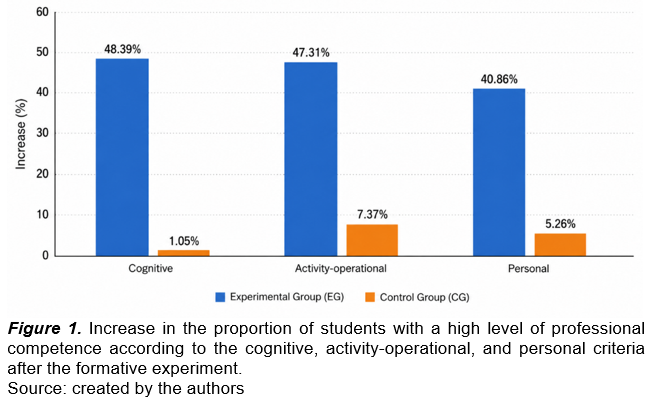
As shown in Figure 1, the proportion of students with a high level of professional competence was considerably higher in the experimental group across all criteria. The greatest difference was observed for the cognitive criterion (48.39% in EG compared with 1.05% in CG), while significant improvements were also recorded for the activity-operational (47.31% vs. 7.37%) and personal (40.86% vs. 5.26%) criteria. These results indicate the effectiveness of the implemented pedagogical conditions.
The results of the control stage demonstrate substantially greater positive dynamics in the experimental group than in the control group. According to Table 4, 60.22% of students in the experimental group achieved a high level of professional competence according to the cognitive criterion, compared with 13.68% in the control group. At the same time, the proportion of students with a low level was considerably lower in EG (6.45%) than in CG (47.37%).
A similar pattern was observed for the activity-operational criterion. A high level was demonstrated by 59.14% of EG students compared with 18.95% of CG students, while the proportion of students with a low level was 11.83% in EG and 53.68% in CG. These findings indicate that students who participated in the intervention demonstrated substantially stronger development of professional skills and abilities than students who continued their studies according to the traditional educational approach.
The same tendency was identified according to the personal criterion. The proportion of students demonstrating a high level was 53.76% in EG compared with 17.89% in CG, whereas the proportion with a low level was 10.75% and 53.68%, respectively. Thus, the experimental group demonstrated more pronounced development of professionally important moral, digital, communicative, cognitive, and emotional-volitional qualities.
The comparative results presented in Figure 1 further support this interpretation. The increase in the proportion of students achieving a high level was considerably greater in the experimental group across all three criteria: 48.39% versus 1.05% for the cognitive criterion, 47.31% versus 7.37% for the activity-operational criterion, and 40.86% versus 5.26% for the personal criterion. These differences provide empirical support for the effectiveness of the pedagogical conditions and the systematic integration of interactive digital tools implemented in the experimental group.
The control group also demonstrated some positive changes, but these were considerably smaller than those observed in the experimental group. This pattern is consistent with the study design: the experimental group received the proposed pedagogical system, author's special course, and targeted pedagogical conditions, whereas the control group continued studying according to the traditional educational approach. Therefore, the observed differences should be interpreted as evidence of the greater effectiveness of the proposed intervention for developing students' professional competence rather than as evidence of the effectiveness of the intervention in the control group.
An important limitation concerns the psychometric validation of the assessment instruments. Although questionnaires, interviews, and pedagogical observation were used to assess students’ professional competence, the available dataset did not contain item-level individual responses. Therefore, internal-consistency coefficients such as Cronbach’s alpha and KR-20 could not be calculated. The study consequently does not provide numerical estimates of internal consistency for the questionnaire-based measures. This limitation should be considered when interpreting the measurement results. Future research should collect and preserve item-level responses and establish the reliability and validity of the assessment instruments before conducting the main intervention study.
Conclusions
The study investigated the effectiveness of systematically integrating interactive digital tools into the process of developing university students’ professional competence. The quasi-experimental study involved 188 first-year university students who were divided into an experimental group (EG; n = 93) and a control group (CG; n = 95). At the formative stage, the experimental group participated in an author’s special course and was exposed to a system of pedagogical conditions based on the systematic use of interactive digital tools in the university’s digital educational environment, whereas the control group continued studying according to the traditional educational approach.
The results of the ascertaining stage showed that the majority of students in
both groups initially demonstrated a low level of professional competence,
which confirmed the need for targeted pedagogical intervention. The assessment
of professional competence was based on three criteria: cognitive,
activity-operational, and personal. These criteria provided an integrated basis
for evaluating students’ professional knowledge, practical skills, and
professionally important qualities.
The control-stage results demonstrated substantially more pronounced positive changes in the experimental group than in the control group. According to the cognitive criterion, 60.22% of EG students achieved a high level of professional competence, compared with 13.68% of CG students. According to the activity-operational criterion, the proportion of students with a high level was 59.14% in EG and 18.95% in CG. According to the personal criterion, the corresponding proportions were 53.76% and 17.89%, respectively. At the same time, the proportion of students with a low level remained considerably higher in the control group across all three criteria.
The comparative analysis presented in Figure 1 further demonstrates the greater
positive dynamics observed in the experimental group. The increase in the
proportion of students with a high level of professional competence was 48.39%
in EG compared with 1.05% in CG for the cognitive criterion, 47.31% compared
with 7.37% for the activity-operational criterion, and 40.86% compared with
5.26% for the personal criterion.
These findings indicate that the pedagogically structured integration of interactive digital tools, combined with the author's special course and the proposed pedagogical conditions, was associated with substantially greater improvements in students’ professional competence in the experimental group than in the control group. The control group also demonstrated some positive changes; however, these changes were considerably smaller. Therefore, the empirical evidence supports the effectiveness of the proposed intervention for enhancing the assessed dimensions of professional competence, while the quasi-experimental design does not warrant attributing all observed changes exclusively to the intervention.
The study contributes to the empirical discussion of digital transformation in higher education by demonstrating the potential value of integrating interactive digital tools with purposeful pedagogical conditions, collaborative learning, digital communication, independent activities, and interactive assessment rather than treating digital technologies as isolated instructional resources. The findings suggest that the pedagogical organization of digital learning activities is an important factor in supporting the development of students’ professional knowledge, practical skills, and professionally important qualities.
At the same time, the findings should be interpreted in light of the study’s limitations. The quasi-experimental design, the absence of random individual assignment, and the use of pedagogical observation, interviews, and questionnaires limit the extent to which causal conclusions and generalizations can be made. Further research should therefore employ larger and more diverse samples, validated performance-based assessment instruments, longitudinal measurements, and, where feasible, randomized or otherwise stronger comparative designs to examine the sustainability and transferability of the observed effects.
Overall, the results indicate that systematic pedagogical integration of interactive digital tools can serve as a promising approach to supporting the development of university students’ professional competence. The most pronounced improvements were observed in the experimental group across the cognitive, activity-operational, and personal criteria, providing empirical grounds for further investigation and refinement of digitally supported professional training in higher education.