
Artículo de investigación
Tecnologías innovadoras para el desarrollo de las habilidades blandas de los estudiantes universitarios
Innovative technologies for developing university students’ soft skills
Recibido: · Aceptado: · Publicado:
Cómo citar: Petrenko, I., Soroka, T., Trynus, O., Sundukova, I., & Pasynchuk, K. (2026). Innovative technologies for developing university students’ soft skills. Revista Eduweb, 20(3), 344–363. https://doi.org/10.46502/issn.1856-7576/2026.20.03.19
Resumen
El estudio aborda el problema del desarrollo de las habilidades blandas de los estudiantes universitarios mediante un sistema integrado de tecnologías educativas innovadoras. El objetivo fue desarrollar y evaluar experimentalmente un sistema metodológico y condiciones pedagógicas para potenciar las habilidades blandas de los estudiantes en la educación superior. Se llevó a cabo un experimento pedagógico de cuatro etapas entre 2021 y 2025, en el que participaron 387 estudiantes universitarios: 194 en el grupo experimental y 193 en el grupo de control. Las habilidades blandas de los estudiantes se evaluaron según criterios motivacionales, cognitivos, de actividad y reflexivos, y se clasificaron en cuatro niveles: bajo, reproductivo, de búsqueda y creativo. Durante la etapa formativa, el grupo experimental participó en una intervención integrada que combinó hackatones educativos, actividades basadas en proyectos, simulaciones, juegos de negocios y de rol, debates profesionales, herramientas de colaboración digital, inteligencia artificial, realidad virtual y gamificación. Los resultados demostraron cambios positivos sustancialmente mayores en el grupo experimental que en el grupo de control. Las puntuaciones medias en el grupo experimental aumentaron en 0,62 puntos para el criterio motivacional, 0,56 para el criterio cognitivo, 0,76 para el criterio de actividad y 0,68 para el criterio reflexivo. La diferencia general pre-post en el grupo experimental fue estadísticamente significativa (t = 12,192, p < 0,05). En la etapa final, el 57,73 % de los estudiantes del grupo experimental demostró niveles de búsqueda o creatividad en el desarrollo de habilidades blandas, en comparación con el 42,49 % del grupo de control. Los resultados indican que la participación en el sistema integrado se asoció con una mayor mejora en las habilidades interpersonales de los estudiantes universitarios que la participación en las actividades educativas regulares.
Palabras clave: habilidades blandas; tecnologías educativas innovadoras; educación superior; estudiantes universitarios; experimento pedagógico.
Abstract
The study addresses the problem of developing university students’ soft skills through an integrated system of innovative educational technologies. The aim was to develop and experimentally evaluate a methodological system and pedagogical conditions for enhancing students’ soft skills in higher education. A four-stage pedagogical experiment was conducted from 2021 to 2025 and involved 387 university students, including 194 students in the experimental group and 193 in the control group. Students’ soft skills were assessed according to motivational, cognitive, activity, and reflective criteria and classified into four levels: low, reproductive, search, and creative. During the formative stage, the experimental group participated in an integrated intervention combining educational hackathons, project-based activities, simulations, business and role-playing games, professional discussions, digital collaboration tools, artificial intelligence, virtual reality, and gamification. The results demonstrated substantially greater positive changes in the experimental group than in the control group. Mean scores in the experimental group increased by 0.62 points for the motivational criterion, 0.56 for the cognitive criterion, 0.76 for the activity criterion, and 0.68 for the reflective criterion. The overall pre–post difference in the experimental group was statistically significant (t = 12.192, p < .05). At the final stage, 57.73% of students in the experimental group demonstrated search or creative levels of soft skills development, compared with 42.49% in the control group. The findings indicate that participation in the integrated system was associated with greater improvement in university students’ soft skills than participation in regular educational activities.
Keywords: soft skills; innovative educational technologies; higher education; university students; pedagogical experiment.
Introduction
Over the past decades, the development of university students’ soft skills has become an increasingly important component of higher education. Soft skills complement professional and technical knowledge by supporting students’ effective communication, teamwork, critical thinking, creativity, adaptability, emotional intelligence, and problem-solving. These competencies are particularly important in educational and professional contexts characterized by rapid technological change, interdisciplinary collaboration, and increasing demands for graduates to adapt to changing work environments. Research has shown that soft skills are associated with students’ career development and employability and that higher education plays an important role in their systematic development (Munir, 2022; Ragusa et al., 2022;Shah et al., 2023).
The digital transformation of higher education has created additional opportunities for developing these competencies. Digital platforms, collaborative environments, simulations, project-based learning, and other technology-supported learning activities can increase students’ engagement in authentic and collaborative tasks and create conditions for practicing communication, teamwork, decision-making, and problem-solving. Previous studies have demonstrated the potential of active learning and digitally supported educational practices for the development of students’ soft skills (Almeida & Buzady, 2022;Almeida & Morais, 2023; Betti et al., 2022). Hackathon-based learning has also been associated with experiential learning, interdisciplinary collaboration, creativity, and problem-solving, although existing research has often examined specific formats or contexts rather than an integrated pedagogical system for higher educatio (Heller et al., 2023; Sajja et al., 2024).
Despite this growing body of research, an important empirical gap remains. First, existing studies frequently examine individual approaches, such as project-based learning, simulation, active learning, or hackathons, rather than evaluating an integrated system that combines several innovative educational technologies within a coherent pedagogical framework. Second, although the literature provides evidence of the potential of particular technologies and active learning strategies, fewer studies have empirically compared changes in students’ soft skills between experimental and control groups using multiple dimensions of soft skills development. Third, the effectiveness of an integrated system combining experiential activities with digital technologies, artificial intelligence, virtual reality, and collaborative learning tools remains insufficiently established in university education. Therefore, there is a need for empirical research that not only describes innovative technologies but also determines whether their systematic pedagogical integration produces measurable improvements in students’ soft skills.
Accordingly, the research objective was to determine the effectiveness of an integrated pedagogical system based on innovative educational technologies for developing university students’ soft skills by comparing changes in the experimental and control groups.
The study was guided by the following hypothesis:
H1: University students who participate in the integrated pedagogical system based on innovative educational technologies will demonstrate significantly greater improvements in soft skills than students who participate in conventional educational activities.
To test this hypothesis, the study compared the experimental and control groups according to four dimensions of soft skills development: motivational, cognitive, activity, and reflective criteria. The study examined changes in students’ indicators before and after the intervention and compared the final distribution of students across the identified levels of soft skills development.
Literature Review
Research on soft skills in higher education has developed along several interconnected directions, including the conceptualization and measurement of soft skills, active and experiential learning, simulation and project-based approaches, and the use of digital technologies to support their development. Rather than treating these directions as separate strands, recent studies increasingly indicate that soft skills develop most effectively when students are engaged in active, authentic, and socially interactive learning activities.
One important research direction concerns the conceptualization and measurement of soft skills. Jardim et al. (2022) developed and psychometrically examined the Soft Skills Inventory, providing empirical support for the multidimensional nature of the construct and offering a basis for its systematic assessment. This contribution is important because it demonstrates that soft skills should not be treated as a single undifferentiated competence. At the same time, measurement-oriented research does not by itself explain which pedagogical conditions are most effective for developing these competencies in specific higher education contexts. Thus, a distinction is needed between establishing valid ways of assessing soft skills and determining how educational interventions can produce measurable changes in them.
A second strand of research emphasizes active, experiential, and collaborative learning. Betti et al. (2022) demonstrated that active learning can contribute simultaneously to the development of hard and soft skills, suggesting that soft skills can be embedded in discipline-specific learning rather than taught exclusively as separate competencies. Almeida and Buzady (2022), using simulation-based learning, reported the potential of experiential activities for developing teamwork, decision-making, and leadership. Almeida and Morais (2023) similarly emphasized interactive teaching, digitalization, and interdisciplinary approaches as strategies for developing soft skills in technical education. Taken together, these studies indicate a relatively consistent pattern: students’ soft skills are supported when learning requires participation, collaboration, decision-making, and the application of knowledge to meaningful tasks.
Project-based and hackathon-based learning provide a more intensive form of such experiential engagement. Research on hackathons emphasizes their capacity to combine teamwork, creativity, problem-solving, interdisciplinary interaction, and practical project development (Heller et al., 2023; Sajja et al., 2024). However, the evidence in this area is largely focused on particular educational formats or contexts. Hackathons, simulations, and project activities therefore provide evidence for the value of individual experiential approaches, but this does not establish whether their systematic combination with other innovative technologies produces additional benefits for the broader development of soft skills.
Another strand of the literature concerns the relationship between soft skills and students’ professional development. Munir (2022) shows that engineering professionals require social and communicative competencies alongside technical expertise, while Shah et al. (2023) demonstrate an association between multidimensional soft skills and students’ career development and career intentions. Ragusa et al. (2022) further emphasize the importance of soft skills within university teaching and learning processes. These studies strengthen the argument that soft skills are an important outcome of higher education; however, their primary contribution concerns the relevance and professional value of these competencies rather than the comparative effectiveness of integrated pedagogical interventions for developing them.
Recent literature also points to the growing role of digital technologies in higher education. Digital platforms, online collaboration environments, simulations, and other technology-supported activities can provide additional opportunities for communication, cooperation, problem-solving, and self-directed learning. Almeida and Morais (2023) highlight digitalization as one element of broader strategies for developing soft skills. At the same time, the presence of digital technologies alone does not demonstrate pedagogical effectiveness. The educational value of a technology depends on how it is integrated into learning activities, interaction, assessment, and students’ practical engagement.
The literature therefore provides relatively consistent evidence for three propositions. First, soft skills are multidimensional and can be systematically assessed (Jardim et al., 2022). Second, active, experiential, collaborative, and project-based learning can create favorable conditions for their development (Almeida & Buzady, 2022; Almeida & Morais, 2023; Betti et al., 2022). Third, soft skills have substantial relevance for students’ professional and career development (Munir, 2022; Ragusa et al., 2022; Shah et al., 2023). However, these strands have generally been investigated separately, and the literature provides less evidence concerning the effectiveness of an integrated pedagogical system that combines experiential learning activities with multiple innovative technologies and explicit pedagogical conditions.
Accordingly, the research gap addressed in the present study is not a general lack of empirical research on soft skills. Rather, it concerns the limited empirical evidence on the effectiveness of an integrated system that combines educational hackathons, project activities, simulations, collaborative digital tools, artificial intelligence, virtual reality, and gamification within defined pedagogical conditions for developing university students’ soft skills. The present study addresses this gap by implementing such a system in an experimental group and comparing changes in students’ motivational, cognitive, activity, and reflective dimensions of soft skills with those observed in a control group.
Methodology
Research Design
The study employed a quasi-experimental pedagogical design to examine the effectiveness of an integrated system of innovative educational technologies for developing university students’ soft skills. The study was conducted from 2021 to 2025 and comprised four interconnected stages: search, ascertaining, formative, and final. The search stage involved the analysis and systematization of relevant psychological, philosophical, pedagogical, and methodological literature and the identification of theoretical foundations for developing students’ soft skills. The ascertaining stage was used to determine students’ initial level of soft skills, their readiness to participate in innovative learning activities, and their perceptions of the role of such activities in soft skills development. During the formative stage, the developed methodological system and pedagogical conditions were implemented in the experimental group. The final stage involved assessment of changes in students’ soft skills and comparison of the experimental and control groups.
The quasi-experimental design was selected because the study was conducted within existing academic groups and did not involve individual random assignment of students to experimental conditions. The design therefore enabled comparison of changes between the experimental and control groups while recognizing the contextual limitations associated with non-random group allocation.
Participants and Setting
The study involved 387 university students from three Ukrainian higher education institutions: Rivne State University of the Humanities, Ternopil Volodymyr Hnatiuk National Pedagogical University, and Central Ukrainian State University named after Volodymyr Vynnychenko. The participants were enrolled in master's-level programmes in education, psychology, social work, and related fields. The sample comprised 194 students in the experimental group and 193 students in the control group.
Sampling and Recruitment Procedure
Participants were selected using a non-probability sampling approach. At the ascertaining stage, the sample size for the student survey was determined with consideration of the required confidence level and sampling error. The study also applied a variational maximum sampling approach for selecting students for the relevant research activities.
The participating academic groups were identified in cooperation with the academic units of Rivne State University of the Humanities, Ternopil Volodymyr Hnatiuk National Pedagogical University, and Central Ukrainian State University named after Volodymyr Vynnychenko. Students received information about the purpose, procedures, expected activities, and voluntary nature of participation before enrolment in the study. Participation was voluntary, and students could decline participation without academic consequences.
Because the study was conducted within existing academic groups, students were not individually randomized to the experimental or control condition. The experimental and control groups were formed from participating academic groups in cooperation with the relevant academic units of the participating higher education institutions. The initial assessment was conducted before the intervention to examine the comparability of the groups across the selected soft-skills criteria. Although the experimental group showed slightly lower baseline mean scores on some indicators, these baseline values were not used as a criterion for selecting students or academic groups for the experimental condition. Rather, the baseline assessment was used to identify the initial level of soft-skills development and to assess the comparability of the two groups. The baseline comparison did not indicate a statistically significant difference between the groups (t = 1.623). Accordingly, the study should be regarded as a quasi-experimental design with non-random group allocation, and the possibility of residual selection bias cannot be completely excluded. The observed differences in outcomes should therefore be interpreted as evidence of an association between participation in the integrated intervention and changes in students’ soft skills, rather than as definitive causal evidence.
The study evaluated an integrated pedagogical intervention in which educational hackathons, project activities, simulations, business and role-playing games, professional discussions, digital collaboration tools, artificial intelligence, virtual reality, and gamification were implemented as interconnected elements. Because the research design did not include separate intervention groups for individual technologies, the study does not permit the independent effectiveness of any particular technology to be determined or ranked. Accordingly, expressions such as “the most effective” are not used to characterize virtual reality, gamification, artificial intelligence, or other individual tools. References to the contribution of specific technologies are therefore understood as descriptions of their role within the integrated intervention rather than as evidence of their independent causal effectiveness.
Assessment Framework
Students’ soft skills were assessed according to four criteria: motivational, cognitive, activity, and reflective. The motivational criterion reflected students’ motives and readiness for educational activities and for the development of soft skills and personal qualities. The cognitive criterion reflected students’ knowledge and understanding of soft skills and their development. The activity criterion concerned students’ ability to apply soft skills in educational and professional situations, including communication, teamwork, problem-solving, leadership, and decision-making. The reflective criterion concerned students’ ability to evaluate their own activities and achievements and to use self-assessment for further development.
Four levels of soft skills development were distinguished: low, reproductive, search, and creative.
Measurement Instrument
The assessment of students’ soft skills was conducted using a structured assessment instrument based on four dimensions of soft-skills development: motivational, cognitive, activity, and reflective. The instrument was developed for the purposes of the present pedagogical experiment and was administered to students at both the ascertaining and final stages.
The motivational dimension assessed students’ motivation and readiness to develop soft skills and personal qualities. The cognitive dimension assessed students’ knowledge and understanding of the nature, importance, and components of soft skills. The activity dimension assessed students’ ability to apply communication, teamwork, leadership, decision-making, and problem-solving skills in educational and professionally oriented situations. The reflective dimension assessed students’ ability to evaluate their own performance, identify strengths and areas for improvement, and use reflection and self-assessment for further development.
Each dimension was assessed using a set of questionnaire items and complementary pedagogical observation indicators. The instrument consisted of 20 items, with 5 items assigned to each of the four dimensions: motivational, cognitive, activity, and reflective. Responses to the questionnaire items were recorded using a 5-point Likert scale ranging from 1 (“strongly disagree”) to 5 (“strongly agree”), where higher scores indicated a higher level of soft-skills development.
For each participant, scores were calculated separately for the four dimensions. The dimension scores were obtained by averaging the scores of all items belonging to the respective dimension. An overall soft-skills score was subsequently calculated as the arithmetic mean of the four dimension scores. The same instrument and scoring procedure were applied to the experimental and control groups before and after the intervention.
Research Methods and Data Collection
The study employed theoretical, empirical, and statistical methods. The theoretical methods included analysis, synthesis, induction, deduction, systematization, and generalization of psychological, philosophical, pedagogical, and scientific-methodological literature. Empirical methods included questionnaires, surveys, interviews, pedagogical observation, analysis of students’ educational activities, and pedagogical experimentation.
The assessment procedures were conducted at the ascertaining and final stages to identify changes in students’ soft skills following the formative intervention. The same assessment framework was applied to the experimental and control groups to enable comparison of changes over time.
Experimental Intervention
During the formative stage, the experimental group participated in an integrated methodological system designed to develop soft skills through innovative educational technologies. The intervention combined educational hackathons, project activities, simulations, business and role-playing games, professional discussions, debates, presentations, digital collaboration tools, artificial intelligence, virtual reality, and gamification.
The intervention was implemented through three pedagogical conditions: (1) creation of a modern innovative educational environment; (2) involvement of students in communicative activities, development of creative abilities, and formation of skills for rational use of time; and (3) systematic application of innovative learning technologies for developing students’ soft skills.
The methodological system consisted of four interconnected components: technological, content, personal, and activity. The technological component focused on creating an innovative educational environment; the content component addressed the content of soft skills and related communicative and creative abilities; the personal component involved the purposeful use of innovative learning technologies for students’ development; and the activity component focused on students’ practical engagement in activities aimed at developing and assessing soft skills.
In the experimental group, students participated in hackathons and project activities and completed simulations, business games, role-playing activities, professional discussions, debates, and presentations. Digital technologies included virtual reality, gamification, online collaboration tools, artificial intelligence, online forums, and social networks.
The control group continued its regular educational activities without systematic implementation of the developed integrated intervention.
Data Analysis
The empirical data were analysed quantitatively and qualitatively. Quantitative analysis was used to compare students’ indicators according to the four assessment criteria before and after the intervention and to examine differences between the experimental and control groups.
The coefficient of significance of differences was calculated to determine whether the observed differences between the groups could be considered statistically significant.
Before the intervention, baseline equivalence between the experimental and control groups was examined. Within-group pre–post changes were also assessed separately. However, because the research hypothesis predicted significantly greater improvement in the experimental group than in the control group, the primary analysis focused on a direct between-group comparison of change scores. For each criterion, change scores were calculated as the difference between the post-intervention and pre-intervention scores (Δ = post-test − pre-test), and the mean changes in the experimental and control groups were compared using an independent-samples t-test. Statistical significance was evaluated at the .05 level.
Changes in the distribution of students across the four levels of soft skills development were also examined. At the final stage, the distributions of 193 control-group students and 194 experimental-group students were compared across the low, reproductive, search, and creative levels.
Ethical Considerations
Participation in the study was voluntary. Before participating, students were informed about the purpose, procedures, and conditions of the research, and informed consent was obtained from all participants. Students were informed that they could withdraw from the study at any time without any negative consequences. Confidentiality and anonymity of participants’ responses were maintained throughout the study, and the collected data were used exclusively for scientific purposes. The study was conducted in accordance with the ethical principles and institutional requirements applicable to educational research.
Results and Discussion
Soft skills encompass non-cognitive competencies that support effective social and professional interaction and personal effectiveness, including leadership, teamwork, emotional intelligence, time management, critical and creative thinking, adaptability, persuasion, and public speaking. Their development is increasingly important in higher education because these competencies contribute to students’ professional readiness and ability to respond to changing professional demands.
Innovative and active learning technologies provide opportunities to develop these competencies through practical and collaborative activities. Educational hackathons engage students in intensive teamwork on authentic problems, promoting critical thinking, creativity, time management, and collaboration (Sajja et al., 2024). Their practical and problem-oriented nature distinguishes them from traditional instructional formats and supports students’ engagement in solving real-world tasks (Kitsios & Kamariotou, 2023). Their interdisciplinary character can additionally stimulate reflection, innovation, and social interaction (Araújo et al., 2025; Heller et al., 2023).
Project-based activities similarly provide opportunities to develop soft skills through practical experience, collaboration, communication, leadership, critical thinking, and problem-solving. Tasks that simulate professional situations can also support students’ adaptability and creativity (Chagovets et al., 2020).
Thus, hackathons, project-based learning, case studies, training sessions, virtual laboratories, digital platforms, AI, and augmented and mixed reality can be considered complementary elements of an integrated pedagogical approach to soft skills development, rather than isolated technologies. Their educational value lies in creating opportunities for active participation, collaboration, problem-solving, reflection, communication, and practical application of knowledge.
Organization of a pedagogical experiment on the development of soft skills in university students.
In the process of experimental research, we, together with students, identified the stages of soft skills development:
1. Cognitive stage, to identify and form students' motives for educational activities, for the development of soft skills and their personal qualities.
2. Applied stage, to form students' soft skills and communication, teamwork, solving practical problems, practical skills, and skills of educational activities, etc.
3. Evaluation stage, to form adequate self-esteem in students for their self-improvement of soft skills.
All the stages we have described form a holistic system for the development of soft skills in university students using innovative technologies.
Analyzing the proposed questions and tasks at the ascertaining stage of the experiment according to the specified criteria, we found that 28.68% of students are at a low level of soft skills development, 63.05% are at an average level, and only 8.27% are at a high level.
Such results of the ascertaining section showed a low level of soft skills development in university students. They prompted us to study in more detail the ways of developing soft skills in university students and to develop an innovative system and pedagogical conditions for the development of soft skills in students using innovative technologies.
The theoretical and methodological basis of the study, which we determined, made it possible to plan a pedagogical experiment, which was carried out from 2021 to 2025 in four stages.
At the search (first) stage, we studied, systematized, and generalized information on the research problem in practice and in psychological, philosophical, and pedagogical literature, and analyzed and accumulated personal work experience.
At the ascertaining (second) stage, we determined students' views on the need to develop soft skills using innovative technologies and their readiness for this type of activity. The study used a phenomenological method, and students were selected using the variational maximum sampling method.
At the formative stage, the developed innovative system and pedagogical conditions for developing students' soft skills using innovative technologies were implemented; the effectiveness of the integrated innovative pedagogical system was evaluated by comparing changes in the experimental and control groups and students' skills and knowledge were measured.
At the final stage, the results of experimental work were processed and analyzed using generalization and mathematical statistics methods.
At the ascertaining stage of the study, the sample size was determined in order to ensure the reliability of the results of the student survey. To determine the number of respondents who needed to be interviewed, we used the formula so that we could state the results with a probability of 0.95 regarding the development of soft skills in university students and at the same time, the sample should have a difference from the general population of no more than 0.05:
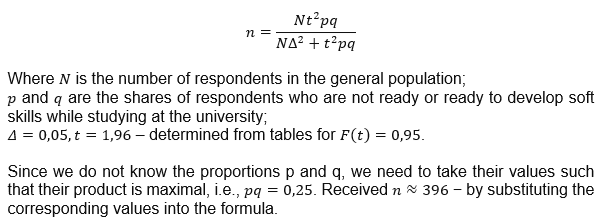
The results of the study showed that students, their motivation, and self-training play a significant role in developing soft skills. In addition, students expressed the opinion that extracurricular activities, as well as classes, are an important innovative environment for developing soft skills. Students also emphasized that they experienced difficulties in developing soft skills during the implementation of educational activities: educational hackathons, project activities, training sessions, case methods, virtual laboratories, digital platforms and technologies, artificial intelligence, augmented and mixed reality technologies.
We also set the goal at the ascertaining stage of the study to assess the general level of development of soft skills among university students, students' awareness of types of life skills, and the need to use innovative learning technologies in the educational process of higher education to develop flexible or soft skills of future specialists, to identify the main shortcomings of the educational process of higher education and the reasons for their occurrence.
During the ascertaining stage of the study, it was found that not all students possess the necessary system of life skills, and the real level of development of flexible or soft skills of future specialists was identified.
At the formative stage of the study, the developed innovative system and pedagogical conditions for the development of soft skills in EG students through innovative technologies were implemented; the effectiveness of the implemented digital innovative educational technologies was compared.
In the process of professional training of EG students and the hackathon, the participants went through the main proposed stages of project work: from the presentation and assessment of the effectiveness of the work done and ready-made solutions, starting from the development of ideas and the formulation of a production problem. This educational format stimulated the development of flexible or soft skills of future EG specialists, such as analysis of production cases, the implementation and development of leadership qualities, independent search for information, and making reasoned decisions.
The introduction of hackathons into the educational process of EG in higher education institutions contributed to:-The development of soft skills (teamwork, communication, critical and creative thinking), which are crucial in the modern educational sector for effective professional activity.
-The organization of joint work in teams, the formation of experience in interdisciplinary interaction, the exchange of achievements and ideas.
-The motivation of students to develop flexible skills (soft skills) through innovative technologies, research, and an independent approach of higher education applicants through participation in project activities and solving practical production tasks.
-The involvement of stakeholders in the educational process to increase the practical significance of the results obtained.
The educational hackathons conducted in EG showed students' readiness to create relevant projects, greater student activity, responsibility, and cohesion, which can be implemented in real conditions of professional activity. Thus, introducing hackathons in universities was an effective means of modernizing education and developing the soft skills and professional activities of EG students.
In the EG educational process, we focused on the connection between emotional intelligence, project-based learning, and the development of soft skills in university students. EG students demonstrated higher levels of soft skills than those who participated in project activities compared to students who did not participate in such activities (CG). This proves that project-based learning improves professional knowledge and helps develop soft skills in university students, which is very important for strengthening interpersonal relationships and developing leadership.
EG students performed exercises aimed at developing soft skills in a professional context. Thus, EG students were offered simulations, business games, and role-playing games, which allowed them to test their soft skills in practical conditions and recreate professional situations, stimulating active participation in the digital field of educational activity. Effective tasks included professional real situations, negotiations, group discussions and debates, and creating presentations, which provided practical experience.
Digital technologies played a significant role in developing soft skills in EG students and modernizing the educational process, in particular through guest lectures, video communication tools, interactive digital resources, and information and communication technologies.
Such innovative technologies opened up new opportunities for EG students to develop soft skills more actively, interactively, and effectively. EG students experimented with various digital technologies, demonstrating successful cases of implementing AI and social networks, online platforms, VR, and gamification. What was important was the development and use of pedagogically sound methods, not just the introduction of technologies into higher education.
So, EG students actively used various innovative technologies to develop soft skills. Let us name the most effective:
1. Virtual reality (VR) and simulations: creating immersive learning environments that simulate real professional situations. VR effectively contributed to the development of soft skills in EG students through modeling various social contexts. VR was used in problem-based learning, including teamwork, public speaking, leadership, and critical thinking.
2. Educational games and gamification: involvement of EG students in creating an educational interactive digital experience. Gamified tasks and games developed soft skills in university students, including creativity, critical thinking, cooperation and communication, and contributed to problem-solving. The study showed that gamification has a positive effect on the development of soft skills in university students and student motivation.
3. Online collaboration tools and platforms: promoting the development of soft skills in university students, teamwork, communication, and project management skills. Shared task management tools, brainstorming boards, and online documents allowed students to work together effectively regardless of location.
4. Artificial intelligence (AI) for the development of soft skills in EG students contributed to personalized feedback: providing students with detailed, individualized feedback on their soft skills, such as argumentation and communication.
5. Online forums and social networks: creating platforms for exchanging ideas and experiences, informal communication, and developing active listening skills. To develop soft skills in EG students, forums were created for discussing projects, professional materials, and exchanging ideas.
All these innovative technologies contributed to the development of key soft skills in EG students, such as critical thinking, problem-solving, and creativity. Their ability and interactivity in involving EG students in the process of active innovative learning contribute to deeper assimilation and understanding of professional material and the development of necessary professional skills.
EG students are offered the following pedagogical conditions to be implemented in the educational process:
1.Development of soft skills in students by creating a modern, innovative educational environment of higher education.
2.Involvement of students in communicative activities, development of creative abilities, formation of skills for rational use of time, etc.
3.Application of innovative learning technologies in the educational process of higher education to develop flexible or soft skills of future specialists: educational hackathon, project activities, training sessions, case method, virtual laboratories, digital platforms and technologies, artificial intelligence, technologies of augmented and mixed reality.
The main components of the developed methodological innovation system and pedagogical conditions for the development of soft skills in EG students by means of innovative technologies were determined:
-Technological component.
-Content component.
-Personal component.
-Activity component.
These components, based on systemic and synergistic approaches during the pedagogical experiment and through the implementation of the identified pedagogical conditions and the proposed system for the development of soft skills in students, formed relationships to achieve the maximum synergistic effect between these components.
The technological component provided for the definition by teachers and students of the main concepts and types of soft skills for successful life.
To ensure this component, the first pedagogical condition was implemented – the development of soft skills in students by creating a modern innovative educational environment of higher education.
The content component provided for familiarizing EG students with the content and implementation of life skills concepts, clarifying the essence of communicative activity, developing creative abilities, forming the ability to rationally use time, etc., for the development of soft skills.
The implementation of the second pedagogical condition was aimed at ensuring this component of the system – involving students in communicative activity, developing creative abilities, forming the ability to use time rationally, etc.
The personal component provided for the development of the necessary soft skills in the students themselves through a system of measures taken for this purpose: the use of innovative learning technologies in the educational process of higher education to develop flexible or soft skills of future specialists: educational hackathon, project activities, training sessions, case method, virtual laboratories, digital platforms and technologies, artificial intelligence, augmented and mixed reality technologies. To ensure this component of the system, the third pedagogical condition was implemented – the use of innovative learning technologies in the educational process of higher education to develop flexible or soft skills of future specialists: educational hackathon, project activities, training sessions, case method, virtual laboratories, digital platforms and technologies, artificial intelligence, augmented and mixed reality technologies.
The activity component is provided to increase students' ability to develop soft skills and to assess their level of formation of necessary life skills.
The implementation of all pedagogical conditions was aimed at ensuring this component of the system.
We note that there is a cyclical relationship between the components of the system and the pedagogical conditions for the development of soft skills in students.
In order to prove the non-randomness of the differences in the numerical values of the indicators in the experimental and control group, we used the formula (agreement criterion) for calculating the coefficient of significance of differences:
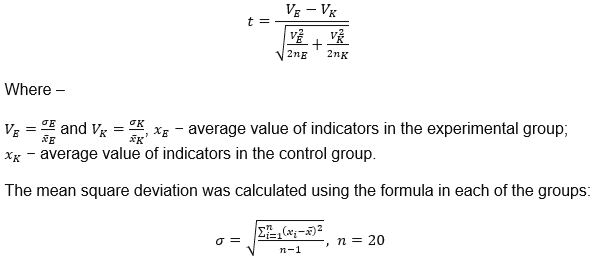
We used the coefficient of significance of differences in pedagogical experiments to find out whether the observed differences between the experimental and control group are statistically significant, that is, whether it can be said that these differences are not accidental, but that they are due to the influence of the studied factor. Thus, in pedagogical research, the criterion of significance of differences is a key tool, which provides an objective assessment of their effectiveness in experimental methods.
Before the start of the experiment, the coefficient of significance of differences was calculated in two groups. The pre–post comparison in the control group yielded t = 2.099 (df = 192, p ≈ .037, two-tailed), indicating a statistically significant but relatively small change in the control group. This within-group result should not, however, be interpreted as evidence that the experimental intervention was more effective. The relevant test of the research hypothesis is the direct comparison of change scores between the experimental and control groups.
Between the EG before and EG after the experiment, the calculation of the coefficient of significance of differences at the significance level p < 0.05 gave the following value t = 12.192, which proves that the difference in indicators is significant. This suggests that the increase in students' readiness for the development of soft skills was largely influenced by the implementation of the developed system and pedagogical conditions, which were proposed in the research process and implemented by us.
The next stage of the study was the analysis of the dynamics of all indicators of the development of soft skills in students according to the selected criteria: motivational criterion, cognitive criterion, activity criterion, and reflective criterion.
For the initial diagnostic assessment, students’ soft skills were summarized using a three-level classification (low, medium, and high), which showed that 28.68% of students were at the low level, 63.05% at the medium level, and 8.27% at the high level. This three-level classification was used only for the general diagnostic description at the ascertaining stage. For the subsequent analysis of the dynamics of soft skills development, a more differentiated four-level scale was applied: low, reproductive, search, and creative. These two classification systems should therefore not be interpreted as equivalent categories. The four-level scale was used for the comparative analysis of students’ distributions at the final stage.
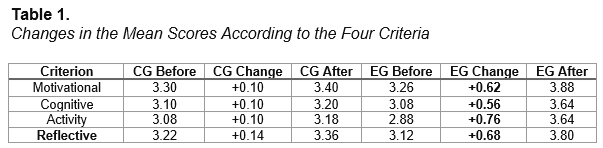
To directly test the study hypothesis, the magnitude of pre–post change was compared between the experimental and control groups. The experimental group demonstrated larger mean improvements than the control group across all four criteria: motivational (+0.62 vs. +0.10), cognitive (+0.56 vs. +0.10), activity (+0.76 vs. +0.10), and reflective (+0.68 vs. +0.14). The independent-samples comparison of change scores was used as the primary test of whether the improvement in the experimental group was significantly greater than that observed in the control group.
The analysis first examined changes in the mean scores of students according to the four established criteria: motivational, cognitive, activity, and reflective. Table 1 shows the results for the experimental and control groups before and after the intervention.
The experimental group demonstrated substantially larger changes across all four criteria than the control group. The greatest increase in the EG was observed for the activity criterion (+0.76), followed by the reflective (+0.68), motivational (+0.62), and cognitive (+0.56) criteria. In contrast, changes in the CG ranged from +0.10 to +0.14.
The baseline comparison indicated no statistically significant difference between the experimental and control groups (t = 1.623), supporting their initial comparability. Within-group analysis showed a statistically significant pre–post change in the experimental group (t = 12.192, p < .05). However, this within-group result does not by itself demonstrate that the experimental group improved significantly more than the control group. Because the research hypothesis concerned the relative magnitude of improvement between groups, the primary test of the hypothesis was based on the direct comparison of pre–post change scores between the experimental and control groups. The experimental group showed larger mean changes across all four criteria, with the greatest increase observed for the activity criterion (+0.76). The results therefore show a consistent pattern across all four criteria: the experimental group demonstrated larger changes than the control group, with the strongest change observed in the activity criterion.
To provide a more differentiated assessment of students’ soft skills development, the final results were classified into four levels: low, reproductive, search, and creative. Unlike the three-level classification used for the general diagnostic description at the ascertaining stage, this four-level scale was applied to distinguish more precisely between students demonstrating different degrees of development at the final stage. The final distributions of the experimental and control groups are presented in Table 2.
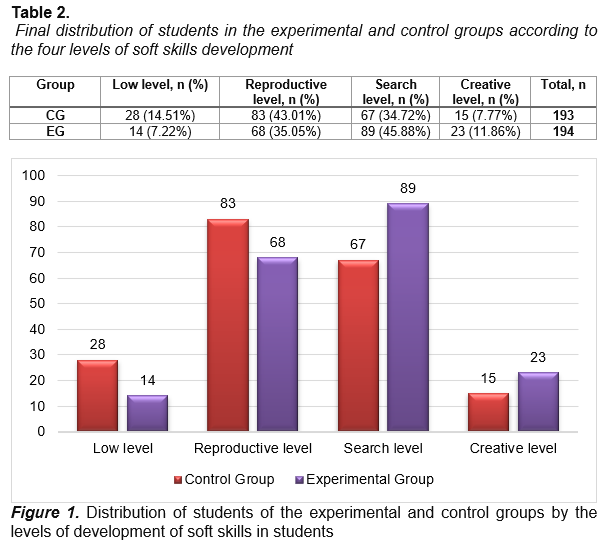
At the final stage, the experimental group showed a more favorable distribution across the four levels than the control group. In the EG, 45.88% of students were classified at the search level and 11.86% at the creative level, whereas the corresponding proportions in the CG were 34.72% and 7.77%. Thus, the combined proportion of students at the search or creative levels was 57.73% in the EG, compared with 42.49% in the CG. At the same time, the proportion of students at the low level was lower in the EG (7.22%) than in the CG (14.51%).
These findings are consistent with the mean-score results presented in Table 1, which also showed substantially larger changes in the experimental group. However, the final distribution alone does not demonstrate the magnitude of within-group change from baseline. Therefore, conclusions about changes in the four-level distribution should be based on a direct comparison with the corresponding baseline distribution rather than on the final distribution alone.
Because the baseline assessment used a three-level classification, whereas the final analysis employed a four-level classification, direct before–after comparison of the four-level distributions was not possible. Therefore, Table 2 is interpreted as a cross-group comparison of the final distribution rather than as a direct measure of within-group change. The evidence for pre–post change is provided by the criterion-level mean scores reported in Table 1 and the corresponding statistical analysis.
The stronger improvement in the activity dimension is consistent with previous research emphasizing the role of active and experiential learning in soft skills development. Betti et al. (2022) reported that active learning can contribute to the development of both professional and soft skills, while Almeida and Buzady (2022) demonstrated the potential of simulation-based learning for developing competencies such as teamwork, leadership, and decision-making. The present findings extend these observations by showing that a broader integrated intervention can be associated with improvements not only in activity-related competencies but also in motivational, cognitive, and reflective dimensions.
The increase in the reflective criterion (+0.68) is also noteworthy. This result may be related to the inclusion of activities requiring students to evaluate their performance, discuss outcomes, present project results, and engage in feedback and self-assessment. However, the present design does not allow the contribution of any single activity or technology to be isolated. The observed improvement should therefore be attributed to the integrated intervention rather than to AI, virtual reality, hackathons, or gamification individually.
The motivational and cognitive changes (+0.62 and +0.56, respectively) further suggest that the intervention was not limited to the behavioral application of soft skills. The combination of collaborative tasks, project activities, simulations, and digital learning environments may have provided students with opportunities to understand the relevance of soft skills and to apply this knowledge in practical situations. This interpretation is compatible with the literature emphasizing the multidimensional nature of soft skills and the importance of combining knowledge, practice, interaction, and reflection in their development.
The final group distributions provide additional evidence of a more favorable outcome for the experimental group. The proportion of students classified at the search or creative levels was 57.73% in the EG compared with 42.49% in the CG, while the proportion at the low level was 7.22% in the EG compared with 14.51% in the CG. These differences are consistent with the criterion-level results presented in Table 1. Nevertheless, because the four-level classification was not used consistently at the baseline stage, the final distribution should be interpreted as evidence of between-group differences at the final stage rather than as a direct estimate of the magnitude of pre–post change.
Several alternative explanations should also be considered. First, because the study used existing academic groups rather than individual randomization, differences between the groups that were not captured by the baseline comparison may have contributed to the observed outcomes. Second, the experimental group received a more intensive and varied learning experience, and therefore the effects may reflect increased engagement, interaction, or exposure to active learning rather than the specific contribution of individual digital technologies. Third, the study design does not permit determination of which component of the integrated system was most influential. These considerations suggest that the results support the effectiveness of the intervention as a whole but should not be interpreted as evidence that any single technology independently caused the observed improvements.
The findings nevertheless provide empirical support for the central hypothesis that students participating in the integrated pedagogical system would demonstrate greater improvement in soft skills than students participating in conventional educational activities. The results are particularly relevant because they show convergence between two forms of evidence: changes in mean scores across four criteria and differences in the final distribution of students across soft skills levels.
An additional limitation concerns the measurement instrument used to assess students’ soft skills. The structured assessment instrument was developed specifically for the purposes of the present pedagogical experiment and included motivational, cognitive, activity, and reflective dimensions. Although the instrument provided a structured framework for assessing changes in students’ soft skills, a separate psychometric validation, including formal assessment of construct validity and internal consistency reliability, was not conducted. Therefore, the measurement results should be interpreted with appropriate caution. Future research should further validate the instrument using established psychometric procedures and examine its reliability and validity in larger and more diverse student samples.
In addition, although students were classified into low, reproductive, search, and creative levels, the operational score thresholds for these classifications were not formally standardized or psychometrically validated, which represents an additional limitation of the study.
Conclusions
The study examined the effectiveness of an integrated pedagogical system based on innovative educational technologies for developing university students’ soft skills. The quasi-experimental study involved 387 students from three Ukrainian higher education institutions, including 194 students in the experimental group and 193 in the control group. The intervention combined active and experiential learning activities with digital technologies within a coherent pedagogical framework comprising technological, content, personal, and activity components.
The experimental group demonstrated substantially greater improvements than the control group across all four assessed dimensions of soft skills. The mean changes were +0.62 versus +0.10 for the motivational criterion, +0.56 versus +0.10 for the cognitive criterion, +0.76 versus +0.10 for the activity criterion, and +0.68 versus +0.14 for the reflective criterion. Although a statistically significant pre–post change was also observed in the control group, the hypothesis concerning greater improvement in the experimental group should be evaluated on the basis of the direct between-group comparison of change scores. The results of this comparison provide the appropriate statistical basis for determining whether the integrated pedagogical system was more effective than conventional educational activities.
The final distribution of students also showed a more favorable pattern in the experimental group. At the final stage, 57.73% of students in the experimental group were classified at the search or creative levels, compared with 42.49% in the control group, while the proportion of students at the low level was 7.22% in the experimental group and 14.51% in the control group. However, because the baseline assessment used a three-level classification whereas the final distribution was reported using four levels, these data should be interpreted as a final between-group comparison rather than as a direct estimate of change across the four levels.
The main contribution of the study is therefore the empirical evaluation of an integrated pedagogical system rather than the validation of any individual technology. Hackathons, project activities, simulations, gamification, collaborative digital platforms, artificial intelligence, virtual reality, forums, and other digital tools were implemented as interconnected elements of the same intervention. The present design does not permit their individual effects to be isolated, statistically compared, or ranked in terms of effectiveness. Accordingly, the observed improvements should be interpreted at the level of the integrated intervention and should not be attributed causally to any particular technology or learning activity.
The findings suggest that the systematic combination of active learning, collaborative interaction, practical tasks, digital technologies, and reflective activities may provide favorable conditions for the multidimensional development of students’ soft skills. This interpretation is consistent with previous research emphasizing the value of active, experiential, collaborative, and digitally supported learning for soft skills development.
The study has several practical implications for higher education. The proposed system can serve as a framework for integrating innovative technologies into learning activities aimed at developing motivational, cognitive, activity, and reflective dimensions of soft skills. Its application should focus not on the adoption of particular technologies in isolation, but on their purposeful integration with pedagogical objectives, collaborative activities, practical tasks, feedback, and reflection.
The findings should nevertheless be interpreted in light of the study’s methodological limitations. The use of existing academic groups and the absence of individual randomization limit causal inference and generalizability. In addition, the simultaneous implementation of multiple technologies and pedagogical strategies prevents the independent contribution of individual components from being determined. Future research should therefore employ randomized or factorial designs, separate intervention conditions, and longer-term follow-up assessments to examine the relative and interactive effects of individual technologies and to determine whether the observed improvements are sustained over time.