
Artículo de investigación
Desarrollar la competencia en diseño y modelado de los futuros profesionales en el entorno de la educación superior digital
Developing design and modeling competence of future professionals in the digital higher education environment
Recibido: · Aceptado: · Publicado:
Cómo citar: Kozak, L., Petrenko, S., Ponomarenko, T., Harashchenko, L., & Vertuhina, V. (2026). Developing design and modeling competence of future professionals in the digital higher education environment. Revista Eduweb, 20(3), 364–384. https://doi.org/10.46502/issn.1856-7576/2026.20.03.20
Resumen
Se demuestra la necesidad de desarrollar la competencia de diseño y modelado de los futuros especialistas en el entorno digital de la educación superior, junto con sus componentes y estructura. Se demuestra el papel del entorno digital en la educación superior para el desarrollo de dicha competencia. Se describen los enfoques ampliamente utilizados en el entorno digital de la educación superior como base para el desarrollo de la competencia de diseño y modelado. Se caracteriza el estado de formación de la competencia de diseño y modelado de los futuros especialistas en el entorno digital de la educación superior. Los resultados del experimento de verificación han demostrado la necesidad de actualizar el currículo de educación superior y realizar un estudio experimental específico en la etapa formativa del estudio. Un análisis comparativo de los resultados (cualitativos y cuantitativos) de las secciones finales de los niveles de formación de todos los componentes de la competencia descrita en los encuestados, la dinámica positiva de su formación, demuestra de manera convincente la eficacia del sistema experimental desarrollado para la formación de estudiantes en el entorno digital de la educación superior y las condiciones pedagógicas. El estudio permitió identificar las principales vías para desarrollar la competencia descrita en el entorno digital de la educación superior entre los futuros especialistas.
Palabras clave: competencia en diseño y modelado; entorno digital; educación superior; componentes STEAM; recursos digitales.
Abstract
The necessity of developing the design and modeling competence of future specialists in the digital environment of higher education, along with its components and structure, is demonstrated. The role of the digital environment in higher education in the development of design and modeling competence is demonstrated. The approaches widely used in the digital environment of higher education as a basis for the development of design and modeling competence are outlined. The state of formation of design and modeling competence of future specialists in the digital environment of higher education is characterized. The results of the ascertaining experiment have shown the need to update the higher education curriculum and to conduct a special experimental study at the formative stage of the study. A comparative analysis of the results (qualitative and quantitative) of the final sections of the levels of formation of all components of the outlined competence in respondents, the positive dynamics of its formation convincingly proves the effectiveness of the developed experimental system of training students in the digital environment of higher education and pedagogical conditions. The study allowed us to identify the main ways of developing the outlined competence in the digital environment of higher education among future specialists.
Keywords: design and modeling competence; digital environment; higher education; STEAM components; digital resources.
Introduction
The modern development of technologies worldwide requires a high level of design and modeling competence from specialists across all specialties.
Intensive development and systemic integration of digital technologies into educational practices significantly change the requirements for the professional activity of specialists, necessitating a rethink of the results of their training and the content of higher education institutions. The educational digital environment becomes a full-fledged space for each student's professional interaction. It ceases to be an auxiliary tool in the educational process, in which a specialist must use digital resources safely and ethically, apply them in practice, and not only master theoretical knowledge.
The formation of design and modeling competence of future specialists in the digital environment of higher education is a critically important task in the conditions of Industry 5.0 and the digitalization of education, since it is this process that ensures the ability of graduates to model professional processes, create new digital products, and work confidently with modern technologies.
A modern specialist must be able to develop their own educational products, organize professional activities in accordance with the principles of activity-based, competency-based, and personality-oriented approaches, and not only possess subject-matter knowledge. Therefore, the development of design and modeling competence is an important task in the professional training of future specialists.
In the practice of training future specialists, there is insufficient integration of competency outcomes into educational programs, fragmented implementation of the digital component, and limited consistency between practical and theoretical training. An additional complexity is the lack of a single scientifically based approach, taking into account European requirements, for assessing the quality of higher education and for determining the mechanisms and structure of developing design and modeling competence in future specialists. This necessitates a comprehensive analysis of organizational aspects and the content of professional training, identifying factors that influence the effectiveness of developing design and modeling competence in future specialists under the conditions of transformation of the educational space. Therefore, the outlined scientific research problem is necessary.
Literature Review
González-Mujico (2024) highlights the importance of assessing digital competence in students and educators beyond self-assessment approaches. The study proposes rubric-based frameworks that enable a more structured and objective evaluation of digital competence, providing relevant methodological foundations for assessing competencies developed in technology-enhanced educational environments.
In the works of Matjašič and Vogrinc (2024), research competence is analyzed as a multidimensional construct that combines attitudes, knowledge, and skills and requires valid instruments and clear operationalization of assessment. Scientists emphasize the need to align theoretical models with teaching practice and discuss the gap between the actual development of research skills and subjective perception.
George-Reyes et al. (2023) in their study identify the mechanisms and structure of the formation of design and modeling competence in future specialists, the development of research competencies, which are linked in research with digital technologies, with the conditions of Education 4.0 and the development of complex thinking, which is necessary for the formation of the corresponding skills of the individual; emphasize the importance of the educational environment for the life of every person.
Sathya and Alamelu (2026) proposed the SmartPD model, an AI-assisted professional development framework designed to enhance teachers’ digital competence in accordance with the DigCompEdu framework. Using a design-based research approach, the authors integrated micro-learning, artificial intelligence tools, and continuous feedback mechanisms into teacher training. Their findings demonstrated significant improvements across all DigCompEdu competence areas, particularly in teaching and learning practices and in facilitating learners’ digital competence. The study highlighted the effectiveness of personalized and scalable digital professional development supported by AI technologies.
Amelia et al. (2024) emphasized the importance of Digital Didactical Design (3D) as a promising pedagogical competence in the digital era. Based on a systematic literature review, the authors argued that 3D enables teachers to design meaningful and student-centered learning experiences through the effective integration of digital technologies. The study demonstrated that participation in the design process helps teachers develop pedagogical knowledge and adapt learning activities to students’ needs. According to the authors, detailed and well-structured digital instructional design contributes significantly to successful learning outcomes and the development of teachers’ pedagogical competence.
Thus, the reviewed studies demonstrate that the development of future professionals in the digital higher education environment requires integrating digital competence, research skills, communication skills, instructional design, and innovative pedagogical approaches. Scholars have highlighted the significant role of digital technologies, artificial intelligence, digital leadership, and learner-centered educational design in enhancing professional preparation and competence development. At the same time, the analysis of the literature reveals that the issue of developing design and modeling competence as an integrated professional competence of future specialists has not been sufficiently explored. In particular, there is a lack of empirical research to identify and validate effective pedagogical conditions, digital tools, and instructional strategies for fostering design and modeling competence in digital higher education environments. Therefore, this study aims to address this research gap by substantiating and experimentally verifying approaches for developing design and modeling competence among future professionals in the context of digital transformation in higher education.
Research objective: To evaluate the effectiveness of a pedagogical system supported by digital technologies for developing design and modeling competence among university students by comparing the levels of its motivational, cognitive, and activity-related components between an experimental group and a control group.
Methodology
Research Design
This study employed a mixed-methods research design combining theoretical, empirical, and statistical approaches to investigate the development of design and modeling competence among future professionals in the digital higher education environment. The research was conducted in two stages: an ascertaining stage aimed at identifying the initial level of competence formation and a formative stage focused on implementing and evaluating an experimental training system supported by specific pedagogical conditions.
Participants
The study involved 346 undergraduate students enrolled in teacher education and educational sciences programs at three Ukrainian higher education institutions. Participants were recruited using purposive sampling because they were studying disciplines related to educational technologies, instructional design, and professional training.
The inclusion criteria were: (1) enrolment in the second to fourth year of undergraduate study; (2) participation in courses involving digital educational technologies; and (3) informed consent to participate in the research. Students who did not complete all stages of the experiment or were absent from more than 20% of the intervention sessions were excluded from the final analysis.
After the baseline assessment, students were assigned to a control group (CG, n = 173) and an experimental group (EG, n = 173) while maintaining comparable distributions regarding study year, mode of study (full-time/part-time), and initial competence levels.
Baseline comparability between groups was established by examining the distributions of competence levels across all assessed components, which showed highly similar initial characteristics in the control and experimental groups.
Research Instruments
The assessment of participants' professional competence was conducted using a structured diagnostic toolkit developed by the authors based on the defined competence framework. The instrument consisted of 36 items grouped into three dimensions corresponding to the conceptual model of competence: motivational (12 items), cognitive (12 items), and activity-based (12 items).
All items were evaluated using a five-point Likert scale (1 = strongly disagree, 2 = disagree, 3 = neither agree nor disagree, 4 = agree, 5 = strongly agree). Higher scores indicated a higher level of competence development.
For each participant, scores were calculated separately for each dimension and as an overall competence index. Based on the percentage of the maximum possible score, participants were classified into three competence levels:
Low level: less than 60% of the maximum score.
Medium level: 60–79%.
High level: 80–100%.
The questionnaire combined self-assessment items with performance-oriented statements describing typical professional situations encountered in digital educational environments. The motivational dimension measured attitudes toward digital professional development, readiness for innovation, and learning motivation. The cognitive dimension assessed knowledge of digital technologies, pedagogical approaches, and inclusive educational practices. The activity-based dimension evaluated the practical ability to apply digital tools in solving professional tasks, organizing collaborative learning, and implementing inclusive instructional strategies.
Prior to the main experiment, the instrument was piloted with 30 students who were not included in the final sample. The pilot study confirmed the clarity and comprehensibility of all questionnaire items, resulting only in minor linguistic revisions.
Content validity was established through expert evaluation by seven university academics specializing in pedagogy, educational technology, and digital learning. Experts independently evaluated each item regarding relevance, clarity, and correspondence to the proposed competence components using a four-point relevance scale. The average Content Validity Index (S-CVI) was 0.92, indicating excellent content validity.
The internal consistency of the instrument demonstrated satisfactory reliability. Cronbach's alpha coefficients were 0.84 for the motivational dimension, 0.87 for the cognitive dimension, 0.89 for the activity-based dimension, and 0.91 for the overall questionnaire, indicating high internal consistency.
Construct validity was additionally examined through exploratory factor analysis, which confirmed the expected three-factor structure corresponding to the theoretical model. The extracted factors explained 68.4% of the total variance, supporting the construct validity of the measurement instrument.
Experimental Procedure
The formative intervention lasted one academic semester (16 weeks) and was integrated into the regular educational process.
Students in the experimental group completed a structured programme aimed at developing design and modeling competence through project-based and inquiry-based learning. The programme included weekly practical workshops, collaborative design projects, digital modeling tasks, case analysis, reflective activities, mentoring sessions, and portfolio development.
Participants designed educational products, developed conceptual and digital models, solved authentic professional problems, presented project outcomes, and received continuous formative feedback from instructors.
The control group studied the same academic content using conventional teaching approaches based on lectures, seminars, and standard practical assignments without the structured digital intervention.
The intervention incorporated several digital technologies. Google Workspace and Moodle were used for communication, learning management, and collaborative work; Canva supported the creation of educational products and visual materials; Padlet and Miro facilitated collaborative brainstorming and project planning; Trello supported project management; cloud services (Google Drive, Microsoft OneDrive, Dropbox, and Mega) enabled collaborative document sharing; and augmented reality, virtual reality, and gamification activities were integrated into selected learning tasks to enhance visualization, interaction, and student engagement.
Data Analysis
The collected data were analyzed using descriptive and inferential statistical methods. At the ascertaining stage, baseline comparability between the control and experimental groups was examined by comparing the distributions of competence levels across the motivational, cognitive, and activity-related components. The highly similar distributions observed across both groups supported their comparability before the intervention. At the formative stage, Pearson’s chi-square test (χ²) was used to examine differences in competence-level distributions between the experimental and control groups. Statistical significance was established atα = 0.05.
The null hypothesis (H₀) assumed that the experimental training system and pedagogical conditions did not significantly affect the development of design and modeling competence. The alternative hypothesis (H₁) assumed that the implemented intervention produced statistically significant improvements in competence formation. The obtained χ² values were compared with the critical values to determine the statistical significance of the observed differences between the groups.
This methodological approach ensured the validity, reliability, and objectivity of the research findings. It enabled a comprehensive evaluation of the proposed system’s effectiveness in developing design and modeling competence in the digital higher education environment.
Qualitative Data Analysis
To complement the quantitative findings, qualitative data were collected through semi-structured interviews and structured classroom observations.
Semi-structured interviews were conducted with 24 students from the experimental group after completion of the intervention. The interviews explored students' perceptions of the learning process, the usefulness of digital technologies, challenges encountered during project implementation, and perceived development of design and modeling competence.
Structured observations were carried out throughout the intervention using an observation protocol focusing on students' collaboration, problem-solving strategies, engagement in project activities, and application of digital tools.
Interview transcripts and observation records were analysed using thematic analysis to identify recurring patterns related to students' experiences and the development of design and modeling competence.
Ethics Statement
Participation in the research was voluntary. All participants received detailed information regarding the objectives, procedures, potential benefits, and confidentiality of the study before providing written informed consent. Participants were informed of their right to withdraw from the study at any stage without any academic consequences.
Confidentiality and Data Protection
All collected data were anonymised before statistical analysis. Personal identifiers were removed from the research database, and access to the data was restricted to the research team. The findings are reported only in aggregated form to protect participants' privacy.
Results and Discussion
The need to develop the design and modeling competence of future specialists in the digital environment of higher education, including its components and structure.
In this study, design and modeling competence is defined as an integrated professional competence that enables future specialists to identify professional problems, design evidence-based solutions, construct conceptual and digital models, implement projects, and evaluate their effectiveness within digital educational and professional environments. This competence integrates motivational readiness, theoretical knowledge, methodological understanding, and practical skills required for planning, modeling, implementation, reflection, and improvement of professional activities(Laakso et al., 2021).
To avoid conceptual ambiguity, this study distinguishes design and modeling competence from several related constructs frequently discussed in the literature(Hsiao et al., 2025).
Instructional (educational) design refers to a pedagogical methodology for planning learning experiences and educational environments. It represents one of the contexts in which design and modeling competence is applied rather than the competence itself.
Research competence is understood as the ability to formulate research questions, select appropriate methods, collect and analyze data, and interpret research findings. Within the present study, research competence supports evidence-based decision-making during the design process but does not constitute the primary construct being assessed.
Digital competence comprises the knowledge and skills required for the effective, safe, and ethical use of digital technologies. It functions as an enabling condition for developing design and modeling competence because digital tools facilitate planning, visualization, collaboration, and implementation of projects.
Three-dimensional (3D) modeling represents a specialized technological skill used to create and manipulate digital spatial models. In this study, it is considered one practical manifestation of design and modeling competence rather than an independent competence.
Project development and project-based learning are instructional approaches through which students apply design and modeling competence in authentic professional tasks. They constitute pedagogical methods used during the intervention rather than the competence itself.
Accordingly, the object of assessment in this research was design and modeling competence, operationalized through three interrelated components.
-The motivational component reflects students' readiness for innovative professional activity, their motivation to engage in design and modeling processes, and their willingness to continuously improve professional practice.
-The cognitive component includes knowledge of design principles, systems modeling, project planning, research methodology, and digital technologies required for solving professional problems.
-The activity-related component reflects students' ability to design, model, implement, test, evaluate, and refine professional projects using appropriate digital technologies and collaborative methods(Matjašič & Vogrinc, 2025).
Thus, instructional design, research competence, digital competence, project-based learning, and 3D modeling are treated in this study as supporting domains, pedagogical approaches, or technological means that contribute to the development of design and modeling competence, which remains the sole target construct evaluated throughout the experimental research(Canoğulları & Sarı, 2026).
The role of the digital environment of higher education in the formation of design and modeling competence. Approaches that are widely used in the digital environment of higher education as the basis for the formation of design and modeling competence.
Design and modeling competence is based on normative, variational, technological, partially methodological, control, and evaluation components; it involves the acquisition by future specialists of the ability to design professional activities, which is impossible without the presence of professional qualities. Thus, design and modeling competence occupies the highest level in the digital environment of higher education, the basis of which is formed by technological, partially methodological, variational, normative, control, and evaluation components, since all of them are implemented in the digital environment of higher education during the creation of a lesson project in the form of its outline. The internal reserve of design and modeling competence is the corresponding competencies, the basis of which is the ability to draw up practical characteristics, the ability to apply them during design and knowledge of the structure of thematic and calendar planning, knowledge of possible structures and types of classes, methods of organizing professional activities, and managing them; knowledge of the specifics of forms, means, and methods of teaching and the ability to select the necessary means, methods, and forms of teaching for a professional subject; the ability to create projects on individual course topics using different educational and methodological sets (Maisiri & van Dyk, 2020).
Unlike the project method, the design method is a more universal approach used in science, engineering, and business, not only in education. It is guided by a needs analysis to create new solutions and develop testing, concepts, and implementation. Both methods (project and design) contribute to design and modeling competence, but the first is in the educational process, and the second is in a professional context. The design method effectively develops design, modeling, and research competence, since it is structured according to the logic of creative and search activities aimed at creating an innovative result in the digital environment of higher education – a design product that solves the current problems of harmonizing augmented, virtual, and objective realities. The achievement of an innovative result demonstrates a high level of development in design and modeling competence.
The formation of design and modeling competence occurs within the digital environment of higher education amid the digital transformation of education, which involves the active use of information technologies in the educational process. Digital technologies are information tools that act as powerful means to ensure a high level of readiness among specialists and to optimize the process of their professional training for professional activity.
A specialist of the 21st century must perform engineering and graphic tasks, use the latest digital technologies and modern computer graphics programs and resources, have a high level of spatial representation, and not just navigate in drawings and diagrams.
In the global context, the training of future specialists in the digital environment of higher education is increasingly focused on developing design skills and forming design and modeling competence as key components of a specialist's professional competence.
The ability to implement educational processes, plan, and model using design is the basis for creating an innovative, flexible, individualized educational environment.
Thus, the Project-Based Learning (PBL) approach is widely used in the digital environment of higher education as a basis for developing design and modeling competence and practice-oriented thinking in future specialists. PBL aims to implement simulated or real educational projects, with an emphasis on research activities, group work, interdisciplinarity, and the presentation of results. For example, the creation of model educational courses by future specialists that integrate critical-thinkingelements, STEAM components, and digital resources (Arvianto et al., 2023).
The Service Learning approach combines project-based learning with civic activity to solve important social problems. Educational initiatives implement the digital environment of higher education as a basis for the formation of design and modeling competence, where students implement and develop educational projects for cultural centers, local schools, libraries, etc., which contributes to the formation of students' practical skills, project management, and social responsibility in the educational environment.
The Inquiry-Based Learning approach is grounded in students' research skills across the stages of research design, hypothesis formulation, problem statement, and the implementation and analysis of research, thereby deeply developing students' design and analytical skills by directly involving them in the creation and evaluation of professional scenarios.
To develop design and modeling competence in the digital environment of higher education, the use of virtual design and digital platforms is widespread globally. The active use of digital learning tools: Google Workspace, Moodle, Canva, and Padlet allows students to work online on projects, in particular, create interactive models, carry out group work remotely, and visualize educational content. This is especially relevant in the context of distance and hybrid learning (Capperucci, 2020).
To form design and modeling competence, project mentoring and tutoring are necessary. When training future specialists in the digital environment of higher education, individual tutoring practices are widely used: mentors accompany them in creating original projects, helping improve the project's structure and content, and providing constructive feedback.
The high effectiveness of the project approach is evidenced by global practices in developing a specialist's design and modeling competence. Their common features are the development of critical thinking, digital support, connection with real educational tasks, interdisciplinarity, and active cooperation with communities. Such approaches and practices can be effectively adapted to the higher education system to develop design and modeling competence, in particular by creating conditions within the digital environment of higher education for updating curricula and educational projects in partnership with communities, and by integrating modern digital technologies into professional activities. In the current global transformation of education, it is increasingly important to train modern specialists to work in a digital environment and to design and implement professional processes based on innovative approaches independently. The development of design and modeling competence among future specialists is recognized as a key factor in professional growth, in which a person is not merely a program executor but a developer of their own professional content (Peng et al., 2020).
In the digital environment of higher education, the following are used to form design and modeling competence: modeling of fragments of classes, individual educational projects during practice, simulation and role-playing games, development of own methodological cases, creation of electronic blogs, portfolios where author's developments are recorded; systematic inclusion of project activity in the structure of educational programs; approaches that form the teacher's ability to identify learning problems, test and create professional solutions; use of digital tools for designing interactive content; use of modules from Inquiry-Based Learning and Educational Design Research to enable students to conduct their own micro-research and design the results in the form of educational projects; assessment of design skills through portfolio management, public defense, reflective analysis; digital design (e-learning design); development of digital educational products (web quests, mobile learning applications) by students as mandatory components of the course (Bielik et al., 2019).
The state of development of design and modeling competence of future specialists in the digital environment of higher education.
The purpose of the ascertaining stage of the experiment was to study the state of development of design and modeling competence of future specialists in the digital environment of higher education.
A significant number of students were involved in the experiment in order to ensure the reliability of the scientific research.
The ascertaining stage of the experiment covered students – applicants for the bachelor's degree in full-time and part-time forms of study.
The total number of participants in the ascertaining stage of the study, during which observations, questionnaires, interviews, and analyses of quasi-professional task performance were conducted, was 346 respondents, of whom 173 were in the control groups and 173 in the experimental groups.
In an experimental study on the structural dimension, we considered design and modeling competence and its formation in future specialists in the digital environment of higher education as a multidimensional system comprising motivational, cognitive, and activity components.
The motivational component reflects readiness for innovative activity, the student's positive attitude towards design and modeling, awareness of their professional significance, and the internal need for professional self-development.
The cognitive component covers the principles of scientific knowledge, the system of knowledge about the methodology of design, modeling, and research activities, and the logic of pedagogical research.
The activity component is reflected in the development of skills and practical abilities for organizing educational research and in the development and implementation of educational projects.
The set of these characteristics constitutes an ability that demonstrates a certain level of design and modeling competence (high, average, low).
At the stage of the ascertaining experiment, we investigated how well the design and modeling competence of future specialists is formed. The ascertaining stage made it possible to conclude that the outlined problem was not given due attention and showed that students are not sufficiently prepared for modeling and design in the conditions of educational and professional activity, do not pay enough attention to modern digital technologies and forms of self-development and self-improvement. All this convincingly proves the need for the formative stage of our study.
From among the students who participated in the ascertaining stage of the experiment, a control group and an experimental group were selected to participate in the formative stage.
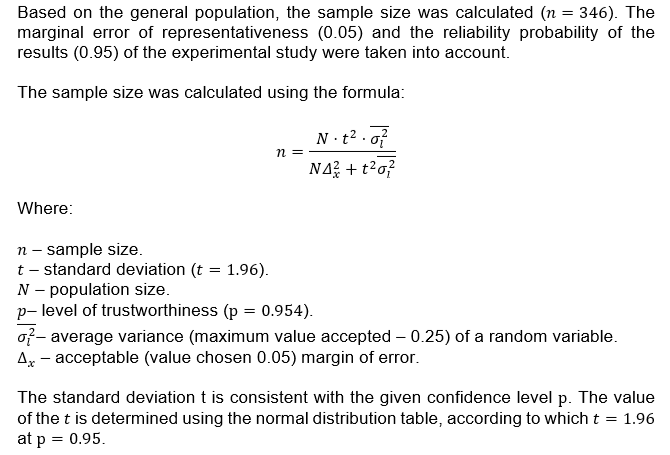
The maximum value was used to obtain more reliable results. =0.5 was adopted in the absence of statistical information, since this gives (0.52=0.25) the maximum variance. Thus, the obtained indicator is overestimated for the sample size, which adds to the reliability of the results. We calculate the sample size of students using the formula:
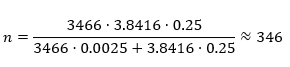
Analysis of the resource provision of higher education institutions provided grounds for asserting that the absolute number of respondents is sufficient to test the study's results.
Taking into account the above components and indicators of the formation of students' design and modeling competence, an ascertaining experiment was planned and conducted with separate control and experimental groups, the results of which allowed us to determine the current state of the levels of students' design and modeling competence. The results of the ascertaining experiment are summarized in Table 1 and Fig. 1.
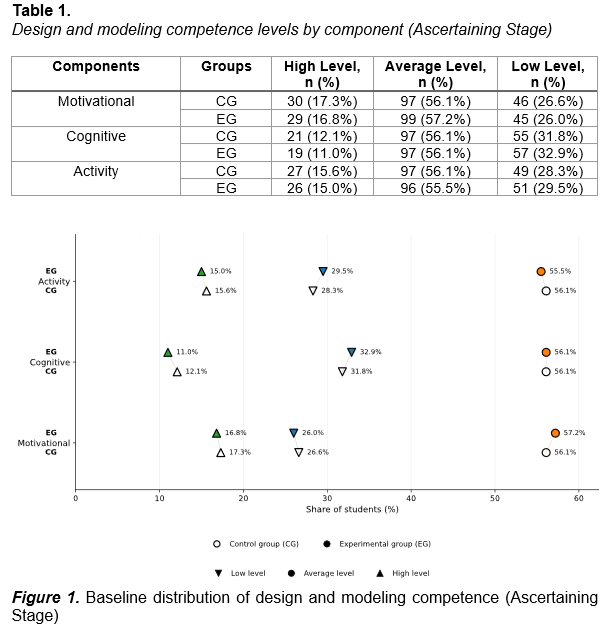
In the ascertaining experiment, statistical processing of the data allowed us to say that the number of students in the experimental group, regarding the formation of design and modeling competence relative to the outlined levels, is as follows:
-According to the motivational component: a low level of formation in the EG is 26.0%, respectively in the CG – 26.6%; an average level – was found in the EG in 57.2% of students, in the CG this indicator is 56.1%; a high level of formation of the outlined competence was found in the EG – 16.8% and in the CG – 17.3%.
-According to the cognitive component: a low level of formation in the EG is 32.9%, respectively in the CG – 31.8%; an average level – was found in the EG in 56.1% of students, in the CG this indicator is 56.1%; a high level of formation of the outlined competence was found in the EG – 11.0% and in the CG – 12.1%.
-By activity component: low level of formation in EG is 29.5%, respectively in CG – 28.3%; average level was found in EG in 55.5% of students, in CG this indicator is 56.1%; high level of formation of the outlined competence was found in EG – 15.0% and in CG – 15.6%.
The objectivity of the experimental study's results is ensured by the equivalence of the two respondent samples, that is, the homogeneity of the experimental and control groups in terms of the level of development of the outlined competence at the beginning of the experiment.
At the ascertaining stage, the distributions of competence levels across the motivational, cognitive, and activity-related components were highly comparable between the experimental and control groups. The differences between the groups did not exceed 1–2 percentage points for most indicators. For example, the proportion of students with a high level of the motivational component was 17.3% in the control group and 16.8% in the experimental group; for the cognitive component, 12.1% and 11.0%, respectively; and for the activity-related component, 15.6% and 15.0%, respectively. Similarly, the proportions of students with low and average competence levels were nearly identical across both groups. These results indicate that the control and experimental groups were comparable at baseline and may be considered equivalent for the purposes of the subsequent formative experiment.
The results of the ascertaining experiment indicated the need to update the higher education curriculum and to conduct a special experimental study at the formative stage of the study.
In order to form the design and modeling competence of future EG specialists, we have identified the following key trends in the digital environment of higher education:
-A competency-based approach to the content of education, where the main attention is paid to the formation and development of students' design and modeling competence of future specialists, in particular the ability to design and analyze professional situations; the ability to interdisciplinary interaction and planning, implementation, and evaluation of educational projects in the digital environment of higher education.
-The spread of the Project-Based Learning (PBL) methodology in modern universities to actively implement project-based learning as a basic methodology for training future specialists in the digital environment of higher education, which is based on the principles of presenting results to an expert audience, using real educational cases, and students' autonomy in solving educational problems.
-Integration of digital technologies, use of digital platforms to form defined competence of future specialists, such as OpenEdu, Erasmus+ Virtual Exchange, eTwinning, which become a space for the implementation of international projects, where students from different countries develop training, joint educational products.
-Within the framework of dual education or professional practice − partnership with a practical environment, which ensures the involvement of students from the first years in professional life (conducting research, implementing innovations, participating in real educational projects), develops design skills in a real context-Mentoring and professional incubation − creation by universities of professional design centers or teaching labs, educational laboratories for innovative education, where, under the guidance of mentor teachers, students design research models, interactive resources, and develop original methodologies.
We at the EG have proposed the implementation of the following measures in the digital environment of higher education to improve the process of forming design and modeling competence of future specialists:
-Integration of interdisciplinary projects into curricula, complex educational projects similar to the Project-Based Learning approach in the USA.
-Use of digital tools for the formation of design and modeling competence, active use of online platforms for creating projects (Miro, Trello, Canva for Education, Google Workspace for Education) in order to form the skills of future specialists in the digital environment of the higher school of virtual design.
-Introduction of a system of presentation of results and portfolios in order to assess design and modeling competence not only through theoretical tasks in the digital environment of the higher school, but also through the creation of an individual pedagogical portfolio by future specialists, which included original projects, digital products, innovative plans, and video lessons.
-Creation of training workshops, design laboratories to outline creative spaces where future specialists will be able to practically work out the stages of developing educational products in the digital environment of higher education – from the idea to its implementation – in practice.
-Involvement of students (similar to Service Learning) in real educational initiatives, joint projects with employers.
-Advanced training of teachers in order to ensure the professional development of higher education teachers in the field of digital technologies, project management, and facilitation of group work.
The formation of design and modeling competence of future specialists is impossible without taking into account the didactic and basic psychological and pedagogical conditions of developmental learning in the digital environment of higher education. We have developed a set of pedagogical conditions in the digital environment of higher education for the effective formation of a system of design and modeling competence of future specialists:
-Positive motivation of future specialists in the digital environment of higher education to form design and modeling competence.
-Taking into account the intellectual and psychological properties of the individual for work in the digital environment of higher education.
-The use of digital innovative methods and technologies of learning in the digital environment of higher education.
-Independent cognitive activity of students for the formation of design and modeling competence, the formation of design and construction skills, and spatial and critical thinking.
Design and modeling competence of future specialists in the digital environment of higher education provided for the formation of students' skills to work in two-dimensional and three-dimensional graphic environments, the basis of which is working with graphics, sketches, drawings, diagrams in a two-dimensional environment; the ability to compose, read, change, use and improve skills for building spatial models of various objects (surfaces of revolution, polygonal, procedural, mesh objects).
The following information technologies were of great importance for the formation of design and modeling competence among future EG specialists in the digital environment of higher education: game technologies (gamification); cloud technologies; augmented and virtual reality technologies. Let us consider these technologies in more detail, along with the features of their application in EG, in relation to the formation of design and modeling competence among future specialists in the digital environment of higher education.
The use of gamification in the digital educational environment of higher education contributes to increased motivation for learning, a deeper understanding of specialized disciplines, and improved professional training of specialists, during which design and modeling competence is formed.
Gamification, the application of game-based approaches in the digital environment of higher education to implement professional tasks effectively, enhances the efficiency and interactivity of the educational process. This allows future specialists to implement new technological concepts more productively by integrating virtual simulators, modeling production processes, and conducting practical simulations.
The introduction of cloud technologies in EG, the most common of which were eDisk, Mega, Microsoft OneDrive, Google Drive, and Dropbox, enabled remote data processing, storage, and analysis, ensuring security, accessibility, and efficiency.
The use of cloud services in the digital environment of higher education contributed to teaching professional disciplines in digital technology integration, laboratory work, modeling of production processes, and research. Higher education students gained access to shared workspaces and modern software.
The introduction of augmented reality technologies in the digital environment of higher education has significant potential for training specialists. They enabled the improvement of the efficiency of the educational process and design activities, combining digital models with real objects to develop design and modeling competence.
The implementation of virtual reality technologies into the digital environment of the university served to:
-Visualization of 3D models on a real scale, which made it possible to study the principles of work and educational design.
-Testing and design of products, and the creation of physical prototypes, which contributed to reducing resource and time costs.
-Learning through simulations and interactive instructions, which increased the quality of professional training and safety.
-Optimization through AR-assisted production processes, which contributed to the performance of technically complex operations.
The skills acquired by EG students in developing design and modeling competence were applied during production practice, in designing educational systems, and in implementing course projects in professional disciplines.
During the research, we considered the concept of design and modeling competence in the context of implementing a competency approach in the digital environment of higher education and the orientation of education toward the formation of an individual's ability to reflectively, innovatively, and creatively implement cognitive activity. The growing role of research and design methods in the actualization of this phenomenon, the need to integrate knowledge, and the development of skills for the independent construction of a digital educational environment are due to the developed system and the pedagogical conditions implemented in the EG.
Results of the formative experiment.
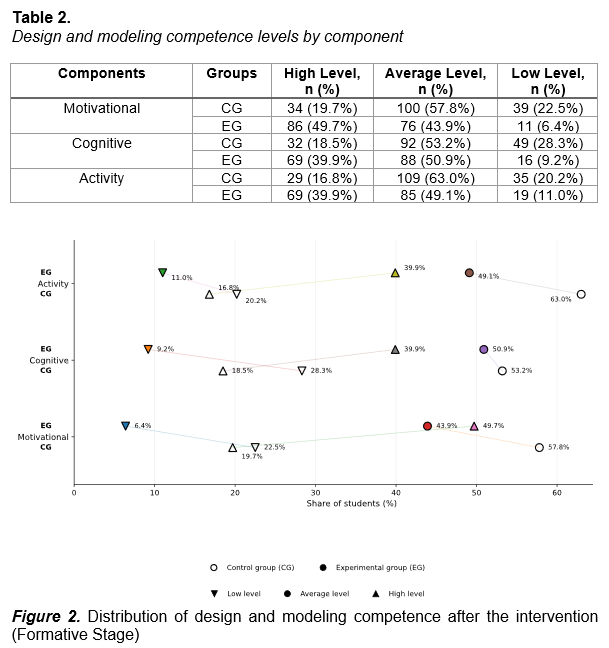
Taking into account the above-mentioned, as at the ascertaining stage, components and indicators of the formation of students' design and modeling competence, and the innovatively developed system implemented in the EG and the author's pedagogical conditions, made it possible to clarify the state of the levels of formation of students' design and modeling competence in the EG and CG. The results of the formative experiment are summarized in Table 2.
Table 2 and Fig 2. presents a comparative analysis of the formation of the cognitive-operational component of the design and modeling competence of the participants of the control and experimental groups at the end of the experimental study.
Pearson's chi-square analysis was conducted for the motivational component at the end of the intervention. The analysis demonstrated a statistically significant association between group membership and motivational competence level, χ²(2, N = 346) = 41.49, p < .001, Cramer's V = .35, indicating a moderate practical effect. The observed frequencies differed substantially from the expected frequencies, with the experimental group containing considerably more participants at the high motivational level and fewer participants at the low motivational level than expected under the null hypothesis. No expected cell frequency was below five, satisfying the assumptions of the Pearson chi-square test.
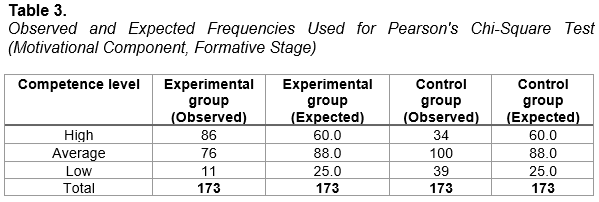
Expected frequencies were calculated according to the Pearson chi-square test assuming independence between group membership and competence level. All expected frequencies exceeded 5, satisfying one of the principal assumptions of the χ² test. Pearson's chi-square test indicated a statistically significant association between group and competence level, χ²(2, N = 346) = 41.49, p < .001, Cramer's V = .35, indicating a moderate effect size.
At the formative stage of the experiment, statistical processing of the data allowed us to say that the number of students in the experimental group, regarding the formation of design and modeling competence relative to the outlined levels, is as follows:
- According to the motivational component: the low level of formation in the EG is 6.4%, respectively in the CG – 22.5%; the average level – was found in the EG in 43.9% of students, in the CG this indicator is 57.8%; the high level of formation of the outlined competence was found in the EG – 49.7% and in the CG – 19.7%.
- According to the cognitive component: the low level of formation in the EG is 9.2%, respectively in the CG – 28.3%; the average level – was found in the EG in 50.9% of students, in the CG this indicator is 53.2%; the high level of formation of the outlined competence was found in the EG – 39.9% and in the CG – 18.5%.
- According to the activity component, the low level of formation in EG is 11.0%, respectively in CG – 20.2%; the average level was found in EG in 49.1% of students, in CG this indicator is 63.0%; the high level of formation of the outlined competence was found in EG – 39.9% and in CG – 16.8%.
Analysis of the results of the formation of all components of design and modeling competence of students at the formative stage of the experiment allows us to state that a significant part of EG respondents had a high and average level, and CG students remained practically at the same level – we observe a predominance of low and average levels.
The qualitative analysis identified four recurring themes: increased confidence in solving professional design problems; improved collaboration and project planning; greater ability to integrate digital technologies into professional tasks; and enhanced reflective thinking regarding project implementation. These qualitative findings supported the quantitative results by demonstrating positive changes in students' professional behaviour and learning experiences.
The research results obtained required empirical confirmation of their objectivity and reliability, which was carried out using statistical methods. We used the nonparametric Pearson criterion (χ²).
Statistical hypotheses were formulated:Hypothesis H₀: The experimental training system and pedagogical conditions do not affect the qualitative changes in the level of formation of the outlined competence, and the results obtained are random.
Hypothesis H₁: The experimental training system and pedagogical conditions significantly affect the qualitative changes in the level of formation of the outlined competence, and the results obtained are not random.
We calculate the nonparametric evaluation criterion χ² using the formula:
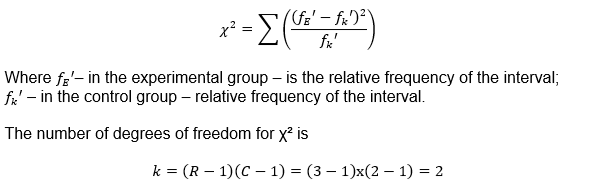
(2 – number of groups, 3 – number of levels).
The critical value of the χ²crit. criterion for the level of α = 0.05 according to statistical tables, and the number of degrees of freedom k=2 was found. Therefore, χ²emp > χ²crit. The basis for rejecting the null hypothesis H₀ is the experimental value of the Pearson criterion, and accepting the alternative hypothesis H₁ about the influence of the experimental system of training students in the conditions of digitalization of education and pedagogical conditions on the formation of design and modeling competence.
It should be noted that the comparative analysis of the results (qualitative and quantitative) of the final sections of the levels of formation in respondents of all components of the outlined competence, the positive dynamics of its formation, convincingly proves the effectiveness of the developed experimental system of training students in the digital environment of higher education and pedagogical conditions.
The conducted study allowed us to identify the main ways of forming design and modeling competence in future specialists in the digital environment of higher education, namely:
1.Integration of elements of design and modeling competence in the digital environment of higher education into the content of professional disciplines. This involves the inclusion of practically oriented tasks, problem situations, and open-ended tasks in the educational process to stimulate applicants in the educational space to make assumptions, analyze the results obtained, and find ways to solve problems. This approach forms a research interest.
2.Creating a digital educational environment favorable for design and modeling activities, which involves the use of digital resources, interactive platforms, software tools, and interdisciplinary connections. This approach increases motivation to learn, expands research opportunities, and creates conditions for implementing individual educational trajectories for students.
3.Applying research methods of teaching, analyzing research data, modeling, observation, involving students in testing hypotheses, studying patterns, and generalizing results. This approach fosters the ability to work with abstract concepts and to think logically, which are essential components of design and modeling competence.
4.Using the project method of teaching in higher education. Implementation of group educational projects and individual (applied, research, informational), which allows students to present results, argue their own position, master the skills of planning activities, processing, and collecting information. This approach contributes to the development of independence, responsibility, and cooperation skills.
5.Stimulating students to self-analysis and reflection, aimed at understanding the stages of performing design and modeling tasks, evaluating the results of work, and their own contribution. This approach allows students to identify difficulties, understand the cognitive process, and outline ways to overcome them, thereby contributing to the development of educational autonomy.
Conclusions
The study confirmed the effectiveness of the proposed model for developing design and modeling competence among students enrolled in educational and pedagogical programmes within a digital higher education environment. The implementation of the model contributed to positive changes across the motivational, cognitive, and activity-related components of competence.
The results of the formative experiment demonstrated that students in the experimental group achieved substantially higher levels of competence development than those in the control group. In particular, the proportion of students demonstrating a high level of competence increased considerably, while the proportion of students with a low level decreased. The statistical analysis confirmed the significance of the observed differences between the groups at the end of the intervention.
The findings suggest that the integration of digital technologies, project-based activities, collaborative learning, and practice-oriented tasks creates favourable conditions for the development of design and modeling competence in higher education students. The qualitative findings further support the quantitative results by indicating increased student engagement, confidence, collaboration, and practical application of acquired knowledge and skills.
The study has several limitations. The sample was restricted to students enrolled in educational and pedagogical programmes, which limits the generalisability of the findings to other academic fields. In addition, the qualitative component involved a relatively small number of participants. Future research should examine the applicability of the proposed model in other disciplinary contexts and explore its long-term impact on competence development through longitudinal studies.
Overall, the results provide empirical evidence that the proposed educational model can effectively support the development of design and modeling competence among students of educational and pedagogical specialities in a digital higher education environment.