
Artículo de investigación
Entornos digitales y desarrollo de la competencia comunicativa en la educación superior
Digital environments and communicative competence development in higher education
Recibido: · Aceptado: · Publicado:
Cómo citar: Chervinska, I., Kovalenko, N., Hainiuk, I., Budanova, O., & Kurach, M. (2026). Digital environments and communicative competence development in higher education. Revista Eduweb, 20(3), 416–437. https://doi.org/10.46502/issn.1856-7576/2026.20.03.23
Resumen
El artículo revela la visión social del espacio de la educación superior. Se muestra el papel de las tecnologías digitales modernas y el entorno digital electrónico en la educación superior para la formación de la competencia comunicativa intercultural de los estudiantes. El análisis de la competencia comunicativa de los estudiantes, realizado por nosotros en la etapa de determinación, mostró un nivel predominantemente bajo e insuficiente de desarrollo de la competencia descrita. Esto nos permitió fundamentar las condiciones pedagógicas, diseñar trabajos experimentales adicionales y desarrollar un sistema de apoyo metodológico para la formación de la competencia comunicativa de los estudiantes en el entorno sociocultural de la educación superior. Los resultados sobre la formación de los indicadores de competencia comunicativa de los estudiantes en la etapa de control indican una efectividad significativamente mayor del experimento formativo en el grupo experimental, donde casi la mitad de los estudiantes alcanzó un alto nivel de competencia comunicativa en todos los criterios identificados. En contraste, en el grupo de control, este indicador es solo una cuarta parte del número total de estudiantes. La efectividad del experimento formativo realizado se confirma mediante el análisis estadístico utilizando el criterio t de Student. Los resultados obtenidos nos permiten hablar de la implementación efectiva y necesaria de las condiciones y el sistema pedagógicos desarrollados para la formación de la competencia comunicativa de los estudiantes.
Palabras clave: competencia comunicativa; entorno digital electrónico; entorno sociocultural de la educación superior; estudiantes; tecnologías digitales.
Abstract
The article reveals the social vision of the higher education space. The role of modern digital technologies and the electronic digital environment in higher education for the formation of intercultural communicative competence of students is shown. The analysis of students' communicative competence, carried out by us at the ascertaining stage, showed a predominantly low and insufficient level of development of the outlined competence. It allowed us to substantiate pedagogical conditions, design further experimental work, and develop a system of methodological support for the formation of students' communicative competence in the socio-cultural environment of higher education. The results on the formation of students' communicative competence indicators at the control stage indicate a significantly greater effectiveness of the formative experiment in the experimental group, where almost half of the students achieved a high level of communicative competence across all identified criteria. In contrast, in the control group, this indicator is only a quarter of the total number of students. The effectiveness of the conducted formative experiment is confirmed by statistical analysis using the Student's t-criterion. The obtained results allow us to speak about the effective and necessary implementation of the developed pedagogical conditions and system for the formation of students' communicative competence.
Keywords: communicative competence; digital technologies; electronic digital environment; socio-cultural environment of higher education; students.
Introduction
The socio-cultural environment of higher education is a social institution in which students gain experience interacting with other individuals and the world as a whole, and acquire professional knowledge. Significant changes in cognition and human consciousness are driven by the rapid development of technology and science, which have led to technological breakthroughs for humanity. The emergence of modern communication needs has led to the development of new methods and forms of communication, including electronic learning. The modern system of higher education is characterized by the need to adopt a systemic approach to describing a student's education amid globalization and rising requirements for the quality of his professional training. Modern interaction of the individual with the world and with other people has intensified to the limit with the expansion of technical capabilities for exchanging digital information, as modern society has entered the stage of global mass communication and digitalization, in which information has become an important social resource.
The global information environment is developing under these conditions. It does not always provide favorable conditions for the assimilation and transmission of cultural patterns that align with individuals' values, and it does not sufficiently contribute to the development of communicative competence among the younger generation. Therefore, there is a need to create conditions for purposeful work to develop an individual's communicative competence and to optimize and manage this process. The search for modern innovative technologies that can ensure the process of forming communicative competence of students in the socio-cultural environment of higher education and the training of competitive future specialists with a high level of communicative competence will contribute to the development of a socially active personality and mobility, which is a full member in the socio-cultural environment (Palshkov et al., 2026).
In such conditions today, it is the higher education institution that should act as a generator of social progress for the student; a center for training a national network of specialists and for developing students' communicative competence, and for introducing innovative changes in production. The university's educational space should be oriented towards broad partnerships, interaction, and dialogue, in which technologies and educational systems enrich and interact with each other, affirming the high competitiveness of each specialist in the labor market.
The social vision of the higher education space is revealed through the processes of identification and socialization within the socio-cultural environment. Socialization, which ensures students’ personal and social development, occurs through interaction with the educational environment, society, and the immediate microsocial context (Ivenz & Reid, 2022).
The concept of communicative competence is closely related to an individual’s ability to interact effectively. It includes communication skills, psychological stability, emotional regulation, planning and organizing interaction, and the ability to analyze and predict the consequences of communicative actions. Communicative competence is a multifaceted phenomenon that combines abilities, knowledge, skills, and acquired experience necessary for professional activity (Nyamekye et al., 2026).
The formation of communicative competence is influenced by several factors: motivation, professional orientation of learning, students’ ability for independent study, appropriate teaching methods and forms, the need for self-improvement, and the use of digital technologies.
Among the forms of learning that contribute to communicative competence development are problem-solving situations, digital lectures, role-playing and business games, workshops, and artificial intelligence–supported activities that allow students to practice communication skills in realistic contexts(Sandal et al., 2020). Workshops, in particular, promote active student participation and serve as an effective form of professional preparation for social dialogue(Ertay & Gilanlioglu, 2024).
Communicative training is considered one of the most effective approaches to developing communicative competence. It fosters the ability to convey information, establish feedback, argue positions, express ideas clearly, understand others’ viewpoints, manage emotions, and prevent conflicts within the socio-cultural environment of higher education. Consequently, these forms of learning enhance students’ ability to engage in effective dialogue and professional communication (Kucherenko et al., 2020).
The development of digital educational ecosystems depends not only on technological infrastructure but also on the quality of communication among ecosystem participants. Existing communication deficits weaken the interconnectedness of educational actors, limiting opportunities for collaboration, knowledge sharing, and collective problem-solving. As a result, the potential of digital educational ecosystems to provide adaptive, learner-centered, and sustainable educational experiences remains only partially realized. This highlights the need to investigate communication mechanisms within multichannel digital environments and their contribution to ecosystem effectiveness.
Despite the growing number of studies devoted to digital educational ecosystems, insufficient attention has been paid to the role of multichannel communication environments in ensuring effective interaction among students, teachers, and institutional stakeholders. Existing research mainly focuses on technological infrastructure and digital tools, whereas the mechanisms through which integrated communication channels contribute to educational effectiveness remain underexplored. This theoretical gap is particularly significant in the context of rapidly developing digital educational ecosystems, where communication quality directly affects collaboration, knowledge exchange, learner engagement, and the overall sustainability of the educational environment. Therefore, further investigation of multichannel communication models is required to better understand their impact on the functioning and development of contemporary digital educational ecosystems.
Despite the rapid growth of research on digital transformation in education, the concept of digital learning ecosystems remains insufficiently explored from a systemic perspective. Existing studies primarily focus on technological infrastructure, digital platforms, learning management systems, and the implementation of educational technologies, whereas the interactions among technological, pedagogical, organizational, and social components of educational ecosystems receive considerably less attention (OECD, 2023). Furthermore, scholars emphasize the need for more comprehensive investigations into stakeholder collaboration, communication processes, learner engagement, and governance structures within integrated digital educational environments (Castro Benavides et al., 2020; OECD, 2023). Therefore, further research is required to examine digital learning ecosystems as holistic educational environments and to identify the factors that contribute to their effectiveness in higher education.
The purpose of this study is to determine and experimentally verify the effectiveness of pedagogical conditions and innovative educational technologies for developing students’ communicative competence within the socio-cultural environment of higher education institutions.
Literature Review
The need to study the issues of the formation of students' communicative competence and the quality of communication in the context of the digital socio-cultural environment of higher education was noted by scientists from different countries, who proposed various forms of innovative content.
The scientific works of Iswandari and Ardi (2022) confirm the universality and necessity of the problem of forming communicative competence in higher education students. Scientists emphasize the significant importance of communicative competence in the context of globalization, where communication requires taking into account tolerance and cultural differences.
The importance of developing intercultural communicative competence among university students was substantiated by Trang and Phuong (2023), who, based on a mixed-methods study involving 628 tourism undergraduates, identified a strong demand for authentic intercultural learning experiences and real-life communication tasks. Their findings demonstrated that students particularly valued activities aimed at improving discourse and behavioral competences, and that they exhibited positive attitudes toward intercultural interaction, highlighting the significance of integrating intercultural communication training into higher education curricula to enhance professional readiness in multicultural environments.
The role of communicative language teaching in fostering students’ communicative competence through supportive educational interactions was highlighted by Zhou and Li (2025), who found that it positively influenced teacher–student developmental relationships, thereby significantly enhancing communicative competence among English language learners. Based on data collected from 891 Chinese university students, the authors demonstrated that the effectiveness of instructional approaches depends largely on the quality of teacher–student relationships, emphasizing the importance of fostering a collaborative and supportive learning environment to develop communicative skills.
Dai (2024) developed the interactional competence model, which clearly and reasonably emphasizes the importance of pedagogical strategies that foster students' ability to cooperate and engage in dialogue in intercultural contexts.
Today, new digital technologies are of great importance in education and communication, posing significant competition to printed publications.
Al-Naabi (2020) substantiates the existing problem of interaction between electronic and traditional textbooks and shows the role of electronic didactics in higher education, which considers, as the main electronic-didactic tool, the automated educational system of higher education, because modern young people give digital media a significant advantage, be it magazines, books, or educational materials. The ways of using digital resources in the socio-cultural environment of higher education to form students' communicative competence are substantiated byAl-Naabi.
Ways of organizing the discussion of material in higher education using Internet technologies and forming students' communicative competence, including Multi User Domain (MUD), which organizes individual and group meetings of students using virtual boards, are shown by Khasanah and Anggoro (2022).
The use of digital technologies in blended learning conditions for students’ formation of communicative competence is the subject of a study by Putri and Nurkhamidah (2023). Scientists consider a modern learning tool – Multiuser Object Oriented (MOO)- which helps in the formation of an object-oriented environment that provides real-time contact on the Internet and, through innovations, enables the computer to create virtual spaces.
Thus, the analysis of publications indicates the complexity of the problem of developing students' communicative competence in the socio-cultural environment of higher education. It is studied at the intersection of digital technologies and pedagogy, psychology, philosophy, as well as in the context of intercultural interaction and globalization of the world space. This allows us to consider the development of students' communicative competence as an integrative phenomenon, which is of key importance for training competitive specialists in the modern educational space.
Methodology
Research Design
The study employed a quasi-experimental research design to investigate the effectiveness of a system and pedagogical conditions in developing students’ communicative competence within the socio-cultural environment of higher education. The research was based on the assumption that the purposeful organization of the socio-cultural environment, integration of digital technologies, and application of interactive teaching methods would contribute to the development of students’ communicative competence.
The experimental study was conducted from 2022 to 2025 and consisted of three interconnected stages: ascertaining, formative, and control.
Participants
The study involved 210 undergraduate students enrolled in the second and third years of study. The participants took part in both the ascertaining and formative stages of the pedagogical experiment. During the formative stage, the participants were divided into an experimental group (EG) of 106 students and a control group (CG) of 104 students. Students in the EG implemented the developed system and pedagogical conditions to develop communicative competence, whereas students in the CG continued their studies using the traditional educational methodology.
Participants were selected using purposive sampling. The inclusion criteria were: enrollment in the second or third year of undergraduate study, regular participation in the educational process during the experimental period, andinformed consent to participate in the study. Students were assigned to the experimental and control groups according to existing academic groups in order to preserve the natural educational setting and ensure the ecological validity of the quasi-experimental design.
Operational Characteristics of Measurement Instruments
The assessment instruments were developed on the basis of the theoretical structure of communicative competence and included motivational, activity, and personal criteria. Content validity was established through expert evaluation by five university academics specializing in pedagogy, educational technologies, and communication studies. Based on their recommendations, several questionnaire items were revised to improve clarity and relevance.
A pilot study involving 32 students who did not participate in the main experiment was conducted to evaluate the psychometric properties of the instruments. Internal consistency was assessed using Cronbach’s alpha coefficient. The obtained values were 0.86 for the motivational criterion, 0.84 for the activity criterion, 0.88 for the personal criterion, and 0.87 for the overall scale, indicating good reliability. Construct validity was examined through exploratory factor analysis, which confirmed the three-factor structure corresponding to the conceptual model of communicative competence.
To ensure objectivity of observational assessments, two independent experts evaluated students’ performance using standardized observation protocols. Inter-rater reliability, calculated using Cohen’s kappa coefficient, reached 0.81, indicating substantial agreement between raters. These procedures provide sufficient evidence of the reliability and validity of the measurement instruments and support the reproducibility of the study.
Research Methods
The study employed a combination of theoretical, empirical, experimental, and statistical methods.
Theoretical methods included systematic analysis, comparison, synthesis, and generalization of scientific approaches to the formation of communicative competence. These methods were used to identify the study’s conceptual foundations, determine the structure of communicative competence, and substantiate the pedagogical conditions for its development within the socio-cultural environment of higher education.
Empirical methods included interviews, conversations, testing, questionnaires, and pedagogical observation. These methods were used to determine the levels of students’ communicative competence and to assess the effectiveness of the educational interventions implemented during the experiment.
Experimental methods included a pedagogical experiment comprising an ascertaining, formative, and control stage. The experiment was conducted to verify the effectiveness of the developed system and pedagogical conditions for forming students’ communicative competence in the socio-cultural environment of higher education.
Statistical methods included quantitative and qualitative analyses to evaluate changes in communicative competence and determine the statistical significance of the results.
Assessment Framework
The formation of students’ communicative competence was assessed according to three interrelated criteria: motivational, activity, and personal.
The motivational criterion reflected students’ motivation for communicative interaction, their interest in communication, readiness for cooperation, and awareness of the importance of communicative competence in educational and professional activities.
The activity criterion reflected students’ ability to apply communicative skills in various educational and social situations, participate in discussions, collaborate with others, solve communicative tasks, and effectively use verbal and non-verbal means of communication.
The personal criterion reflected students’ individual qualities that facilitate effective communication, including self-confidence, empathy, tolerance, responsibility, openness to interaction, and the ability to establish constructive interpersonal relationships.
Based on the identified criteria and indicators, three levels of communicative competence formation were distinguished: high, sufficient, and low.
Experimental Procedure
The pedagogical experiment consisted of three interconnected stages.
During the ascertaining stage, the initial level of students’ communicative competence was assessed according to the established criteria and indicators. The results demonstrated the predominance of low and sufficient levels of communicative competence and confirmed the need to improve the educational process in higher education institutions.
Analysis of the ascertaining-stage results made it possible to identify key directions for improving the socio-cultural environment of higher education. Particular attention was paid to creating a multi-channel digital educational environment that would enhance students’ engagement, stimulate communicative interaction, and support a personality-oriented model of learning.
During the formative stage, the developed system and pedagogical conditions for developing students’ communicative competence were implemented in the experimental group's educational activities.
The implementation was based on several pedagogical conditions:
-Creation of a multi-channel digital educational environment that supports communicative interaction.
- Orientation of the educational process toward a personality-activity model of learning.
- Integration of digital technologies into educational and extracurricular activities.
- Intensification of educational work to develop students’ communicative competence.
The formative program involved the use of modern digital technologies and interactive teaching methods, including virtual educational platforms, mobile applications, multimedia technologies, simulations, virtual laboratories, social networks, online courses, Massive Open Online Courses (MOOCs), discussions, debates, business games, role-playing activities, project-based learning, communicative trainings, and workshops.
These tools and methods were used to increase students’ communicative activity, develop cooperation skills, stimulate social interaction, and create conditions for the practical application of communicative competence in educational and professional contexts.
The control group continued its educational activities using the traditional methodology, without implementing the developed pedagogical conditions.
During the control stage, repeated diagnostics were conducted to determine changes in students’ communicative competence. The results obtained in the experimental and control groups were compared according to the established criteria and levels to evaluate the effectiveness of the implemented system and pedagogical conditions.
To improve the transparency and reproducibility of the study, the overall experimental procedure is presented in Figure 1.
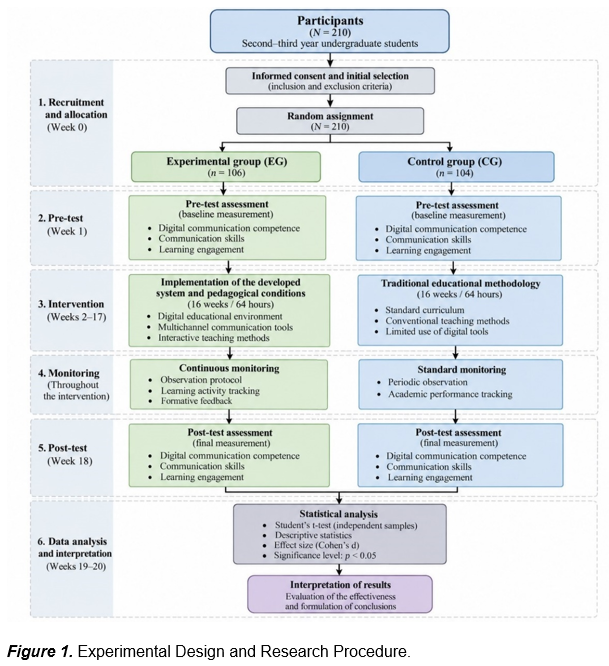
Figure 1 illustrates the sequence of research stages, participant allocation, intervention implementation, assessment procedures, and statistical analysis.
Operational Characteristics of Measurement Instruments
Digital Communication Competence Questionnaire
Purpose: Assessment of students' digital communication competence.
Number of items: 24
Dimensions:
-Digital interaction (6 items)
-Online collaboration (6 items)
-Information exchange (6 items)
-Communication ethics (6 items)
Scale: 5-point Likert scale (1 = strongly disagree; 5 = strongly agree)
Score range: 24–120 points
Interpretation:
-Low level: 24–55
-Medium level: 56–87
-High level: 88–120
Reliability: Cronbach's α = 0.87
Multichannel Communication Skills Assessment
Purpose: Evaluation of practical communication performance in digital educational environments.
Tasks:
– LMS communication activities
– Video conferencing participation
– Collaborative cloud-based work
– Social communication tasks
Scoring system:
0–25 points for each task
Total score: 0–100 points
Interpretation:
– Low: 0–39
– Medium: 40–69
– High: 70–100
Student Engagement Scale
Purpose: Measurement of students’ engagement in learning activities.
Components:
– Behavioral engagement
– Emotional engagement
– Cognitive engagement
Items: 18
Scale: 5-point Likert scale
Score range: 18–90
Reliability: Cronbach's α = 0.84
Observation Protocol
Purpose: Assessment of communication activity during learning.
Indicators:
– Frequency of student-teacher interactions
– Peer collaboration
– Feedback exchanges
– Participation in collaborative tasks
Observation frequency:
Once every two weeks during the intervention period.
Evaluation scale:
1–5 points for each indicator.
Statistical Analysis
The equivalence of the groups at the pre-test stage and differences at the post-test stage were determined using Student's t-test for independent samples. Statistical significance was established at p < .05. Effect size was additionally calculated using Cohen's d to determine the practical significance of the intervention effects.
Psycho-Educational Instruments
Digital Communication Competence Questionnaire
The level of students' digital communication competence was assessed using a structured questionnaire developed on the basis of the DigComp 2.2 (Vuorikari et al., 2022, 2022) framework. The instrument consisted of 24 items grouped into four dimensions: digital interaction, online collaboration, information exchange, and communication ethics. Responses were measured on a five-point Likert scale ranging from 1 ("strongly disagree") to 5 ("strongly agree"). The internal consistency of the questionnaire was satisfactory (Cronbach's α = 0.87).
Multichannel Communication Skills Assessment
Students' ability to operate within multichannel educational environments was evaluated through a performance-based assessment. Participants completed practical tasks requiring the use of learning management systems, video conferencing tools, collaborative cloud platforms, and social communication applications. Performance was evaluated according to standardized criteria developed by the research team.
Student Engagement Scale
To determine the influence of the intervention on learning engagement, a modified version of the Student Engagement Scale was applied. The instrument measured behavioral, emotional, and cognitive engagement in digital learning environments. Higher scores indicated stronger involvement in educational activities.
To assess student engagement, a modified version of the School Engagement Measure (SEM) developed by Fredricks et al. (2005) was used. The original instrument conceptualizes engagement as a multidimensional construct consisting of behavioral, emotional, and cognitive dimensions. For the purposes of the present study, several items were adapted to reflect participation in digital learning environments while preserving the theoretical structure of the original scale.
Academic Interaction Observation Protocol
The quality of educational communication was additionally assessed through structured observation. Researchers evaluated the frequency of student-teacher interactions, peer collaboration, feedback exchange, and participation in collaborative tasks. Observations were conducted according to a standardized protocol throughout the experimental period.
Reliability and Validity Procedures
To ensure measurement reliability, all instruments underwent pilot testing prior to the main study. Internal consistency coefficients indicated satisfactory reliability of the measurement instruments. Content validity was established through expert evaluation by specialists in educational technology and pedagogy. Construct validity was verified through factor analysis.
Data Analysis
The study involved 210 participants who were divided into experimental and control groups. Descriptive statistics (mean values, standard deviations, frequencies, and percentages) were calculated for all variables. To determine statistically significant differences between groups, Student's t-test for independent samples was applied. Statistical significance was established at p < .05. All analyses were performed using SPSS Statistics software.
Quantitative analysis was used to determine the distribution of students across the identified levels of communicative competence formation and to compare results obtained before and after the formative intervention.
Qualitative analysis was used to interpret the direction and nature of changes in students’ communicative competence and to determine the contribution of the socio-cultural environment, digital technologies, and interactive teaching methods to its development.
Statistical analysis was applied to assess the significance of differences between the experimental and control groups and to verify the effectiveness of the implemented pedagogical conditions.
The effectiveness of the formative intervention was evaluated using Student’s t-test. The statistical analysis revealed significant positive changes in the experimental group across all criteria for the formation of communicative competence (t = 5.176, p < 0.001). In contrast, the changes observed in the control group did not reach statistical significance. The post-experimental comparison between the groups also demonstrated statistically significant differences (t = 3.200, p < 0.01), confirming the effectiveness of the developed pedagogical conditions and the system for forming students’ communicative competence.
Ethical Considerations
The study was conducted in accordance with the ethical principles applicable to educational research. Participation in the study was voluntary, and the participants were informed about the purpose, procedures, and stages of the research before taking part in the experimental work. The confidentiality and anonymity of the participants were maintained throughout the research process. The collected data were used exclusively for scientific purposes, and participants were informed of their right to withdraw from the study at any stage without any negative consequences.
Results
The results of the ascertaining stage demonstrated the initial distribution of students by levels of communicative competence formation in both the control and experimental groups. The analysis showed the predominance of low and sufficient levels of communicative competence, while the proportion of students with a high level remained relatively limited. The results obtained confirmed the need to improve the educational process and to create favorable pedagogical conditions for the development of students’ communicative competence within the socio-cultural environment of higher education. The summarized results are presented in Table 1.
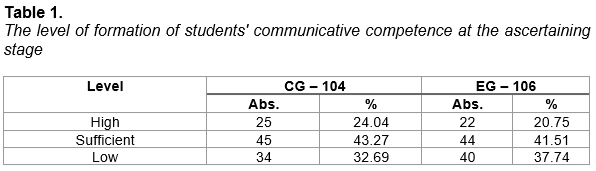
Based on the results of the formation of students' communicative competence according to three criteria in the ascertaining experiment, we came to the following conclusions:
1.To increase students' communicative competence according to the three identified criteria, there is a need to adjust the higher education process.
2.Special attention should be focused on filling and organizing the socio-cultural environment of higher education – creating an educational multi-channel digital environment that contributes to better perception of information, arouses students' desire to take an active part in education and profession, maximally satisfies students' interests, and stimulates communicative interaction by reorienting education to a personal-activity model of interaction during classes.
3.It is necessary to introduce digital technologies (virtual educational platforms, mobile applications, multimedia technologies, simulations, virtual laboratories, social networks, online courses and massive open online courses (MOOCs), etc.) into the socio-cultural environment of higher education, and use interactive teaching methods (discussions, debates, business games, project methods, etc.)
4.It is urgent to intensify the educational work of higher education institutions in terms of forming students' communicative competence.
To form students' communicative competence, we have substantiated and implemented pedagogical conditions in the EG and developed an innovative methodology that should be implemented in the educational process of the socio-cultural environment of higher education:
- Creation of an educational multi-channel digital environment that contributed to a better perception of information.
- Implementation of psychological and pedagogical support for students and reorientation of education to a personal and activity model of interaction during classes.
- Introduction of digital technologies in the socio-cultural environment of higher education (virtual educational platforms, mobile applications, multimedia technologies, simulations, virtual laboratories, social networks, online courses and open mass online courses (MOOCs), etc.).
-Use of interactive teaching methods (discussions, debates, business games, project methods, etc.).
Therefore, our analysis of students' communicative competence at the ascertaining stage showed a predominantly low and sufficient level of formation of the outlined competence and allowed us to substantiate pedagogical conditions, design further experimental work, and develop methodological support for the formation of students' communicative competence in the socio-cultural environment of higher education.
The effectiveness of implementing pedagogical conditions and the proposed system for developing students' communicative competence in the socio-cultural environment of a higher education institution, in accordance with the tasks of the formative experiment, was assessed through the comprehensive development of motivational, activity, and personal criteria. The effectiveness of the implementation of pedagogical conditions and the system was assessed by comparing the results of the control groups and experimental groups before and after the formative experiment.
The level of formation of students' communicative competence indicators at the control stage was re-evaluated in the control and experimental groups. Mathematical statistics methods were used to verify the reliability of the results obtained.
According to the results of the experimental study, the re-evaluation of the level of formation of students' communicative competence indicators at a higher education institution after conducting a formative experiment across all criteria yielded the following statistical data.
Control group. In this group, moderate positive changes in the distribution of students (104 students) were observed in the levels of formation of communicative competence among respondents.
A high level was demonstrated by 26.92% of respondents – 28 students, which is 3 more than the initial indicators.
A sufficient level was demonstrated by 50.00% of respondents – 52 students, an increase of 7.
Accordingly, the number of students decreased to 23.08% (24 people), which is 10 respondents fewer than the initial indicators.
Experimental group: In this group (106 students), respondents experienced more pronounced positive changes in the levels of development of communicative competence.
A high level of development of communicative competence was demonstrated by 50.94% of respondents − 54 students, which is an increase, compared to the initial results, of 32 people.
A sufficient level was demonstrated by 33.96% of respondents − 36 students, which means a decrease of 8 people.
The number of students with a low level decreased significantly to 15.09% of respondents (16 people), which is 24 students fewer than the initial indicators.
The obtained results of the development of communicative competence indicators of students at the control stage indicate a significantly higher effectiveness of the formative experiment in the experimental group, where almost half of the students achieved a high level of development of communicative competence according to all the identified criteria. In contrast, in the control group, this indicator is only a quarter of the total number of students.
Using the Student's t-test, the reliability of the identified changes was assessed to determine whether the difference between the two samples' mean values is statistically significant.
In practice, this test allows us to determine whether two groups differ as a result of implementing a specific intervention (in our case, pedagogical conditions and the system) or whether the difference isattributableto random factors. Using the Student's t-test, we can objectively assess the effectiveness of the implemented pedagogical conditions and system in the experimental group in comparison with the control group.
Compared with the Pearson correlation coefficient, the Student's t-test was chosen because the purpose of the study was to determine differences between the groups (CG and EG), not to assess the degree of linear dependence between the two data sets. The Pearson correlation coefficient is more suitable for assessing the degree of dependence between variables, whereas the Student t-test allows us to assess whether the mean differences between the two groups (CG and EG) are statistically significant.
The effectiveness of the conducted formative experiment is confirmed by statistical analysis. Statistically significant positive changes are observed in the experimental group across all criteria for the development of students' communicative competence (t = 5.176, p < 0.001). In contrast, the changes in the control group are not statistically significant. The difference between the groups after the experiment is also statistically significant (t = 3.200, p < 0.01), demonstrating the effectiveness of the applied pedagogical conditions and the system for developing communicative competence.
To assess the effectiveness of the implemented pedagogical conditions and the developed system for forming students’ communicative competence, a comparative analysis of the control and experimental groups was conducted before and after the formative intervention. The dynamics of changes in students’ communicative competence levels are presented in Table 2.
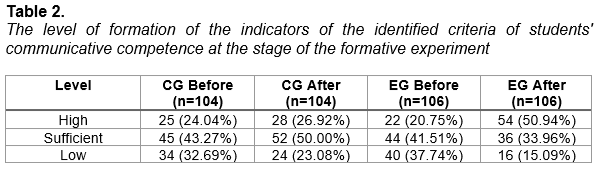
As shown in Table 2, both groups showed positive changes; however, the experimental group demonstrated substantially greater progress. The proportion of students with a high level of communicative competence in the experimental group increased from 20.75% to 50.94%, while the proportion with a low level decreased from 37.74% to 15.09%. In the control group, the changes were less pronounced, with the proportion of students demonstrating a high level increasing only from 24.04% to 26.92%. These results indicate that the implemented pedagogical conditions and the developed system significantly contributed to the formation of students’ communicative competence within the socio-cultural environment of higher education.
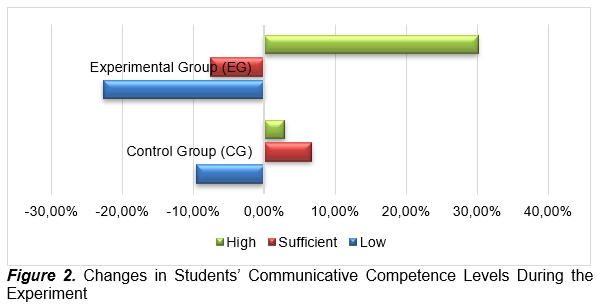
Figure 2 visually confirms the positive dynamics identified during the experiment. The graphical representation clearly demonstrates the substantial increase in the proportion of students with a high level of communicative competence and the simultaneous decrease in the proportion of students with a low level in the experimental group. Compared with the control group, the observed changes were considerably more pronounced, providing additional evidence of the effectiveness of the proposed pedagogical conditions and instructional system.
Discussion
The implementation of educational technologies in a multichannel digital environment enhances the quality of educational interaction and supports the development of student competencies. These findings confirm the increasingly important role of integrated digital ecosystems as a means of improving communication, collaboration, and student engagement in higher education.
The obtained findings are consistent with recent international studies emphasizing that educational technologies create conditions for more active student participation and strengthen collaborative learning processes. Previous research has demonstrated that digital ecosystems facilitate knowledge sharing, increase learning flexibility, and promote personalized educational trajectories. Contemporary theoretical approaches conceptualize digital educational ecosystems as interconnected networks of technological, pedagogical, and social elements that interact to support learning, communication, and knowledge construction (Dalsgaard & Ryberg, 2023; Mishra & Koehler, 2006; Otto & Kerres, 2023). Within such ecosystems, educational effectiveness depends not only on technological infrastructure but also on the quality of pedagogical design and social interaction among participants. The present study extends these findings by highlighting the role of multichannel communication environments as a critical component of ecosystem effectiveness.
The results also support contemporary theoretical approaches that view digital educational ecosystems as interconnected networks of technological, pedagogical, and social elements. Recent studies have emphasized that learning ecosystems are characterized by the interaction and interdependence of diverse educational resources, digital infrastructures, communication channels, and social actors, which collectively support knowledge construction and learning processes (Bozkurt & Stracke, 2023; Otto & Kerres, 2023). Digital educational ecosystems have also been shown to facilitate knowledge sharing, learner participation, flexibility, and collaborative learning through integrated technological and organizational structures (OECD, 2023). From this perspective, educational outcomes depend not only on the availability of digital tools but also on the quality of communication and interaction among ecosystem participants. The observed improvements may therefore be explained by the enhanced opportunities for continuous feedback, collaborative problem-solving, and learner-centered engagement provided by multichannel environments.
Furthermore, the findings align with international research on digital transformation in higher education, which emphasizes the growing significance of adaptive and technology-enhanced learning environments. Recent studies suggest that successful digital ecosystems foster greater learner autonomy, strengthen digital competence, and support sustainable educational development. The present study contributes to this body of knowledge by providing empirical evidence from a higher education context and demonstrating the practical value of integrating multiple communication channels into the educational process.
Despite these positive findings, several limitations should be acknowledged. The study was conducted within a specific educational context, which may limit the generalizability of the results to other institutional settings. Future research could examine the long-term effects of multichannel communication environments across different disciplines, educational levels, and cultural contexts.
Overall, the findings suggest that educational technologies integrated within digital educational ecosystems can enhance communication quality and support more effective learning experiences. These results contribute to the ongoing discussion on digital transformation in higher education and provide practical implications for the design of future educational environments.
Our result is consistent with the authors' conclusions (Kostikova et al., 2021)on the role of modern digital technologies and the electronic digital environment in higher education in the formation of students' intercultural communicative competence. In particular, the professional level of future specialists and the development of communicative competence among higher education applicants, which, across all spheres of social life, is a vector of their success, positivelyaffect creative self-realization. To a large extent, the transformations in the modern world brought about by the development of communication means are driven by global computer networks and mass media.
The authors note the role of modern digital technologies in shaping students' intercultural communicative competence. The development of students' intercultural communicative competence and the expansion of their horizons are facilitated by communication with peers from other countries. It is very important to pay attention to analysis and reflection, to adequate discussion, and to the exchange of information on various problems of our time. With the help of modern digital technologies in the process of forming intercultural communicative competence, teachers teach students to evaluate material critically; respond to messages and information in oral and written form; express their thoughts competently and correctly; work independently; engage in self-education; and defend their point of view. In order to effectively maintain multi-level and diverse contacts and forms of communication in the modern world, it is necessary, in addition to knowledge of the appropriate language, to also know the rules, norms, customs, traditions of another culture – you need to know the culture and history of your partners, know the mechanism of the communication process itself, the complex of forms of their communication behavior, in order to predict all the significant possibilities of misunderstanding partners (Kostikova et al., 2019).Therefore, authors also revealed the positive impact of digital technologies on the formation of students' communicative competence, as we have confirmed, that the creation of an electronic digital environment of a higher education institution for the formation of intercultural communicative competence of students is of great importance, in order to constantly ensure access to the work programs of disciplines, their modules, curricula, practices, access to electronic educational resources and publications of library electronic systems; obtaining the results of intermediate certification, recording the progress of the educational process, conducting all types of classes, interaction via the Internet between participants in the educational process, procedures for assessing learning outcomes, distance educational technologies. Therefore, the formation of communicative competence as an integrative indicator of the degree of mastery of digital competence, which is an integral part of the quality training of qualified specialists, is relevant.
In the experiment, we applied the main principles of learning and multifunctional components to form the successful communicative competence of a higher education applicant, in harmony with the authors(Kostikova et al., 2019).
In order to form successful communicative competence of students, it is important to adhere to the basic principles of learning:
- Taking into account alternative forms of speech training, educational and methodological base, free time, specific conditions of activity in order to master language norms and organize dialogical skills.
- Complexity in solving problems of professional activity (independent isolation of communication issues by the student).
- Identification of the main elements of communicative competence that require improvement and orientation towards self-education of the personality.
- Openness and humanization (combination of traditions and innovations; introduction of socio- and culturally relevant measures in the socio-cultural environment of higher education), because communication itself is a component of the motivational and needs sphere of the student and is associated with the orientation of each individual, encourages the choice of value orientations, the formation of a person’s worldview, and the development of his or her intellect.
The findings of the study demonstrate that the implementation of the proposed pedagogical conditions and the developed system for fostering students' communicative competence contributed to statistically significant improvements in the experimental group compared with the control group. The positive dynamics observed across all criteria suggest that the integration of targeted pedagogical interventions within the socio-cultural environment of higher education can effectively support the development of communicative competence.
These findings are consistent with previous studies emphasizing the importance of active learning environments, collaborative interaction, and student-centered educational approaches for developing communication skills (Fredricks et al., 2005; OECD, 2023). The results also support contemporary views that communicative competence develops most effectively when students engage in continuous interaction, collaborative problem-solving, and reflective learning activities within digitally enriched educational environments.
At the same time, the present study extends previous research by demonstrating that the effectiveness of communicative competence development depends not only on instructional methods but also on the systematic implementation of pedagogical conditions that promote meaningful communication among participants in the educational process. The observed improvements suggest that creating opportunities for sustained interaction, feedback exchange, and cooperative learning may strengthen students' ability to communicate effectively in academic and professional contexts.
Nevertheless, the findings should be interpreted with caution. Several methodological limitations may have influenced the results. First, the study was conducted within a limited number of higher education institutions, which may restrict the generalizability of the findings to other educational contexts. Second, the use of self-report instruments may have introduced response bias, as students could overestimate their level of communicative competence. Third, the duration of the intervention was limited to a single experimental period, making it difficult to determine the long-term sustainability of the observed effects. Fourth, although efforts were made to ensure the equivalence of the experimental and control groups, the quasi-experimental design does not completely eliminate the influence of external variables that may have affected participants' development.
Future research should involve larger and more diverse samples, include longitudinal designs to assess the stability of outcomes over time, and combine self-report measures with observational and performance-based assessment methods. Further studies may also examine how specific components of the proposed pedagogical system contribute to the development of different dimensions of communicative competence.
Overall, the results provide empirical support for the effectiveness of the developed pedagogical conditions and suggest that their implementation can contribute to enhancing students' communicative competence in higher education settings.
Limitations
Several limitations should be considered when interpreting the results of this study. First, the research was conducted with 210 undergraduate students from a limited number of higher education institutions, which may restrict the generalizability of the findings to other educational contexts and student populations. Second, the study focused on assessing communicative competence using motivational, activity, and personal criteria; therefore, other potentially relevant dimensions of communicative competence were not examined. Third, the formative experiment evaluated the overall effectiveness of a комплекс pedagogical intervention that included digital technologies, interactive teaching methods, communicative training, and psychological-pedagogical support. Consequently, it was not possible to determine the individual contribution of each component to the observed improvements. Finally, the study assessed the immediate outcomes of the intervention and did not investigate the long-term sustainability of the achieved results. Future research should involve larger and more diverse samples, longitudinal designs, and comparative analyses of specific educational technologies to provide a deeper understanding of their impact on students’ communicative competence.
Conclusions
The study confirms the effectiveness of educational technologies for enhancing students' communicative competence within multichannel digital learning environments. The obtained results demonstrate that the integration of digital communication tools, collaborative platforms, and interactive educational technologies contributes to more active educational interaction, learner engagement, and the development of communication skills required in contemporary digital educational ecosystems.
At the same time, several limitations should be acknowledged. The study was conducted within a specific institutional context and involved 210 participants from a limited educational environment. Consequently, the findings should be interpreted with caution when generalized to other higher education institutions, disciplines, cultural settings, or educational systems. In addition, the quasi-experimental design and the duration of the intervention may not fully capture the long-term effects of technology-enhanced communication development.
Future research should focus on expanding the geographical and institutional scope of investigations, incorporating longitudinal research designs, and examining the sustainability of communication competence development over time. Particular attention should be devoted to the use of artificial intelligence technologies, including generative AI systems, intelligent tutoring systems, conversational agents, and AI-supported feedback mechanisms, as tools for developing communicative competence in higher education. Further studies may also investigate how AI-driven personalized feedback, adaptive learning environments, virtual simulations, and multimodal communication platforms influence students' communication skills, learner autonomy, engagement, and collaboration within digital educational ecosystems. Recent international research highlights the need for longitudinal, comparative, and process-oriented studies of AI-supported communication learning, particularly regarding feedback quality, communicative competence development, and human–AI collaboration in educational settings.
Overall, the findings contribute
to the growing body of research on digital educational ecosystems and provide
practical implications for the design of technology-enhanced
learning environments aimed at fostering students' communicative competence
in the era of artificial intelligence.
Funding
This research did not receive external funding from any agencies.